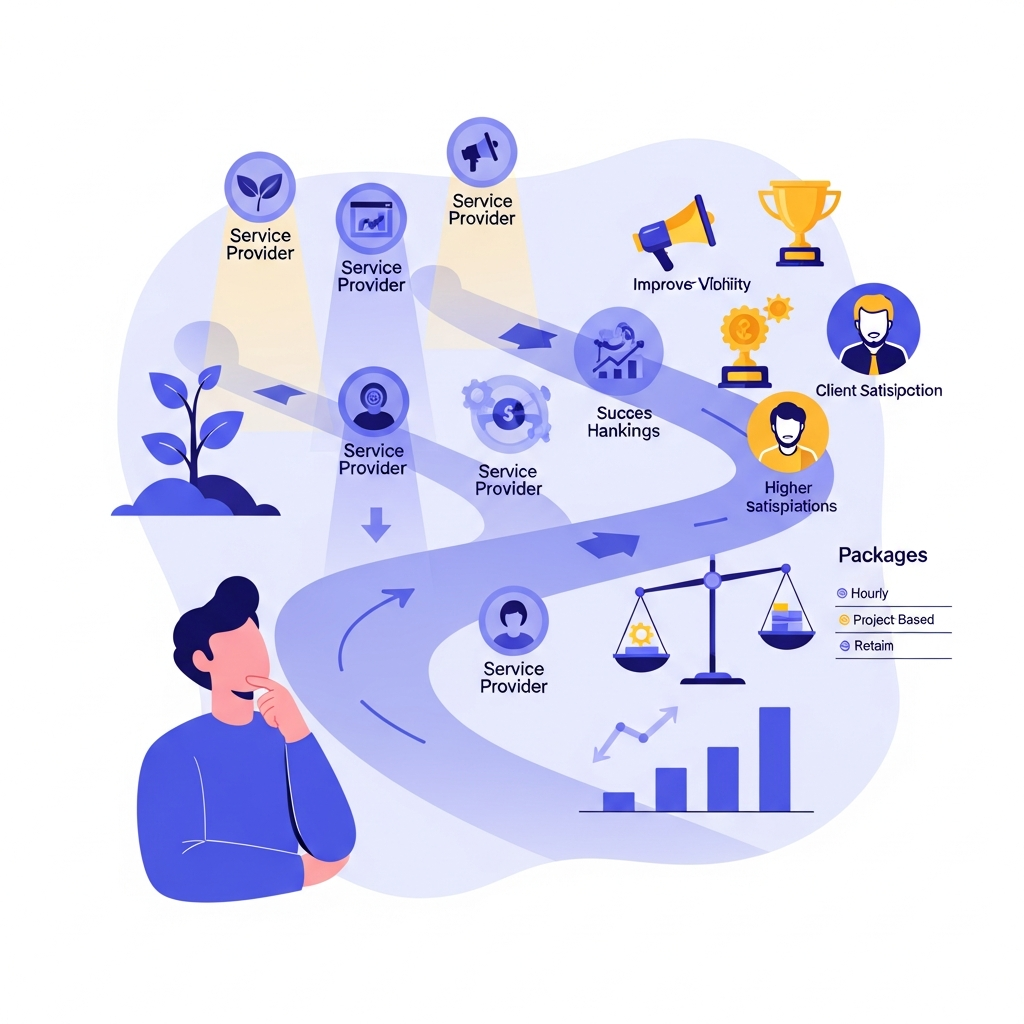
The In-house SEO Manager's Guide to How to Choose an SEO Services Provider: Practical Wins for Your Team
Define Your Needs
Before you start evaluating providers, map out your objectives. This means translating business goals into measurable SEO outcomes, such as increased organic traffic, higher product-page conversions, or improved visibility in key geographies. A clear brief helps you compare apples to apples when vendors present proposals and pricing.
Begin with a simple discovery checklist: your target markets, product priorities, content cadence, and preferred CMS platforms. Define acceptable timelines for wins, and establish a governance model that suits your organization—whether you need weekly executive dashboards or monthly deep-dives. For many teams, the most valuable insights come from aligning SEO with broader growth plans and marketing technology stacks.
Within your team, designate a primary owner for the vendor relationship and a secondary reviewer for technical and content decisions. This prevents bottlenecks and ensures that both business and technical stakeholders have a voice. For template-driven guidance, see how automation-driven teams think about cadence and ownership in our 30-day content calendar framework. 30-day content calendar for SEO.
What to Look for in an SEO Services Provider
Technical proficiency and audit discipline
Strong providers start with a rigorous technical SEO audit. They should diagnose crawlability, indexing, site speed, structured data, and mobile responsiveness. A thoughtful provider not only identifies issues but prioritizes fixes by impact and effort, offering a roadmap that your team can execute or co-own.
Beyond audits, ask about ongoing site monitoring. Continuous optimization requires automated checks and human review to catch changes in search engine behavior, algorithm updates, and market shifts. If a vendor emphasizes a single tactic without a holistic audit process, it’s a red flag.
Content strategy, optimization, and linking
A solid provider integrates content with SEO goals. They should demonstrate scalable content planning, keyword mapping, on-page optimization, and a principled approach to acquiring high-quality links. Look for a demonstrated balance between technical fixes and content-driven growth that aligns with your brand voice and compliance standards.
Evaluate their content governance: who approves changes, how content quality is maintained, and how localization or multilingual needs are handled. If your business operates across regions, ensure the partner can manage localization workflows and maintain consistency across languages and markets.
Analytics, reporting, and transparency
Transparency is non-negotiable. Your provider should deliver clear dashboards, milestone-based reporting, and access to raw data or exportable reports. Ask for a sample dashboard and a description of how ROI is calculated, including the attribution model and data sources (Google Analytics, Search Console, server logs, etc.).
In practice, you want to see a balance of top-line metrics (traffic, rankings, visibility) and bottom-line impact (revenue, ROAS, or qualified lead growth). As you review options, consider how the vendor handles governance, access control, and security, especially if you have enterprise data or regulatory requirements. For real-world governance patterns, explore how automated SEO dashboards can prove value in our governance-focused article. ROI dashboards and governance.
Pricing, Packages, and ROI
Pricing models vary widely in the SEO services market—from flat retainers to performance-based structures or modular packages. The key is to understand what you’re actually buying. A best-in-class option should disclose scope, deliverables, cadence, and a transparent path to value, not just a monthly number.
When comparing pricing, convert packages into a common currency of deliverables and outcomes. For example, quantify the value of a technical fix, a content sprint, or a link-building initiative in terms of traffic lift and conversion impact. Your evaluation should map costs to milestones and milestones to measurable outcomes aligned with your KPIs.
Beware of hidden costs, such as setup fees, add-on services, or long lock-in periods without clear exit terms. If you’re evaluating an enterprise-scale provider, request a pricing model that accommodates multi-site governance, centralized dashboards, and scalable support across regions. For a concrete look at how automation-driven pricing discussions unfold, see our guide on content calendars and pricing models. 30-day content calendar for SEO.
Onboarding, Governance, and Reporting
Successful onboarding sets the stage for long-term results. Seek a structured initiation that includes a discovery workshop, data access setup, and a shared success plan with milestones. A strong partner will also establish a clear governance model, including SLAs, escalation paths, and a cadence for reviews with your leadership team.
Governance matters just as much as the initial work. You want clarity on who owns decisions, how changes are communicated, and how risk is managed. Look for transparent security practices, data privacy assurances, and documented governance terms that you can reference in an RFP or contract. For a practical perspective on governance in automated SEO, our dedicated piece explains how dashboards prove value over time. ROI dashboards and governance.
Reporting should be digestible and actionable. Request a sample monthly report, including which metrics are tracked, how baselines are established, and how progress is communicated to executives. When possible, ask for an analyst to join quarterly reviews to translate data into strategy and next steps for your team.
White-Label Options and Agency Partnerships
If you’re an agency, a white-label arrangement can dramatically expand capacity without sacrificing brand integrity. For in-house teams, a partner with strong white-label capabilities can provide scalable support while preserving the client-facing appearance of your own agency or team. Probe for brand-safe content controls, localization readiness, and the ability to customize dashboards and reports with your branding.
As you explore options, assess the partner’s client onboarding processes and how they handle multi-brand governance. Does the provider offer a centralized management console for multi-site coordination? Can you white-label reports and dashboards for your leadership and clients? For broader context on agency partnerships and white-label dynamics, consider reading a practical perspective from industry leaders, such as our notes on scalable, agency-backed support. Also explore examples of automation in global markets, including localized publishing practices in non-English locales. Mind Digital's SEO services is a good reference for what robust agency partnerships can look like in practice.
For teams pursuing multilingual and multi-market campaigns, confirm that the provider can sustain localization workflows without compromising quality or brand voice. The right partner will align with your content standards, editorial calendars, and compliance requirements while offering scalable white-label options.
A Practical Evaluation Framework
Use a repeatable framework to compare providers side by side. A structured checklist helps you move from broad capabilities to concrete commitments. Here’s a compact, 8-step framework you can apply in vendor conversations and RFPs:
- Define objective and success metrics for the first 90 days, 6 months, and 12 months.
- Request a technical audit approach and a prioritized remediation plan with timelines.
- Ask for a content strategy that maps to keyword opportunities and user intent.
- Review link-building strategy, quality controls, and anchor text governance.
- Evaluate reporting dashboards and the granularity of data provided to your team.
- Inspect onboarding timelines, SLA terms, and escalation paths.
- Examine security practices, data privacy measures, and SOC2 readiness if applicable.
- Test a pilot or trial period with clearly defined success criteria and a restart path if outcomes lag.
As you work through these steps, incorporate internal links to practical resources that illustrate the framework in action. For example, our post on the 30-day content calendar demonstrates how to set concrete, time-bound actions that feed into the framework. 30-day content calendar for SEO. For governance, our exploration of ROI dashboards offers a blueprint for translating data into decisions. ROI dashboards and governance.
Real-World Wins and Case Studies
What makes a partnership truly valuable is the ability to translate activity into business impact. Focus on providers that bring a track record of traffic gains, keyword growth, and revenue impact across multiple sites or brands. Request client references and case studies that reflect your industry, market maturity, and technical needs. Look for consistency: recurring optimization, transparent reporting, and clear milestone achievement.
In many teams, the fastest path to ROI is a staged approach. Start with high-impact pages, technical fixes, and a content sprint that targets low-competition, high-conversion topics. Then scale to more ambitious campaigns as you validate the model. If you want a practical reference on how automation and publishing scale, check our 30-day calendar and related governance discussions for real-world patterns. 30-day content calendar and ROI dashboards provide typical templates you can adapt.
For a regional case study that showcases localization and scale, explore ourSão Paulo automation example in the Brazilian ecommerce context. São Paulo automation for ecommerce.
Risks, Pitfalls, and Red Flags
All partnerships carry risk. Common red flags include vague deliverables, lack of a documented audit trail, unclear data ownership, or inconsistent performance reporting. Avoid providers who promise rapid, exponential growth without a credible plan or those who rely on black-hat tactics that could jeopardize your brand reputation.
Another frequent pitfall is vendor lock-in without exit terms or a clear migration plan. Ensure you have a staged wind-down process, data portability, and a transition plan if expectations aren’t met. Finally, maintain healthy skepticism around over-promising on multi-site governance without scalable processes and a robust security posture.
Next Steps: How to Start the Process
Armed with a clear brief and a practical evaluation framework, you can begin the vendor outreach with confidence. Start by drafting an RFP or a short-form vendor questionnaire that captures your goals, required capabilities, and governance expectations. Include a pilot proposal that outlines scope, timelines, and success criteria. If you want a reference for a concise RFP structure, you can adapt the governance elements from the ROIs dashboards framework above.
To see how similar teams structure onboarding and ongoing governance, consider reviewing our recommended reading on automated publishing and dashboards. The linked resources demonstrate how to embed transparency and accountability into your SEO programs while maintaining brand integrity across teams and geographies. For a broader view on agency partnerships and white-label strategies, explore the Mind Digital example and the automation-focused articles listed above.
As you finalize your shortlist, schedule a joint workshop with your top three providers. Use the workshop to validate their audit approach, content plan, and reporting formats. The goal is to leave with a mutually agreed 90-day plan that clearly links activities to measurable outcomes and operational governance. When you’re ready to compare, return to the practical framework and the pilot criteria to ensure you’re making a data-informed choice that serves your team now and in the future.
Closing Thoughts
Choosing an SEO services provider is less about picking the loudest pitch and more about ensuring alignment on goals, clarity of process, and rigor in governance. A strong partner should help you scale without compromising quality, deliver consistent, measurable ROI, and fit your brand's voice and compliance needs. By applying a disciplined evaluation framework, you’ll illuminate true capability, priced fairly, and backed by transparent operations that your team can trust now and down the road.