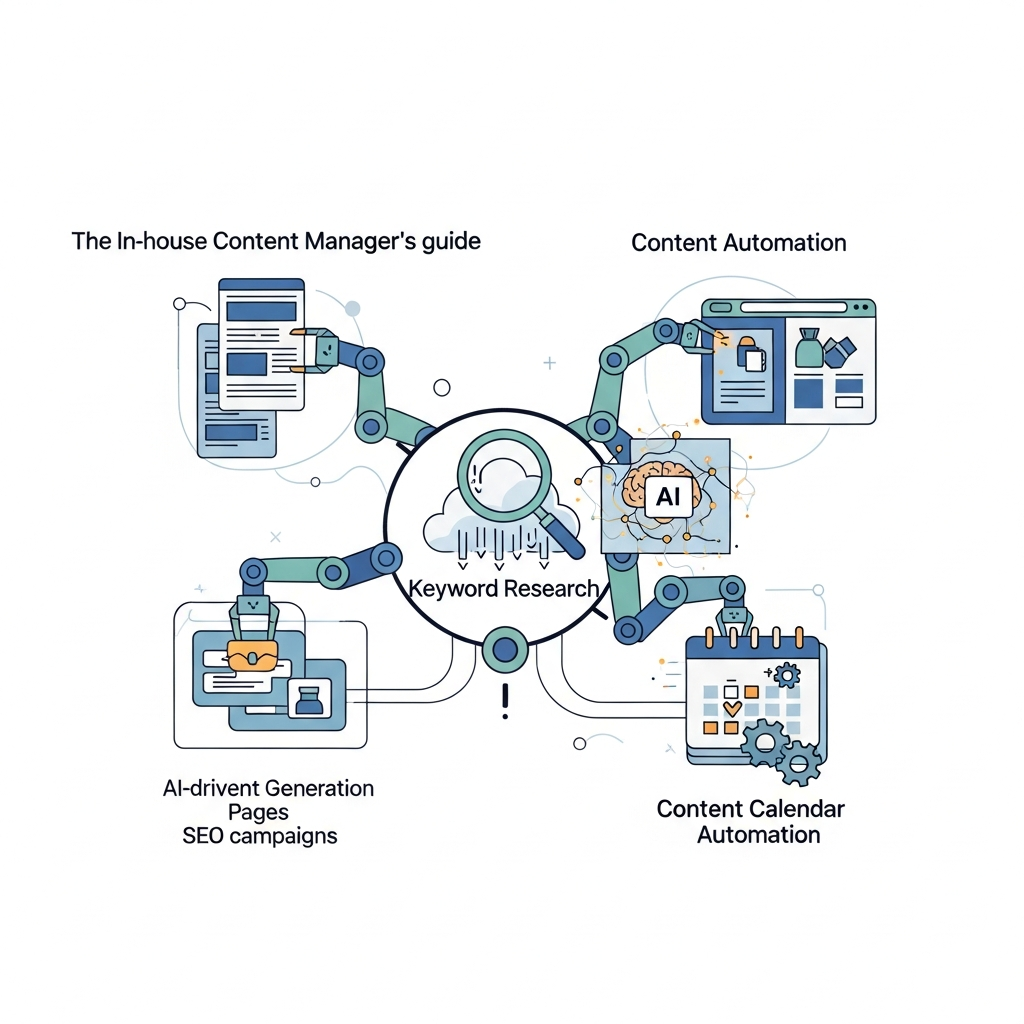
The Inhouse Manager Guide to Integrated Keyword Research and Content Automation: Scale Ecommerce Product Pages Without Sacrificing Quality
Introduction
In ecommerce, the race to win more product-page visibility often collides with the reality of limited time and resources. Teams must publish accurate, persuasive product copy at scale while maintaining brand voice, compliance, and performance. This guide presents a practical framework for combining integrated keyword research and content automation to scale product pages without sacrificing quality. The approach balances human oversight with AI-enabled processes to deliver consistent, data-driven content at speed.
At its core, integrated keyword research and content automation means aligning keyword strategy with automated content workflows. The result is a repeatable system that produces keyword-rich product pages, category pages, and supporting content while preserving brand guidelines and accuracy. This is not about replacing humans with machines; it is about extending human capabilities with repeatable, auditable automation that scales.
What integrated keyword research and content automation means for ecommerce
Integrated keyword research and content automation blends two core disciplines: keyword intelligence and production velocity. When done well, you achieve three outcomes: higher visibility for relevant product queries, faster page creation for new SKUs, and consistent optimization across hundreds or thousands of product pages. For ecommerce, this means product descriptions, category explanations, meta data, and internal linking can be aligned to strategic topics while staying on brand.
Key benefits include improved scalability, better governance, and clearer measurement. With integrated keyword insight guiding automation, there is less guesswork and more evidence-based content decisions. The approach also supports localization, enabling multi-language product pages to rank for regionally relevant searches without losing coherence across markets.
Note that automation does not replace editorial judgment. It creates a framework where AI-generated drafts are refined by human editors, ensuring accuracy, tone, and compliance with product specifications. The result is a scalable system that still respects product detail requirements and brand voice.
Planning the framework: keyword research and content automation workflow
Effective planning starts with a clear map from keyword clusters to content assets. Begin by identifying core product pages, category hubs, and supporting content that will anchor each cluster. From there, translate clusters into brief templates that drive content creation and optimization tasks.
A practical planning framework includes: stakeholder roles (SEO, content, product, compliance), data sources (keyword research tools, CMS data, analytics), and governance rules (approval gates, style guides, and localization guidelines). The framework should also specify metrics for success, such as incremental traffic, ranking improvements for target pages, and time saved in production.
Recommended workflow elements include: - Automated keyword discovery and clustering aligned to product taxonomy. - Brief generation that feeds AI content production with clear page goals and constraints. - On-page optimization steps that apply consistent meta data, headings, structured data, and internal-links patterns. - Quality gates that combine automated checks with human review before publish.
Mapping keywords to content assets
For each keyword cluster, create a content map that links to specific product pages, category pages, and supporting blog content. This map should include target page, page type (product, category, help), intent alignment, and a required content template. The map acts as the backbone of the entire automation pipeline and ensures coherence across pages and markets.
Designing the content calendar: AI driven generation and scheduling
A robust content calendar coordinates production with product launches, promotions, and seasonality. AI driven content generation for SEO campaigns can draft product descriptions and SEO-friendly metadata, while human editors verify accuracy and tone. A customizable content calendar for SEO automation enables teams to adjust cadence, language variants, and publishing windows across geos and channels.
Best practices for calendar design include: - Define publishing cadences aligned to product life cycles and marketing calendars. - Schedule keyword-optimized drafts ahead of promotions to ensure pages are live when demand peaks. - Build in localization windows for regional markets, ensuring translations and local nuances are reflected in copy.
Automation tools can generate briefs, assign tasks, and trigger publish when approvals are complete. The aim is to create predictable, auditable workflows that reduce manual coordination and friction between teams.
Template-driven content briefs
Content briefs should specify intent, audience, tone, required keywords, length ranges, and any product constraints (specs, features, use cases). Templates help maintain consistency and speed. Editors then verify that AI-generated drafts meet these briefs before moving to publishing stages.
Automation architecture: tools, data, and governance
Automation architecture is the blueprint that connects keyword research, content creation, and publishing systems. A typical architecture includes a keyword platform, an AI content generator, a content calendar, a CMS, and an analytics layer. Data flows from keyword discovery into briefs, then into AI drafts, through QA, and finally into live pages with structured data and internal linking patterns.
Key considerations for architecture include:
- Data integrity and privacy: ensure data used for generation complies with governance policies.
- CMS compatibility: WordPress, Webflow, Shopify and others should support batch updates and structured data markup.
- Localization workflows: support for multilingual content creation and translation management.
- Quality control gates: automated checks for keyword placement, content length, and factual accuracy.
- Analytics integration: connect to your analytics stack to measure impact on traffic, conversions, and revenue.
The end-to-end nature of end-to-end SEO automation means that you can orchestrate the entire process from keyword discovery to live page, with governance and auditability at every step.
Phase-by-phase implementation: discovery, creation, optimization
Adopt a phased approach to minimize risk while building muscle with automation. Each phase includes specific objectives, milestones, and gates for progression.
Phase 1 — Discovery and keyword research
Phase 1 focuses on identifying keyword clusters that align with product taxonomy and user intent. Produce a prioritized keyword list, group phrases into themes, and map themes to candidate pages. Establish data provenance and quality checks so every keyword decision can be audited later.
Phase 2 — Content briefs and AI drafts
Convert keyword themes into briefs for AI content generation. Include tone guidance, required blocks (features, benefits, specifications), and constraints (brand voice, regulatory notes). Generate first drafts, then run automated checks for keyword density, readability, and compliance before human review.
Phase 3 — On-page optimization and publishing
Apply on-page optimization consistently: meta titles, meta descriptions, headings, image alt text, structured data, and internal linking. Schedule publishing through the content calendar, with review queues for compliance or product changes. After publish, monitor performance and adjust as needed.
Quality control: prompts, templates, and human review
Quality control is the safety net that preserves accuracy and brand integrity. Create prompts and templates that guide AI writers toward desired outcomes while avoiding common pitfalls such as misrepresentations or inconsistent tone. Human editors should verify technical specs, ensure product voice alignment, and approve pages before they go live.
Best practice includes a tiered review process: automated checks capture style and SEO alignment, followed by human patent or compliance checks for regulated products. Regularly review prompts and templates to address gaps revealed by new product categories or evolving SEO guidelines. This reduces drift and keeps content fresh and accurate over time.
Measuring ROI and governance: dashboards, SLAs, and compliance
ROI in an integrated keyword research and content automation system comes from traffic growth, ranking improvements, and increased conversion rates, all balanced against production speed and cost. Establish dashboards that show keyword performance, page-level impact, and overall program health. Governance should be formalized with service level agreements (SLAs), access controls, and data privacy controls suitable for enterprise contexts.
Recommended metrics include organic traffic growth by page and cluster, rankings for target keywords, click-through rates, and revenue impact attributable to organic changes. Use a mix of leading indicators (crawlability scores, page speed) and lagging outcomes (conversion rate, average order value) to gauge program effectiveness. Regular governance reviews help align stakeholders and ensure continued value delivery.
Scaling for localization and multi-site SEO
Scaling multiplies the benefits of automation but also raises complexity. Multilingual and multi-country product pages require localization workflows that preserve keyword intent while adapting language, currency, and regulatory notes. A scalable approach includes centralized governance for global standards, paired with regional templates and local editors to maintain accuracy and nuance.
Standards to consider include a unified taxonomy across markets, centralized keyword repositories with language variants, and localization QA gates. Ensure that your automation stack supports local compliance requirements and that you have clear routing for editorial sign-off in each market. When done well, localization becomes a natural extension of the content engine rather than a bottleneck.
Implementation checklist
- Define the product page taxonomy and identify target keyword clusters by intent.
- Create content briefs templates aligned to each cluster and page type.
- Set up an automation pipeline linking keyword discovery, briefs, AI drafts, QA, and publish.
- Establish governance, SLAs, and data privacy controls for all teams involved.
- Design a flexible content calendar with localization and geotargeting considerations.
- Build on-page templates for meta data, headings, schema, and internal linking.
- Integrate analytics dashboards to monitor ROI and program health.
- Implement a human-in-the-loop for critical pages or regulated products.
- Phase in localization workflows and multi-site governance as you scale.
Resources and next steps
To deepen your understanding and practical execution, explore these resources that align with the concepts discussed in this guide. They offer concrete examples for implementing automated content calendars, governance dashboards, and scalable ecommerce SEO workflows:
Automated 30 day content calendar guide and Measuring ROI and governance in automated SEO dashboards and Sao Paulo automation for ecommerce in Brazil
Continuing education and hands-on practice are essential. If you are evaluating a toolset or partner for these capabilities, consider pilots that track incremental traffic, time-to-publish, and cost per page. Use data from initial pilots to refine prompts, templates, and governance frameworks before wider rollout.
Conclusion
Integrated keyword research and content automation offers a practical path to scale ecommerce product pages while preserving quality and brand integrity. By aligning keyword strategy with repeatable content workflows, organizations can publish more pages faster, maintain consistency, and measure tangible ROI. The framework outlined here emphasizes planning, governance, and continuous improvement, ensuring that automation remains a force multiplier rather than a bottleneck.
Remember, automation is most effective when humans lead with strategy, editors validate with expertise, and data informs every decision. With a solid framework, ecommerce teams can achieve scalable growth without sacrificing the accuracy or voice that makes their products compelling to customers.