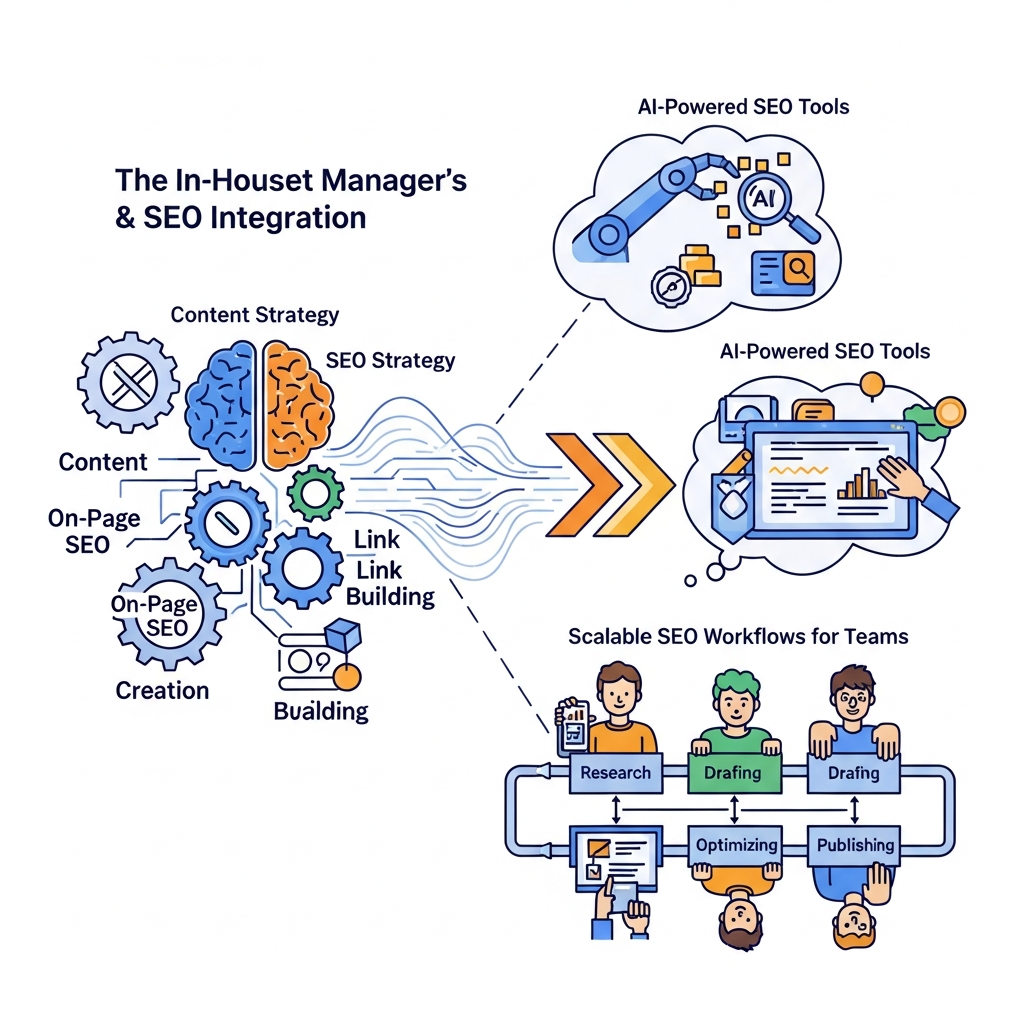
The In-house Content Manager's Guide to Content Marketing and SEO Integration: Scale Ecommerce Product Pages Without Sacrificing Quality
Introduction: The challenge of scale without sacrificing quality
In ecommerce, content and search visibility are two sides of the same coin. Product pages win customers when descriptions are informative, reviews are trustworthy, and the page loads quickly on any device. They win traffic when search engines understand the page intent and rank it accordingly. Yet many in-house teams struggle to scale content creation and on-page optimization across dozens, hundreds, or even thousands of product pages.
This guide explains how to fuse content marketing and SEO into a single operating system. It shows how to use AI-powered tools and automation-ready processes to drive volume without diluting quality. The result is a scalable approach that supports multi-channel growth, preserves brand voice, and provides auditable governance for executives and stakeholders.
Why integrate content and SEO at scale for ecommerce
Core business outcomes hinge on three pillars: visibility, relevance, and conversion. Content marketing builds relevance by answering shopper questions and showcasing product value. SEO ensures that content is discoverable by the right audience at the right moment. When aligned, teams can publish more pages, optimize faster, and improve metrics such as organic traffic, time on page, and conversion rate from search.
Key benefits of a unified approach include:
- Faster content production with consistent quality across product categories and geographies.
- Data-driven keyword plans that feed briefs, briefs that feed briefs—creating a closed loop from idea to page live.
- Structured data and schema support that helps search engines understand product attributes, reviews, pricing, and availability.
- Mobile-friendly optimizations and performance improvements that boost both user experience and rankings.
For teams managing many pages, a scalable system reduces manual overhead, accelerates iteration, and provides a clear ROI through unified dashboards and governance.
A practical framework for content marketing and SEO integration
Adopting a repeatable framework is essential to scale without chaos. The framework below translates strategic intent into repeatable, auditable steps that a team can own from planning to publishing.
Step 1: Align goals and audiences
Start with a quarterly alignment between content, product, and SEO leaders. Define target pages, geographies, and product SKUs. Agree on success metrics (traffic, rankings, revenue lift, and rate of publish), and establish governance rules so every page follows a consistent review process.
Step 2: Map keywords to content themes
Develop a keyword map that ties buyer intent to product pages. Identify primary keywords and supporting terms, including questions shoppers ask in each category. Use these insights to drive content briefs that specify tone, length, and required on-page elements.
Step 3: Create data-informed content briefs
briefs should include: target keyword, user intent, recommended headings, required structured data, image guidelines, and a note on mobile optimization. AI can draft outlines, but human editors should validate accuracy and brand voice.
Step 4: Optimize on-page structure
Adopt a consistent template for product pages and category pages. Include dedicated H1s, descriptive meta titles, bullet features, and FAQs. For ecommerce, prioritize features like price, availability, and shipping details where they help conversions.
Step 5: Implement structured data and schema guidance
Use product schema for price, availability, and reviews. Apply FAQ schema for common shopper questions. Structured data helps rich results and improves click-through rates by providing immediate context in SERPs.
Step 6: Prioritize site speed and mobile experience
Performance is a ranking and conversion factor. Optimize images, implement lazy loading, and ensure critical CSS is inlined for above-the-fold content. A mobile-first mindset ensures pages render quickly on smartphones, where most ecommerce traffic originates.
Step 7: Establish governance and QA
Define review cycles, sign-off authorities, and publication calendars. Implement a content QA checklist that covers accuracy, freshness, accessibility, and performance targets. Maintain an audit trail to support executive reporting.
Building scalable workflows with AI-powered tools
AI-powered tools can dramatically increase content throughput while preserving quality. The goal is not to replace humans but to augment them with reliable, auditable automated processes that fit your governance model.
How to build scalable workflows in practice:
- Automate content ideation and outlines using AI, then assign human editors for validation.
- Use AI to optimize on-page elements—title tags, meta descriptions, and internal linking—within a controlled framework.
- Leverage AI-assisted localization for multilingual product pages, with review steps to ensure cultural relevancy.
- Automate publishing with schedule controls that align to campaigns and promotions, while preserving editorial calendars.
For teams evaluating AI-powered capabilities, it’s essential to focus on benefits, not hype. Ensure tools support governance, versioning, and compliance with data privacy standards. See real-world playbooks in our recommended resources below.
Practical tip: incorporate a daily stand-up that reviews automated outputs, flags quality issues, and adjusts prompts and rules to improve results over time.
Technical foundations: speed, schema, and mobile
Technical excellence underpins scalable content. Without it, even the best content will underperform. Here are the core technical pillars to align with content and SEO goals.
Site speed and performance
Page load times influence both user experience and search rankings. Prioritize image optimization, caching strategies, and minimal render-blocking resources. Regularly audit Core Web Vitals and address regressions promptly.
Structured data and schema guidance
Structured data provides context to search engines. Implement product, review, and FAQ markup where relevant. Validate schemas with rich result testing tools and monitor for compliance with evolving standards.
Mobile-friendly best practices
Mobile performance drives a large share of conversions. Optimize touch targets, font sizes, and layout shifts. Ensure responsive design works well with dynamic content blocks and image carousels used on product pages.
Governance, quality assurance, and ROI
A scalable system requires rigorous governance. Executives want visibility into progress, risk, and impact. Operators want predictable delivery. The table stakes are:
- Clear SLAs, roles, and responsibilities for content and SEO work.
- Auditable decision logs and version history for every page update.
- Integrated analytics that tie content activities to business metrics like organic traffic and revenue.
- Security and privacy controls for data handling and access to CMS and analytics platforms.
To prove value, set up dashboards that show ROI, content performance, and workflow velocity. Consider three lenses: traffic uplift, on-page quality, and conversion impact. For a practical approach to governance dashboards, see our hands-on playbook linked below.
Onboarding playbook: 6 practical steps to start today
Use this concise 6-step plan to kick off a scalable content-SEO integration program.
- Audit existing product pages and catalog structure to identify highest-potential pages.
- Develop a 30-day content calendar focused on product pages, category hubs, and FAQs. Automated 30-Day Content Calendar.
- Create briefs that align with keyword maps, then run them through AI-assisted drafting with human QA.
- Apply structured data and optimize for mobile and speed in parallel with content changes.
- Publish on a controlled cadence, with ongoing QA and governance reviews.
- Measure results weekly and adjust strategy based on performance data; implement governance dashboards to prove value. See a practical ROI guide for automated dashboards ROI and governance dashboards.
As you scale across regions or marketplaces, consider a bilingual or multilingual workflow. For a regional case study on automation in ecommerce, explore our São Paulo post: São Paulo automated publishing for ecommerce in Brazil.
Common pitfalls and best practices
Even well-planned programs stumble. Here are frequent blind spots and how to avoid them:
- Over-automation without human oversight. Mitigation: maintain a QA gate and editorial review.
- Ignoring site speed as content volume grows. Mitigation: progressive optimization and lazy loading.
- Inconsistent brand voice across pages. Mitigation: centralized voice guidelines and templates.
- Poor data governance. Mitigation: strict access controls and audit trails.
By combining AI-powered efficiency with disciplined governance, teams can scale content production while maintaining quality, relevance, and trust with shoppers.
Conclusion: A sustainable path to scale
Content marketing and SEO integration is not a one-off project; it is a continuous operating system for ecommerce growth. The most successful programs combine AI-assisted workflows with rigorous governance, performance monitoring, and a strong emphasis on user experience. When teams align around a common framework, leverage scalable tools, and keep a tight feedback loop, product pages become engines of discovery and conversion rather than bottlenecks in the customer journey.
Ready to start? Begin with a clear set of pages to optimize, a baseline KPI suite, and a plan to iterate quickly. The path to scale is iterative, collaborative, and measurable—and it starts with a single, well-structured workflow that blends content and SEO into one powerful discipline.