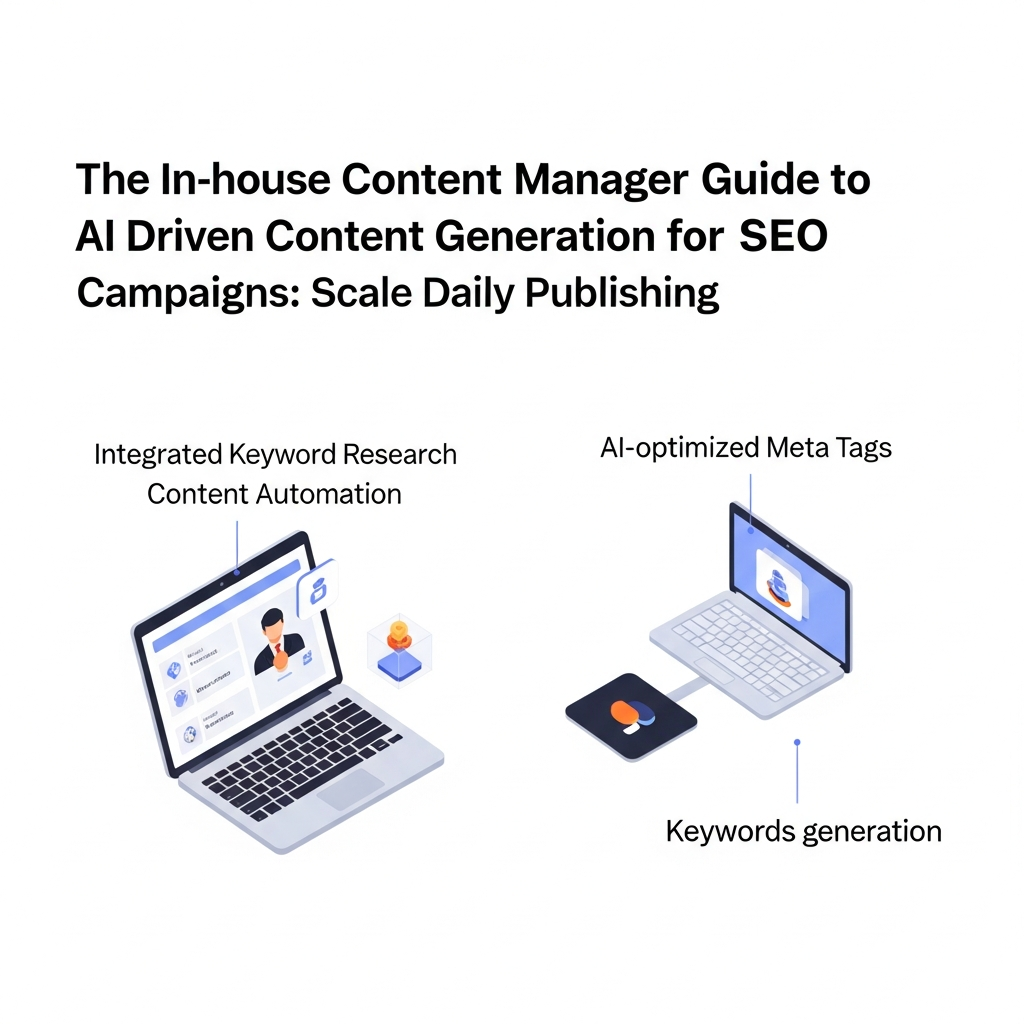
The In-house Content Manager's Guide to AI Driven Content Generation for SEO Campaigns: Scale Daily Publishing
Introduction
Daily publishing is a common goal for modern SEO campaigns. Yet for most in-house teams, bottlenecks like ideation, keyword alignment, editorial bandwidth, and on-page optimization slow progress. AI-driven content generation, when paired with CMS integrations and governance controls, offers a practical path to scale daily publishing without sacrificing quality or rankings.
This guide helps you design an AI-first program that fits inside a traditional CMS workflow. You’ll find actionable steps, KPIs, and guardrails so your team can move from pilot to production without chaos. We’ll cover planning, tooling, workflow automation, and measurement—plus concrete examples you can adapt to your own content calendar.
Why AI-driven content generation matters
AI-powered content generation is not about replacing human writers; it’s about augmenting their capabilities. The most successful programs start with a clear brief, topic pyramids, and a mapping between keywords and content assets. The result is faster draft creation, more consistent topic coverage, and a publishing cadence that keeps pace with demand.
When integrated with a CMS, AI can draft outlines, generate meta information, write first-pass paragraphs, and suggest internal linking opportunities. The process should be governed by editorial guidelines and QA checks to preserve brand voice and accuracy. In this model, AI accelerates discovery and production, while human editors provide the final polish and strategic insights.
Planning for scale: goals, governance, and QA
Scaling daily publishing begins with a plan that covers goals, frequency, quality gates, and governance. Start with a target number of articles per day or week, then design a workflow that reliably hits that cadence. A realistic ramp balances speed with accuracy and ensures consistent reader value.
Key steps include:
- Define publishing cadence and minimum quality criteria.
- Map each topic to keyword intent and content type (guide, comparison, review, etc.).
- Establish QA gates: editorial review, factual verification, and SEO checks before publication.
- Set up a content calendar that aligns with product launches and campaigns.
Start small with a pilot zone (e.g., two to four topics) and scale once you prove ROI and editorial discipline. Create a simple SLA for content turnaround, including draft, QA, and publish timelines, to keep stakeholders aligned.
CMS integration and tooling
Successful AI-driven content programs integrate with your CMS and analytics stack. Common platforms include WordPress, Webflow, and Shopify, each with its own API and content model. The goal is to keep the editorial flow familiar while extending it with AI-assisted drafts, optimized meta tags, and automated internal linking.
Choose tools that offer robust API access, role-based permissions, and data privacy safeguards. A well-integrated stack reduces context-switching for writers and editors and makes it easier to publish content on schedule. For teams operating across multiple markets, CMS integration also enables localization workflows and consistent taxonomy across languages.
Integrated keyword research and content automation
At the heart of AI-driven content is a strong keyword strategy. Begin with keyword discovery, intent mapping, and topic clustering. Then let AI drafts align with the cluster and write to the user intent you’ve identified. The cycle should be repeatable and auditable, not ad hoc.
Practical approach:
- Start with a master keyword list and map each term to a content type and target page.
- Feed AI with constraints: audience, tone, length, and required sections.
- Incorporate synonym and semantic variations to avoid over-optimization.
- Regularly review keyword performance and refresh briefs as goals shift.
As you scale, build a living keyword brief library that your editors can reuse and evolve. This reduces drift and keeps content aligned with business goals. For more on practical calendar frameworks, see our Automated 30-Day Content Calendar post linked in the Getting Started section.
AI optimized meta tags and keyword generation
Meta tags remain a critical hook for both search engines and users. AI can draft meta titles and descriptions that incorporate target keywords while remaining compelling. It can also propose keyword-driven headers, alt text, and structured data snippets to improve rich results.
Best practices:
- Limit meta titles to around 60 characters and descriptions to 155-160 characters for most engines.
- Keep user intent top of mind; avoid stuffing keywords into metadata.
- Test variations and monitor CTRs to calibrate prompts and prompts constraints.
Use AI prompts that specify product intent, audience, and the unique value proposition of the piece. Periodically audit generated metadata against performance data to refine prompts and guardrails.
Workflow automation for content creation and optimization
Automation should map directly to editorial processes. A typical workflow includes idea capture, AI drafting, editor QA, SEO checks, publishing, and post-publish performance monitoring. You can layer tasks such as translation, localization, and repurposing across channels without duplicating effort.
Step-by-step example:
- Capture an idea in a content calendar with target keyword clusters.
- Generate an AI draft with a structured outline and prompts for each section.
- Run an automated SEO checklist: URL structure, header usage, internal linking, and schema basics.
- Submit to human editor for polish and fact-checking.
- Publish and monitor on-page performance and rankings.
Automation tools can also alert editors when a piece drifts from the brief, or when ranking signals change. Build a feedback loop so prompts become more precise over time, reducing review time and rework.
Content strategy driven by AI for SEO
AI is a powerful planning tool, but it should inform human strategy, not replace it. Use AI to surface content gaps, predict performance, and suggest content formats that align with user intent. The content strategy should produce a balanced mix of evergreen guides, timely updates, and product-focused pages.
Strategy ideas:
- Topic pyramids that feed multiple assets (pillar pages, clusters, and micro-posts).
- Localization and geo-targeting to extend reach across markets and languages.
- Visual assets and schema-rich content to improve discoverability and SERP features.
For teams that operate globally, AI can help you map content to regional intents while preserving a unified brand voice. Regularly review topic coverage to avoid gaps and redundancies, and ensure your content calendar reflects seasonal and product-driven campaigns.
Governance and quality controls
Governance is essential for scaling safely. Establish brand voice guidelines, fact-check policies, and gate checks before anything goes live. Implement versioning, change logs, and audit trails for every AI-generated draft. Regular editorial reviews are critical to maintain reliability and trust with readers.
Practical governance checklist:
- Brand voice and tone guidelines documented and accessible.
- Editorial QA checklist and sign-off responsibilities.
- Role-based permissions and approval workflows in your CMS.
- Data privacy safeguards and data handling policies for AI prompts and outputs.
Incorporate periodic quality audits, and ensure the governance model scales with your content portfolio. If you manage multilingual content, harmonize governance across languages to maintain consistency.
ROI measurement and dashboards
Measuring the impact of AI-driven content requires clear KPIs, dashboards, and governance. Track inputs (content produced, briefs created) and outputs (pages published, traffic, conversions). Use dashboards that compare pre- and post-automation periods and provide ROI calculations across campaigns and sites.
Practical metrics:
- Publication velocity (articles per day/week).
- Organic traffic growth and keyword ranking momentum.
- Engagement metrics (time on page, scroll depth, CTR from SERPs).
- ROI indicators (LTV, revenue per visitor, cost per content piece).
To deepen your understanding of ROI dashboards and governance, read our detailed guide: Measuring ROI and Governance in Automated SEO Dashboards.
Keep your ROI model transparent: document inputs, assumptions, and calculation methods, then publish quarterly ROI reports to stakeholders. This discipline will help you justify ongoing investments in AI-driven content programs.
Getting started: a practical ramp
Ready to begin? A pragmatic 14-day ramp can move your team from discovery to production. Day 1-2: define goals and gather briefs; Day 3-5: set up your content calendar and AI prompts; Day 6-9: run pilot drafts and QA; Day 10-12: publish a small batch; Day 13-14: review results and adjust prompts and processes.
During the ramp, lean on templates and briefs to keep consistency. If you’re looking for a template-driven approach to content calendars, check out our 30-day content calendar framework: Automated 30-Day Content Calendar.
As you scale, consider parallel workflows: multilingual translations, image generation, and repurposing content for social or email. All of these can be integrated into the same automation framework to maximize ROI and maintain quality. For localization workflows in global markets, see our Sao Paulo automation guide: Sao Paulo Automation Guide.
Pitfalls and best practices
Despite its promise, AI-driven content can underperform if not managed carefully. Over-reliance on prompts can lead to generic writing or factual mismatches. To avoid this, maintain strong editorial oversight and continuous prompt refinement. Also watch for data drift, where prompts generate content that diverges from your brand voice or updated guidelines.
Best practices:
- Establish a robust prompt library with guardrails for accuracy, tone, and length.
- Regularly audit AI outputs for factual accuracy and brand alignment.
- Keep audience intent front and center; update briefs as topics evolve.
- Balance automation with human creativity to maintain unique angles and voice.
Remember, AI should empower editors, not replace them. Build a feedback loop where editors refine prompts, which in turn improves future drafts. This ongoing calibration is key to sustainable scale.
Playbook: checklists for success
Use these checklists as a quick reference during weekly reviews or sprint planning.
- Content planning: ensure topics map to buyer intent and keyword clusters.
- Drafting: confirm prompts include structure (intro, sections, CTA) and SEO constraints.
- QA: verify factual accuracy, citations, and internal linking opportunities.
- Publishing: verify URLs, canonicalization, and metadata before going live.
- Measurement: update dashboards and compare against targets.
Conclusion
AI-driven content generation can unlock scalable, data-driven publishing for SEO campaigns when paired with careful planning, CMS integration, and governance. By combining AI's speed with human editors' judgment, in-house teams can publish more consistently, improve topic coverage, and drive sustainable traffic growth. Start with a clear ramp, a solid set of prompts, and a governance framework, and you’ll turn daily publishing into a repeatable competitive advantage.