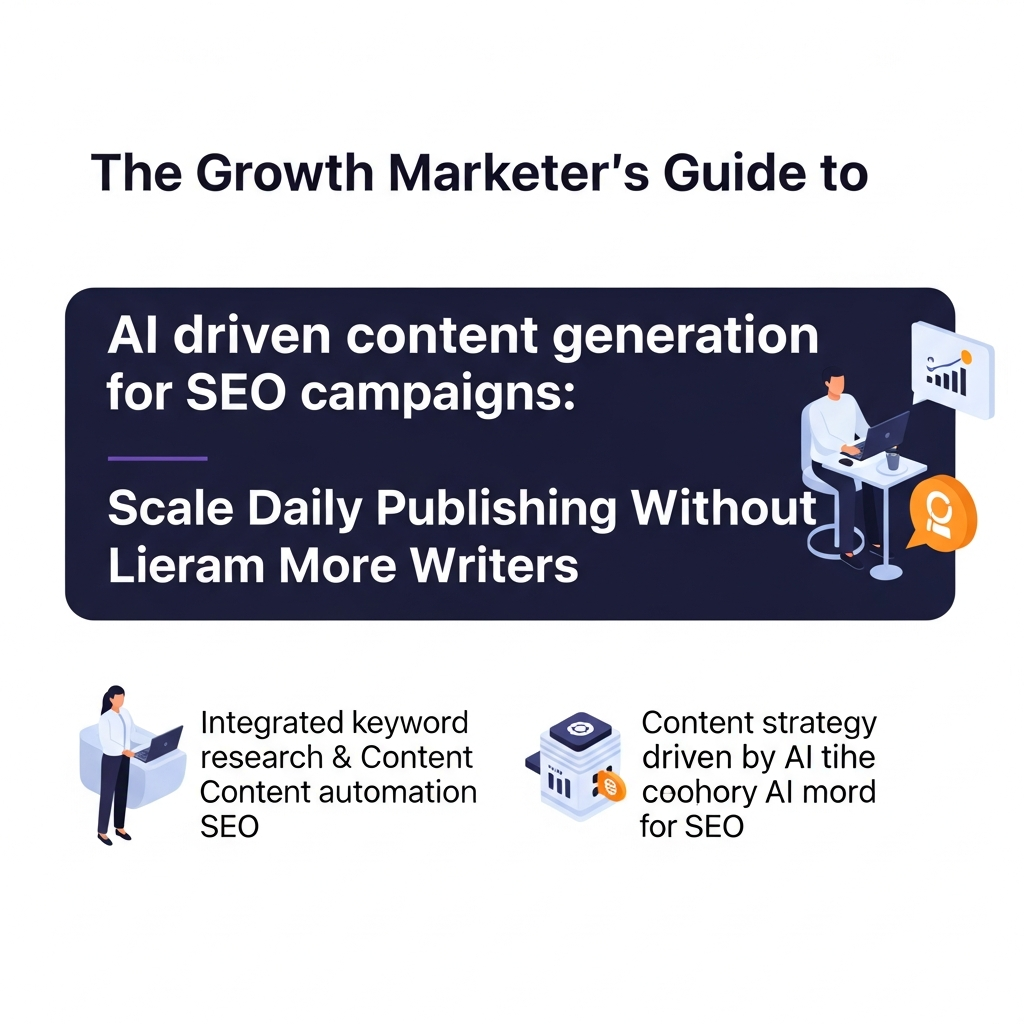
The Growth Marketer's Guide to AI driven content generation for SEO campaigns: Scale Daily Publishing Without Hiring More Writers
Introduction
For growth marketers, AI-driven content generation for SEO campaigns represents a shift from manual, one-off creation toward a scalable, repeatable process. The goal isn't to replace human writers but to amplify their output with machine-assisted drafting, optimization, and scheduling. When implemented thoughtfully, AI can help you publish more frequently, test hypotheses faster, and maintain brand voice across multiple sites and languages.
This guide walks you through building a sustainable AI-powered content engine. You'll learn how to structure workflows, align AI output with keyword strategies, and govern quality so your daily publishing calendar remains reliable and effective. Throughout, you’ll find practical patterns, cautions, and concrete steps you can adapt to your team and tech stack.
Why AI-driven content generation matters for SEO campaigns
SEO today rewards speed, relevance, and consistency. AI-driven content generation helps you keep up with demand without sacrificing quality. By automating routine drafting, data-driven keyword augmentation, and on-page optimization suggestions, your team can focus on strategy, human editing, and creative experimentation that actually moves rankings and engagement.
However, AI is not a silver bullet. The most successful programs combine machine-generated content with robust human QA, brand guidelines, and governance. The objective is to create a scalable, transparent process where AI handles volume while humans steer quality, voice, and narrative. When this balance is achieved, you unlock daily publishing at scale without the overhead of additional full-time writers.
In the sections that follow, we’ll outline a practical blueprint you can adapt—from intent research to final publication—so you can justify the investment to stakeholders and maintain accountability across teams.
Planning your AI-driven content pipeline
A reliable AI content pipeline begins with clear inputs and measurable outputs. Start with an auditable content calendar, a defined set of topics aligned to strategic keywords, and a content brief framework that AI can interpret consistently. Your pipeline should cover discovery, drafting, editing, optimization, publishing, and performance feedback cycles.
Key steps include establishing guardrails for topic depth, tone, length, and format. Decide which content types you’ll automate (blog posts, FAQs, product guides, pillar pages) and which require heavier human involvement. As you design the flow, think in terms of governance: who approves what, how QA is performed, and what dashboards track progress against goals.
For teams moving from manual to automated workflows, it helps to pilot with a small set of high-potential topics before expanding. This reduces risk and surfaces practical prompts, templates, and review criteria you can reuse at scale.
Integrated keyword research and content automation
AI shines when it’s fed with structured input. Begin with integrated keyword research that combines volume, intent, and competitive gaps. AI can then translate those signals into topic briefs, outline skeletons, and on-page focus points. The connection between keyword data and content output is what makes automation truly effective for SEO campaigns.
Practical technique: map each primary keyword to a set of secondary keywords and long-tail variants. Use AI to generate outlines that naturally weave these terms into headings, meta descriptions, and on-page sections. The goal is semantic coherence—content that covers user intent comprehensively while maintaining readability and brand voice.
As you scale, automate keyword discovery workflows across multi-site properties and language variations. This helps keep topics aligned with audience needs in each market, while supporting centralized governance and reporting.
For deeper reading on implementation patterns, explore our resource on ROI governance dashboards for automated SEO and how to structure your analytics stack for scalable insights.
Auto-generated outlines and briefs for SEO
One of the most valuable outputs of AI in SEO is the auto-generation of article outlines and briefs. A well-formed brief defines the purpose, audience, primary keyword focus, required sections, and style guidelines. AI can then draft a near-ready outline with suggested subheadings, data prompts, and callouts for additional optimization.
Human editors review and adjust tone, add brand-specific angles, and insert links to credible sources. When briefs are consistent, downstream writers (or AI authors with human QA) have a reliable starting point, reducing cycle time and maintaining quality at scale.
To see a concrete example of how a 30-day content calendar can be operationalized, you can read about a practical approach in our post on automated content calendars designed for SEO at scale.
As you refine this process, consider tying briefs to internal linking strategies and content silos to preserve topical authority across your site network.
From AI drafts to publication-ready content
AI drafts often require refinement to meet editorial standards. Implement a two-tier QA process: automated checks (grammar, plagiarism, readability, keyword density) and human review (brand voice, factual accuracy, and contextual relevance). This hybrid approach preserves quality while accelerating throughput.
Establish style guides and tone presets that your AI system can apply consistently across posts. Maintain a feedback loop where editors rate AI outputs, and the system uses those ratings to improve future drafts. Over time, the model augments its prompts to produce outputs closer to your ideal first draft.
In practice, this means you can regularly publish higher volumes of SEO-friendly content without compromising on reader experience. The balance between automation and editorial input is the key to sustainable growth.
AI-optimized meta tags and keyword generation
Meta tags—title tags, meta descriptions, and schema snippets—remain critical for click-through rates and rich results. AI can generate meta tags aligned with the primary keyword and related terms, while respecting length limits and readability. Use prompts that explicitly steer meta descriptions toward user intent and unique value propositions for each page.
Beyond basic tags, AI can propose internal linking opportunities and schema markup recommendations. This supports better crawlability and richer search results, which in turn can improve rankings and visibility.
Always pair AI-generated meta content with human review to ensure accuracy and alignment with brand standards. The combination tends to yield the best balance of scale and quality.
Workflow automation and daily publishing at scale
A robust workflow combines content creation, optimization, scheduling, and publication into a seamless loop. Automate the repetitive steps—draft assembly, keyword wiring, basic on-page optimization, and pre-publish checks—while reserving final approval for senior editors on high-stakes topics.
For multi-site or multilingual programs, centralize governance with a shared content calendar, standardized templates, and global dashboards to monitor performance across domains. Automation should enable you to publish consistently, but with built-in review gates to prevent quality dips during peak periods.
As a reference, you can explore our guidance on automated publishing workflows and how to jumpstart SEO at scale with a 30-day content calendar.
Internal note: See our post on 30-day content calendar for SEO at scale for a hands-on blueprint.
Governance, ROI, and risk management
Automation introduces new governance challenges: data privacy, access controls, audit trails, and vendor risk. Establish clear ownership for every stage of the content lifecycle, define SLAs for content quality, and implement dashboards that translate activity into ROI metrics. This helps executives understand value and ensures accountability across teams.
Track core KPI families such as organic traffic, keyword rankings, published volume, time-to-publish, and engagement metrics. Use dashboards to spot anomalies quickly and iterate on prompts, templates, and briefs to improve outcomes over time.
For deeper governance considerations and ROI measurement, consult resources focusing on automated SEO dashboards and governance practices.
To see practical governance examples, read about how teams measure ROI and governance in automated SEO dashboards that prove value, which provides a framework you can adapt to your organization.
Implementation path: a practical 6-step plan
- Define scope and goals: decide which pages, topics, and regions will be included in the initial rollout.
- Build a keyword-first brief library: create templates that map keywords to outlines and meta plans.
- Establish QA gates: set editorial standards and automated checks for every content type.
- Design the publishing workflow: integrate content calendars with CMS and publishing schedules.
- Pilot and measure: run a two-week pilot on a focused set of topics and evaluate impact.
- Scale with governance: broaden coverage while maintaining quality through dashboards and SLAs.
Throughout this process, keep a clear feedback loop so AI outputs improve and editors become more efficient. The aim is scalable, repeatable success, not one-off wins.
Resources and case studies
As you explore AI-driven content generation for SEO campaigns, use a mix of official guides, case studies, and practitioner-oriented posts to inform your approach. For a concrete example of how automated content strategies translate into practical outcomes, you can review our related posts linked below.
Reader note: for a Brazilian market-focused example of publishing automation, see our Sao Paulo case study in Portuguese.
Further reading and related posts:
- Sao Paulo publishing automation for Brazilian ecommerce
- Measuring ROI and governance in automated SEO dashboards
Internal resources to deepen your knowledge include our posts on 30-day content calendars and ROI governance, both of which illustrate concrete patterns you can adapt to your own program.