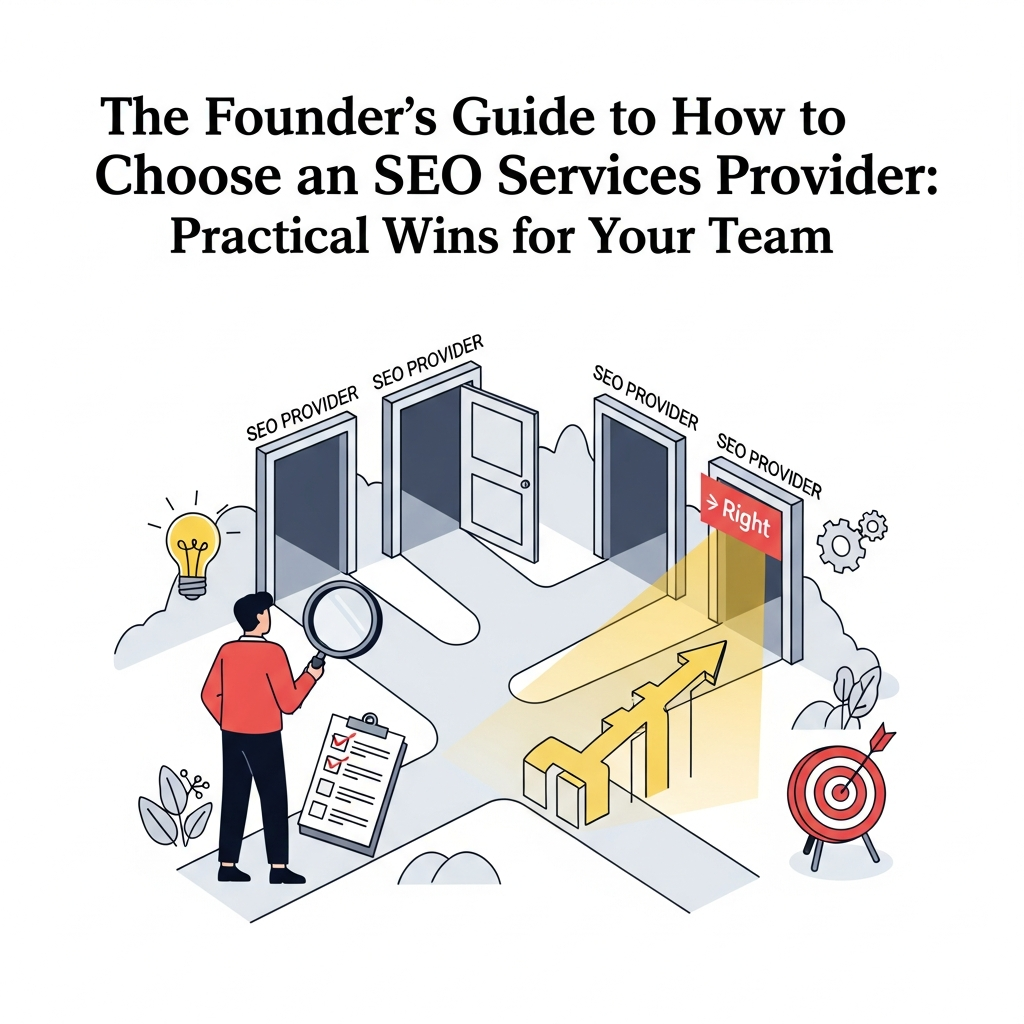
The Founder's Guide to How to Choose an SEO Services Provider: Practical Wins for Your Team
Why choosing the right provider matters
For founders, the decision to hire an SEO services provider is about more than a monthly retainer. It sets a ceiling on your organic growth, the speed at which you can scale content, and the quality of signals you send to search engines. A strong partner acts like an extension of your team: they interpret your product, your audience, and your brand voice into search campaigns that drive real, trackable outcomes. Poor choices, by contrast, squander budget, erode trust with stakeholders, and create a shadow IT stack that is hard to unwind.
When evaluating options, most founders ask: can this provider deliver consistent results across multiple markets? Will they align with our product roadmap and our brand voice? Can we trust them with sensitive data and complex analytics dashboards? The right criteria for selecting an SEO partner balance capability, governance, and economics. And the moment you have a framework, you can compare agencies or consultancies objectively instead of relying on vibes or case studies alone.
The practical advantage of a framework is that it translates into an action plan for your first 90 days. You’ll be able to confirm a shared scope, set measurable milestones, and align expectations across stakeholders—from executives to product and marketing teams. This article provides a starter playbook you can adapt to your business context. It leans on established best practices for how to choose an seo services provider without promising overnight miracles.
Building your evaluation framework
A rigorous framework answers five core questions: strategic fit, technical capability, governance and transparency, commercial terms, and cultural alignment. Below is a practical checklist you can adapt. The aim is to create an objective, repeatable process rather than a one-off vendor scorecard.
Strategic fit: does the provider understand your market and goals?
Ask for a candid narrative of how they would approach your business in the first 90 days. Look for clarity on target keywords, content types, and channels that align with your product roadmap. A capable partner should demonstrate experience in similar verticals and a practical plan for internationalization if you operate across geographies. This is part of the core framework for how to choose an seo services provider and should influence every subsequent due diligence step.
Technical capability: can they execute at scale?
Evaluate their technical playbook—site audits, on-page optimization, structured data, and CMS integrations. Request a sample technical audit and a transparent methodology that shows how they identify issues and prioritize fixes. A strong vendor should be able to articulate how their tooling integrates with your CMS (WordPress, Shopify, Webflow) and analytics stack, and how they handle localization for multilingual campaigns. For founders, this is a practical signal of whether the provider can deliver the expected pace of improvement without breaking your site.
Governance and transparency: how will you see progress?
Governance is about reporting cadence, dashboards, and decision rights. Look for a clear governance model, weekly or biweekly standups, and a concise set of metrics that tie to business outcomes—traffic, rankings, conversions, and revenue. If a provider cannot share a dashboard or a weekly update format, that’s a red flag. See our guidance on governance dashboards in our ROI-focused content for a deeper blueprint.
Commercial terms and SLAs: what are the guardrails?
Commercial terms should be transparent, predictable, and scalable. Seek clarity on pricing models (retainer, milestones, or performance-based components), renewal terms, and what happens when scope expands. A robust contract includes SLAs for response times, deliverable quality, and data security. Remember that economics should reflect the value you receive, not just the lowest monthly price.
Cultural fit and collaboration: will your teams work well together?
Culture matters because the daily work lives in joint rituals, workflows, and communication styles. How quickly can you resolve disagreements? Is the agency comfortable operating as an extension of your team, or will you be managing a separate vendor relationship? In the end, the most successful partnerships combine expertise with a shared operating rhythm that supports rapid experimentation and learning.
The due diligence playbook
Use a repeatable, documented process to reduce bias and make evaluation faster. The following subsections translate common questions founders ask into concrete steps you can execute in a 2–4 week window.
3.1 Define scope and success metrics
Start with a compact scope—one product line, one geolocation, or one content vertical. Define success in measurable terms: target organic traffic uplift, conversion rate improvement, or cost per acquisition reduction. Document baselines, target KPIs, and a simple hypothesis test for each initiative. This creates a shared reference point for your RFP or vendor shortlisting.
3.2 Shortlist criteria
Equip your team with a checklist that weighs strategy, execution capability, pricing clarity, and governance. Score each vendor on a consistent rubric: strategic fit, technical depth, reporting quality, security posture, and client references. Ask for three client references and, if possible, a short pilot proposal to validate the fit.
3.3 Assess deliverables
Request templated deliverables: an initial 90-day plan, a technical audit sample, a content calendar outline, and a link-building plan. Review the quality of the artifacts: are they concrete, data-driven, and aligned to your audience? A realistic agency will present a transparent plan with milestones, budgets, and risk mitigations rather than generic statements.
3.4 Pilot plan
Design a low-risk pilot to test core capabilities: content generation quality, on-page optimization, and a measurable uplift in a defined channel. Establish exit criteria, a timeline, and a decision rule for continuing, refining, or terminating the engagement. A structured pilot helps you validate the practical feasibility of the vendor’s approach before committing to a longer contract.
ROI, governance, and data privacy
ROI is more than a momentary KPI—it’s the cumulative effect of consistent, well-governed optimization. Governance also includes data privacy and regulatory compliance, which are increasingly important for enterprise-scale SEO partnerships. Use the following guardrails to ensure you’re measuring value and protecting your data.
4.1 ROI metrics you can actually track
Define ROI as a function of incremental revenue from organic channels minus the cost of the SEO program. Track inputs (time, spend, tooling) and outputs (traffic, keyword rankings, page-level conversions). Use a simple formula like ROI = (incremental revenue from SEO - SEO costs) / SEO costs. Tie improvements to business outcomes such as new customers, average order value, or trial signups. For a practical framework to measure governance and ROI in automated SEO, refer to our post on measuring ROI and governance in automated SEO dashboards that prove value.
4.2 Data privacy and security
Security policies should cover data access, storage, retention, and breach notification. Look for SOC 2 or equivalent certifications, clear data handling clauses, and documented permission models for team members. If your business operates under strict data-privacy rules, insist on data processing addenda and breach response protocols. A vendor that treats data responsibly reduces risk and accelerates procurement decisions.
4.3 Reporting and dashboards
Dashboarding should be ongoing, transparent, and actionable. Require a standard reporting package with weekly highlights, monthly deep dives, and an executive summary. Dashboards should map to your defined KPIs and demonstrate progress toward revenue goals. If possible, align dashboards with your existing analytics stack to minimize friction and maximize adoption. See our guide on governance dashboards for practical templates and data-visualization practices.
4.4 References and case studies
Ask for case studies that resemble your business in size, market, and product category. Contact references to verify the vendor’s ability to deliver on timelines, quality, and ROI. While case studies are persuasive, verify that the results were achieved with a replicable approach and not a one-off experiment. This step is essential to credible due diligence in how to choose an seo services provider.
Negotiating contracts and SLAs
Contract terms determine how value is realized and how risk is managed over time. Negotiate around pricing, scope, performance, and termination terms to ensure you have a clear exit path if results stall or governance breaks down.
5.1 Price and value
Ask for transparent pricing with a breakdown of activity, deliverables, and any add-ons. Avoid bundles that obscure what you’re paying for. Consider a tiered structure that scales with your growth, ensuring you’re not overpaying during early stages but still receiving value as you expand.
5.2 SLAs and performance guarantees
Define response times, deliverable quality, and the frequency of performance reviews. Include remedies for SLA breaches (credit hours, scope adjustments, or service-level reviews) and a clear process for escalating issues. For large organizations, embed these in a formal service level agreement (SLA) with measurable metrics.
5.3 Change orders and scope creep
Put a predictable mechanism in place for changes in scope. Require written change orders that include impact on milestones, timelines, and costs. This discipline preserves budget integrity and avoids sudden overruns that blindsight leadership.
5.4 Termination and transition
Ensure a clean wind-down and transition plan, including data export, access revocation, and knowledge transfer. Define notice periods and a phased handover to minimize disruption. A thoughtful termination clause reduces risk when the partnership ends and makes it easier to switch providers if needed.
Onboarding and ongoing governance
The onboarding phase sets the tone for the entire relationship. A well-structured governance cadence keeps teams aligned and speeds value realization. Below are practical steps to ensure a smooth start and enduring collaboration.
6.1 Kickoff and onboarding plan
Kick off with a joint discovery workshop, a shared roadmap, and a prioritized backlog. Create a one-page onboarding plan that includes milestones, owners, and success metrics. This document becomes the reference point for all future reviews and a practical artifact to reference during the evaluation of how to choose an seo services provider.
6.2 Governance rituals
Institute regular cadences: weekly tactical reviews, monthly performance reviews, and quarterly strategic sessions. Establish a single point of contact for both sides and a transparent issue-tracking system. Regular rituals prevent drift and keep stakeholders engaged throughout the engagement.
6.3 Communication and tools
Agree on collaboration tools, data-sharing protocols, and access levels. Use a shared project board or backlog where both teams can track tasks, deadlines, and outcomes. Clear communication reduces ambiguity and accelerates decision-making.
6.4 Training and enablement
Provide enablement resources so your team can understand the basics of the provider’s approach, how to review dashboards, and how to contribute to content calendars. This is especially important for founders and in-house teams who want to maintain control over the quality and voice of the SEO program.
Industry-specific considerations
Different sectors require tailored SEO approaches. Whether you operate in ecommerce, B2B software, or local services, your selection criteria should reflect the unique dynamics of your market. The guidance below offers pragmatic angles for three common archetypes.
7.1 Ecommerce and product pages
For ecommerce sites, prioritize product-page optimization, category-level SEO, and structured data. Look for evidence of scalable product-schema deployment, image optimization, and content strategies that address buyer intent. Localization for geos and languages is critical if you scale internationally. For localization best practices, see localization-focused posts in our resource library.
7.2 SMB and startups
Small businesses and startups demand affordability, rapid wins, and transparent ROI. Seek turnkey onboarding, clearly defined milestones, and white-label options if you plan to partner with an agency. Emphasize ease of implementation and a lightweight governance model that respects lean teams while delivering measurable growth.
7.3 Enterprise governance
Enterprises require centralized control, SOC2-compliant security, multi-site management, and strong vendor governance. Evaluate the provider’s ability to scale, support complex data ecosystems, and offer a robust enterprise roadmap. References should include multi-brand or multi-region deployments with consistent outcomes.
Quick-start checklist and templates
Use this practical, founder-friendly starter plan to accelerate your decision process. The 14-day sprint below is designed to surface the core capabilities you need and de-risk the first engagement. You can also adapt the templates for an RFP, proposal evaluation, or vendor comparison.
- Define 1–2 revenue-focused SEO goals for the first 90 days (e.g., 15% traffic uplift to key product pages).
- Prepare baseline metrics: organic sessions, top keywords, conversion rate, and revenue attributed to organic search.
- Request one templated technical audit, one content calendar concept, and one link-building outline.
- Ask for three client references and two sample deliverables that mirror your scope.
- Agree on a small pilot with explicit success criteria and a concrete exit plan if milestones aren’t met.
- Define reporting cadence: weekly highlights, monthly deep-dives, and quarterly business reviews.
- Set a governance ritual calendar and a single point of contact for both teams.
- Include localization and CMS integration requirements if you operate across markets.
- Push for a transparent pricing breakdown and scalable plans that match growth trajectories.
- Draft a lightweight RFP or proposal template to compare vendors consistently.
- Agree on data privacy terms and an audit trail for all critical actions.
- Plan for onboarding: a kickoff workshop, access provisioning, and a documented playbook.
- Prepare a decision checklist for the executive team to accelerate sign-off.
- Store all artifacts in a shared, secure workspace and ensure proper access controls.
For deeper explorations, you can explore our related resources: Automated 30-day content calendar guide, Measuring ROI and governance in automated SEO dashboards, and a localization example for ecommerce markets in Brazil regional publishing in Sao Paulo.
If you want a quick reference to the provider landscape and how they typically present proposals, visit the Asimpletool homepage for a concise overview of capabilities, support models, and integration options.