All-in-One SEO Automation Solution for Marketers: The Enterprise Playbook to Scale Content and Prove ROI
Introduction: Why enterprises need an all-in-one SEO automation solution for marketers
Enterprise marketing organizations face a persistent challenge: how to scale content and optimization across dozens or even hundreds of sites without losing governance, quality, or ROI. An all-in-one SEO automation solution for marketers acts as a unifying platform that brings together keyword discovery, content generation, optimization, publishing, and analytics under a single governance model. The result is faster time-to-market, consistent brand voice, and auditable ROI across multi-brand portfolios.
In this guide, we’ll unpack what makes a true enterprise-grade automation stack, how it aligns people and processes, and the practical steps to implement it without disrupting existing CMS and analytics ecosystems. Throughout, you’ll see how governance, security, and centralized dashboards come together to deliver demonstrable business value.
Core components of an all-in-one SEO automation solution for marketers
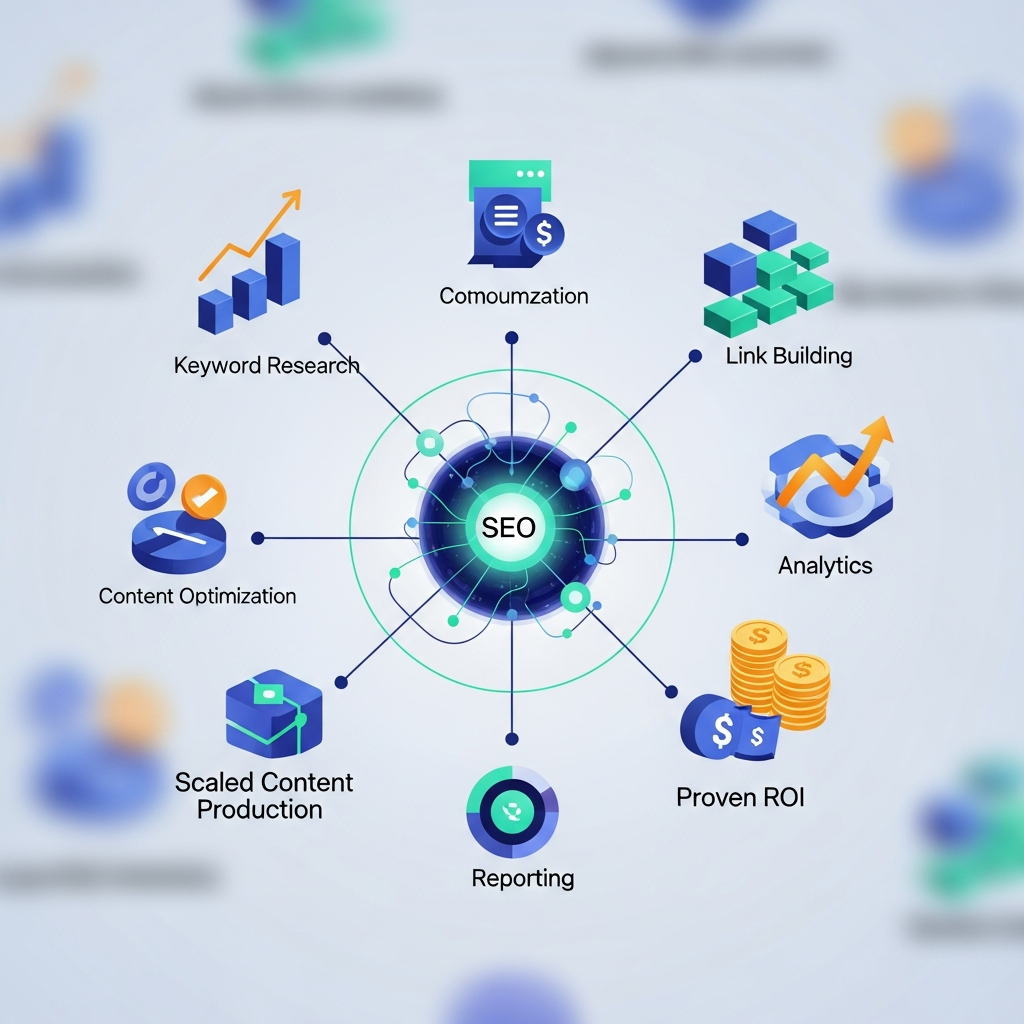
A comprehensive platform for enterprise SEO must blend several capabilities into a single workflow. Below are the essential components and how they fit together.
- Automated SEO platform for multi-site management: One control plane to manage priorities, calendars, and assets across brands and markets.
- AI-driven keyword discovery tool: Continual ideation that surfaces high-impact terms aligned with business goals and audience intent.
- Rankable content automation system: From outlines to drafts, SEO-informed content generation that optimizes for on-page factors and user intent.
- Centralized SEO dashboards for multiple sites: Unified reporting with drill-down by brand, region, or product line.
- End-to-end publishing workflows: Briefing, authoring, optimization, review, approval, and publication integrated with CMSs.
- Automated internal linking and optimization: Smart linking suggestions to improve crawlability and page authority.
- Governance and access controls: Role-based access, approval gates, and audit trails that satisfy enterprise risk requirements.
When implemented thoughtfully, these components enable teams to operate at scale without compromising quality. For example, a single keyword plan can be translated into hundreds of published pages across locales, with automated tagging, structured data, and internal linking tuned for each site.
To see how real teams structure these capabilities, explore practical examples in our related resources: 30-day content calendar automation, measuring ROI and governance in automated SEO dashboards, and localized publishing workflows in Sao Paulo.
Governance and security: the backbone of enterprise SEO automation
Governance is not a luxury; it’s a requirement when you operate across many brands, markets, and CMS environments. An enterprise-grade solution provides enforcement of standards, visibility for executives, and trust for data partners. Key governance features include:
- Role-based access control with least-privilege permissions
- Audit trails for keyword changes, content briefs, and publication events
- Data residency and privacy controls to meet regional requirements
- SOC 2-type controls, encryption in transit and at rest, and secure API access
- Change management and approval workflows that align with brand guidelines
Beyond security, governance reduces risk by providing reproducible processes. A well-governed workflow makes it possible to roll out new markets quickly while maintaining brand integrity and compliance. Enterprise leaders should demand clear SLAs around data handling, uptime, and support response times as part of the vendor evaluation.
ROI dashboards and measurement: proving value at scale
ROI is the north star for enterprise marketing. An all-in-one solution should deliver dashboards that translate activity into business impact. Focus on metrics that connect content programs to revenue, such as:
- Organic traffic growth by brand and geography
- Keyword ranking momentum and page-level visibility
- Content velocity: production rate, publication cadence, and approval times
- On-site engagement: time on page, bounce rate, and conversion signals
- Cost-to-serve: headcount hours saved through automation vs. manual processes
- ROI and ROAS: attribution models that map content to revenue and lifetime value
Governed dashboards should offer multi-site aggregation with drill-downs for executive reporting. Practically, you’ll want ready-to-share ROI visuals for quarterly business reviews, plus the ability to export or embed dashboards in stakeholder portals. For inspiration on governance-led ROI reporting, see our article on automated SEO dashboards and governance.
Internal reference: Measuring ROI and governance in automated SEO dashboards.
Content workflows for scale: from discovery to publication
Scaled content requires repeatable workflows. An end-to-end process typically follows these stages:
- Strategic discovery: AI-driven keyword discovery informs a master content calendar aligned to business goals.
- Brief and outline: A structured content brief defines intent, audience, and required sections.
- Content generation: AI-assisted drafting with brand-voice controls and SEO optimization baked in.
- Editing and compliance: Editorial review, fact-checks, and localization checks across geographies.
- On-page optimization: Meta tags, headings, structured data, internal links, and image optimization.
- Publishing and localization: CMS publishing with local language variants and geo-targeting.
- Monitoring and iteration: Post-publish performance signals trigger optimization cycles.
Practical tips for success:
- Use a centralized content calendar to prevent content cannibalization across sites.
- Enforce brand voice and tone constraints in AI models to maintain consistency.
- Integrate with CMSs (WordPress, Webflow, Shopify, etc.) to streamline publishing.
- Incorporate localization workflows to maintain quality across languages.
Internal references: 30-day content calendar automation, and local Sao Paulo publishing workflows.
Implementation playbook: how to roll out a scalable SEO automation stack
Deploying an enterprise-grade solution requires discipline and a phased approach. Here is a practical playbook you can adapt:
- Start with a pilot across 2–3 brands to establish governance, metrics, and ROI baselines.
- Map existing CMS integrations and data sources to the automation platform’s connectors.
- Define a joint plan with IT, security, and marketing to ensure data privacy and access controls.
- Set milestones for keyword discovery, content production, and publication cadence.
- Groom the editorial process: assign owners, SLAs, and review loops to avoid bottlenecks.
- Iterate quickly: use dashboards to identify bottlenecks and reallocate resources as needed.
Best practices include documenting governance policies, establishing an executive sponsor, and ensuring cross-team alignment on KPIs. A successful rollout minimizes disruption to current workflows while delivering early wins in content velocity and ranking momentum.
Choosing the right platform: criteria for evaluation
When evaluating an all-in-one SEO automation platform for marketers, enterprise buyers should look beyond features. Use a comprehensive checklist that includes:
- Multi-site governance: centralized control, localization, and access management
- Security and privacy: SOC 2, data residency, encryption, and secure APIs
- CMS integrations and API capabilities for WordPress, Webflow, Shopify, and custom stacks
- White-label and partner-friendly terms for enterprise collaborations
- Roadmap alignment: vendor commitment to feature development and support
- Analytics and ROI: native dashboards, attribution models, and reporting flexibility
- Support quality and onboarding: hands-on guidance during pilot and rollout
Successful procurement also involves realistic ROI projections, total cost of ownership, and a clearly defined transition plan from any legacy systems. For readers of enterprise SEO, governance and ROI clarity are often the deciding factors more than feature lists alone.
Common pitfalls and how to avoid them
Even the best platforms can fail if teams neglect governance or mismanage change. Typical pitfalls include:
- Over-reliance on AI without human oversight for quality and brand voice
- Failing to define KPIs and governance terms before rollout
- Underestimating data migration and CMS integration complexity
- Inadequate training and change management for editors and marketers
- Under-allocating budget for ongoing optimization beyond initial rollout
Mitigate these risks by establishing clear policies, running a controlled pilot, and setting up ongoing governance reviews. Remember, the platform is a tool; it succeeds when people, processes, and data work in concert.
Conclusion: turning enterprise ambition into measurable SEO impact
An all-in-one SEO automation solution for marketers is not a silver bullet, but a strategic asset for enterprises seeking scale, governance, and measurable ROI. By combining AI-assisted keyword discovery, end-to-end content workflows, centralized dashboards, and robust governance, organizations can accelerate content velocity, improve search visibility, and deliver auditable outcomes across brands and markets.
Ready to explore how this approach fits your portfolio? For practical steps and real-world examples, consider visiting our related resources and case studies, or book a tailored demo to see how the platform could map to your current tech stack and goals.