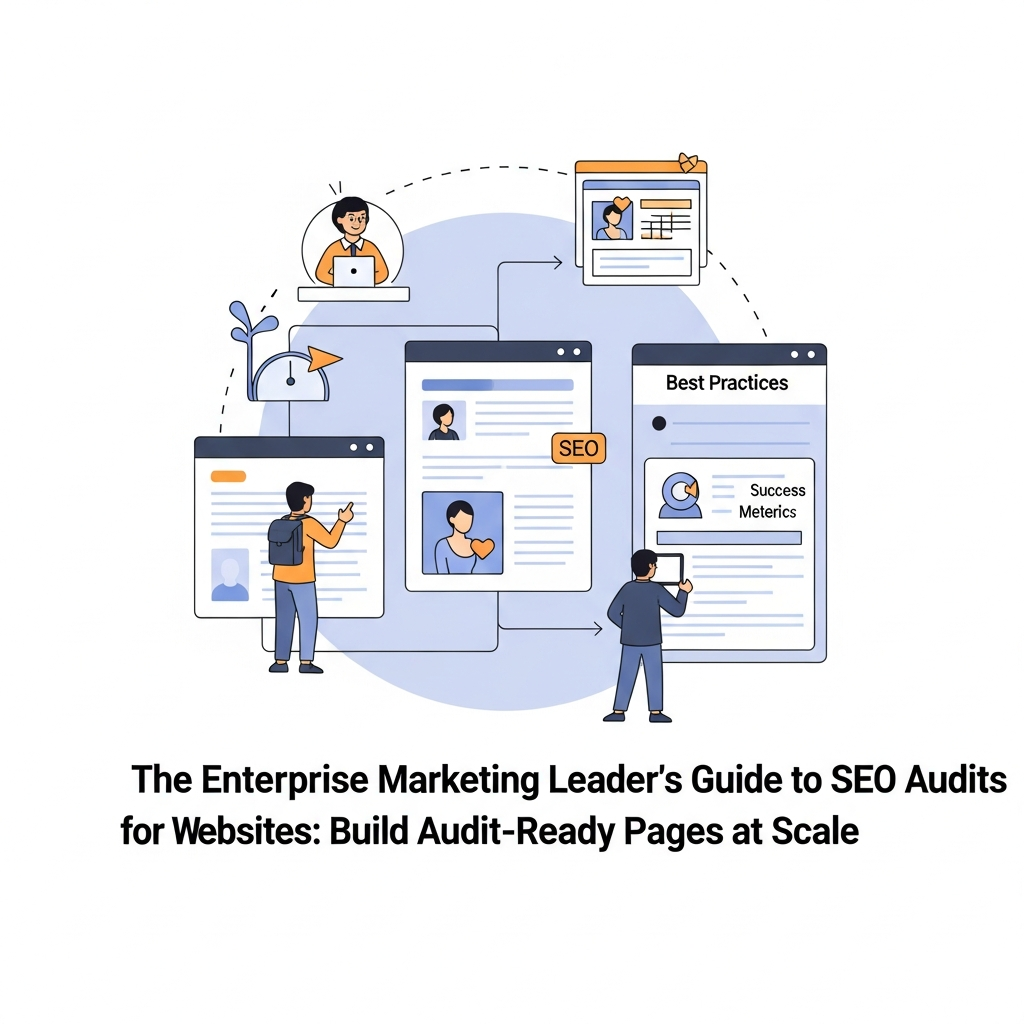
The Enterprise Marketing Leader's Guide to SEO Audits for Websites: Build Audit-Ready Pages at Scale
Why audit-ready pages matter at scale
In large organizations with multiple brands, a jump from manual audits to an audit-ready page standard is not just a technical upgrade—it's a governance decision. Audit-ready pages are those that pass repeated checks for crawlability, speed, structure, accessibility, and page-level signals that drive rankings and conversions. When you scale across dozens or hundreds of domains, consistency becomes a competitive advantage. The goal is to reduce time-to-insight, accelerate remediation, and demonstrate ROI across teams and geographies.
Audits that surface actionable pages, not just issues, help marketers align on priorities and budgets. They also create a baseline for governance: who owns what, what tools are used, and what the cadence of checks looks like. For enterprise teams, this means fewer firefights and more confident decisions about where to invest resources. For readers of this guide, expect a framework you can adapt to a multi-brand portfolio while maintaining quality and brand voice.
As you progress, you’ll want to link audit outcomes to ROI. Consider a simple equation: improvements in crawlability, page speed, and structured data lead to higher organic visibility, which translates into more qualified traffic and improved conversions. When you pair audits with governance dashboards, leadership can see the correlation between audit remediation and business impact. For a practical example of governance-focused dashboards, see our ROI and governance guide.
Internal note: For executives seeking concrete, proven ROI narratives, explore our hands-on resources about measuring ROI and governance in automated SEO dashboards ROI-focused dashboards.
Designing a scalable audit framework
A scalable audit framework must balance depth with repeatability. The framework should be modular, allowing brands to run core checks while layering brand-specific signals. Start by defining ownership, cadence, and data sources. Then codify the audit rules into checklists that can be executed automatically or by a lightweight internal team.
Key components of a scalable framework include:
- Central governance model with clear ownership across domains, content, and technical teams.
- Standardized audit checklists that cover technical SEO, on-page optimization, content quality, and structured data.
- A single view of audit findings across sites to prioritize remediations by ROI impact.
- Automation where possible (crawl reports, speed tests, and schema checks) with human-in-the-loop for complex decisions.
When you design the framework, map the checks to business outcomes. For example, a faster page loads code-level improvements that reduce bounce rate and improve user experience, while improved schema usage can lift rich results visibility. The framework should also align with your vendor governance and SLAs so teams know when to escalate issues and how remediation timelines are measured.
Technical SEO essentials
The technical pillar ensures search engines can crawl and index pages efficiently across all brands. Start with a baseline crawlability check, then assess site structure, canonicalization, and canonical face-offs across brands. Page speed, render-blocking resources, and mobile performance should be tested regularly. Use a standardized scorecard to capture pass/fail status and remediation owners.
Best practices include auditing robots.txt, sitemap.xml, and crawl budgets, plus ensuring proper handling of dynamic content and SPA routes. For large portfolios, maintain a site-wide canonical strategy, consistent redirect rules, and robust error handling to avoid 404 clusters that waste crawl budget.
On-page optimization and content alignment
Audit on-page signals such as title tags, meta descriptions, header structure, and keyword placement. The goal is to align each page with user intent while maintaining brand voice. Create templates for common page types (category pages, product pages, blog posts) that preserve semantic relevance and avoid keyword stuffing. Track keyword coverage across sites to ensure consistent targeting of core themes without cannibalization.
Content alignment extends to internal linking. Leverage logical link paths to ensure important pages gain authority without creating brittle cross-site link schemes. When you automate content workflows, validate outputs for accuracy and tone before publishing at scale.
Structured data, accessibility, and localization
Schema markup and structured data help search engines understand page content and improve eligibility for rich results. Audit for correct implementation of schema types across brands, ensuring no markup errors and consistent application. Accessibility checks (ARIA attributes, alt text, keyboard navigation) improve user experience and comply with governance standards.
Localization adds another layer: ensure hreflang signals are correct for multilingual sites, and translate or adapt content to regional contexts without sacrificing technical integrity. For teams expanding into new markets, build localization workflows into the audit, with ownership that spans content, UX, and technical operations. You can explore localization strategies in related enterprise resources.
Measuring ROI and governance
ROI in SEO audits is not a single metric; it’s a combination of process efficiency, visibility gains, and business impact. The governance layer should translate audit findings into measurable outcomes—faster remediation cycles, higher-quality pages, and more reliable performance tracking across brands.
Establish a core set of KPIs that connect to business goals. Examples include crawl error rate over time, page speed improvements per site, schema coverage rate, time-to-remediate critical issues, and changes in organic traffic or conversions after remediation. Tie these to a governance dashboard that updates on a regular cadence and surfaces executive-ready narratives.
For practical guidance on governance dashboards and ROI measurement, see our dedicated resource on measuring ROI and governance in automated SEO dashboards ROI-focused dashboards.
Dashboards, metrics, and reporting
Dashboards should be designed for both operators and leaders. Operators need granular signals: crawl results, indexing status, and remediation progress by brand. Leaders require at-a-glance evidence of ROI, risk, and governance posture. Use a three-tier reporting approach: operational dashboards for teams, executive dashboards for leadership, and vendor/partner dashboards for third-party orchestration. Link the dashboards to live data sources (GSC, GA4, your CMS, and performance dashboards) to maintain authenticity and timeliness.
Case studies and evidence
In practice, audit-driven improvements manifest as more pages indexed, faster load times, and better structured data adoption across brands. Rather than presenting generalized outcomes, you should narrate the remediation sequence: which issues were found, who owned them, what the remediation steps were, and how long it took to see impact. Use consistent framing across brands to demonstrate scale without losing individual context.
How to evaluate SEO providers and audits
Evaluating a provider starts with governance alignment and transparency. Look for clear SLAs, data privacy commitments, and a defined process for onboarding and escalation. Ask providers to share sample audit templates, remediation playbooks, and a roadmap that maps to your 90-day rollout plan.
Key evaluation criteria include:
- Technical capability: crawl, speed, schema, accessibility, and localization support.
- Operational governance: ownership, escalation paths, and milestone-based pricing.
- Visibility and reporting: dashboards that align with executive needs and team workflows.
- Scalability: ability to manage hundreds of pages across multiple brands with consistency.
- Security and privacy: SOC 2, data handling, and vendor stability.
For readers exploring governance-focused measures, note that you can reference our practical resources on governance in automated SEO dashboards and related articles to understand how to structure ROI-focused reporting around audits.
90-day rollout plan to audit-readiness
This rollout plan translates the framework into a practical, time-bound program. It is designed to deliver visible improvements across a multi-brand portfolio while keeping teams aligned on priorities and governance.
Phase 1 (Weeks 1-2): Align on ownership and data sources. Define roles for each brand and set up centralized dashboards. Establish a baseline of current SEO health, and agree on the audit checklist scope for all sites.
Phase 2 (Weeks 3-6): Implement core technical and on-page checks. Standardize templates for audit reports and remediation playbooks. Start automated checks for crawlability, speed, and schema across brands. Begin incorporating localization considerations where relevant.
Phase 3 (Weeks 7-9): Roll out content and structure adjustments. Apply templates to top-priority pages, fix canonical issues, and optimize internal linking. Validate improvements through a controlled test across a subset of brands.
Phase 4 (Weeks 10-12): Scale remediation and governance. Expand the audit program to all remaining brands, refine dashboards, and prepare executive reporting. Document learnings and update SLAs as needed. For ongoing inspiration, explore examples of scalable automation and governance in practice.
Localization and enterprise considerations
Enterprises operate across geographies with varying languages and markets. A robust audit program must support localization workflows without compromising on technical integrity. Ensure hreflang accuracy, localized metadata, and culturally appropriate content while preserving core SEO signals. Consider dedicated localization owners who collaborate with content, tech, and analytics teams to maintain consistency across markets.
To explore localization strategies in a real-world context, you can read localized automation articles and case studies in related regions, including region-specific discussions like the SAO PAULO automation article SAO PAULO automation guide.
Practical checklist you can start today
Use this starter checklist to begin implementing audit-ready pages at scale:
- Define audit ownership across brands and establish a central governance model.
- Baseline crawlability, site structure, and speed across all sites.
- Standardize templates for core pages (home, category, product, blog).
- Audit structured data coverage and accessibility, then fix critical gaps.
- Implement localization workflows and verify hreflang correctness for multilingual sites.
- Set up executive dashboards and operational dashboards that reflect ROI
- Create remediation playbooks with owners and target timelines.
- Integrate audit findings with content calendars and CMS workflows.
- Link audit outcomes to measurable business metrics (traffic, conversions, revenue).
- Schedule quarterly reviews to refresh the audit scope and governance terms.
As you work through the checklist, leverage internal resources and external guides to reinforce best practices. For ongoing ideas on content calendars and ROI governance, review related resources in our repository.
Internal resource references: for scalable content workflows and ROI governance, see our 30-day content calendar guide 30-day content calendar guide, and for governance-driven ROI measurement, consult our ROI governance article ROI dashboards. You can also explore localization insights from regional automation posts like the SAO PAULO localization article.
For a broader overview of our platform capabilities and a practical homepage overview, visit our site homepage.