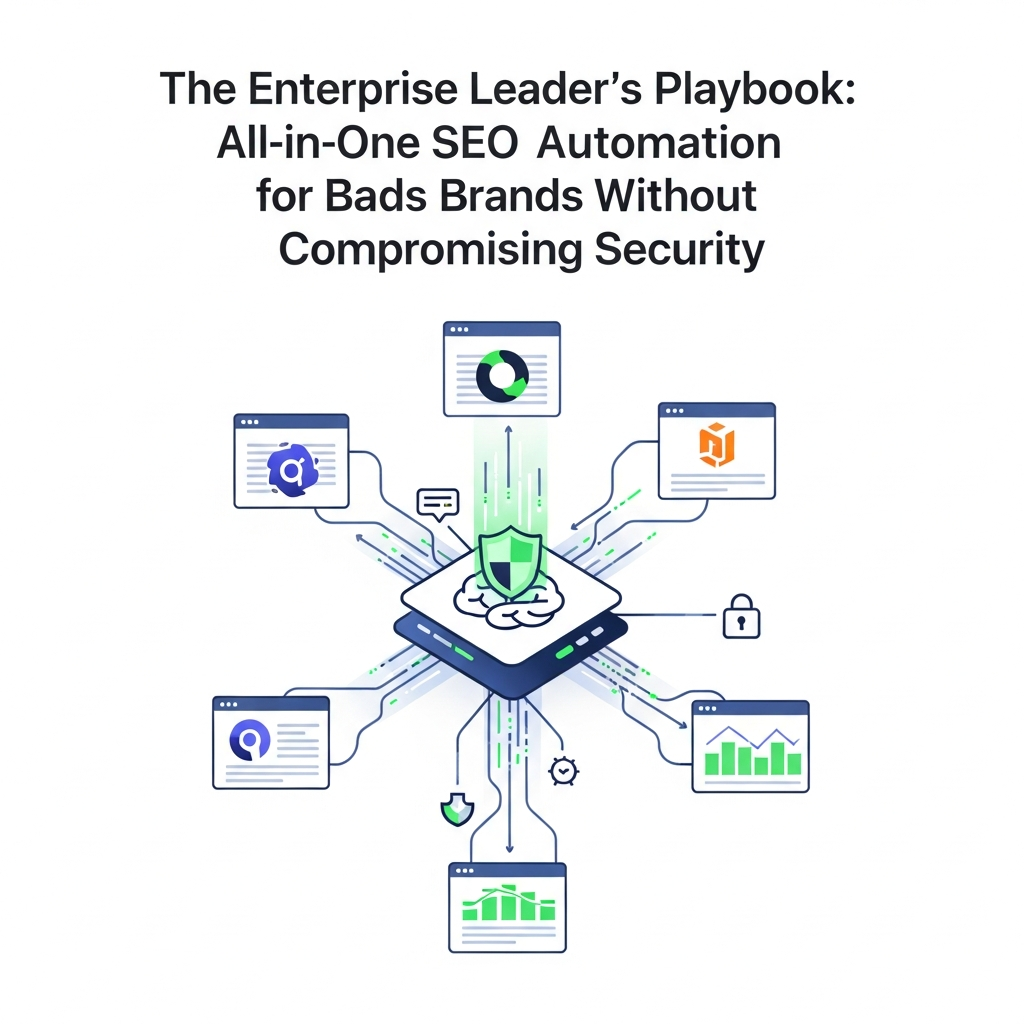
The Enterprise Leader's Playbook: All-in-One SEO Automation for Brands Without Compromising Security
Introduction
For modern brands that operate across multiple sites and regions, marketing teams face two concurrent pressures: the need to scale content velocity and the obligation to maintain strict security, governance, and data privacy. An all-in-one SEO automation solution for marketers promises to align these goals by providing centralized dashboards, automated workflows, and auditable reporting at enterprise scale. This guide outlines why enterprise teams should consider such a platform, what capabilities to expect, and how to implement a scalable rollout without compromising data security.
At its heart, enterprise-grade SEO automation is about translating strategy into repeatable, verifiable actions. It enables teams to publish and optimize content across hundreds of pages and languages while ensuring brand voice, compliance, and ROI visibility. In practice, this means centralized dashboards that consolidate performance across sites, governance features that enforce policy, and secure data handling that satisfies legal and stakeholder requirements. The result is faster time-to-value, better collaboration, and a clear narrative of how organic search contributes to business outcomes.
Throughout this playbook, we’ll connect practical steps, guardrails, and real-world tactics to help leaders evaluate, select, and deploy an all-in-one SEO automation solution that fits large brands and agency ecosystems alike. We’ll also provide concrete checklists, templates, and internal links to resources that deepen your understanding and accelerate your journey.
Core Capabilities of an Enterprise-Grade Platform
An effective all-in-one SEO automation platform for marketers should deliver a cohesive set of capabilities that work together across content, technical SEO, and governance. Below are the capabilities that separate true enterprise-grade solutions from basic automation tools.
Centralized dashboards for multiple sites
The backbone of enterprise SEO is a unified view of performance across all properties. Centralized dashboards enable senior leaders to monitor traffic, rankings, and conversion metrics for dozens or hundreds of domains from a single pane of glass. Features to expect include role-based access, cross-site KPI rollups, and customizable dashboards for different stakeholders (CMO, VP of Marketing, regional heads).
Practical example: a large consumer brand with regional sites can compare global performance with local optimization efforts, spot gaps quickly, and allocate resources where ROI is highest. The dashboards should surface alerts for material changes and provide exportable reports for executive reviews.
Multi-site management and centralized governance
Centralized management isn’t just about aggregates; it’s about governance at scale. Enterprise platforms offer centralized workflows, templates, and policy enforcement that span teams, markets, and CMS ecosystems. You should be able to define who can publish, approve, or modify content, apply localization rules, and maintain brand voice across all sites. Version control, audit trails, and change logs are essential for accountability.
Best practice includes a modular permission system that maps to organizational roles (Content Editor, SEO Specialist, Localization Lead, Compliance Reviewer). Governance also extends to automation rules: when to auto-generate meta tags, how often to refresh structured data, and who approves automated changes before they go live.
Security and privacy controls
For brands, security is non-negotiable. Enterprise SEO tools must provide data encryption at rest and in transit, robust authentication, and strict access controls. SOC 2 or equivalent certifications, data residency options, and clear data handling policies help ensure compliance with regional regulations and internal risk frameworks.
A secure platform also supports integration governance: APIs with permission scopes, audit logs for API activity, and controls to prevent data leakage between sites or teams. When evaluating tools, look for independent security attestations, Incident Response practices, and transparent breach notification commitments.
Auditability and reporting
Auditability means every optimization decision has an intact rationale. Automated SEO should generate traceable content briefs, changelog entries, and justification for recommended actions. Reporting must translate data into business value—demonstrating how optimization impacts traffic, conversions, and revenue. Favor platforms that offer pre-built executive dashboards and customizable, exportable reports aligned to corporate KPIs.
Additionally, reporting should cover governance metrics: who approved changes, when, and the outcome. This transparency is critical for procurement, risk reviews, and executive governance committees.
Security and Governance Considerations
Beyond feature sets, the security and governance posture of an all-in-one SEO automation platform determines the long-term viability of a multi-site program. This section highlights practical considerations that enterprise buyers should validate before signing.
Data privacy and localization
Data localization options help satisfy regional data sovereignty requirements. When a platform processes data across multiple geographies, you want to ensure data residency controls, regional storage, and clear data processing agreements. This is especially important for AI-assisted content generation where input prompts and outputs may involve sensitive information.
Review how the vendor handles user data, retention policies, and the ability to delete data at contract end or upon request. A transparent data flow diagram is a practical artifact to request during negotiations.
Access controls and authentication
Strong authentication, SSO, and granular role-based access control prevent unauthorized changes. Audit trails that track login events, API calls, and content edits are essential for incident response and compliance reporting. Consider multi-factor authentication (MFA) requirements and how access is provisioned and de-provisioned across teams.
Compliance and governance SLAs
Enterprise agreements should include governance SLAs, data breach response times, and continuity commitments. Vendors with mature governance programs offer governance playbooks, standardized onboarding, and clear escalation paths for issues that affect content publishing or data privacy.
Architectural Design for Scale
A scalable architecture is the technical foundation that enables consistent results across sites and regions. The right design supports flexible CMS integrations, AI-assisted content workflows, and reliable analytics pipelines without creating bottlenecks or security gaps.
Data model and permissions
A clean data model separates content, SEO metadata, localization variants, and performance data. Role-based permissions should map to content workflows, ensuring that automated actions run within guardrails established by governance.
Structure also matters for analytics: ensure event tracking, conversion data, and engagement signals are consistently mapped across sites, with standardized naming conventions to enable cross-site comparisons.
Integrations: CMS, analytics, and AI content
Enterprise platforms must integrate with your preferred CMS (WordPress, Webflow, Shopify, etc.), analytics stacks (GA4, Google Search Console, Data Studio), and AI content capabilities. A robust integration layer reduces manual data transfer work and minimizes risk of data misalignment.
When evaluating integrations, verify API rate limits, data synchronization schedules, and error handling. Plan for a phased integration approach to avoid disruption during the transition from manual to automated workflows.
ROI, Analytics, and Governance
A critical requirement for enterprise SEO is the ability to prove ROI through centralized analytics and governance dashboards. You should be able to demonstrate incremental traffic, engagement, and revenue lifted by automated SEO activities, while maintaining compliance and governance standards.
Defining success metrics
Start with a core metric set: organic traffic growth by site, keyword visibility, on-page optimization uplift, and conversion rate from organic traffic. Add downstream business metrics such as revenue, average order value, and customer lifetime value where possible.
Tie improvements to specific automation actions: meta tag optimization, internal linking recommendations, or content calendar automation. This helps attribute value to the automation tool rather than manual activities alone.
ROI calculation approaches
ROI can be estimated using a simple model: ROI = (Incremental Gross Margin from organic traffic minus automation cost) divided by automation cost. For more granularity, track opportunity uplift per campaign, time savings, and reduced manual labor hours. Enterprise dashboards should automate these calculations and present them in a digestible format for leadership.
If your organization requires more rigorous ROI validation, consider framing ROI in a multi-year model that accounts for scale effects as the platform is adopted across additional sites and markets. Reference dashboards, like the ones covered in the article Measuring ROI and Governance in Automated SEO Dashboards That Prove Value, to build your governance narrative.
Implementation Playbook: From Pilot to Enterprise
A successful rollout starts with a clear plan, a measurable pilot, and a scalable strategy to extend automation across markets. Below is a practical playbook that aligns with an all-in-one SEO automation solution for marketers.
Phase 1: Discovery and pilot scope
Define the business objectives, select two or three representative sites for the pilot, and establish baseline metrics. Map out governance rules, security requirements, and reporting needs. Create a lightweight data migration plan to avoid data gaps during the pilot.
During this phase, set up the centralized dashboard templates and determine which automation rules will run automatically and which require human approval.
Phase 2: Pilot execution and quick wins
Run the pilot with a tight cadence. Capture quick wins such as accelerated content publishing, improved meta tags, and early improvements in on-page optimization. Use the pilot results to refine governance policies and demonstrate tangible ROI to stakeholders.
Document the changes, decisions, and outcomes in a pilot report. This report becomes a cornerstone for the broader rollout and helps align cross-functional teams.
Phase 3: Scale and governance expansion
Based on pilot outcomes, expand automation to additional sites and regions. Introduce localization workflows, language-specific SEO checks, and regional dashboards. Ensure ongoing training, support, and governance reviews to maintain consistency.
Establish a cadence for governance reviews, SLAs, and vendor governance updates. A scalable rollout requires continuous improvement loops and a clear escalation process for issues.
Best Practices and Common Pitfalls
To maximize value and minimize risk, adopt disciplined practices and watch for common missteps that slow momentum or erode trust in automation.
- Prefer structured briefs over freeform prompts for AI-generated content to preserve brand voice.
- Test automation rules in a staging environment before going live to avoid accidental content changes.
- Maintain separate data environments for testing and production to protect live sites.
- Document all governance decisions and keep audit trails up to date for governance reviews.
- Balance automation with human oversight to ensure quality and compliance at scale.
Pitfalls to avoid include over-automation without governance, neglecting data privacy considerations, and underinvesting in training and change management. The most successful enterprises treat SEO automation as a governance-enabled capability rather than a pure technology purchase.
Getting Started with an All-in-One SEO Automation Solution for Marketers
If you’re ready to embark on an enterprise-grade automation journey, begin with a structured evaluation checklist that covers security, governance, scalability, and ROI. Start by inventorying your sites, CMSs, analytics tools, and localization needs. Then align stakeholders on the top-line goals, required governance, and success metrics.
A practical next step is to request a guided demo from a vendor that specializes in multi-site, enterprise-grade SEO automation. During the demo, verify the platform’s ability to integrate with your CMS, analytics stack, and localization workflows. Ask for a security questionnaire and a data privacy overview to ensure compliance with your internal policies.
For teams exploring the ROI angle, consult resources on automated dashboards and governance metrics. See this article on ROI and governance dashboards for concrete methodologies. If you’re planning a 30-day content calendar, our guide offers a practical jumpstart approach: Automated 30-Day Content Calendar: How to Jumpstart SEO at Scale.
For regional publishing patterns, you’ll find value in regional case studies and localization workflows, such as the Brazilian e-commerce publishing example: São Paulo automation for Brazilian e-commerce.
Templates and Checklists
Use these starter templates to accelerate your implementation:
- SEO Automation Pilot Plan Template: objectives, sites, metrics, and governance rules.
- Multi-Site Access & Compliance Checklist: roles, permissions, and security controls.
- Content Calendar Automation Brief: input prompts, approval flows, and localization checks.
Example checklists, playbooks, and template documents can be adapted from the referenced resources and internal playbooks to fit your organizational standards.
Conclusion
An all-in-one SEO automation solution for marketers offers a compelling path to scale, govern, and demonstrate ROI across complex enterprise environments. By prioritizing centralized dashboards, robust governance, and rigorous security, brands can unlock faster time-to-market for content while maintaining the governance rigor required by stakeholders.
The journey from pilot to enterprise is a structured one: define objectives, establish governance, implement with guardrails, measure ROI, and scale thoughtfully. With the right platform and a disciplined rollout, your organization can achieve sustainable, auditable, and secure SEO growth across all sites and markets.