The Enterprise Leader's Guide to Mastering an Enterprise SEO Automation Platform: Scale Across Brands with Confidence
Introduction
Leaders at scale face a familiar tension: the need to accelerate organic growth across many brands and regions, while preserving governance, security, and a consistent brand voice. An enterprise SEO automation platform promises to unlock this balance by standardizing workflows, enabling centralized control, and speeding up content creation and optimization. But not every tool is built for an enterprise reality. The right platform must deliver governance, security, auditable processes, and multi-site orchestration without sacrificing speed.
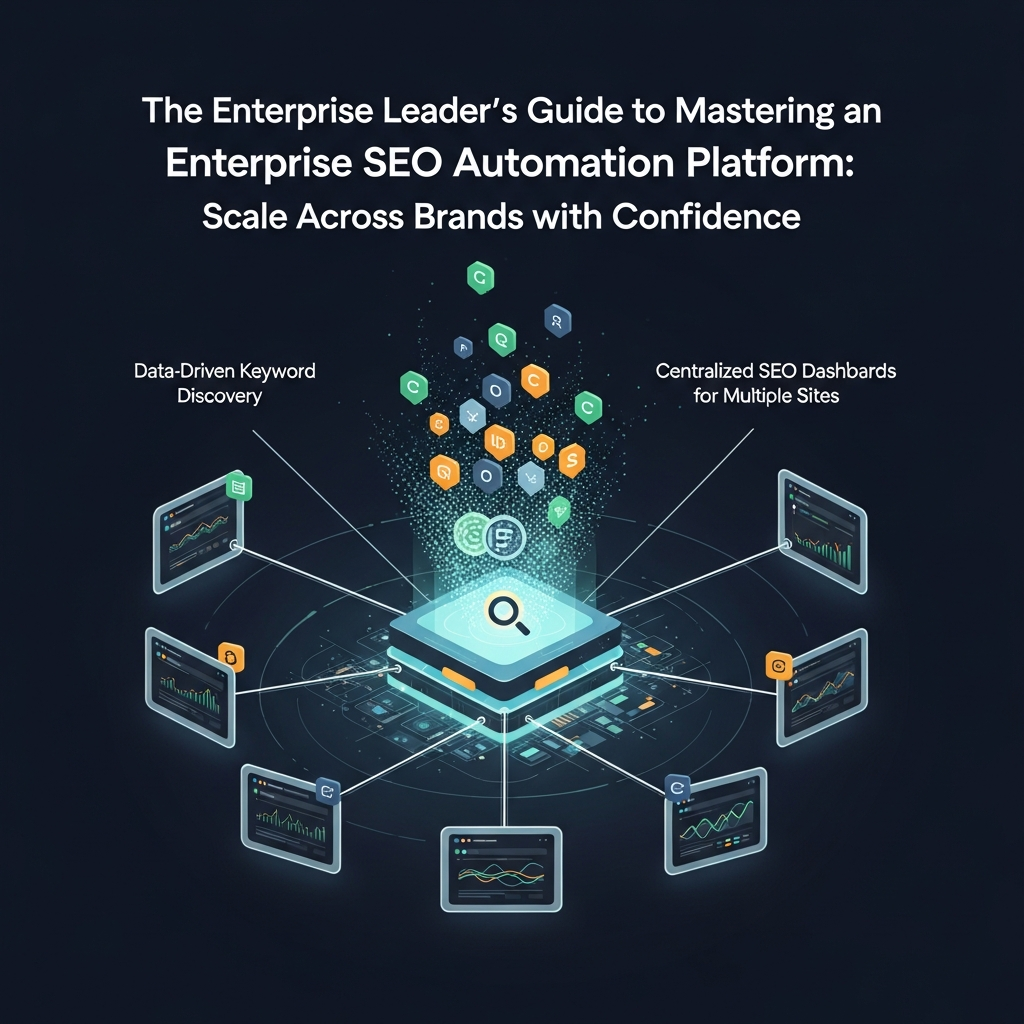
In this guide, you’ll find a practical framework for evaluating and implementing an enterprise-grade SEO automation platform. We’ll cover data-driven keyword discovery, centralized dashboards for multiple sites, security and data handling, auditability, and the customization that protects brand voice across a global portfolio. For deeper practical patterns, consider the 30-day content calendar approach and the ROI governance dashboards discussed in our linked resources.
Why an Enterprise-Grade Platform Matters
When a portfolio spans dozens of brands or languages, ad hoc optimization quickly becomes chaotic. An enterprise-grade platform aligns teams, standardizes processes, and provides a single source of truth. It helps you avoid silos, maintain consistency in on-page optimization, and automate repetitive tasks without surrendering control to a black-box system.
Key benefits include faster time-to-value, scalable content production, and auditable trails that satisfy governance and procurement requirements. For executive teams, centralized dashboards translate activity into measurable ROIs, paving the way for continued investment across brands and markets.
Core Features to Evaluate
When you compare platforms, anchor your evaluation around governance, security, visibility, and extensibility. Ask vendors to demonstrate how their solution handles role-based access, data residency, and audit trails. Look for modular workflows that can be staged from pilot to full-scale rollout, with clear SLAs and escalation paths.
Within each feature area, prioritize around these questions:
- Can content calendars, keyword research, and page optimization be driven by a single workflow, across multiple sites?
- Does the platform offer native analytics dashboards that align with your existing analytics stack?
- Is there an API or CMS integration strategy that supports WordPress, Shopify, Webflow, or enterprise CMS ecosystems?
- How does the tool handle localization and multilingual SEO without diluting brand standards?
Data-Driven Keyword Discovery for Automation
Automation thrives when it starts with quality data. Instead of cataloging keywords manually, enterprise-grade platforms should enable data-driven discovery that surfaces opportunity at scale. A strong platform will integrate keyword intent, search volume trends, and competitive gaps into automated briefs that feed content calendars and on-page optimization.
Consider whether the tool supports automated keyword clustering, topic modeling, and intent-aware scoring. You’ll want to translate these insights into concrete content plans that power dozens or hundreds of pages across brands while preserving each brand’s language and audience tone. A practical starting point is to pilot data-informed briefs for a select set of high-potential pages and measure lift before expanding scope.
For a practical pattern, explore how automated keyword discovery can align with a content calendar. Our blog on automated 30-day content calendars outlines a scalable approach to jumpstarting SEO at scale, and it’s a useful companion to this guide.
Internal note: see Automated 30-day content calendar for jumpstarting SEO at scale for a deeper dive.
Centralized Dashboards for Multi-Site Management
One of the defining advantages of an enterprise platform is a centralized vantage point. Multi-site dashboards should consolidate performance metrics, rankings, content calendars, technical health, and link profiles across brands and geographies. The right dashboards empower decision-makers to compare performance, allocate resources, and spot anomalous trends quickly.
Look for dashboards that support role-based access, customizable widgets, and the ability to export or push data to your existing BI stack. If your portfolio includes agencies or partners, white-label dashboards with secure sharing capabilities can streamline governance and executive reporting.
For governance-focused insights, see how dashboards can quantify progress toward quarterly targets and illustrate ROI across brands. A practical resource on governance dashboards is available in our post on measuring ROI and governance in automated SEO dashboards that prove value.
Internal reference: ROI and governance in automated SEO dashboards.
Security and Data Handling in SEO Automation Tools
Enterprise programs demand robust security and data privacy controls. This means encryption at rest and in transit, granular access controls, and clear data ownership policies. Your vendor should provide documentation about SOC 2 or equivalent compliance, data residency options, and clear breach notification procedures.
Beyond compliance, consider how data flows through the automation platform. Is data processed in a way that limits unnecessary transmission, and are there secure connectors to your CMS, analytics tools, and BI platforms? The most resilient platforms also separate user-generated content from system-level data, reducing risk when roles change or contractors come and go.
Security design should also extend to auditability. Audit logs, change histories, and predictable versioning ensure you can trace what happened, when, and by whom—critical for governance reviews and external audits.
Auditability, Governance, and Reporting
Auditability is not an afterthought—it's a core capability. Enterprises require transparent reporting that can be shared with executives, procurement teams, and compliance stakeholders. Look for time-stamped activity logs, approvals workflows for content changes, and the ability to generate executive-ready reports with a few clicks.
Governance features should include role-based access, approval workflows, and policy enforcement that governs who can publish content, initiate campaigns, or modify templates. A platform that provides an auditable trail makes it easier to surface value during quarterly reviews and renewals.
When evaluating reporting, ensure dashboards align with your existing KPI framework. Can you map outcomes to revenue, traffic, and conversion metrics? Can dashboards be shared securely with external teams and clients if you operate in an agency context?
Template Customization and Brand Voice in Automation
Brand voice consistency across thousands of pages is a common challenge. Enterprising platforms support template customization that preserves tone, tone guides, and brand standards while enabling scalable output. Look for adjustable content briefs, style guides, and guardrails that feed AI-assisted generation without compromising brand identity.
Localization adds another layer. Your templates should accommodate multilingual content, region-specific SEO signals, and localized metadata while maintaining centralized control. Be wary of tools that optimize for generic language at the expense of brand personality.
Practical tip: define a small set of brand-voice templates and use them as the backbone for automation. This keeps output consistent, while still allowing bespoke adaptations per brand when needed.
Implementation Blueprint
Rollout planning is as important as the technology itself. Start with a governance model that designates who owns standards, who can approve changes, and how performance will be measured. Then, stage a phased pilot before a full-scale rollout. Typical phases include discovery, pilot, expansion, and optimization.
Discovery should map brands, sites, CMS integrations, and data sources. The pilot typically covers a subset of brands or languages to validate data quality, content templates, and reporting. Expansion scales the platform to all sites, while optimization refines templates, workflows, and dashboards based on feedback and results.
For implementation patterns, check the detailed overview documented in our governance and ROI dashboards post.
Internal reference: ROI-focused governance dashboards.
Vendor Selection and Governance
Choosing the right partner requires a governance-first mindset. Seek vendors with clear SLAs, data protection commitments, and transparent roadmaps. Request references across similar enterprise contexts and verify how they handle upgrades, data migration, and incident response. A strong vendor will offer support during onboarding, assist with integrations, and provide training resources for teams.
Negotiation points should cover data ownership, access controls, and exit terms. Ensure the contract aligns with your procurement process and includes measurable milestones, deliverables, and a predictable support cadence.
As part of your due diligence, compare how different vendors approach centralized management, multi-brand localization, and security certifications. The balance between feature richness and governance controls often defines long-term success at scale.
ROI, Case Studies, and KPIs
Enterprise SEO investments require credible metrics. Common KPIs include organic traffic growth, keyword rankings, page-level conversions, and content cycle times. A mature platform should expose these metrics in a way that ties to business outcomes—revenue, profitability, and market reach—across all brands.
Pair quantitative results with qualitative signals such as improved collaboration, faster campaign launches, and stronger brand consistency. Case studies and reference architectures provide a blueprint for what to expect when you scale from pilot to enterprise-wide deployment.
To explore governance in practice, review case studies and governance-focused analyses in our content library, including ROI dashboards and enterprise-scale implementations.
Getting Started: 8-Week Rollout Plan
Week 1–2: Align executives and define governance standards. Establish roles, approval workflows, and key metrics. Validate data sources, CMS connections, and analytics integrations. Prepare a pilot scope with 2–4 brands and a clear success criteria.
Week 3–4: Run the pilot with templates, keyword briefs, and content briefs. Monitor data quality, editorial workflows, and publishing cadence. Use dashboards to surface early wins and any blockers in governance or security.
Week 5–6: Expand to additional brands or languages. Introduce localization templates and refine brand voice guardrails. Start integrating with the broader tech stack, including analytics and BI tools.
Week 7–8: Transition to enterprise-wide rollout. Solidify operating rhythms, finalize SLAs, and publish an executive ROI update. Consider sharing a brief with procurement and leadership to lock in long-term investment.
As you plan, leverage practical guidance from our content on content calendars and ROI governance. For a tangible blueprint, see the automated content calendar and governance dashboards resources linked earlier.
Conclusion
An enterprise SEO automation platform is not a silver bullet; it is a framework for scalable, governed, and measurable growth. The right platform harmonizes multi-brand content, centralized visibility, and robust security with brand voice and localization. By prioritizing governance, data quality, and auditable processes, your enterprise can scale organic visibility while maintaining control and trust with stakeholders.
To explore practical ways to consolidate your automation approach, you can review our overview of automation strategy and our governance-focused resources. For a concrete look at how to jumpstart your program with a proven content calendar approach, visit our 30-day content calendar guide, and see ROI-focused dashboards for governance insights.
Explore our broader automation approach here: overview of our automation approach.