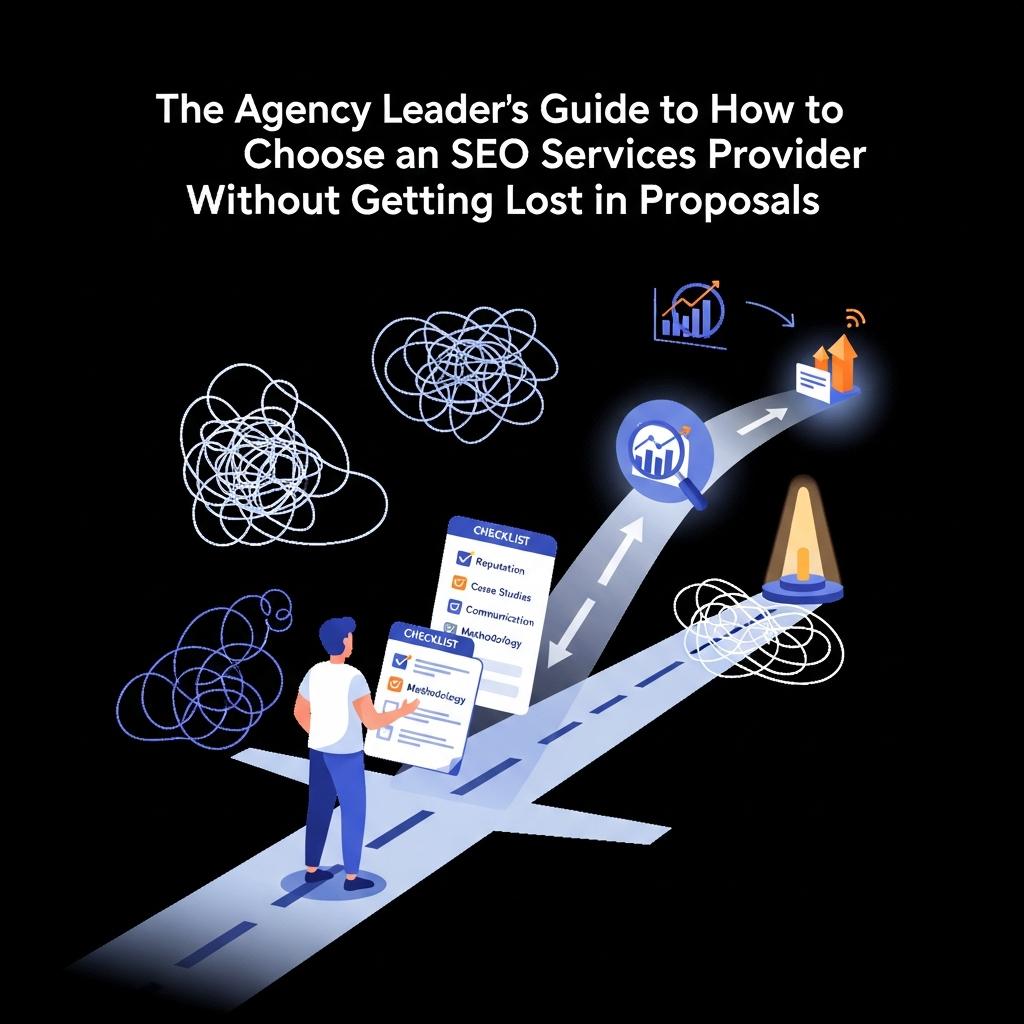
How to Choose an SEO Services Provider: A Practical Framework for Agency Leaders
Why choosing an SEO partner is a strategic decision
Choosing an SEO services provider goes beyond selecting a vendor. It signals a strategic shift in how your agency scales client outcomes, manages risk, and communicates value to stakeholders. A thoughtful selection process helps you align capabilities with client promises, ensure consistency across campaigns, and prevent scattershot investments that fragment results.
For many agencies, the right partner acts as an extension of the team—providing capacity for content creation, technical optimization, and scalable reporting. The wrong partner, meanwhile, can introduce drift between client expectations and delivered results. This is especially true when serving multiple clients with diverse needs, where governance, data privacy, and quality control become mission-critical.
The goal is to create a repeatable, auditable path from initial inquiry to ongoing value realization. The framework in this article helps agency leaders compare proposals with a common yardstick, so ROI projections, risk assessments, and governance practices are transparent and comparable across providers.
Define your decision framework: ROI, governance, and risk
Before you evaluate providers, define the decision framework you will use. The strongest frameworks center three pillars: return on investment (ROI) and profitability, governance and control, and risk management including data privacy and security. By setting these expectations early, you create a decision matrix that scales with your agency’s growth.
ROI should be defined in terms of traffic, leads, and revenue lift attributable to SEO initiatives, as well as efficiency gains from automation and scaled production. Governance includes how work is planned, approved, and reviewed—across teams, clients, and geographies. Risk management covers data handling, subcontractor risk, compliance with regulations, and vendor stability over time.
As you draft your framework, document the metrics you’ll monitor, the cadence of reporting, and the acceptable thresholds for variance between projected and actual outcomes. Your decision framework should translate into a scoring rubric you can apply to each vendor proposal. This makes the comparison objective and repeatable rather than subjective and one-off.
The 7 criteria for selecting an SEO partner
Use these criteria as the backbone of your evaluation rubric. Rank each item on a consistent scale (for example, 1–5) and attach notes or evidence from each vendor’s proposal and references.
- Strategic alignment and domain expertise. Does the provider demonstrate proven success in your industry or with a similar client mix? Look for case studies, playbooks, and domain-specific frameworks that map to your goals.
- ROI and measurement capability. Can the vendor quantify expected outcomes? Do they provide a clear methodology for attribution, funnel mapping, and KPI alignment (traffic, qualified leads, revenue) with auditable dashboards?
- Governance, SLAs, and vendor management. Are there explicit SLAs, weekly or monthly governance cadences, and a transparent onboarding plan? Governance should cover change management, risk controls, and escalation paths.
- Data privacy and security. What controls exist around data access, retention, and sharing? Is the vendor SOC 2 compliant or pursuing ISO/27001? How are subcontractors vetted?
- Technical capabilities and integration. Assess the breadth of technical offerings: site audits, speed optimization, structured data, crawlability, CMS integrations (WordPress, Shopify, Webflow), and API access for reporting or content automation.
- Pricing, contracts, and value. Compare pricing models (retainers, project-based, performance-based) and the transparency of scope. Are there hidden costs, add-ons, or ramp-up fees?
- Quality control and brand governance. How does the partner ensure brand voice, content quality, and editorial consistency across multiple clients and markets?
Each criterion should be supported by concrete evidence in the vendor’s materials. For example, look for how they handle internationalization, localization, and multi-site governance. When you see a clear, repeatable process behind each criterion, you can move to the next stage with confidence.
A practical checklist for vendor evaluations
To operationalize your selection, use a vendor evaluation checklist. Below is a practical, field-tested set of items you can adapt to your RFPs and pilot programs.
- Discovery alignment. Do their initial questions demonstrate a deep understanding of your client mix and growth targets?
- Measurement plan. Is there a documented measurement plan with baseline metrics and target KPIs?
- Content process. How will content be planned, created, reviewed, and published at scale?
- Technical road map. What are the milestones for technical SEO improvements (site speed, structured data, crawlability) and how are these tracked?
- Localization and localization governance. If you operate in multiple regions, how will localization be handled across languages and markets?
- Security and privacy. Are data handling practices clearly documented? Is there a data processing agreement (DPA)?
- Onboarding plan. What does the first 30–60 days look like, and what milestones define success?
- Communication plan. What are the cadence, channels, and stakeholders involved?
- Case studies and references. Can they provide client references who resemble your agency’s size and client mix?
- Trial or pilot feasibility. Is a pilot program offered? What are the acceptance criteria and exit terms?
As you build and populate this checklist, consider linking to practical resources such as a 30-day content calendar for rapid start and ROI-focused dashboards. For example, you can explore a structured approach to content calendars and ROI dashboards in our related resources.
For a concrete template you can adapt, see: 30-day content calendar for scalable SEO and ROI and governance dashboards.
Due diligence steps for SEO firms: security, privacy, compliance
Due diligence is about reducing risk before you commit. Start with a security and privacy-focused checklist that covers data access, data storage, and vendor subcontractors. Confirm that the provider has formal governance processes, incident response plans, and documented data retention policies.
Key questions to ask include: How do you segregate client data in multi-tenant environments? Are data logs retained for audit purposes, and for how long? What is your process for third-party risk assessment, and do you perform regular vulnerability scans or penetration testing? If you manage sensitive client data, insist on third-party security attestations and a clear data breach protocol.
Beyond policy, review practical safeguards. Is access to production systems role-based and time-limited? Are there manual or automated controls for sensitive actions? Do you require encryption at rest and in transit? A robust vendor will publish compliance maps and a clear DPA that aligns with regional data privacy laws (for example, GDPR, CCPA, or other applicable regimes). The goal is clarity: documented controls that survive executive-level scrutiny and vendor transitions.
Pricing, ROI projections, and governance
Understand what you’re paying for and how value will be demonstrated. Pricing models vary from monthly retainers to milestone-based fees or outcome-driven structures. A sustainable approach emphasizes transparency: a clearly scoped baseline, predictable increments as you scale, and explicit governance terms that protect your investment.
ROI projections should be grounded in realistic assumptions about content velocity, keyword strategies, and the impact of technical SEO improvements. Build ROI models that tie incremental organic traffic to conversions, average order value, or lead value. Don’t settle for vanity metrics; insist on attribution plans that reflect multi-channel ecosystems and path-to-purchase complexity.
Governance is the counterpart to ROI. You should have a defined cadence for performance reviews, a documented escalation path, and a mechanism to adjust scope as business needs change. A strong vendor will provide dashboards and reporting templates that align with your existing analytics stack (for example GA4, Search Console, and your data visualization tool). For practical guidance on governance dashboards, explore the linked resource above.
If you’re exploring international or multilingual opportunities, discuss localization costs, translation quality controls, and regional compliance. A transparent provider will present localization roadmaps and cost implications as part of the initial proposal rather than as hidden add-ons.
How to run an evaluation: RFPs, pilots, and SLAs
An evaluation framework should include three stages: the RFP stage, a pilot or trial phase, and the final vendor selection with a contractual agreement. In the RFP, require vendors to present a concise methodology, a 90-day plan with milestones, and a transparent pricing schedule. Include a scoring rubric that weighs strategic alignment, ROI potential, governance, and privacy protections.
The pilot stage is where you convert theory into practice. Define a scoped pilot with measurable objectives, a fixed timeframe, and explicit acceptance criteria. Use this pilot to test content generation quality, on-page optimization workflows, CMS integration, and dashboard reporting. The pilot should mirror real client challenges but remain tightly constrained to manage risk.
SLAs are non-negotiable in enterprise contexts. Demand clear uptime commitments, response times, and escalation procedures. Require governance reviews at regular intervals and a process for renegotiating terms as your program matures. A well-constructed SLA palette will include security clauses, data handling guidelines, and clear termination terms if the relationship no longer meets performance thresholds.
Step-by-step decision framework for agency leaders
Use this practical, repeatable framework to move from first inquiry to a signed contract with confidence.
- Clarify objectives. Define target markets, client mix, and the level of automation you require. Document expected outcomes in concrete terms (e.g., 20% lift in organic revenue for a defined set of clients).
- Assemble a cross-functional evaluation team. Include leaders from SEO, content, analytics, and procurement. Diverse perspectives improve risk assessment.
- Standardize requirements. Create a requirements matrix that maps each vendor’s capabilities to your priorities: ROI, governance, privacy, tech stack, and localization.
- Issue a focused RFP. Ask for referenceable case studies, case-specific KPIs, a pilot proposal, and a transparent pricing breakdown. Request a data privacy addendum upfront.
- Conduct a structured vendor review. Use a scoring rubric, interview key vendor contacts, and verify references. Document any red flags and mitigations.
- Run a controlled pilot. Implement a short pilot with explicit milestones and exit terms. Compare results against your ROI model and governance expectations.
- Final evaluation and negotiation. Synthesize pilot results, governance fit, and pricing. Negotiate terms that protect your agency’s scale, client standards, and risk tolerance.
- Onboard and govern. Establish onboarding milestones, a communication cadence, and a quarterly review process that ties back to client outcomes.
Remember: the most successful partnerships aren’t the cheapest or the flashiest. They’re the ones that align with your strategic goals, provide auditable value, and maintain control as you scale. If you want practical examples of how to structure the RFP and pilot, consult the linked pilot and ROI resources for templates you can adapt to your needs.
Appendix: templates and quick-start resources
- RFP template. A concise structure to solicit capabilities, governance, and pricing from vendors.
- Pilot plan checklist. Objectives, success criteria, timelines, and acceptance criteria for a controlled pilot.
- ROI calculator. A simple model that links traffic and conversions to revenue, with sensitivity analyses for different scenarios.
For additional regional and localization insights, you may explore localization-focused guides such as the São Paulo content automation article: localization and content publishing in Brazilian ecommerce.
Finally, to see how ROI-focused governance dashboards can prove value across multiple sites, refer to our ROI governance dashboard guide. These resources complement the decision framework and help you communicate outcomes to stakeholders with confidence.