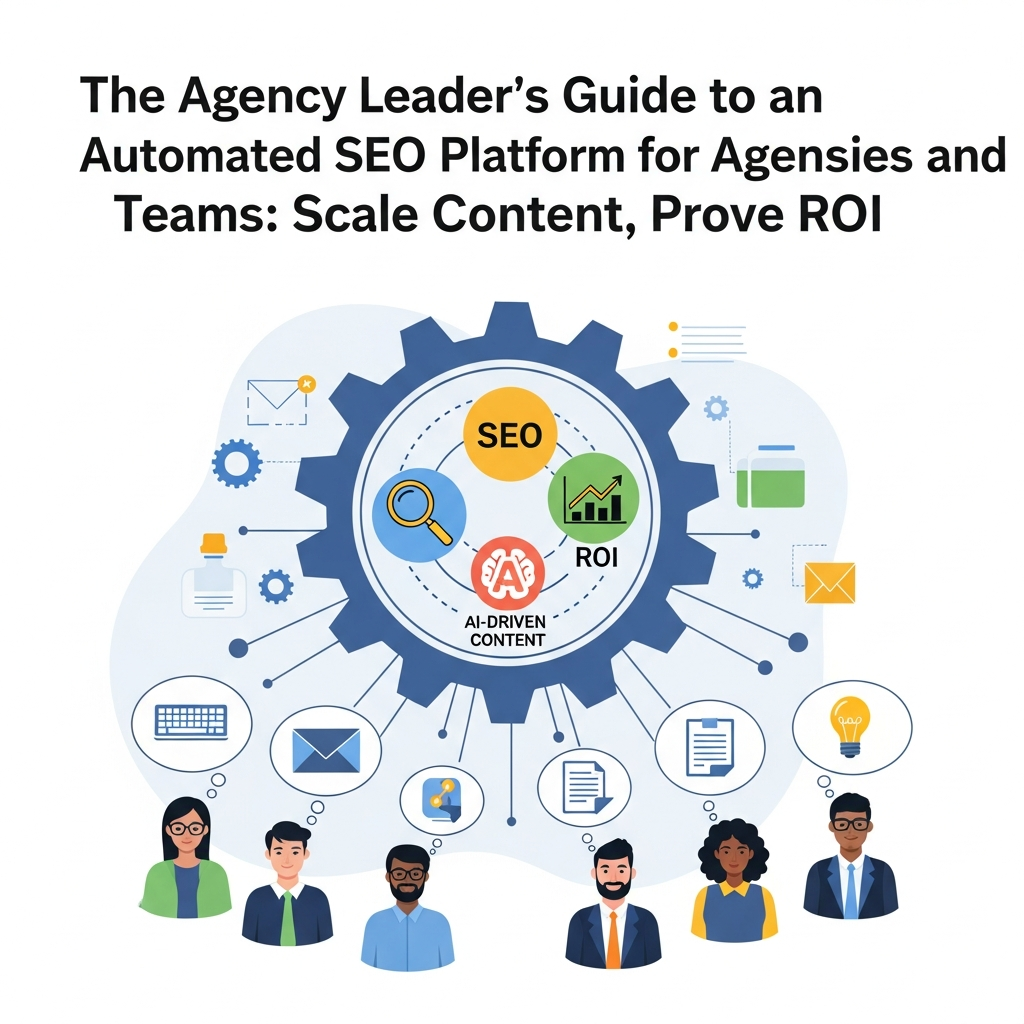
The Agency Leader's Guide to an Automated SEO Platform for Agencies and Teams: Scale Content, Prove ROI
Why automate SEO for agencies and teams
Agencies face a paradox: demand for scalable, consistent SEO outcomes across many clients, and the reality of constrained writer bandwidth and manual optimization bottlenecks. An automated SEO platform designed for agencies and teams can unlock capacity without sacrificing quality. By shifting repetitive, rule-based tasks to AI-driven engines, leadership teams can focus on strategy, client education, and governance rather than operational firefighting.
At its core, an automated platform offers three pillars: content generation, publishing and optimization, and performance analytics. When these are stitched together with strong governance, multi-site management, and white-label capabilities, agencies gain the speed to publish, the discipline to optimize, and the evidence to prove ROI across a portfolio of clients.
Consider the typical agency workflow: you brief a client, draft outlines, assign writers, publish, and then optimize. The cycle repeats for dozens of pages every week. Automation accelerates this loop while preserving brand voice and SEO quality. For agency leaders evaluating tools, the question isn’t just about features—it’s about how the platform harmonizes with your existing processes, CMS stacks, and reporting requirements. To understand the value, imagine a 3-month pilot that demonstrates faster publish cadence, improved keyword coverage, and measurable traffic lift across multiple client sites. That’s the kind of ROI narrative this guide aims to help you build.
Core capabilities of an automated SEO platform
A robust automated SEO platform for agencies and teams typically combines AI-driven content generation, automated on-page optimization, publishing queues, internal linking, and centralized analytics. Below are the core capabilities to look for, with practical notes on how they map to agency needs.
AI-driven content generation for SEO campaigns
AI-assisted drafting accelerates topic research, outlines, and first drafts that align with a client’s target keywords. The goal is not to replace human editors but to provide strong first-pass content that editors can refine quickly. Look for capabilities such as:
• Topic clustering and keyword intent matching
• AI-generated outlines tailored to dominant and long-tail keywords
• Style and tone controls to preserve brand voice across multiple clients
Practical tip: pair AI-generated drafts with human QA checkpoints to ensure accuracy, factuality, and brand consistency. This combination keeps velocity high without compromising quality.
Automated publishing and optimization for blog sites
Publishing automation ensures that approved content goes live on schedule and in the correct CMS context. The optimization layer should adjust on-page elements—title tags, meta descriptions, header structure, and internal linking—based on evolving SEO signals. Benefits include:
• Consistent metadata optimization across dozens of pages
• Routine updates to reflect new keyword opportunities
• Automated internal linking frameworks that improve crawlability
For agencies, the value is not only speed but governance: dashboards show which pages publish, when, and with what optimization rules applied. This transparency supports client reporting and stakeholder updates.
Automated internal linking and meta generation
Internal linking is a powerful but often neglected lever. An automated platform can propose internal link opportunities, create brief linking briefs for editors, and even auto-insert contextually relevant links at publish time. Meta tag generation x-ray scans help ensure consistency in description length, keyword presence, and unique value propositions across the site portfolio.
Tip: maintain a hierarchy that mirrors client site architecture and avoid over-optimization by setting guards for anchor text variety and link density across large sites.
CMS integrations and API access
Agencies work with WordPress, Webflow, Shopify, and other CMS platforms. A strong platform provides native connectors and robust APIs for seamless data exchange, content calendars, and reporting feeds. Key considerations include:
• Native CMS plugins or reliable API adapters
• Webhook-driven automation for new content or updates
• Data export formats compatible with your analytics stack
Multi-site scaling: centralized management across clients
One of the most compelling use cases for an automated SEO platform is multi-site management. For agencies handling dozens of clients, centralized workflows reduce duplication of effort while maintaining client-specific governance and branding. Focus areas include:
- Portfolio-wide keyword strategy with client-specific tweaked variants
- Shared templates for outlines, briefs, and publishing calendars
- Role-based access controlling what editors, strategists, and clients can see
- Consistent reporting dashboards that slice data by client, geo, or language
In practice, multi-site management means you can push a single optimization framework across all client sites, while keeping each site’s taxonomy and content cadence distinct. It’s the combination of standardized processes with client-specific tailoring that drives scale without sacrificing ROI.
Localization and global campaigns
Agencies serving multilingual clients require localization workflows. Automation should support language variant creation, locale-specific keyword discovery, and localization review loops. This reduces translation bottlenecks while maintaining SEO quality signals in each market.
Governance and security at scale
With growth comes governance complexity. Look for audit trails, role-based access, SOC 2-type controls, and data privacy assurances. Enterprises especially value vendor SLAs, uptime commitments, and data replication guarantees. A scalable platform should offer granular dashboards that satisfy executive-level reporting needs while remaining operable for day-to-day editors and SEOs.
ROI and governance: proving value at scale
For agency leadership, ROI is the north star. ROI in an automated SEO platform is not a single metric; it’s a composite of velocity, visibility, client retention, and lifecycle efficiency. Consider these metrics when building a business case:
- Publish velocity: time-to-publish improvements and content calendar adherence
- Keyword coverage: breadth and depth of optimized pages for target intents
- Traffic and rankings lift by client and by campaign
- Content cost per page: editors' time saved versus traditional workflows
- ROI dashboards: daily, weekly, and monthly reporting that correlates content activity with client outcomes
Governance tools matter as much as performance metrics. Centralized dashboards should offer drill-downs for executive summaries and detailed client reports. For agencies, white-label capabilities and clear SLA terms are essential to keep client relationships smooth and scalable. If you’re evaluating ROI narratives, consider a pilot that tracks a defined set of KPIs across three clients over 12 weeks. You’ll learn not only about results but also about integration and operational fit.
To see a practical approach to ROI dashboards and governance in action, read our post on measuring ROI and governance in automated SEO dashboards that prove value: ROI dashboards and governance in automated SEO dashboards.
Implementation blueprint: from pilot to production
A disciplined rollout reduces risk and accelerates time-to-value. Use a phased approach that minimizes disruption while proving incremental gains. A practical blueprint looks like this:
- Define success: establish 3–5 client use cases, target KPI milestones, and a strict pilot scope.
- Map workflows: align client content briefs, editors, SEO specialists, and CMS processes. Create standardized templates for outlines, briefs, and briefs-to-briefs handoffs.
- Configure the automation: enable AI-generated outlines, meta generation rules, internal linking heuristics, and publishing calendars. Set guardrails to prevent over-optimization.
- Run a 30-day pilot: test across 2–3 clients with varied sites. Monitor publishing cadence, quality checks, and initial ROIs.
- Scale with governance: refine SLAs, onboarding playbooks, and reporting cadence. Expand to additional clients and languages as appropriate.
For a practical starter guide, see our 30-day content calendar framework: Automated 30-day content calendar—how to jumpstart SEO at scale.
Best practices and common pitfalls
To maximize value and minimize risk, adopt these best practices:
- Start with a content governance plan that documents tone, voice, and optimization standards.
- Balance AI efficiency with human oversight for accuracy and brand alignment.
- Prioritize high-impact pages first: product pages, category pages, and cornerstone content.
- Implement robust QA: editorial checks, data validation, and regular content audits.
- Maintain transparency with clients: share dashboards, milestones, and actionable insights.
Be mindful of common pitfalls like over-automation in niche topics, neglecting localization nuances, or ignoring accessibility and UX signals in the pursuit of scale. A measured approach that combines automation with human review yields durable, client-ready results.
Choosing the right platform: criteria and considerations
When evaluating platforms, prioritize alignment with your agency’s goals, client requirements, and technology stack. Key criteria include:
- Multi-site management and scalable governance
- Quality controls and content-grade assurance processes
- CMS integrations, APIs, and data portability
- Security, compliance, and privacy protections
- White-label options and partner-friendly terms
- ROI-focused reporting, dashboards, and SLAs
Practical due diligence steps include requesting a trial, examining case studies, and asking for a segmented rollout plan with clear milestones. If you’re evaluating with enterprise needs, look for SOC2-type assurances and vendor stability proofs as part of governance considerations.
A successful pilot blends selection criteria with a concrete implementation plan. Consider the following 90-day plan as a template:
- Week 1–2: align stakeholders, define success metrics, and set up governance models.
- Week 3–6: configure automation rules, upload client briefs, and run test content in a staging environment.
- Week 7–9: publish a limited set of pages, monitor quality checks, and adjust prompts or templates as needed.
- Week 10–12: expand to additional clients, begin full-scale reporting, and begin client-facing dashboards.
Along the way, leverage internal and external resources to optimize the pilot. For Brazilian e-commerce and localization workflows, see the Sao Paulo publishing case study post: Sao Paulo automated publishing for Brazilian e-commerce.
Real-world implications: examples and hypothetical outcomes
While every agency portfolio is different, practical outcomes from a well-executed automated SEO platform often include faster content cycles, improved keyword coverage, and more consistent reporting. A typical scenario might show:
- 30–50% faster content publication cycles across a 12-week window
- 25–40% increase in targeted keyword rankings for top-priority pages
- Clear, auditable ROI signals supported by dashboards and client reports
These results are not guaranteed, of course, and depend on client readiness, content quality, and how aggressively the platform is configured. The key is establishing a repeatable, transparent process that scales across your client base while maintaining brand fidelity.
Conclusion: start small, think scalable
An automated SEO platform for agencies and teams has the potential to transform how you publish, optimize, and report on organic search results. By combining AI-assisted content generation, automated publishing and optimization, and centralized multi-site governance, agencies can deliver consistent client outcomes at scale while maintaining a sharp lens on ROI.
If you’re ready to start, begin with a clearly defined pilot, a pragmatic governance framework, and a plan to measure impact across multiple clients. And as you expand, use the available internal resources and community-style guidance to iterate toward greater efficiency and stronger client outcomes.
For ongoing guidance on ROI-focused governance and automation dashboards, explore our related content:
ROI dashboards and governance in automated SEO dashboards and 30-day content calendar framework.