The Agency Growth Leader's Guide to Automated Publishing and Optimization for Blog Sites: Scale Content Without Hiring More Writers
Introduction
For growth-focused agencies, the demand to publish more content, faster, while maintaining quality is a constant pressure. Automated publishing and optimization for blog sites is not about replacing human writers; it’s about augmenting them with reliable, scalable processes that align with client goals and brand standards. When done well, automation accelerates idea validation, speeds up production, and frees senior teams to focus on strategy, not busywork.
This guide is designed for agency growth leaders who want to scale client blogs with a repeatable, governable system. It covers the elements that make automation work at scale, the governance that keeps quality high, and the practical steps to implement a pipeline that delivers measurable ROI. You’ll find practical templates, a playbook for pilots, and pointers to proven patterns that align with multi-site and multi-brand strategies.
What Automated Publishing and Optimization for Blog Sites Really Means
In its simplest form, automated publishing and optimization for blog sites combines AI-assisted content generation, structured briefs, on-page optimization, and intelligent internal linking into a cohesive workflow. The goal is to publish high-quality, SEO-friendly posts at scale without sacrificing brand voice or editorial standards.
Key outcomes include faster go-to-market for blog campaigns, more consistent internal linking across posts, and AI-assisted meta tag and keyword generation that supports visibility across multiple search engines and geographies. The approach supports multi-site management, centralized dashboards, and governance that senior leaders expect from an enterprise-grade solution.
Organizations pursuing this approach typically measure ROI through organic traffic growth, keyword rank improvements, and the efficiency gains from automation dashboards and governance reports. The emphasis is not on “tech for tech’s sake” but on concrete business value—faster content cycles, clearer analytics, and stronger content calendars.
Core Components of a Scalable Automated Publishing System
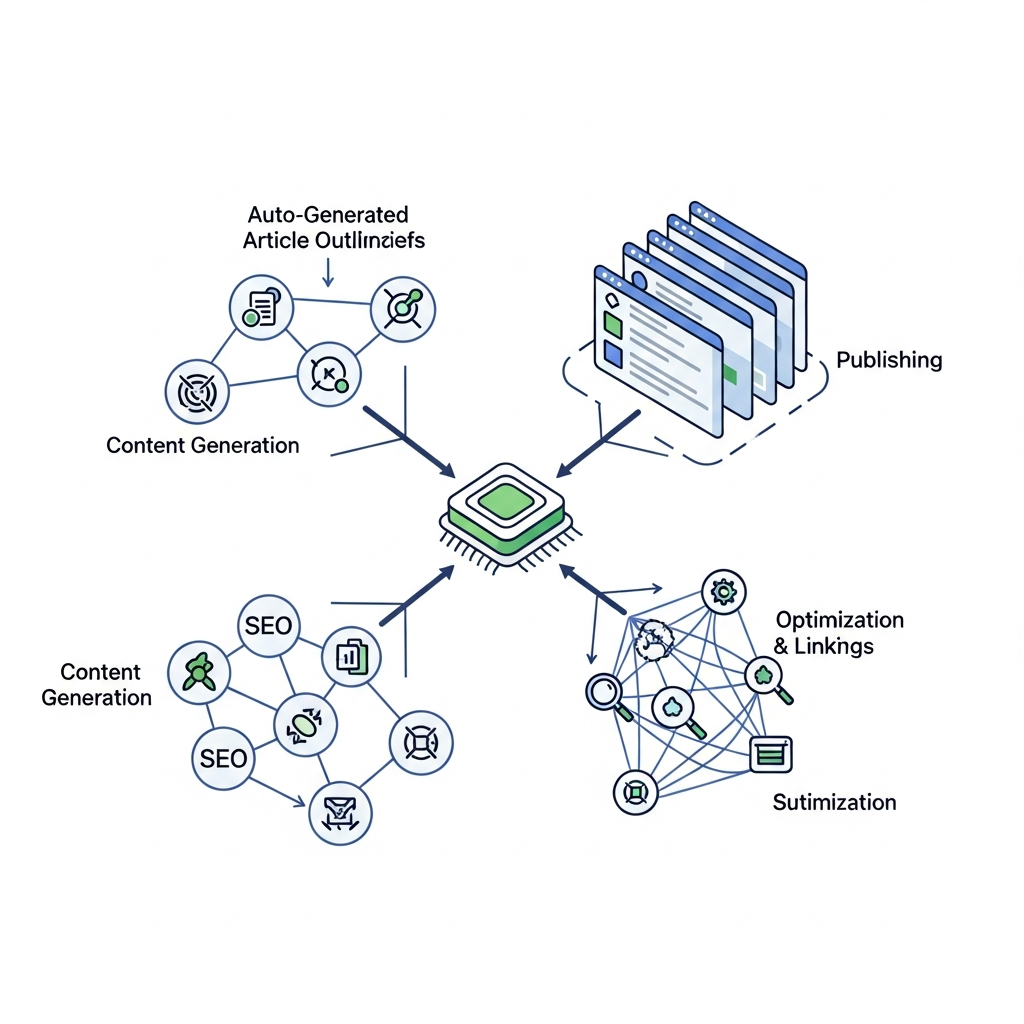
A robust system built around automated publishing and optimization for blog sites rests on four core pillars. Each pillar supports the others, creating a stable, scalable pipeline from idea to indexed page.
- Auto-generated outlines and briefs for SEO: Templates and prompts guide writers and AI to produce topic scopes, intent-driven headlines, and keyword plans. The briefs reduce revision cycles and ensure alignment with client goals from the start.
- Automatic internal linking and optimization for posts: A connected system maps new posts to relevant existing content, builds a logical crawl path, and signals related topics to search engines. This improves crawlability and page authority distribution across a site.
- Bulk article creation for SEO campaigns at scale: A managed queue enables large campaigns with scheduled publishing windows, ensuring consistency in tone, structure, and quality checks across dozens or hundreds of posts.
- AI-optimized meta tags and keyword generation: AI suggests title tags, meta descriptions, and H1s based on audience intent, existing ranking signals, and CMS constraints. These tags are testable and adjustable within governance controls.
These components should operate within a governed workflow that requires editorial sign-off for each post, ensuring that automation supports editorial standards rather than replacing them. When combined effectively, they enable a predictable cadence of publishable content across multiple sites and brands.
Auto-generated outlines and briefs for SEO
Structured outlines help writers start from a defensible SEO position. Briefs include target keywords, user intent, competitor gaps, and suggested headings. They also set constraints for tone, word count, and internal linking targets. The result is a faster drafting process with fewer cycles of rewrites and a higher likelihood of ranking improvements from day one.
Automatic internal linking and optimization for posts
Internal linking is a cornerstone of on-page SEO and site architecture. Automated linking uses topic modeling and semantic signals to suggest relevant internal connections. It helps search engines understand content relationships and distributes page authority to the most important pages. Proper governance ensures links are contextually relevant and not over-optimized.
Bulk article creation for SEO campaigns at scale
Bulk creation must balance quantity with quality. A controlled pipeline combines AI drafting with human review, editorial calendars, and QA checks. Batch publishing reduces manual frictions, but the system should still enforce brand voice checks, factual accuracy, and compliance with client guidelines.
AI-optimized meta tags and keyword generation
Meta tags shape click-through from search results and influence ranking signals. AI-assisted generation suggests compelling titles and descriptions aligned with user intent and competition. Teams retain final approval to preserve consistency and regulatory compliance across client sites.
A Scalable Workflow for Agencies
A well-designed workflow blends people, process, and technology into a repeatable rhythm. Below is a practical blueprint that agencies can adapt to their existing tech stack and client mix.
- Define goals and success metrics: Establish target traffic, ranking milestones, and content cadence per client. Tie metrics to client KPIs like qualified leads or revenue from organic search.
- Build a starter content calendar: Create a master calendar that maps topics to strategic keywords and seasonal moments. Schedule briefs and drafts to fit client workflows.
- Set up templates and briefs: Develop standardized templates for outlines, briefs, and QA checklists. Ensure templates reflect brand voice, tone, and compliance requirements.
- Content creation with AI plus human review: Use AI to draft, then route to editors for factual accuracy, tone, and brand alignment. Maintain a feedback loop to improve AI prompts over time.
- On-page optimization automation: Apply AI-driven on-page optimization at publish time, including header structure, image alt text, and schema markup where appropriate.
- Internal linking strategy: Automatically surface relevant internal links during drafting but require editorial approval for final placement.
- Quality control and governance: Implement QA gates, style guides, and client-specific constraints. Use dashboards to monitor project health and ROI across clients.
For a concrete implementation blueprint, our 30-day content calendar blueprint provides a tested sequence that teams can adapt. See the practical guide with templates and timelines at this link: 30-day content calendar for rapid SEO at scale.
ROI, Governance, and Dashboards
ROI in automated publishing comes from a combination of traffic growth, improved click-through rates, and efficient content production. Governance dashboards provide executives with a clear narrative about value, risk, and progress. A strong reporting framework links activities to outcomes and makes it easier to justify continued investment.
To see practical examples of how governance dashboards translate activity into value, explore our guide on measuring ROI and governance in automated SEO dashboards that prove value. It offers concrete metrics, templates, and reporting calendar ideas that scale with your client portfolio. Measuring ROI and governance in automated SEO dashboards that prove value provides a hands-on reference.
When considering international or multilingual campaigns, governance should also address localization controls, translation processes, and brand consistency across markets. A well-governed automation stack makes it easier to demonstrate value to multi-brand executives and to maintain compliance across jurisdictions.
For an example of localization and regional publishing, you can also explore how teams in Sao Paulo approach automated publication for ecommerce in Brazilian markets. This showcases how localization workflows fit into the broader automation model: Sao Paulo automation for Brazilian ecommerce.
Technical Considerations
Implementing automation at agency scale requires thoughtful integration with content management systems (CMS), analytics tools, and workflow software. Some practical considerations include:
- CMS compatibility: Ensure the automation layer can interface with WordPress, Webflow, Shopify, and other CMS platforms used by clients.
- Data governance and security: Align with enterprise-grade security practices, data privacy requirements, and access controls.
- API and plugin strategy: Favor platforms with robust APIs to connect keyword research, content calendars, and dashboards into a single pane of glass.
- Localization and localization workflows: Support multi-language content workflows, regional keyword maps, and translation memory.
- Quality assurance gates: Implement editorial sign-off steps and fact-check protocols within the automated pipeline.
Automation should augment editorial teams, not create new bottlenecks. The governance layer—policies, SLAs, and review cycles—determines whether automation delivers reliable ROI over time.
Best Practices and Common Pitfalls
To maximize value, keep these practices in mind. They help avoid quality declines and ensure scalability across client portfolios.
- Define guardrails: Establish tone, factual accuracy thresholds, and brand voice constraints in templates and briefs.
- Phase the rollout: Start with a pilot on a subset of sites or brands, then expand in controlled waves with staged QA gates.
- Maintain editorial governance: AI is a tool, not a replacement for editors. Keep human review at critical decision points.
- Quality over quantity: Prioritize targeted content that fills gaps and aligns with buyer personas and funnel stage.
- Monitor semantic quality: Use topic modeling and semantic signals to avoid keyword stuffing and ensure relevance.
- Protect brand integrity: Implement language and policy checks, including legal and compliance reviews where applicable.
When done well, automated publishing reduces cycle times, improves consistency, and creates scalable SEO momentum across client portfolios.
Implementation: A 30-Day Plan
Organizations often find success with a structured 30-day sprint. Here’s a blueprint you can tailor to your client mix:
- Days 1–5: Discovery and goal setting — Define success metrics per client, audience intent, and content gaps. Align on governance and approvals.
- Days 6–10: Template and brief design — Create outlines, briefs, and QA checklists. Build multilingual and CMS-specific variants if needed.
- Days 11–15: Pilot content — Generate a small set of posts using AI, with human editors validating accuracy, tone, and linking opportunities.
- Days 16–20: Automation ramp — Expand to bulk article creation while enforcing governance gates and editorial reviews.
- Days 21–25: On-page optimization — Apply AI-generated meta tags, structured data, and internal linking strategies at publish time.
- Days 26–30: Reporting and iteration — Review dashboards, measure early ROI signals, refine prompts, and plan next wave of content.
For a detailed, battle-tested plan with templates, see the companion guide to automated content calendars and ROI governance. It provides practical worksheets and milestone checklists to accelerate your pilots.
Choosing the Right Tool for Agency-Scale Automation
When evaluating automation tools for agency use, consider these criteria:
- Multi-site and multi-brand management capabilities
- White-label options or partner-friendly terms
- Security, data privacy, and SOC2-type assurances
- CMS integrations and API accessibility
- Quality controls, editorial governance, and audit trails
- ROI-focused dashboards with clear attribution models
Conclusion
Automated publishing and optimization for blog sites is not a myth; it’s a disciplined, engineered approach to scaling content operations while maintaining quality. For agency leaders, the right system blends AI assistance with human governance, strong editorial standards, and transparent reporting. The payoff is a faster publishing cadence, better on-site SEO signals, and demonstrable ROI to clients and fellow executives.
As you start your journey, anchor your initiative to a clear pilot plan, a governance framework, and a portfolio of client goals. Use templated outlines and briefs to reduce friction, rely on automatic internal linking to strengthen site structure, and implement AI-driven meta tags to improve visibility. With the right combination of people, process, and technology, you can scale content production without sacrificing quality or brand integrity.