In-house Content Managers: AI driven content generation for SEO campaigns Can Scale Daily Publishing
Why AI-driven content generation matters for SEO campaigns
In-house content teams face a daily publishing demand that can outpace manual workloads. AI-driven content generation for SEO campaigns offers a way to scale ideation, drafting, and optimization without sacrificing quality or brand voice. When deployed with clear guardrails and editorial standards, AI can produce publication-ready drafts, freeing editors to focus on strategic planning, link-building, and performance analysis.
Key benefits include speed, consistency, and the ability to test variations quickly. AI-generated outlines can seed topics aligned to keyword opportunities, while AI-assisted rewriting can improve readability and SEO signals. But AI is most powerful when used as a partner to human editors, not a replacement. The best practices combine machine-generated drafts with rigorous review processes, style guidelines, and brand-safe constraints.
As you consider adoption, ensure your roadmap includes governance, analytics, and a feedback loop from performance data. AI excels when it is trained on your brand voice and editorial standards, producing outputs that feel familiar to readers while expanding your content footprint.
Daily publishing workflow: From AI briefs to published posts
A reliable daily publishing workflow starts with a well-defined brief. The brief translates SEO intent, target keywords, audience personas, and approved tone into a machine-friendly prompt. The AI then generates a first draft, usually with sections for an introduction, main points, subtopics, and a conclusion. Editors review for factual accuracy, tone, and alignment with the brand voice.
Next comes optimization: on-page SEO signals, semantic relevance, internal linking opportunities, and meta tag suggestions. The best systems produce an SEO brief and an outline that guides the writer. Finally, the content is scheduled in the CMS, pushed to production workflows, and monitored by dashboards that track performance and quality metrics.
For teams aiming to publish at scale, automation is more than drafts. It also includes a content calendar that sequences topics, assigns owners, and aligns with campaigns. A well-constructed calendar ensures a mix of evergreen and timely content, seasonal relevance, and consistent publishing cadence. See our guide on automated 30-day content calendars for a hands-on approach to this rhythm.
In practice, detail-driven briefs reduce ambiguity and provide a repeatable pattern your editors can trust. When combined with ongoing QA, the workflow preserves brand consistency while dramatically increasing throughput.
Core capabilities for scalable SEO content
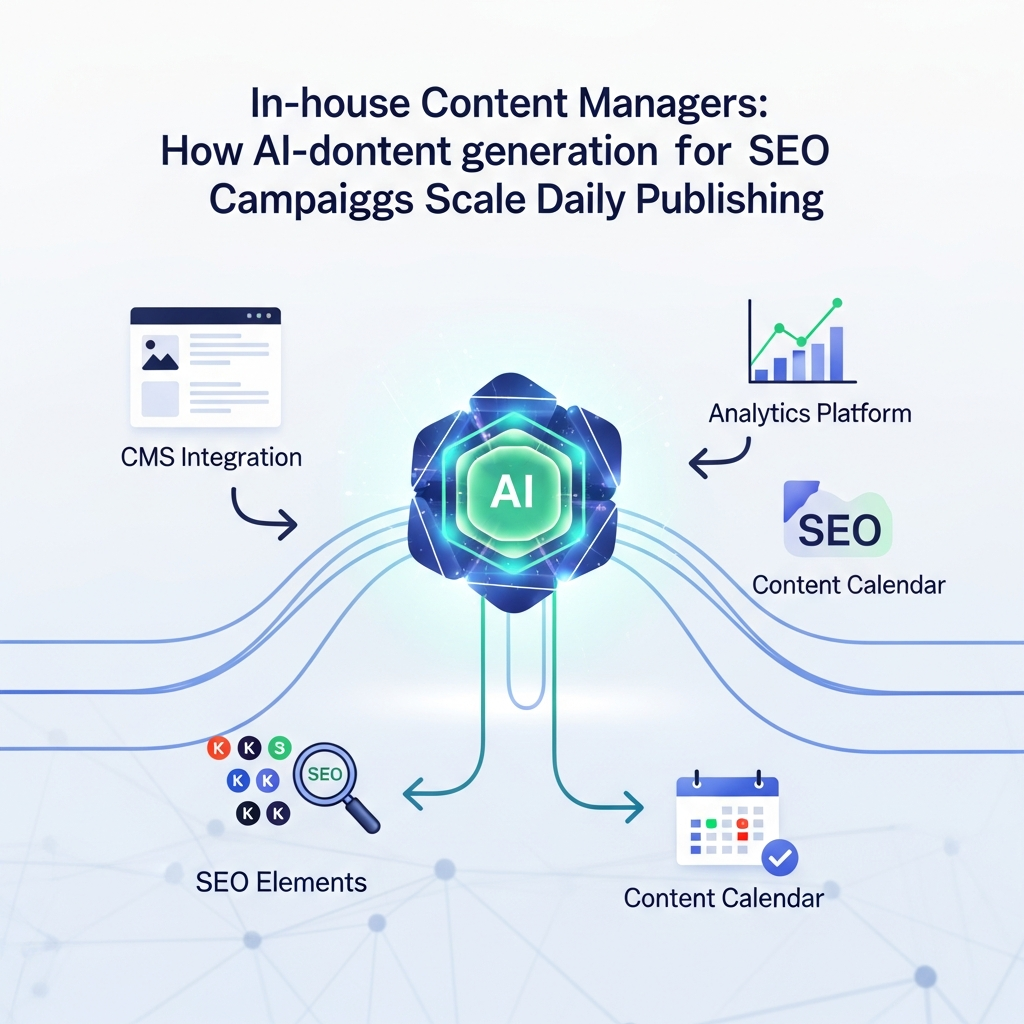
Successful AI-driven content campaigns rely on a few core capabilities. First, AI content generation and optimization turn keyword research into publishable text that adheres to editorial standards. Second, AI-generated meta tags and structured data suggestions help search engines understand page context and improve click-through rates. Third, a content calendar automation layer coordinates topics, prompts, and publishing times to maintain a regular cadence.
In practice, you’ll typically see a three-layer workflow: ideation, drafting, and optimization. Each layer has guardrails, quality checks, and human oversight. The result is a scalable system that preserves brand voice while enabling daily or near-daily publication at scale. A practical way to think about this is as an assembly line for content where AI handles the repetitive drafting tasks and editors handle interpretation and polish.
To illustrate: AI can generate an outline and a first draft based on targeted keywords. Editors then verify, rephrase for readability, add authoritative sources, and adjust for tone. The system then outputs on-page SEO elements, including meta titles, descriptions, and image alt text. This triad—content generation, content optimization, and meta-tag automation—drives higher efficiency and better search signals.
As capabilities evolve, you may add AI-assisted internal linking suggestions, content gap analyses, and multilingual content generation to expand reach without sacrificing consistency.
Ease of integration with CMS and analytics platforms
One of the biggest barriers to scale is interoperability. An AI-driven content workflow that integrates with your CMS (WordPress, Shopify, Webflow, and others) and analytics stack (GA4, Search Console, Data Studio) unlocks daily publishing without manual handoffs. Modern AI platforms offer native CMS connectors, API access, and webhook-based automation that align with existing publishing pipelines.
Practical considerations include authentication standards, data locality, and version control. Look for features like CMS-ready content blocks, templated metadata, and published vs draft states that map to your editorial calendar. If you’re new to automation, start with a pilot that plugs into a single CMS and a single analytics dashboard, then broaden to multi-site management as you prove value.
To see a concrete example of how automation connects to a broader SEO toolkit, explore the ROI-focused dashboards and governance guide linked in this article. If you’re curious about calendar-driven workflows, the automated 30-day content calendar post provides a concrete blueprint.
Internal links to relevant resources can help teams learn by example. For instance, the platform homepage offers a high-level view of capabilities, while the São Paulo publication automation piece demonstrates localized publishing at scale.
Further reading: the platform homepage, automated 30-day content calendar for SEO at scale, ROI and governance dashboards for automated SEO, São Paulo publication automation for e-commerce
Governance, brand voice, and quality control
Governance is non-negotiable for enterprise-grade or multi-brand programs. Establish clear editorial guidelines, brand voice matrices, and approval workflows that apply to AI-generated content. Create style checklists, fact-checking routines, and citation standards so AI outputs stay accurate and on-brand. A robust system combines automated checks (grammar, plagiarism, tone) with human reviews at defined gate points.
Quality control also includes risk management around misinformation and compliance. Build guardrails into prompts and runtime constraints to prevent harmful or off-brand content. Use a two-tier review process: an automated QC pass followed by a human editorial pass. Documentation of changes and decisions helps with audits and stakeholder transparency.
Bringing in governance translates into better consistency across authors, domains, and languages. It also makes it easier to demonstrate value to executives when you can present audit trails, version histories, and KPI milestones. You can deepen governance with role-based access controls, change logs, and proactive anomaly detection in content performance.
Pilot to scale: building a rollout plan
Scaling begins with a structured pilot. Define success metrics (published post velocity, keyword coverage, engagement metrics, and on-page SEO signals). Establish a cross-functional pilot team that includes content writers, editors, SEO specialists, and a developer or IT liaison for integrations. Create a tight timeline with milestones for briefs, drafting, review, publication, and measurement.
During the pilot, start with a single topic cluster and a single CMS, then replicate the pattern across additional topics and sites. Use the content calendar to sequence topics, map keyword intent, and assign owners. Capture learnings and adjust prompts, tone, and editorial checks based on feedback. After a successful pilot, you can expand to multi-site management and more languages if needed.
As you scale, governance grows in importance. Maintain a central playbook with templates, QA checklists, and escalation paths. This reduces variability and ensures a consistent brand experience across all published content. For practical guidance, consult the ROI dashboards and 30-day calendar post to align rollout templates with governance practices.
Measuring ROI, dashboards, and governance
ROI is not just about traffic; it’s about the quality of signals that influence rankings, engagement, and conversions. A well-designed automated SEO dashboard measures content velocity, keyword movement, page-level optimization, and audience engagement. It should tie publishing activity to business outcomes like organic traffic growth, time on page, bounce rate, and revenue impact.
Governance metrics include throughput (posts published per day/week), SLA adherence, and reliability of integrations. It’s essential to set up dashboards that are readable by executives and actionable for editors. The ROI narrative improves when you can show content investments translating into measurable outcomes over time. For an in-depth look at governance and ROI dashboards, consult the dedicated guide linked earlier in this article.
Beyond surface metrics, track content variety, topic saturation, and alignment with strategic campaigns. This helps ensure that automation expands your reach without creating content fatigue. Regular audits of performance data reinforce confidence in the automation program and guide iterative improvements.
Practical playbook: 14-step checklist for AI-powered daily publishing
- Define editorial goals and KPIs aligned with SEO targets. Clarify whether speed, quality, or breadth of coverage takes priority for each quarter.
- Map target keywords to content topics and prompts. Build a keyword map that ties intent to content formats (how-to, list, guide, case study).
- Create brand-safe prompts and guardrails for the AI model. Include tone, voice, and compliance constraints to ensure consistent outputs.
- Build an editorial style guide and QA checklist. Include grammar, citations, and citation standards to reduce factual errors.
- Establish a pilot with measurable milestones. Define a minimum viable cadence (e.g., 2-3 posts/day for 4 weeks) and success criteria.
- Set up CMS connectors and content templates. Ensure templates support metadata, schema markup, and image optimization.
- Define a content calendar cadence. Decide on daily, near-daily, or weekday publishing based on bandwidth and impact.
- Implement a human-in-the-loop review process. Assign editors to approve AI drafts before publication, with time-bound queues.
- Create metadata templates and AI-generated meta tags. Ensure consistency with brand voice and SEO guidelines.
- Schedule publication with a publishing calendar. Integrate with CMS workflows and QA gates to minimize delays.
- Monitor performance in dashboards and adjust prompts. Use data to refine topics, angles, and keyword targeting.
- Iterate prompts based on results and feedback. Apply learnings from top-performing posts to new drafts.
- Maintain documentation for governance and audits. Record decisions, revisions, and approvals for accountability.
- Plan for scale across sites and languages, with a rollout plan and SLAs. Prepare multi-site governance and localization workflows.
In practice, this checklist provides a repeatable framework that keeps teams aligned and helps you quantify incremental gains from automation. For a concrete calendar approach, refer to the automated 30-day content calendar post linked earlier.
Conclusion: next steps and considerations
AI-driven content generation for SEO campaigns can unlock new levels of daily publishing without eroding quality or brand voice. The right approach blends AI capabilities with human expertise, governance, and a clear operational playbook. Start with a focused pilot, validate with robust metrics, and scale thoughtfully across sites and languages. When you combine CMS integrations, calendar automation, and optimized meta tags, you create a resilient engine for ongoing SEO success.
As you move from pilot to scale, remember that automation is a tool for augmentation—not replacement. The human editors, strategists, and developers who supervise, tune prompts, and govern the process remain essential to achieving sustainable results. If you’d like a deeper dive into real-world use cases and templates, explore the recommended blog posts linked in this article.
Internal references and further reading: the platform homepage, automated 30-day content calendar for SEO at scale, ROI and governance dashboards for automated SEO, São Paulo publication automation for e-commerce