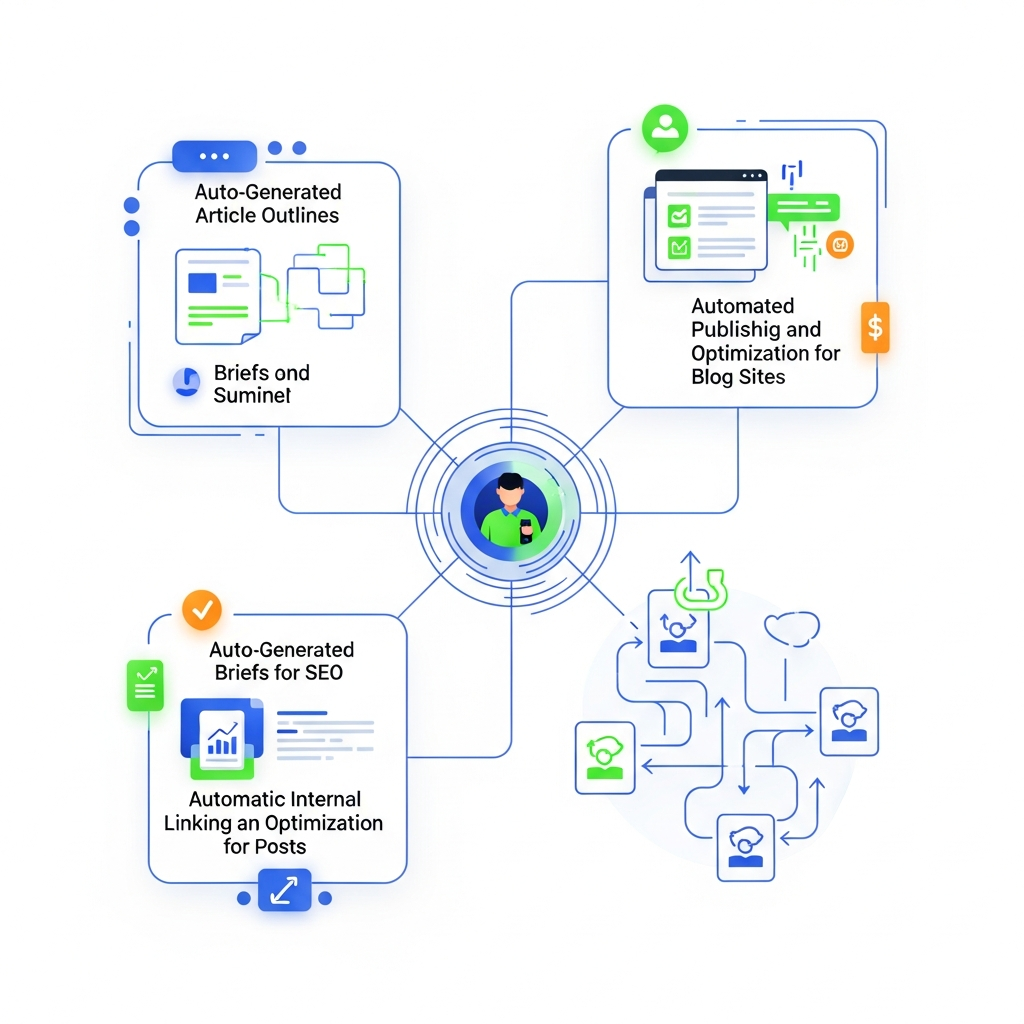
How In-House SEO Managers Can Master Auto-Generated Article Outlines and Briefs for SEO — Without Sacrificing Quality
The value of auto-generated outlines and briefs for SEO
Auto-generated outlines and briefs are not a shortcut that bypasses quality; they are a structured starting point that aligns writers, editors, and SEO goals at scale. When designed well, these outlines ensure essential keywords, user intent, and content structure are baked into every piece from the start. This reduces friction later in the editorial process and helps preserve the brand voice across content teams.
For in-house SEO teams, the biggest payoff is speed without sacrificing depth. A well-tuned outline can guide topic selection, keyword targeting, section ordering, and the balance between informational and transactional content. When combined with templates and governance checks, you can reproduce high-quality content across topics and domains while maintaining a consistent voice and SEO performance.
In practice, teams that adopt auto-generated outlines report faster kickoff times for new articles, more predictable editorial calendars, and better alignment with SEO strategies such as internal linking, schema usage, and content clustering. This is especially valuable for multi-site or multilingual programs where governance and consistency become critical.
To see how automation scales content programs, explore examples such as a structured 30-day content calendar that pairs outlines with briefs, a governance framework for QA, and dashboards that show how automated content contributes to traffic and conversions. Automated 30-Day Content Calendar provides a concrete starting point for practical implementation.
Designing effective auto-generated outlines and briefs
Effective outlines start with a clear brief: target keywords, search intent, content type, word-length bands, and the user journey. When your automation system receives a request, it should generate a template that covers headline options, H2/H3 structure, suggested meta tags, and placeholders for FAQs, visuals, and internal links. The result is a repeatable, scalable process that still allows for human oversight where it matters most.
Key design considerations include: alignment with your content pillars, coverage of long-tail variations, and explicit sections for intent-driven differences (informational vs. transactional vs. navigational). A robust outline should also embed opportunities for internal linking and support for on-page SEO signals such as schema and structured data.
When building outlines, start with a baseline that reflects your most successful posts and then layer on topic-specific adjustments. You can progressively refine templates by analyzing which sections drive engagement and which structures yield higher on-page conversions. This iterative approach keeps your process responsive to audience needs while maintaining efficiency.
To illustrate a practical approach, pair each outline with a brief that outlines tone, voice guidelines, and a checklist of quality controls. The brief acts as a contract between writer and editor, ensuring that every article starts from the same quality bar and SEO intent. For a practical example of a structured approach you can adapt, review the 30-day content calendar resource linked above.
Template customization and preserving brand voice
Templates are most valuable when they respect your brand voice and editorial standards. In automation, templates should include not only structural elements but also style guidelines, tone, terminology, and prohibited phrases. You want to avoid generic boilerplate and instead deliver consistent language that still feels human and nuanced.
Practical steps for template customization include:
- Define voice personas for different audiences (technical buyer, general reader, executive stakeholder) and map them to outline variants.
- Standardize approved terminology, product names, and competitor references to maintain consistency.
- Incorporate brand-approved style rules into the brief (sentence length, passive vs. active voice, and preferred citation style).
- Embed placeholders for brand storytelling elements, examples, and case studies to ensure a consistent narrative arc.
With template customization, you can automate the generation of outlines that inherently respect voice guidelines, reducing the need for heavy manual edits. This is especially valuable in large teams where writers operate across multiple channels and formats.
For a concrete example of how template-driven automation supports brand voice at scale, see our discussion on template customization and governance, and how it aligns with enterprise-grade automation practices. If you want to explore how to tailor templates for a specific region, the São Paulo publishing automation post offers regional localization insights that can be incorporated into a global template strategy.
Integrating with editorial workflows and CMS
Automation must fit into existing editorial workflows and CMS ecosystems. The most effective setups include a defined handoff between outline generation and writer assignment, automated checks for SEO completeness, and a human-in-the-loop review at critical quality gates. Integration with common CMS platforms (WordPress, Webflow, Shopify) should be seamless, with APIs exposing outline data, keyword targets, and suggested sections directly within the editor.
To maximize value, design a lightweight governance layer that defines who can approve outlines, who can modify templates, and what constitutes approval criteria. This ensures that automation accelerates production while preserving accountability and brand standards.
An example workflow: 1) outline is generated from the brief, 2) writer selects a chosen variant, 3) automated on-page checks flag potential SEO issues (missing H1, alt text gaps, internal links), 4) editor approves or requests adjustments, 5) the article is published with auto-generated meta data and schema where applicable. The end-to-end flow should be documented in your internal SOPs and tested in a pilot before broad rollout.
For additional guidance on governance and dashboards that prove value, consider resources on ROI and governance dashboards in automated SEO workflows. Measuring ROI and governance in automated SEO dashboards that prove value offers practical metrics and templates you can adapt.
Quality controls, governance, and human-in-the-loop checks
Automation should enhance quality, not replace critical review. Establish a multi-layer QA process that includes: topical relevance checks, keyword coverage validation, and readability scoring. A lightweight human-in-the-loop step can catch nuances that automation may miss, such as brand-voice inconsistencies or nuanced product guidance.
Quality scoring can be codified with a rubric that weighs: accuracy of information, alignment with user intent, completeness of sections, internal linking richness, and accessibility considerations. Use automated tests to flag issues, then route for human review before publication. This approach keeps production fast while maintaining high editorial standards.
In enterprise contexts, governance must scale. Establish SLAs for content turnaround, define data privacy controls, and codify security requirements for automation tools. For teams seeking governance maturity, dashboards that map content quality, SEO impact, and operational throughput are essential for executive reporting. A practical reference on ROI governance dashboards can be found in our ROI-focused resources linked above.
Best practice: start with a small batch of posts and iteratively add more language coverage and templates as you learn what resonates with readers and search engines. The goal is to create a repeatable, auditable process that reduces risk while increasing output quality.
Rollout plan: from pilot to production
Begin with a focused pilot that targets a single content pillar or topic cluster. Define success criteria, such as a target improvement in time-to-publish, a specific uplift in organic impressions, or a measurable increase in internal linking opportunities. Document the pilot’s workflows, templates, and governance rules so you can replicate and scale later.
A practical pilot often includes a 30-day sprint: select 4–6 topics, generate outlines and briefs, assign writers, and run through the entire editorial cycle with automated checks. The aim is to demonstrate faster throughput, consistent quality, and positive SEO signals across the set. As you move from pilot to production, gradually widen the scope to additional topics, languages, and CMS integrations.
As you scale, you’ll want to reference established templates and governance playbooks. The automated 30-day content calendar resource linked earlier provides a blueprint for piloting and expanding automation; it helps you manage cadence, topics, and performance expectations at scale. Automated 30-Day Content Calendar offers a concrete starting point you can adapt to your team.
Measuring ROI and governance
Measuring the impact of auto-generated outlines and briefs requires a disciplined approach to data. Track metrics that matter: time-to-publish, content-to-ROI ratios, organic traffic growth, keyword ranking trajectories, and internal linking density. Dashboards should provide visibility into editorial velocity, quality scores, and the alignment of content with business goals.
For governance, define and monitor SLAs, access controls, and security controls to ensure compliance and accountability. A structured governance framework helps leadership see the value of automation and makes it easier to justify continued investment. See our guide on governance dashboards for practical templates and examples you can adapt to your environment. ROI dashboards and governance provides actionable metrics and templates.
Beyond internal metrics, consider external validation such as user engagement, dwell time, and conversion metrics tied to content campaigns. When you connect your automated outlines to your analytics stack, you gain a robust view of how well your content performs across channels and geographies.
To see regional workflow considerations and localization best practices, explore localized automation resources, including content in other languages and markets. Regional examples can help ensure that auto-generated outlines respect local nuances while maintaining global consistency.
Pitfalls to avoid and best practices
Common pitfalls include relying too heavily on automation for topics that require deep expertise, neglecting brand voice in templates, and skipping QA steps. To avoid these issues, implement a human-in-the-loop for high-importance content, and routinely audit outputs for tone, accuracy, and alignment with SEO intent.
Best practices to sustain value over time include: 1) maintaining a library of vetted templates with region- and topic-specific adjustments, 2) continuously updating keyword targets and content clusters based on performance data, 3) keeping governance documentation up to date, and 4) embedding internal linking opportunities within outlines to support crawlability and content relevance.
Always test changes in a controlled environment before rolling them out broadly. This minimizes risk and helps you quantify the impact of new templates, voice guidelines, or linking strategies. Also, ensure you have a plan for handling multilingual content and localization, especially if you operate across geographies where cultural nuances matter for user experience and SEO.
For teams curious about practical regional approaches, the São Paulo automation post demonstrates how publishing automation can adapt to local market needs while leveraging a shared automation core. São Paulo publishing automation for Brazilian ecommerce offers region-specific insights you can adapt for global programs.
Conclusion: taking control of automation without losing quality
Auto-generated outlines and briefs can be a powerful enabler for in-house SEO teams when designed with a clear brief, robust templates, and strong governance. By combining templates that preserve brand voice with a human-in-the-loop quality process and metrics that matter, teams can accelerate content production while maintaining or even improving SEO outcomes.
Use the pilot-to-production approach to learn rapidly, scale responsibly, and keep a tight feedback loop between writers, editors, and SEO strategists. The goal is a content system that is fast, consistent, and aligned with business objectives, not a one-off productivity hack. If you’re ready to start, map your first pilot around a tight topic cluster, establish your outline templates, and set up a governance framework that can scale with your organization.
For ongoing guidance and practical templates, revisit the linked resources and examples throughout this article, including the 30-day content calendar and ROI governance dashboards, which provide actionable steps you can model in your own program.