How In-house Content Managers Can Scale Blog Publishing with Automated Publishing and Optimization for Blog Sites
Overview
Many in-house content teams still publish manually, juggling editors, writers, and a growing backlog of topic ideas. The result is inconsistent cadence, variable content quality, and missed opportunities for topical relevance and SEO. Automated publishing and optimization for blog sites offers a practical path to publish daily or near-daily content without sacrificing quality. It blends AI-assisted drafting, automated optimization, and centralized scheduling to align with editorial goals and brand voice.
The objective is not to replace humans but to empower them with repeatable workflows, templates, and governance checks. When done well, automation accelerates production while improving on-page optimization, internal linking, and metadata. In this guide, we’ll explore a structured framework your team can adopt to publish consistently at scale, with a focus on real-world applicability and governance.
Benefits and risks of automation
The primary benefit is cadence. Automated publishing helps you hit daily or near-daily targets, which signals momentum to search engines and readers alike. It also unlocks time for strategy, longer-form content, and refined reader journeys. When paired with automated optimization, each post becomes more discoverable and more aligned with your topical priorities.
Risks exist if automation is treated as a black box. Poor prompts, weak quality controls, and insufficient governance can degrade content quality and dilute brand voice. To mitigate this, combine human review checkpoints with clear standards for style, fact-checking, and citation practices. A transparent workflow helps maintain quality as you scale.
A balanced automation program uses guardrails, not ultimatums. Start with a narrow set of topics, implement a repeatable publishing cadence, and continually measure impact on traffic, engagement, and conversions. Over time, you can broaden scope to multilingual content, new geos, or multi-brand sites while preserving governance.
Core components of an automated blog program
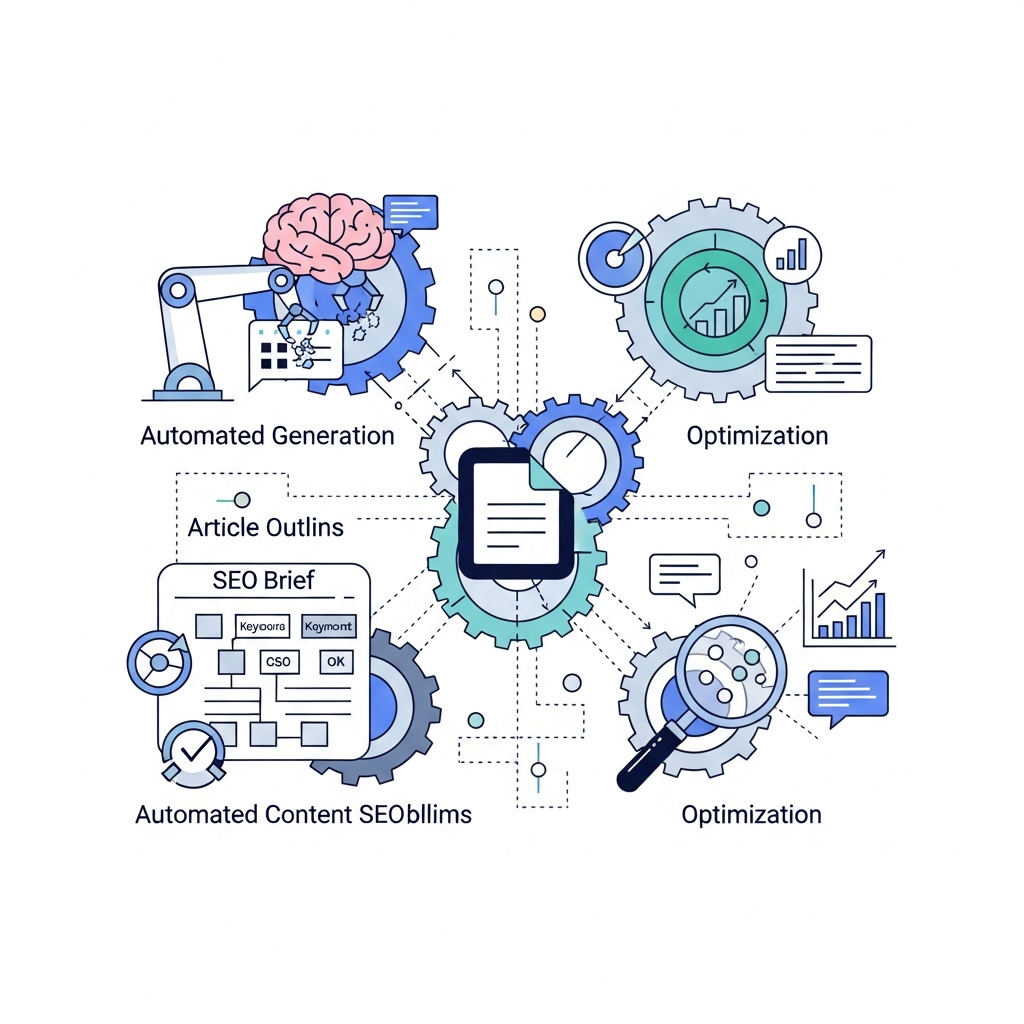
A robust automated publishing and optimization program comprises three interlocking components. Each component has clear inputs, outputs, and quality checks that keep content aligned with editorial goals.
Automated publishing
Automated publishing covers content creation, scheduling, and publishing across your CMS and distribution channels. It starts with templates and outlines generated by AI, then undergoes human-inspired review loops before going live. The scheduling layer ensures you maintain a consistent cadence, reduce peak-time bottlenecks, and coordinate campaigns across teams.
Practical approaches include auto-generated article outlines and briefs for SEO to ensure each draft targets specific keywords, intents, and reader needs. For example, a post about "How to Improve Site Speed for E-commerce" can be prepared with a built-in checklist that aligns with your SEO calendar and product-launch plans.
SEO optimization
Optimization isn’t a one-off step; it’s an ongoing process integrated into the publishing workflow. Automated optimization platforms can generate meta tags, structured data, canonical signals, internal links, and keyword-scored sections that reinforce topical authority. The goal is to produce SEO-friendly content that also preserves readability and brand voice.
Typical optimization tasks include automatic internal linking suggestions, title and meta tag optimization, schema markup for product pages, and content gap analysis that guides future topics. A well-tuned system also flags potential content quality issues early, reducing post-launch revisions.
Content calendar and scheduling
The calendar acts as the backbone of your publishing plan. An automated content calendar integrates with your editorial calendar, SEO priorities, and product launches. It helps teams visualize workload, align with campaigns, and ensure coverage of high-priority topics.
To illustrate, you can reference a 30-day content calendar that’s pre-populated with topic clusters, keyword targets, and due dates. Access to practical templates and examples is available in public resources like the automated 30-day content calendar for scalable SEO planning.
Designing scalable workflows
Scaling content publishing requires repeatable processes, clearly defined roles, and reliable tooling. A scalable workflow combines people, process documents, and technology integrations to maintain quality while increasing output.
People and roles
Assign ownership for each stage of the workflow. Typical roles include a Content Program Manager, SEO Specialist, Editors, and Writers. In larger teams, you’ll add a Governance Lead to oversee brand voice, compliance, and QA checks.
Clear handoffs reduce friction. Define entry and exit criteria for each stage, set response-time SLAs, and establish review checklists. For multi-brand or multilingual programs, assign regional editors to maintain local relevance and language quality.
Processes and templates
Documented playbooks accelerate onboarding and consistency. Use templates for outlines, briefs, and QA checklists. Include prompts that guide AI agents to address topic intent, audience persona, and conversion goals.
Leverage a templated QA checklist that covers accuracy, tone, readability, and SEO compliance. A typical checklist includes: factual accuracy, author attribution, image licensing, alt-text, and a minimum readability score.
Tooling and integrations
Integrate an automated publishing platform with your CMS, analytics stack, and content asset library. Ensure you have a workflow tool for status tracking, and a dashboard for governance. If you operate across multiple sites, centralized dashboards simplify oversight and reporting.
Governance, quality, and ROI
Governance ensures consistency, compliance, and measurable ROI. Establish policies for content ownership, data privacy, and review cycles. Regular dashboards help leadership see progress, quality trends, and the impact on organic traffic and engagement.
ROI is most meaningful when tied to clearly defined KPIs: publish cadence, on-page optimization pass rate, time-to-publish, organic traffic growth, average engagement per article, and lift in rankings for priority keywords. Automate data collection for these metrics and present them in digestible dashboards that stakeholders can understand.
Governance also encompasses vendor relationships and security. Keep a rolling log of SLAs, access controls, and data-handling practices. For teams managing many brands or markets, a centralized governance model minimizes risk and accelerates value realization.
For organizations exploring enterprise-grade automation, you can read more about measuring ROI and governance in automated SEO dashboards here: Measuring ROI and Governance in Automated SEO Dashboards.
Pilot to scale: a practical path
A measured pilot helps you test feasibility, validate quality, and build a business case. Start with a single brand or topic cluster, define success criteria, and set a 6–8 week pilot window. Use a small, representative team to iterate quickly on prompts, QA checks, and publishing cadence.
During the pilot, track the following milestones: prompt quality, draft accuracy, time-to-publish, and initial SEO results. If the pilot meets or exceeds targets, expand to additional topics, geos, or brands. Document the learning and prepare a rollout plan for broader adoption.
For a broader reference on scalable automation concepts, see resources about 30-day content calendars and ROI governance: 30-day content calendar templates and ROI governance dashboards.
If your team also manages content for a market like Brazil, a regional example can provide practical localization lessons. See how teams automate Portuguese-language publishing for ecommerce in studies like Sao Paulo automation for Brazilian ecommerce.
Getting started: a practical checklist
Ready to begin? Use this starter checklist to set up automated publishing and optimization for blog sites in days, not weeks.
- Define audience personas and core topics aligned with your business goals.
- Create a templated outline and SEO briefs for your most important topics.
- Establish a publishing cadence that balances quality and quantity.
- Implement automated optimization rules for titles, meta descriptions, and schema markup.
- Set up governance dashboards that track cadence, quality, and ROI.
- Run a six-week pilot with a single brand or geolocation and capture learnings.
For teams seeking a turnkey blueprint, consider leveraging templates and playbooks from public resources. Their practical examples can accelerate your learning curve and help you avoid common missteps.
If you want a historical view of how automation can scale content, you can study the examples and templates linked earlier in this article. The goal is to have a living playbook that evolves with your content strategy and measurement framework.
Case studies, templates, and pitfalls
Real-world case studies illustrate how automation improves velocity, consistency, and SEO outcomes when paired with strong governance. Common pitfalls include underestimating the importance of editorial QA, letting AI-generated content drift from brand voice, and neglecting localization considerations when expanding to new markets. Use these insights to design guardrails, not rigid constraints.
Templates—outlines, briefs, and QA checklists—accelerate onboarding and keep teams aligned. If you’re evaluating tools, compare how different platforms handle content calendars, keyword research integration, and remote collaboration with editors across time zones. For readers seeking additional concrete examples, explore the public posts referenced above for scalable strategies.
Internal links and further reading
For hands-on templates and practical experiments, you can explore a few related resources:
- Automated 30-day Content Calendar templates
- ROI and governance dashboards for automated SEO
- Portuguese-language automation guide for Brazilian ecommerce
Where to start depends on your current setup. If you’re migrating from manual processes, begin with a pilot that uses easy wins—high-volume topics with clear SEO intent—and scale gradually while maintaining quality gates.
In summary, automated publishing and optimization for blog sites is not about replacing human writers. It’s about enabling editorial teams to publish more consistently, optimize smarter, and demonstrate measurable impact. With a structured framework, clear governance, and targeted pilots, your in-house team can unlock sustained growth at scale.