How Growth Marketers Can Achieve Bulk Article Creation for SEO Campaigns at Scale Without Burnout
Batching for scale: the core idea
Bulk article creation for SEO campaigns is not about writing faster in a vacuum. It’s about designing a repeatable, quality-first pipeline that turns ideas into publishable content at scale. The goal is to maximize output without sacrificing accuracy, brand voice, or topical relevance. Batching helps teams reduce context switching, lowers cognitive load, and creates predictable velocity.
To start, define a target cadence that aligns with your resources and business goals. For many teams, a practical baseline is 20–40 publishable articles per month across multiple sites or sections. The exact number isn’t a badge of honor; the key is consistency and measurable impact on SEO metrics like organic traffic, dwell time, and conversions. A well-designed batching routine also buffers against staff illness, vacations, or sudden shifts in priorities.
Next, design a “content engine” where each piece follows a repeatable template: a topic brief, a data-backed outline, a draft, a quality gate, and a publish-ready asset. When this engine runs on a timetable—daily, weekly, or per batch—the team knows exactly what to produce, who approves it, and when it goes live. This predictability is essential for sustainable scale.
For audience-focused teams, batching isn’t about churning low-effort content. It’s about aligning output with audience intent, search demand, and conversion goals. A batch that ignores intent maps or content gaps wastes time and harms ROI. The right batching framework balances quantity with quality, guided by data and guardrails that protect brand integrity.
Planning and topic clustering
Effective bulk creation starts with smart planning. Topic clustering is the backbone: a handful of pillar topics augmented by related subtopics that cover the breadth of your domain. Each pillar becomes a hub for internal linking, authority building, and consistent content cadence. The planning phase should answer:
- What audience problem does this pillar solve?
- What keywords and intents does it target?
- Which pages will act as anchors (pillers) and which will be satellites (supporting posts)?
- What governance rules ensure tone, accuracy, and brand voice?
Once topics are clustered, assign production slots. A well-structured calendar reduces last-minute scrambles and makes it easier to balance workload. For example, you might allocate two days for outline creation, one day for initial drafts, and a separate window for QA and optimization. A clear calendar also helps with collaboration between writers, editors, and SEOs.
In practice, you’ll want to maintain a master keyword map that ties each article to a specific intent (informational, navigational, transactional). This map acts as the single source of truth for what you’ll cover, why it matters, and how it will support the broader SEO strategy. If you’re unsure how to map intents effectively, consider pairing your planning with a lightweight keyword research process to validate demand before writing.
AI-generated outlines and briefs
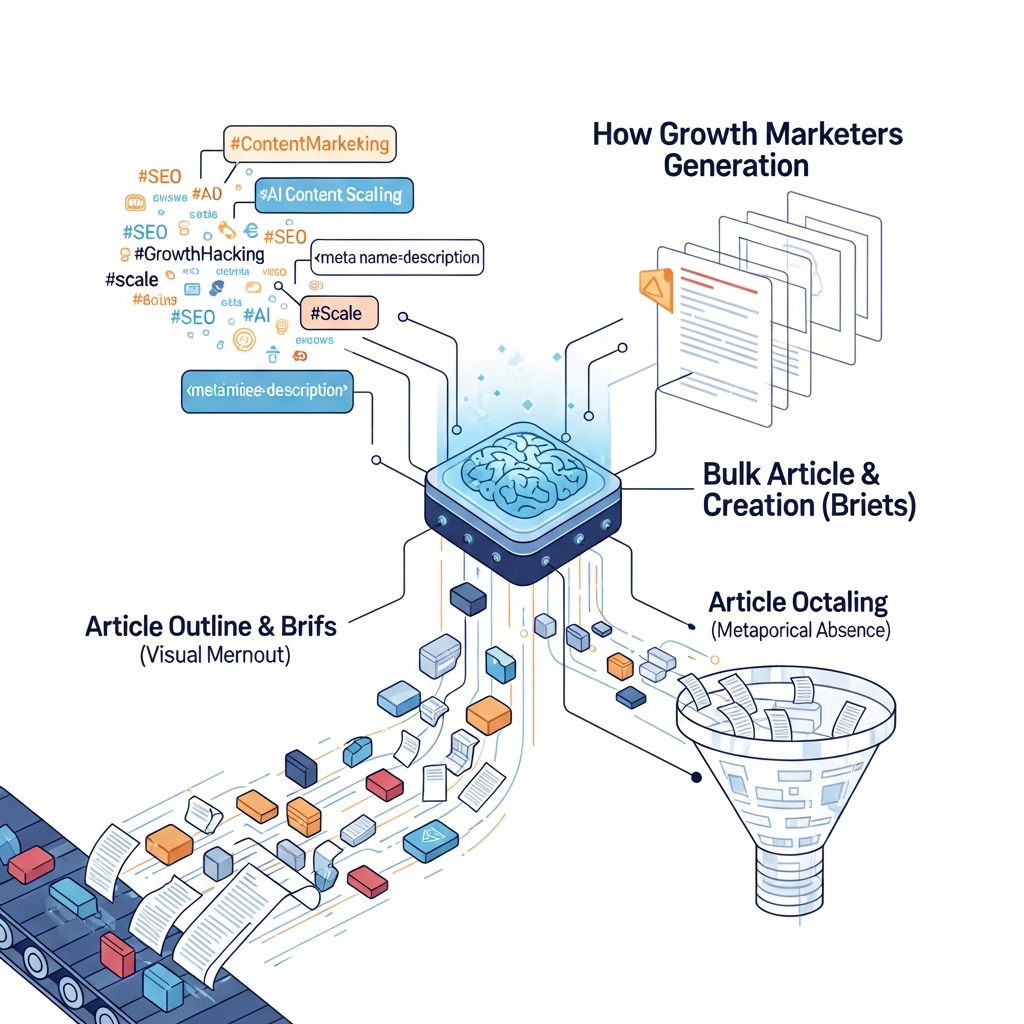
Artificial intelligence can dramatically accelerate the outline and brief stage, freeing writers to focus on depth and clarity. The process typically looks like this:
- Input the pillar topic and target keywords.
- Generate a structured outline with sections, subheadings, and suggested data points.
- Create a brief for writers that includes tone, audience, length, and SEO requirements.
- Review outlines for completeness, accuracy, and potential gaps.
Quality control starts at the outline. A well-crafted outline reduces rewrites and keeps content aligned with user intent. It also makes it easier to scale: multiple writers can produce drafts from the same core blueprint without diverging from the topic’s spine.
When paired with a brand voice guardrail, AI-generated briefs ensure that every article sounds consistent, even when produced by a larger team. Regular audits of outlines against published articles help refine prompts and improve future outputs.
AI-optimized meta tags and keyword generation
Meta tags remain critical for click-through and on-page relevance. AI can accelerate the creation of meta titles, descriptions, and keyword decorations (schema, alt text, and header metadata) while ensuring alignment with the article’s intent. A typical workflow looks like this:
- Extract primary keyword and related terms from the topic brief.
- Generate multiple meta title options that balance search intent and brand voice.
- Create meta descriptions that include primary and secondary keywords, while remaining compelling to users.
- Suggest internal linking opportunities and image alt text to reinforce semantic relevance.
Remember to review AI-generated metadata for accuracy and brand compliance. AI works best as a first pass, not a final governor. Human editors should verify keyword stuffing risks, ensure readability, and validate that metadata respects platform guidelines and update cycles.
To see practical examples of applying AI-driven meta and keyword workflows, you can explore related hands-on guidance in our sister resources. For instance, a breakdown of a 30-day automated content calendar demonstrates how metadata evolves as topics scale across a content plan. 30-day automated content calendar shows how metadata and structure adapt batch-by-batch.
Workflow automation for content creation
Automation is the heartbeat of scale. It’s not about removing humans; it’s about orchestrating people, content, and systems into a predictable rhythm. Core automation domains include content calendar management, outline generation, drafting, QA, publishing, and performance monitoring. A practical automation stack often includes:
- Content calendar automation that triggers outlines and briefs when topics are ready.
- Template-driven drafting with AI assistance and defined guardrails for tone and accuracy.
- QA gates that automatically check for keyword usage, readability, and factual consistency.
- CMS publishing workflows with content staging, SEO metadata, and internal-linking automation.
Automation reduces manual frictions and frees editors to focus on strategic decisions—audits, topic expansion, and cross-functional alignment. It also enables governance by providing auditable trails, version history, and repeatable processes that scale with your organization.
Important governance few teams discuss early enough: establish role-based access, data privacy controls, and an SLA for content reviews. When you pair automation with clear ownership, scale becomes a sustainable long-term capability rather than a burnout scenario.
Measuring ROI and governance
Scale without governance is a funnel for waste. ROI in automated content comes from a combination of traffic growth, engagement metrics, and downstream conversions. Define a small set of leading indicators for each pillar topic, such as organic impressions, click-through rate, dwell time, and on-page conversions. Tie these to quarterly targets to keep leadership informed.
Governance also means visibility. Establish dashboards that show progress against plan, content quality scores, and adherence to brand voice. The goal is to have a single source of truth that can be audited, rather than a pile of disparate spreadsheets. When possible, use multi-site or multi-brand dashboards to compare performance and identify scaling opportunities.
Governance is more than analytics. It’s about access control, data security, and vendor oversight. If you’re evaluating tools or partners, ensure you have clear SLAs, SOC2-type assurances, and documented update paths to handle platform evolution without disrupting publication cycles.
For readers who want concrete guidance on governance dashboards, our framework emphasizes three pillars: revenue alignment, content quality, and operational efficiency. A related deep-dive on governance and dashboards shows practical steps to prove value with automated SEO dashboards. ROI dashboards that prove value offers a blueprint you can adapt to your stack.
Pitfalls and best practices
Bulk content at scale comes with common traps. Avoid these pitfalls by anchoring your process to quality and intent:
- Overemphasizing quantity at the expense of accuracy or brand voice.
- Neglecting semantic relationships and internal linking, which weakens topical authority.
- Relying on AI for content that requires nuanced expertise or local market knowledge without human checks.
- Underinvesting in data privacy, governance, and security—particularly for multi-site operations.
- Skipping QA gates that catch SEO metadata misfires or factual inaccuracies before publish.
Best practices to counter these pitfalls include: deploy a lightweight QA checklist, implement a review cadence in your calendar, and maintain a living style guide that AI prompts reference. Also, regularly refresh topic clusters to reflect changing user intent and competitive dynamics.
Incorporating localization and language quality is essential when publishing across geographies. For teams exploring multilingual automation, consider dedicated localization workflows and native QA checks to preserve nuance and regulatory considerations across markets. If you’re evaluating localization automation examples, a case study-style approach helps illustrate how to scale language-specific content without losing quality.
Practical blueprint: step-by-step plan
Here’s a concrete, repeatable blueprint you can adapt to your stack and team size.
- Define 4–6 pillar topics and map a keyword intent for each. Create a simple content calendar with batch windows (e.g., two days for outlines, one day for drafting, one for QA).
- Set up AI-assisted outlines and briefs using a standardized template. Validate prompts against your brand voice and audience personas.
- Generate meta tags and on-page metadata in bulk, with human review checkpoints.
- Automate draft-to-publish workflows in your CMS, including internal linking, image optimization, and schema markup.
- Implement a lightweight QA gate and performance monitoring dashboard. Track leading indicators like impressions, CTR, and time on page.
- Review results quarterly, refine topics, and adjust the content calendar to close gaps in coverage or capitalize on topical shifts.
For teams seeking additional real-world context, see how 30-day content calendars can jumpstart SEO at scale. 30-day automated content calendar provides a practical blueprint you can mirror in your planning process. Another resource highlights governance and ROI dashboards to prove value to stakeholders. ROI-focused dashboards serve as a blueprint for measurement. And for teams operating in non-English markets, a regional automation example demonstrates localization workflows. São Paulo publication automation offers relevant guidance.
With discipline, your team can scale content production while maintaining quality, voice, and SEO performance. The key is to treat bulk creation as an integrated system rather than a collection of individual tasks. When each stage feeds the next with clear guardrails and verifiable checks, you can publish more, do it faster, and keep the brand strong.