Automated SEO Platform for Agencies and Teams: Scale Content Without Burnout
Introduction
Agency leaders are juggling client demands, publish cadence, and the constant pressure to demonstrate ROI. The promise of an automated SEO platform for agencies and teams is simple in concept: generate high-quality content, optimize at scale, and publish with minimal manual toil. The deeper reality, however, lies in balancing speed with quality, governance with agility, and automation with brand voice.
In this guide, you’ll find a practical blueprint for using an automated SEO platform to scale content across multiple clients and sites without burning out your teams. We’ll explore the core capabilities, governance practices, and deployment strategies that separate a good automation tool from a game-changing platform.
What Is an Automated SEO Platform for Agencies and Teams?
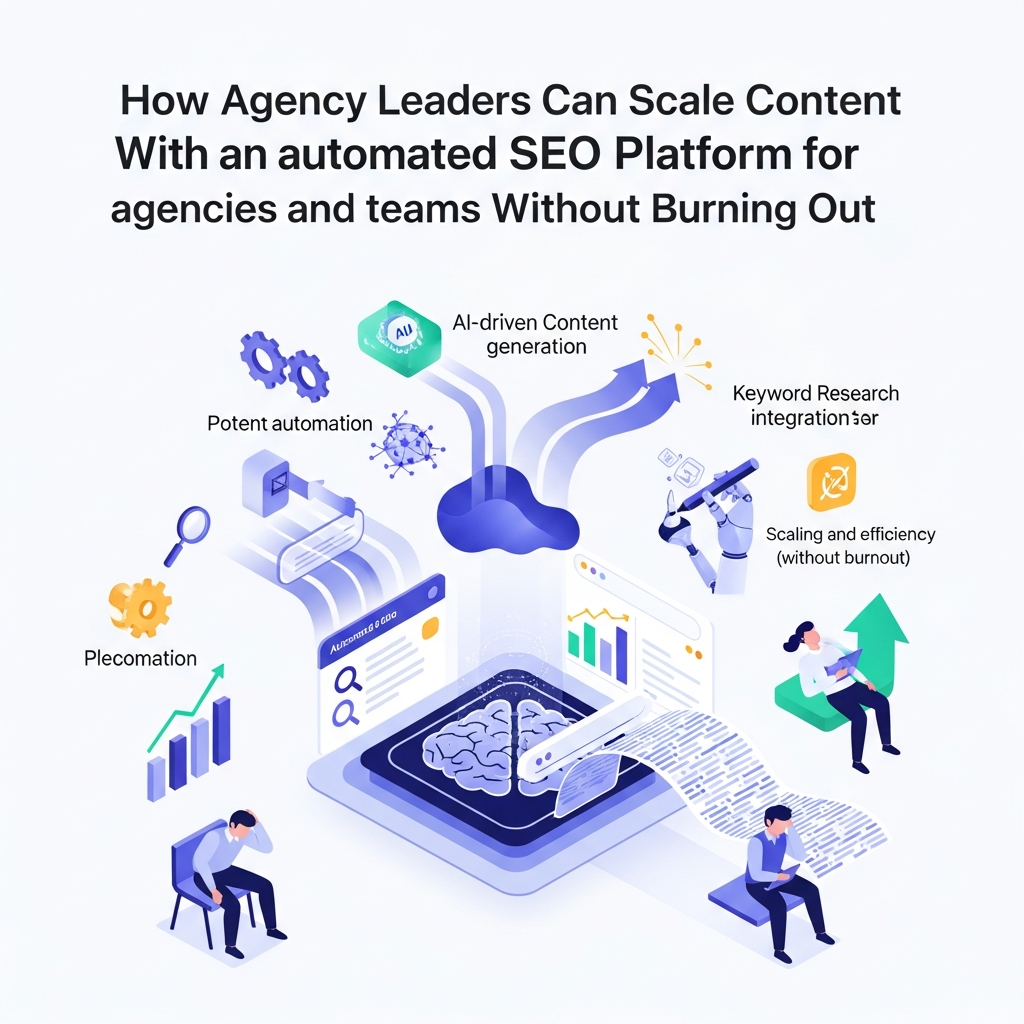
An automated SEO platform designed for agencies and teams combines several capabilities into a single workspace: AI-assisted content generation, integrated keyword research, AI-powered content strategy, workflow automation for creation and optimization, and end-to-end orchestration from ideation to publishing and reporting. The objective is to enable scalable, consistent outcomes across many clients and brands without sacrificing quality or control.
Think of it as a content operations hub that aligns strategy, execution, and measurement. It’s not about replacing human expertise; it’s about amplifying it with reliable automation, governance, and visibility. When built correctly, this approach shortens cycles, reduces manual error, and creates a repeatable process that teams can trust.
Core Capabilities
AI-Driven Content Generation for SEO Campaigns
AI-generated briefs and outlines speed up kickoff, but the real value comes from human-in-the-loop review that preserves tone, accuracy, and brand voice. A robust platform offers configurable templates, topic clusters, and prompts tailored to industries, enabling writers to hit briefed targets consistently. For agencies, this capability scales content calendars across dozens of clients without sacrificing quality.
Practical tip: pair AI-generated drafts with a dedicated QA checklist that covers accuracy, factual confidence, and citation integrity. This guardrail preserves trust while maintaining velocity.
Integrated Keyword Research and Content Automation
Integrated keyword research means the platform surfaces opportunity keywords, intent-based clusters, and semantic variations within the same workflow that creates content. This minimizes handoffs between tools and reduces the time from idea to publish. When you, as an agency, bring multiple sites into one dashboard, you can capacity-plan around high-opportunity topics and optimize for multilingual markets as needed.
Best practice: establish a living keyword map that updates according to ranking shifts, seasonality, and client strategic priorities. Tie these into content calendars so that every published piece has a clear, business-aligned intent signal.
Content Strategy Driven by AI for SEO
AI can analyze search intent patterns, competitive gaps, and historical performance to propose content strategies that align with client goals. The platform should translate insights into a concrete content calendar, with recommended topics, formats, and distribution channels. The stronger the alignment between AI insights and human editorial judgment, the better the outcomes across indicators like traffic, engagement, and conversions.
Tip: build a governance layer on top of AI recommendations. Include editorial reviews, client approvals, and brand-voice checks to ensure every piece serves broader marketing objectives.
Workflow Automation for Content Creation and Optimization
End-to-end workflow automation connects discovery, creation, optimization, internal linking, publishing, and reporting. Automations should handle routine tasks such as metadata generation, schema tagging, internal linking suggestions, and recurring content-refresh cycles. The aim is to reduce manual handoffs and create reliable SLAs for each stage of the lifecycle.
Best practice: design modular automations so that teams can insert new steps (e.g., multilingual localization or CMS-specific optimizations) without rearchitecting the entire pipeline.
End-to-End SEO Automation
End-to-end automation means the platform supports multi-site management, centralized dashboards, and governance controls across brands. Features to prioritize include security and data privacy, access controls, audit trails, and API support for custom integrations. For agencies serving multiple clients, centralized management translates into faster onboarding, consistent reporting, and scalable workflows.
Performance consideration: ensure your platform provides actionable dashboards that translate raw data into ROI metrics your clients understand, such as organic revenue impact, qualified traffic, and time-to-publish reductions.
Scaling Your Content Strategy Across Clients
Scaling requires a repeatable rhythm that teams can own. Start with a tight baseline: a repeatable content calendar, a core keyword map, and a governance model that supports white-label delivery if you operate as an agency. Then layer on automation gradually, validating each step with real client results before expanding scope.
- Define a scalable content taxonomy: tier topics by client priority and seasonality.
- Build templates for briefs, outlines, and editors’ checklists to maintain consistency across clients.
- Implement a staged publishing calendar with automated QA gates and client approvals.
As you scale, consider multi-site management capabilities, so you can oversee dozens of client sites from a single interface. You’ll want centralized reporting that consolidates wins across all engagements, making it easier to demonstrate value to leadership and clients alike.
For practical examples and inspiration, explore our articles on automated calendars and ROI dashboards: Automated 30-day content calendar and ROI and governance dashboards. Also, see a regional application in Sao Paulo automation for ecommerce in Brazil.
Governance, ROI, and Quality Assurance
Automation without governance is risky. Establish clear roles, access controls, and approval workflows that preserve brand safety and compliance. ROI should be tracked with standardized metrics that tie content investments to traffic, lead quality, and revenue outcomes. A robust platform provides dashboards and reporting templates that translate raw data into business-impact narratives for clients and executives.
Key governance practices include iterative QA, version control for content assets, and a transparent change log. When combined with automated testing for internal links, structured data, and page speed, governance becomes a competitive advantage rather than a compliance burden.
Internal links may be a valuable way to anchor governance practices. For example, teams can reference a best-practices article like ROI and governance dashboards to align stakeholders around measurable outcomes.
Deployment Blueprint: How to Roll Out Automation with Confidence
Begin with a pilot program that covers a small set of clients, a defined content calendar, and measurable success metrics. A well-planned pilot reduces risk and builds stakeholder confidence as you scale. Your blueprint should include onboarding milestones, training for editors and analysts, and a clear handoff to client-facing teams.
Phase guidelines you can adapt:
- Discovery and setup: map client needs to automation templates and the keyword plan.
- Content production sprint: generate and publish a defined batch of content with QA gates.
- Measurement and optimization: review results, refine prompts, and adjust the calendar.
- Scale: extend to additional clients and sites with standardized SLAs.
For concrete guidance on governance and ROI, see ROI dashboards and governance.
Real-World Scenarios and Use Cases
Scenario A: An agency handles 25 SMB clients. With automation, they standardize a 60-day content calendar, automate briefs, and publish across WordPress and Shopify sites. Editorial teams review AI drafts, preserving brand voice while accelerating throughput. Outcome: higher publish velocity with consistent quality and better client reporting.
Scenario B: A mid-market ecommerce brand launches a new product line. AI-driven keyword research identifies intent signals and content opportunities, while automated workflows manage page updates, structured data, and internal linking. Outcome: faster time-to-market and stronger product-page rankings.
Scenario C: An enterprise marketer needs governance across hundreds of sites. Centralized dashboards consolidate performance, and SOC2-compliant controls ensure data privacy. Outcome: scalable SEO across brands with auditable reporting for executives.
Choosing the Right Platform: A Practical Evaluation
When evaluating platforms, prioritize: multi-site management, integration depth with CMSs (WordPress, Webflow, Shopify), robust keyword research, AI-assisted content generation quality controls, and transparent ROI reporting. Create a checklist that includes security, compliance, onboarding time, and vendor support levels. A strong partner will provide white-label options, clear SLAs, and roadmap visibility to support enterprise-grade deployments.
To structure your evaluation, use a framework that covers: (1) capability fit, (2) governance and compliance, (3) ease of onboarding, (4) analytics and ROI, and (5) total cost of ownership. For broader market context and use cases, review industry-focused resources like the linked articles in this piece.
Common Pitfalls and How to Avoid Them
Pitfall 1: Over-reliance on AI without human QA. Mitigation: maintain editorial and factual QA steps to preserve quality and accuracy.
Pitfall 2: Inadequate governance for multi-site deployment. Mitigation: implement role-based access, audit trails, and centralized governance policies.
Pitfall 3: Poor integration with client CMS and analytics tools. Mitigation: choose platforms with open APIs and proven CMS integrations; test data flows during onboarding.
Pitfall 4: Unrealistic ROI expectations. Mitigation: define realistic KPIs, pilot timelines, and staged expansions to ensure measurable gains.
Conclusion
An automated SEO platform for agencies and teams is not a magic tool; it’s a strategic engine. When thoughtfully implemented with AI-generated content, integrated keyword research, AI-driven strategy, and disciplined workflow automation, it enables scalable, high-quality content at scale. The result is faster client delivery, clearer governance, and ROI that can be demonstrated across dozens of sites and campaigns.
To see how automation can specifically support your agency or team, explore practical resources and case studies in the linked posts above, and consider starting with a small pilot to build confidence and refine your playbook.
Further reading and resources: