How Agency Growth Leaders Can Scale Content Without Burnout Using an Automated SEO Platform for Agencies and Teams
Why an automated SEO platform matters for agencies and teams
Agency growth hinges on ability—and speed. The demand for fresh, optimized content across multiple client domains puts a strain on even the most capable teams. An automated SEO platform designed for agencies and teams helps you orchestrate content production, optimize for search intent, and maintain brand voice at scale. The goal is not to replace humans, but to augment their capabilities with reliable processes, governance, and insight.
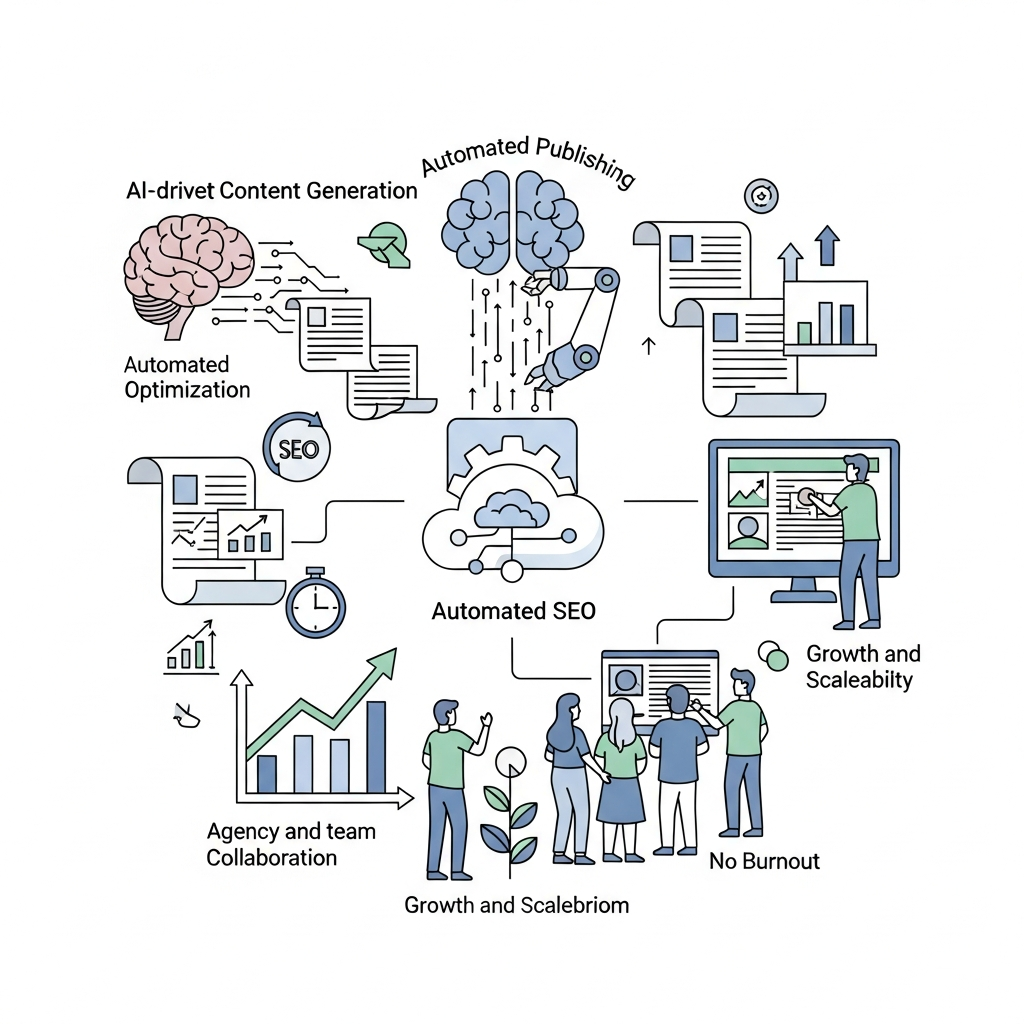
Think of an automated platform as the central nervous system for multi-site SEO. It coordinates keyword research, content briefs, publication schedules, on-page optimization, and performance analytics. When configured correctly, it reduces the time from idea to publish, improves consistency, and creates auditable signals that can be shared with clients and leadership.
For agencies juggling dozens of clients or in-house teams managing multiple brands, the ability to standardize workflows while preserving client-specific nuances is a competitive advantage. The platform should support multi-site management, localization, and secure data handling across teams and clients.
Scale content workflows without burning out your team
Burnout is a real risk when teams try to keep pace with demand. Automated platforms mitigate this by turning repetitive tasks into repeatable processes. You still need human oversight to validate quality, brand voice, and strategic alignment, but you gain latitude to focus on higher-value activities like strategy refinement, link building, and client storytelling.
Key approaches to scale without burnout include:
- Automating content ideation and outlines using AI-augmented briefs that align with client targets.
- Implementing a standardized publishing cadence that mirrors client calendars and seasonal campaigns.
- Automating on-page optimization signals, meta tags, and internal linking where appropriate.
- Building centralized dashboards for visibility across all sites and clients.
As you scale, the platform’s governance tools matter as much as speed. Version control, role-based access, and audit trails ensure you can demonstrate consistent quality and compliance across clients and regions.
Core features of an automated SEO platform for agencies
The most effective platforms bring together several capabilities that align with the needs of agencies and teams. Below are the core areas to assess.
AI-driven content generation and optimization
AI-driven content generation helps you draft initial article outlines, briefs, and even first drafts that you can refine. The best systems incorporate keyword research, semantic relevance, and brand voice constraints, so the output aligns with client goals from the outset. Combined with on-page optimization suggestions, this feature accelerates production while preserving quality.
Automated publishing and optimization for blog sites
Automation for publishing to CMS platforms (WordPress, Shopify, Webflow, etc.) reduces manual handoffs. Automated optimization includes meta tag generation, image alt text, schema markup, and internal linking suggestions designed to improve crawlability and click-through rates. The platform should support multi-site publishing workflows and flag any conflicts with client guidelines or legal considerations.
Integrated keyword research and content automation
Keyword research should be tightly coupled with content briefs. Expect keyword intent classification, clustering, and prioritization that feed directly into content calendars. This integration ensures each post targets the right audience and answers the questions that matter to search engines and users alike.
ROI, governance, and measurable outcomes
ROI is not just a metric; it’s a governance discipline. A mature automated SEO platform provides dashboards that translate activity into business value. Look for end-to-end visibility—from keyword discovery and content production to publication performance and client reporting.
Important governance features include:
- Client-specific dashboards with configurable metrics (traffic, rankings, conversions, revenue impact).
- Audit trails showing who did what, when, and why—supporting transparency with clients.
- SLA options and multi-provider governance to manage relationships across agencies and teams.
- Security controls and data protection measures suitable for enterprise use, including SOC2 considerations if applicable.
To connect strategy to dollars, tie content performance to KPI targets such as organic traffic growth, keyword rank movement, and revenue lift from organic channels. Dashboards should harmonize data from analytics tools with content tooling, delivering a clear ROI narrative for leadership and clients alike.
For readers seeking practical guidance, we cover ROI measurements and governance in more detail in our dedicated guide: measuring ROI and governance in automated SEO dashboards that prove value.
A practical pilot playbook to start fast
Pilots are essential to prove value before large-scale commitments. A well-designed pilot reduces risk and surfaces the adjustments needed for enterprise-scale adoption.
Define success metrics and a limited scope
Choose a small, representative set of clients or a single multi-site client to pilot. Define concrete metrics: content output per week, average time to publish, client-approved quality scores, and a measurable lift in target KPIs after a 60- to 90-day period.
Set governance and data boundaries
Clarify who can access which data, how data is stored, and how reports are shared with clients. Include security considerations and privacy controls suitable for the client types you serve.
Plan migration from manual to automated processes
Map current workflows and identify bottlenecks. Create a phased migration plan that gradually expands automation while preserving editorial integrity. Include a fallback plan if the automation misses critical brand signals.
For practical steps and a detailed blueprint, see our guide on a 30-day content calendar to jumpstart SEO at scale: Automated 30-Day Content Calendar: Jumpstart SEO at Scale.
Real-world use cases by agency size
Different organizations face different constraints. Here are three representative scenarios.
Multi-site agencies with centralized governance
Large agencies juggling dozens of brands benefit from centralized dashboards, standardized content calendars, and automated internal linking strategies. The platform enables you to align multi-brand voices while maintaining brand-specific constraints and compliance requirements.
In-house teams at SMBs or startups
In-house teams often struggle with bandwidth and need rapid content cycles. An automated platform accelerates ideation, drafting, and posting, while allowing teams to iterate quickly based on performance data and client feedback.
Enterprise marketing with complex vendor ecosystems
Enterprises demand enterprise-grade governance, security, and integration with multiple CMSs and analytics tools. The right platform provides governance controls, robust SLA options, and a roadmap that scales with organizational growth.
Real-world patterns and lessons learned are summarized in our enterprise-focused resources and case studies. You can explore practical approaches through related posts and guides on our site.
Risks, pitfalls, and best practices
Every automation journey has potential pitfalls. Common risks include over-reliance on templates that erode brand voice, gaps in content quality control, and insufficient human review that leads to inaccurate or misaligned posts. To mitigate these risks:
- Maintain a human-in-the-loop for final approval and brand voice calibration.
- Build rigorous quality checks into the workflow, including editorial review checkpoints.
- Establish clear guidelines for localization, cultural nuance, and legal/compliance constraints across regions.
- Continuously measure and tune content strategy based on performance data and client feedback.
Best practices also include starting with a strong content calendar, clearly defined briefs, and a feedback loop that informs model improvements and process refinements.
How to choose the right platform: evaluation criteria
Selecting a platform requires evaluating capabilities against your unique needs. Consider these criteria:
- Scope of automation: content ideation, drafting, publishing, optimization, and linking.
- Multi-site management: the ability to govern many sites with centralized controls.
- CMS integrations: native or API-based connections to WordPress, Webflow, Shopify, and others.
- Language and localization support: localization workflows for global brands.
- Security and compliance: data privacy, access controls, and compliance certifications.
- ROI signaling: dashboards that translate activity into tangible business value.
- Support and partnerships: white-label options, SLAs, and vendor reliability.
To explore practical guidance, you can consult our in-depth resource on governance and ROI dashboards mentioned earlier. It provides a framework for evaluating automation tools and measuring value for clients and leadership.
For readers interested in a Brazil-specific automation approach, you can review our Brazilian ecommerce automation post: São Paulo: Automatize Publicação para Ecommerce Brasileiro.
Closing thoughts
An automated SEO platform for agencies and teams is not a universal cure-all. It is a strategic investment that, when paired with thoughtful governance, human oversight, and client-centric workflows, can unlock scale without sacrificing quality. The objective is to create repeatable, auditable processes that empower teams to deliver results faster and with more predictability.
As you consider next steps, remember that pilots and phased rollouts reduce risk and accelerate learning. Leverage the right internal links, benchmarks, and client feedback to continuously improve your approach and demonstrate value across your portfolio.
To dive deeper into practical implementations and governance, our related resources offer concrete playbooks and templates you can adapt for your organization. For example, see the 30-day content calendar guide, ROI-focused governance, and a localized case study from Brazil to understand how localization workflows can scale across markets.
Internal references you may find helpful: