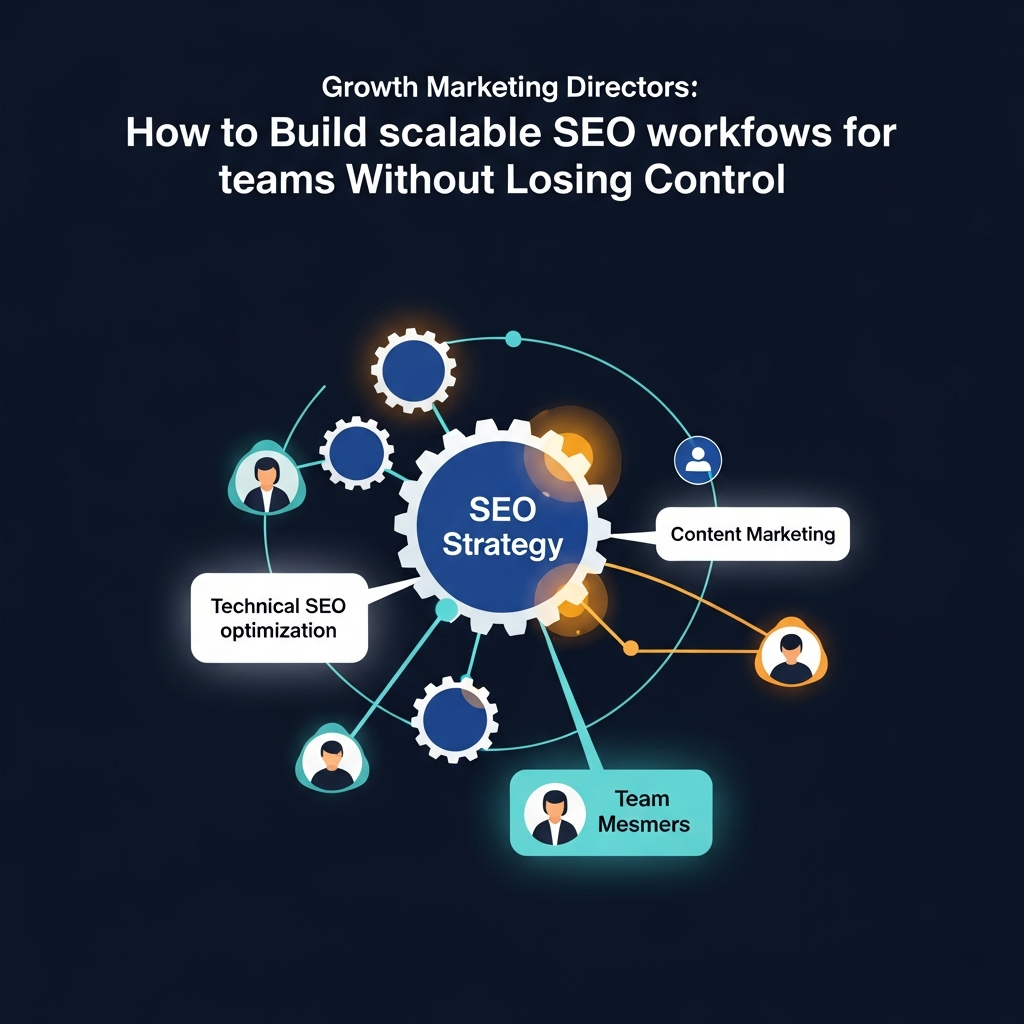
Growth Marketing Directors: How to Build scalable seo workflows for teams Without Losing Control
Growing organic visibility at scale without losing governance is one of the defining challenges for growth marketing leaders today. The goal is to design scalable seo workflows for teams that deliver consistent results across multiple sites, languages, and product lines. This guide walks through a practical framework—balancing automation, robust governance, and data-driven decision making—to help you accelerate ROI while preserving control.
Why scalable SEO workflows matter
In fast-moving organizations, success hinges on repeatable, auditable processes. Scalable seo workflows for teams enable you to standardize keyword research, content optimization, technical audits, and reporting so that every channel can operate with a shared playbook. When workflows are scalable, teams move faster, errors decrease, and performance is easier to measure across quarterly cycles.
Without a scalable approach, teams often stumble on bottlenecks: writers missing briefs, crawls that stall on large sites, or dashboards that fail to reflect true ROI. The remedy is not merely more tools; it’s a governance-enabled, modular system where each component can be upgraded or swapped without destabilizing the whole operation. This is especially important for multi-brand or multi-market programs where consistency and speed matter as much as accuracy.
Design principles for scalable workflows
To build scalable seo workflows for teams, start with a clear design blueprint that you can repeat across teams and sites. Key principles include modularity, automation with guardrails, governance and visibility, and continuous improvement through measurable experiments.
- Modularity: Break processes into discrete, replaceable modules (audits, keyword research, content briefs, on-page optimization, linking, analytics). This makes it easy to upgrade one module without rewriting the entire workflow.
- Automation with guardrails: Automate repetitive tasks (data collection, template creation, metadata population) while embedding guardrails (quality checks, approvals, rollback plans) to preserve quality.
- Governance and visibility: Define roles, SLAs, data ownership, and access controls. Central dashboards should reflect progress, risks, and ROI in real time.
- Data-driven iteration: Treat each campaign as an experiment. Establish hypotheses, run controlled tests, and document outcomes to inform the next cycle.
In practice, this translates into a repeatable cadence: quarterly audits, monthly optimization sprints, weekly dashboards, and a centralized content calendar that aligns with keyword priorities and product launches. The emphasis is on predictable, measurable improvements rather than one-off wins.
Governance, visibility, and control
Governance is the backbone of scalable seo workflows for teams. Without it, ROI calculations become unreliable and cross-team collaboration suffers. A robust governance model includes role-based access, documented processes, version control for assets, and transparent performance reporting.
Key governance components include:
- Roles and ownership: Assign owners for audits, content briefs, on-page optimization, and analytics. Ensure handoffs are clear and tested.
- SLAs and performance thresholds: Define minimum acceptable results, response times for requests, and escalation paths for blockers.
- Auditability and change logs: Record changes to pages, metadata, and schema; maintain an auditable trail for governance reviews.
- Central dashboards: Use dashboards that consolidate site dashboards, keyword performance, traffic, and ROI across teams and markets.
Governance is not a tax on speed; it is the framework that ensures scale is sustainable. For teams operating across multiple sites, governance reduces risk and speeds up decision making because everyone follows the same playbook with clear criteria for success.
Technical SEO strategies
Technical foundations determine how far you can scale SEO, especially when managing numerous pages or multilingual sites. Scalable seo workflows for teams rely on proactive technical optimization, consistent crawlability, and reliable page experience signals.
Core areas to standardize include:
- Crawlability and indexation: Maintain clean sitemap structures, robots.txt health, and canonical strategies that reflect site architecture. Regular crawl budget reviews prevent bottlenecks on large catalogs.
- Site architecture: Implement a modular, logical hierarchy with consistent URL patterns and breadcrumb trails that improve navigation and internal linking.
- Schema and structured data: Adopt a starter set of schema types (product, article, FAQ, Organization) with templates that auto-populate from content briefs.
- Page speed and performance: Optimize images, leverage caching, and monitor critical rendering paths. Speed improvements have compounding effects on rankings and conversions.
- Localization and international SEO: Standardize hreflang usage, translation workflows, and geo-targeting signals to enable scalable localization across markets.
When applying these strategies at scale, build automated checks. For example, automated metadata templates reduce manual errors, while scheduled audits detect page-level issues before they impact rankings. Consider a phased rollout: begin with high-ROI sections (product pages, cornerstone content) and expand to supporting pages as governance matures.
Practical example: automation guardrails for on-page optimization
Imagine a workflow that automatically extracts on-page elements from a content brief, applies canonical rules, and flags potential keyword cannibalization. A human reviewer then approves or adjusts before publishing. This combination of automation and governance ensures consistency without sacrificing speed. For a deeper dive into automation guardrails, explore our guide on automated content calendars and governance dashboards linked below.
Content marketing and SEO integration
SEO and content marketing should be two sides of the same workflow. Scalable seo workflows for teams require a tightly integrated content calendar, keyword-driven briefs, and a QA process that validates both SEO and editorial quality.
Best practices include:
- Keyword-driven briefs: Each content piece starts with a brief grounded in keyword strategy, intent, and audience personas.
- Editorial alignment: Sync editorial calendars with SEO priorities so that publish cadence matches search demand and promotional calendars.
- Content briefs and templates: Use standardized templates for title tags, meta descriptions, header hierarchies, and internal linking guidance.
- Internal linking strategies: Plan linking structures during content planning to distribute authority efficiently across the site.
Automation accelerates this integration by auto-generating briefs from keyword analyses, but human review remains essential to preserve brand voice and quality. For an actionable example of content automation in practice, see our post on an automated 30-day content calendar.
As you scale, consider localization needs. A global site often requires separate content calendars and keyword plans per region. See our localization resources and localized content playbooks for more detail. If you’re exploring multilingual workflows, you might also find localized case studies informative, such as the Sao Paulo automation piece linked here.
Internal reading: Automated 30-Day Content Calendar: Jumpstart SEO at Scale, Measuring ROI and Governance in Automated SEO Dashboards, and Sao Paulo: Automatize Publicação para Ecommerce Brasileiro.
Analytics-driven improvements and ROI
Analytics are the compass for scalable seo workflows for teams. A data-driven approach helps you quantify ROI, justify budgets, and optimize workflows across domains. Build dashboards that translate SEO activity into business outcomes—traffic, conversions, and revenue—at a glance.
Key analytics practices include:
- ROI-focused metrics: Track incremental traffic, engagement metrics, and revenue attribution by channel, geography, and product line.
- Unified dashboards: Consolidate GA4, Search Console, and CMS data into a single view with week-over-week and month-over-month comparisons.
- Experimentation framework: Use controlled experiments to test keyword changes, metadata updates, and internal linking strategies before full deployment.
- Governance through dashboards: Align stakeholders with transparent KPI ladders, milestones, and escalation paths when targets aren’t met.
ROI storytelling matters. When leadership can see a clear path from an optimization to revenue impact, procurement cycles accelerate. For a concrete governance approach to dashboards, our referenced piece on ROI governance provides a structured template you can adapt to your organization.
Operational playbook: step-by-step setup
Here is a practical, repeatable sequence to establish scalable seo workflows for teams in your organization:
- Audit and baseline: Map current workflows, identify bottlenecks, and define initial KPIs aligned with business goals.
- Define the playbook: Create modular process templates for audits, keyword research, content briefs, on-page optimization, internal linking, and reporting.
- Select automation guardrails: Establish quality checks, approvals, and rollback plans to prevent errors from propagating.
- Roll out in phases: Start with high-ROI areas (product pages, cornerstone content) and expand to supporting assets as governance matures.
- Build governance dashboards: Create a central view for all sites and teams, with role-based access and clear SLAs.
- Institutionalize a review cadence: Schedule quarterly audits, monthly optimization cycles, and weekly status updates.
- Measure and iterate: Capture results, refine templates, and adjust KPIs based on outcomes and market changes.
For a deeper dive on the playbook structure and sample templates, review our related resources on automated content calendars and governance dashboards.
Scaling across teams and sites
Scaling requires governance that travels across brands, regions, and platforms. Multi-site programs benefit from centralized control planes, localization-ready templates, and standardized onboarding for new markets or clients. The objective is to minimize friction when adding a new site while preserving the integrity of your SEO foundations.
Practical scaling tips include:
- Centralized templates: Use universal templates for briefs, metadata, and schema that adapt to site-specific contexts.
- Localization workflows: Create regional workflows with language-specific guidelines, translators, and QA checkpoints.
- Onboarding playbooks: Standardize onboarding processes for new teams or markets to accelerate time-to-value.
- Cross-team governance: Ensure shared metrics and governance reviews so all sites stay aligned with corporate goals.
As you scale, maintain a feedback loop. Regularly solicit input from site owners and editors to refine templates, dashboards, and SLAs. This continuous improvement mindset preserves performance while expanding reach.
Case studies and practical examples
While every organization is different, several patterns recur in successful implementations of scalable seo workflows for teams. A typical outcome involves a 15–40% uplift in target-page rankings, improved crawl efficiency, and clearer ROI signals within 6–12 months of implementing a governance-driven framework.
Example scenarios:
- A mid-sized ecommerce brand standardizes product-page optimization across 3 markets, achieving faster indexation and higher conversion rates with a shared metadata template and automated QA checks.
- A multi-brand publisher uses centralized dashboards to monitor keyword coverage, internal linking health, and author contributions, reducing time-to-publish by 30% while maintaining content quality.
- An enterprise company implements localization-ready workflow modules, enabling rapid expansion into new geographies with consistent technical SEO and governance across sites.
For readers seeking concrete, real-world grounding, the ROI governance and automated content calendar articles (referenced earlier) provide detailed frameworks and templates you can adapt to your organization.
Closing thoughts
Building scalable seo workflows for teams is less about more tools and more about disciplined processes that scale. With modular design, guardrails, and transparent governance, growth marketing leaders can accelerate velocity, improve accuracy, and demonstrate ROI without surrendering control. The path to scale is iterative: start with a solid baseline, automate the repetitive work, and continuously refine the process based on data and feedback.
Interested in practical examples and templates? Explore the linked internal resources for automated content calendars and ROI governance dashboards to complement the concepts in this article. If you’re evaluating localization or enterprise-grade capabilities, consider how multi-site management and localization workflows can be standardized across your portfolio.