Growth Marketers: How to Scale Daily Publishing With an All-in-One SEO Automation Solution
Overview
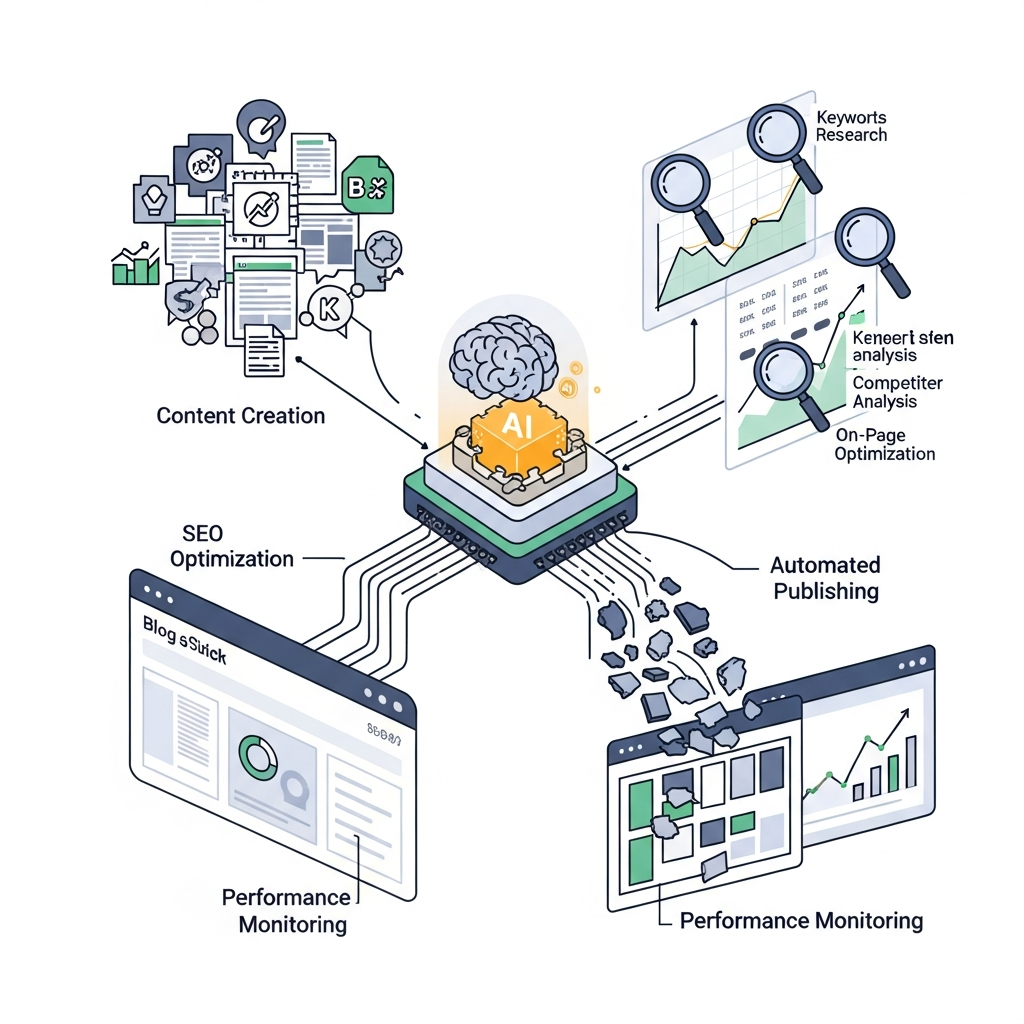
For growth-minded marketers, the ability to publish high-quality content every day without sacrificing SEO quality is a strategic advantage. An all-in-one SEO automation solution for marketers combines AI-driven content generation, automated publishing, on-page optimization, analytics dashboards, and centralized multi-site management. The goal is to scale daily publishing while maintaining brand voice, relevance, and measurable ROI.
This guide outlines a practical playbook to deploy AI-driven content automation across teams, with guardrails that protect quality and governance. You’ll find actionable steps, templates, and examples to help you move from pilot to enterprise-scale across multiple sites and markets.
Why AI-driven SEO automation matters
Automation isn’t about removing humans from the loop; it’s about removing repetitive friction so your teams can focus on strategy, quality, and experimentation. AI-driven content generation accelerates ideation and rough drafting, while automated publishing and optimization ensure that every post is primed for search engines and readers alike.
Key advantages include:
- Consistent publishing cadence across teams and time zones.
- Standardized on-page optimization, such as meta tags, headings, and internal linking, at scale.
- Centralized governance for multi-site programs, enabling global localization without losing brand coherence.
- Real-time analytics dashboards that translate activity into ROI signals.
As you evaluate options, prioritize platforms that offer native CMS integrations, API access, and robust security controls. For teams that operate across several languages or regions, centralized management and localization workflows become a decisive factor.
Designing a daily publishing pipeline
A practical publishing pipeline blends strategy, automation, and human QA. The aim is to reduce manual effort without compromising content quality or relevance. Below is a blueprint you can adapt to your own team structure.
3.1 Content calendars and briefs
Start with a shared, AI-assisted content calendar that outlines topics, keywords, and publishing dates. Build briefs that include target personas, intent signals, and required media (text, images, schema). This ensures writers and editors know exactly what to deliver and when.
Tip: Use a customizable content calendar for SEO automation to plan at least 30 days ahead, while reserving slots for timely topics and evergreen assets. For a concrete example of a 30-day calendar, explore Automated 30-Day Content Calendar.
3.2 AI content generation and quality assurance
AI can draft outlines, intros, and even first-pass sections, but human QA remains essential. Establish a lightweight review protocol that checks for accuracy, tone, and brand voice. Use AI to generate variations and test which versions perform best in rankings and engagement.
Quality controls should include fact-checking routines, tone checks against a brand style guide, and localization QA for non-English assets. Over time, you’ll refine prompts, scoring rubrics, and automatic quality gates within the automation platform.
3.3 Publishing and optimization
Publishing should trigger on-page optimization routines: ensure proper title and meta tag generation, structured data where applicable, internal linking, and schema markup. Automations can re-publish updated content as rankings shift, provided governance rules are in place to prevent over-optimization.
To validate outcomes, pair publishing with performance dashboards that surface changes in impressions, clicks, and conversions. If you’re working with multiple sites, ensure centralized dashboards reflect cross-site performance without data silos.
Choosing the right all-in-one SEO automation solution
Not all automation platforms are equal. When evaluating options, map capabilities to your most pressing needs: speed of content production, quality governance, multi-site management, localization, and ROI visibility. A strong platform should offer:
- AI-driven content generation with controllable prompts and tone controls
- Automated publishing workflows integrated with your CMS
- Built-in on-page optimization, metadata generation, and internal linking
- Analytics dashboards that translate activity into ROI metrics
- Governance features for roles, approvals, and SLAs
- Multi-site centralized management and localization workflows
As you compare options, request a use-case driven demo focused on your top sites and languages. Don’t settle for a tool that can only publish; prefer a platform that demonstrates measurable impact on traffic, engagement, and revenue.
Implementation playbook
Rolling out an all-in-one SEO automation solution requires a staged approach that minimizes disruption while delivering early value. Here’s a practical path you can adapt.
- Define success metrics: Establish baseline traffic, ranking targets, average time-to-publish, and a ROI target. Align with executive sponsors and marketing leadership.
- Pilot scope: Start with a single brand or a small portfolio of sites, a defined content genre, and a 60–90 day window to prove value.
- Governance and roles: Set approvals, tone guidelines, localization rules, and data privacy requirements. Create a clear escalation path for content issues.
- Data and integrations: Connect your CMS, analytics, and keyword research tools. Ensure data flows are secure and auditable.
- Rollout plan: Expand to additional sites in waves, validating quality gates and ROI at each step. Schedule training for content teams and editors.
For more on governance and ROI governance, see our article on Measuring ROI and Governance in Automated SEO Dashboards.
Measuring ROI and governance
ROI is more than traffic growth. It includes publishing velocity, cost per article, and the quality uplift from automated optimization. Build dashboards that answer: how many articles published per week, how does ranking improve over time, what is the incremental revenue from SEO, and how do costs compare to manual processes?
Establish leading indicators (impressions, click-through rate, draft-to-publish cycle time) and lagging indicators (rank stability, revenue from organic channels). Use experiments to quantify lift, and document governance adjustments to improve reliability. For practical governance dashboards, see our guidance on ROI-focused dashboards.
Multi-site management and localization
Large teams operate across brands and geographies. A robust all-in-one solution should provide centralized control with locale-specific customization. Features to value include role-based access, translation workflows, content localization checks, and consolidated reporting across sites.
Localization isn’t just translation; it’s adapting search intent, cultural nuance, and regulatory considerations for each market. Centralized dashboards help leadership see cross-site performance and allocate resources accordingly. If you’re exploring multilingual automation, ensure your platform supports language-specific prompts, metadata, and internal linking rules.
Pitfalls, best practices, and guardrails
Automation is powerful, but it can drift without guardrails. Common pitfalls include over-automation that erodes brand voice, insufficient QA before publishing, and misconfigured localization that harms relevance. The best practice is to couple automation with lightweight human review at defined gates, maintain a living brand style guide, and continuously test prompts and templates.
Other guardrails include setting publishing limits, establishing a content quality score, and modeling data privacy and compliance in all workflows. Regularly review performance metrics and be prepared to pause or rollback automation if quality or ROI dips unexpectedly.
Templates and quick-start resources
If you’re ready to move from theory to practice, start with these templates:
- 30-day content calendar template: outlines topics, keywords, authors, and publishing dates. Included in our recommended resources above as a practical starting point for rapid scale.
- Content brief template: describes audience, intent, required media, tone, and localization notes.
- ROI dashboard blueprint: defines metrics, data sources, and visualization requirements.
For deeper dives into specific workflows, review our internal resources: Automated 30-Day Content Calendar, and Measuring ROI and Governance in Automated SEO Dashboards. You can also explore localization-focused insights here: Localization for ecommerce in Brazil.
Throughout this guide, we’ve emphasized a practical, ROI-focused approach. By combining a well-designed daily publishing pipeline with an all-in-one SEO automation solution for marketers, you can raise content velocity, improve search visibility, and deliver measurable value across audiences and geographies.