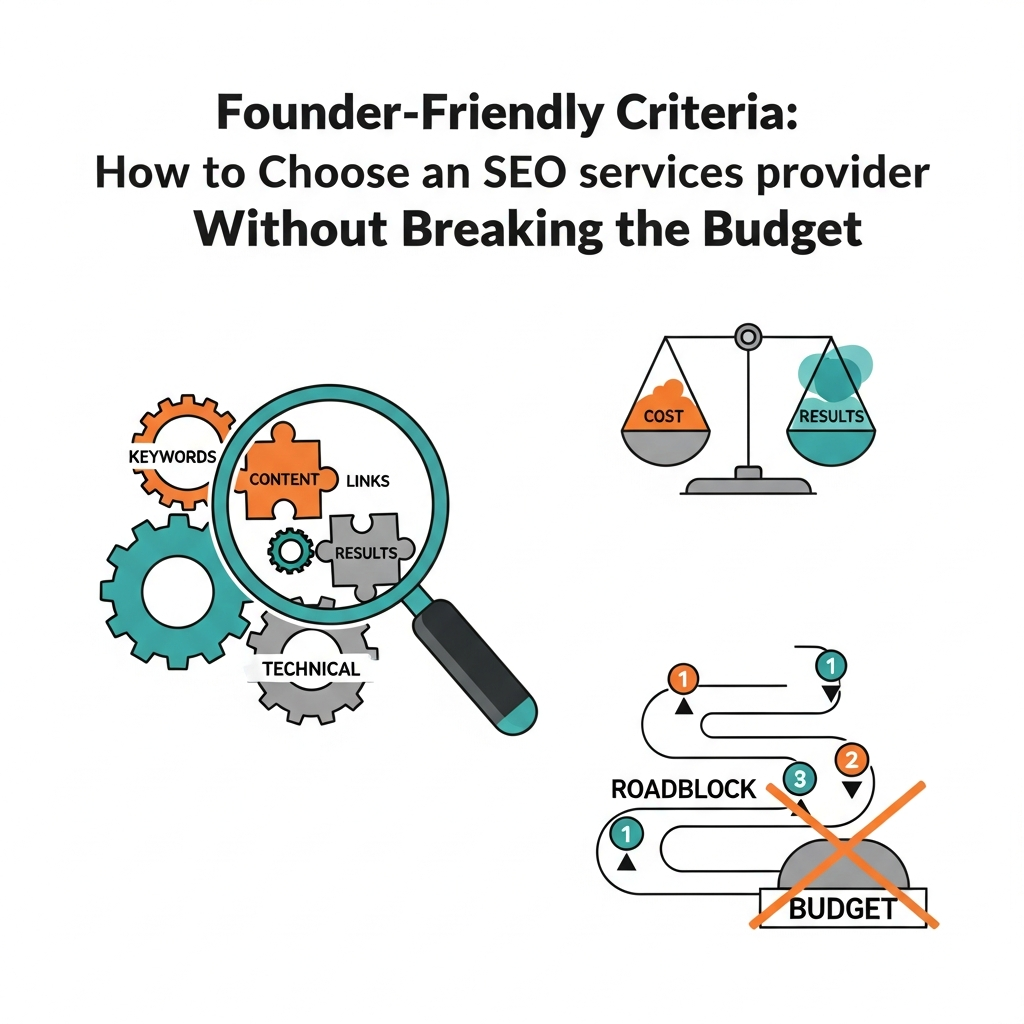
Founder-Friendly Criteria: How to choose an SEO services provider Without Breaking the Budget
1) Define goals and ROI expectations
For founders, the first step in choosing an SEO services provider is translating business goals into measurable SEO outcomes. This alignment keeps both teams honest about what success looks like and helps you compare providers on the same footing. Start by identifying the core business metrics that SEO should influence, such as qualified traffic, product-page visibility, or lead generation, and map them to concrete SEO KPIs.
Next, set a realistic ROI framework. Decide how you will measure incremental value from SEO—consider lift in organic sessions, improved conversion rates, and the lifetime value of customers acquired through search. Establish a baseline for current traffic, rankings, and revenue, then target milestones over 3, 6, and 12 months. A founder-friendly plan emphasizes clarity, not hype, and favors vendors who can commit to transparent milestones and auditable results.
Practical steps you can take today include drafting a simple one-page objectives sheet for each priority area (awareness, consideration, conversion) and pairing it with a short list of scenarios that would indicate success or red flags. With this foundation, you can evaluate proposals by the same ROI lens and avoid vendors who promise big outcomes without a clear path to them.
2) Understand pricing, packages, and value
Pricing is a major decision point, but it should be paired with clarity on the scope and deliverables. Different providers price differently—retainers, project-based fees, performance-based models, or a la carte add-ons. The key is to understand what you’re paying for, how deliverables are defined, and how value is tracked over time.
When reviewing pricing, look for a transparent breakdown that shows core components (technical SEO audit, on-page optimization, content planning and production, link-building, analytics and reporting) and optional add-ons (multilingual SEO, local SEO, eCommerce optimization, structured data improvements). Ask for a pricing grid that maps each tier to concrete milestones and cadence (monthly sprints, biweekly updates, etc.). Beware hidden costs such as set-up, migrations, or tooling licenses that inflate the total cost of ownership.
Best practices for pricing discussions include requesting a trial period or pilot with a clearly defined success criteria, a detailed statement of work, and a governance model that stipulates SLAs, review cadences, and escalation paths. A strong vendor will offer a predictable price with room to scale as you grow, rather than a vague quote with unclear deliverables.
3) Vendor due diligence and governance
Due diligence is the armor that protects founders from hidden risk. Start with governance and data privacy as non-negotiables. Confirm if the provider adheres to recognized security standards, offers transparent data handling practices, and can provide evidence of independent audits or SOC2-type controls if you operate at scale.
Next, probe the vendor’s operating model. How are teams structured? Who owns strategy, execution, and QA? What does onboarding look like, and how are accounts staffed during peak periods? Governance also includes contract terms: SLA clarity, termination rights, data ownership, and a clear process for requesting changes in scope without spiraling costs.
Due diligence steps in practice: request client references and case studies, verify client logos and sectors, check performance under real-world scenarios, confirm data privacy policies, review onboarding playbooks, and assess the partnership’s long-term viability through the vendor’s roadmap and financial stability signals.
4) Capabilities: technical SEO, content, and links
A strong SEO partner should demonstrate depth across three core capabilities: technical SEO, content strategy and production, and link-building. Technical SEO includes crawlability, site speed improvements, structured data, canonicalization, and mobile optimization. Content capabilities cover keyword research, content calendars, tone/brand alignment, and scalable production workflows. Link-building strength means ethical outreach, quality opportunities, and a risk-aware approach that protects against penalties.
Use a capability matrix to compare providers. For each area, list the minimum acceptable standards and the differentiators that matter to your business. For instance, you might require weekly content production with editorial QA, a technical audit every quarter, and a link-building plan aligned to your product calendar. Don’t accept vague assertions; ask for sample reports, templates, and proofs of impact from previous clients.
Internal references can help you see how a provider’s capabilities translate to outcomes. For example, a post on automated content calendars can shed light on how a partner plans content at scale, while a governance-focused piece can illustrate how dashboards translate activity into value. See our 30-day content calendar guide for a practical perspective on fast-start content workflows.
5) ROI-driven reporting and dashboards
Reporting is the compass that keeps you aligned with ROI. Every vendor should offer clear, consistent dashboards that connect SEO activity to business outcomes, with accessible metrics for executives and granular data for specialists. Look for dashboards that track traffic, rankings, conversions, revenue, and cost metrics, and that support drill-downs by channel, geography, and device.
To validate ROI-focused reporting, examine how the provider defines and tracks key metrics, how often dashboards are refreshed, and how they handle attribution across multiple marketing channels. A practical approach is to request a sample dashboard and a 90-day reporting cadence with defined milestones. If you’re evaluating multi-site programs, ensure the provider can present consolidated dashboards plus site-specific views.
For practical ROI framing, see our ROI governance dashboards article for concrete examples of what strong reporting looks like. This kind of resource helps you ask the right questions and avoids accepting vague optimism as a substitute for data. If you’re expanding into new regions, you may also find regional case studies valuable; for example, a Portuguese-language case on automated publishing for ecommerce in Brazil can offer localization insights (Sao Paulo ecommerce automation).
6) Partner fit: collaboration and engagement model
Beyond numbers, the soft factors determine long-term success. Evaluate cultural fit, communication cadence, and responsiveness. Ask how the vendor handles change requests, how quickly they can adapt to new priorities, and how they collaborate with internal teams (writers, developers, analytics). A founder-friendly partner should integrate seamlessly with your workflow, provide transparent milestones, and avoid last-minute scope changes that derail your budget.
Clarify engagement models: will you have a dedicated account manager, a quarterly business review, and a clear escalation path? Consider whether the vendor offers white-label options if you are an agency or a multi-brand enterprise and whether their process supports your governance needs without creating friction.
7) Step-by-step evaluation checklist
Use this practical checklist to compare providers side by side. Each item should be scored on a simple scale (0-5) to keep comparisons objective.
- Business alignment: does the provider map to your top objectives and ROI targets?
- Scope clarity: are deliverables, timelines, and milestones well defined in the SOW?
- Pricing transparency: is there a clear breakdown of core vs. add-on services?
- Governance and SLAs: are response times, uptime, and escalation paths documented?
- Security and data privacy: do they meet your privacy and security requirements?
- Team structure: who will work on your program and what is their experience?
- Tooling and tech stack: what platforms will they use and how will data flow?
- Reporting capabilities: what dashboards exist and how often are they updated?
- Case studies and references: can they demonstrate results in your industry?
- Trialability: is a pilot available to validate value before a larger commitment?
- Localization and scale: can they support multiple sites or locations if needed?
- Contract terms: is there flexibility to adjust scope without punitive costs?
During the due diligence phase, request direct references and, if possible, speak with a current client in a similar market. Use the references to validate claimed outcomes and process quality. For region-specific onboarding or localization, check whether the provider has prior experience with similar geographies or languages, and assess their approach to localization in content and SEO.
8) Run a pilot and negotiate terms
A pragmatic path to decision-making is a structured pilot. Define a narrow scope (e.g., a single product page SEO optimization, a focused content initiative, or a 4-week technical audit) with explicit success criteria. Establish a fixed duration, a clear cost, and a plan for evaluating results. Use the pilot to test technical capabilities, collaboration quality, and the provider’s ability to deliver on promises.
Negotiation tips for founders: demand a written SOW with explicit milestones, avoid long-term lock-ins without an exit clause, and seek an opt-out clause if the provider fails to meet agreed-upon targets. Ensure the contract includes data ownership terms, a transparent data migration plan, and defined SLAs for support and issue resolution. After the pilot, use the results to negotiate a full program with a staged ramp-up and a governance cadence that matches your leadership cadence.
In short, choose a partner who combines clear pricing, strong governance, proven capabilities, and a collaboration model that fits your organization. A founder-friendly approach prioritizes transparency, measurable ROI, and a path to scale without breaking the budget.
Helpful resources and examples can be found in our curated content library: for a practical, starter-friendly content calendar approach, see the 30-day automated content calendar guide. For governance-focused ROI dashboards, review the ROI dashboards article. And for localization and regional publishing insights, explore the Sao Paulo automation post.