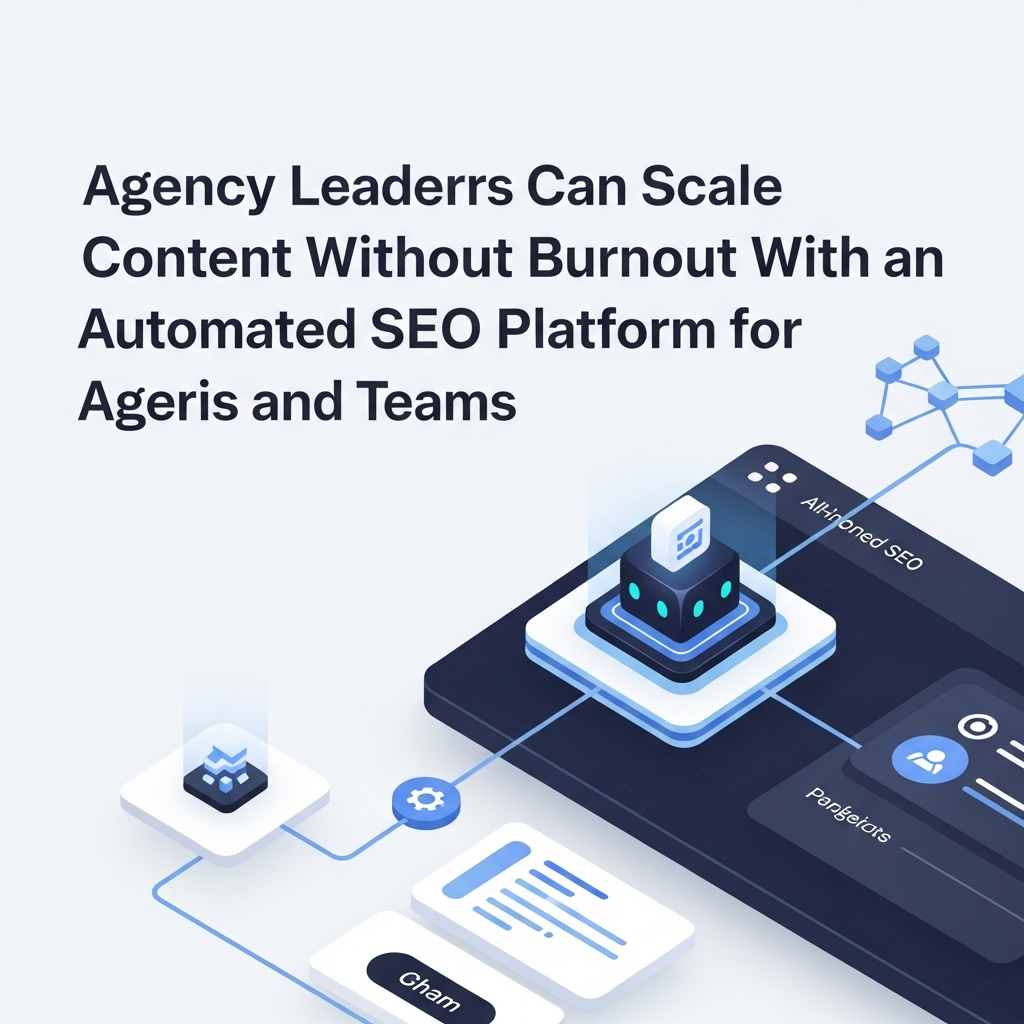
Agency Leaders Can Scale Content Without Burnout With an Automated SEO Platform for Agencies and Teams
Introduction
In today’s competitive digital landscape, agencies and teams face a demanding paradox: the need to publish more high-quality content across more client sites without burning out your people. Automated SEO platforms designed for agencies unlock a scalable, repeatable playbook that combines AI-assisted content creation, on-page optimization, and centralized publishing across multiple domains. When deployed thoughtfully, these platforms reduce manual bottlenecks while maintaining brand voice, compliance, and client transparency.
This guide explores what makes an automated SEO platform suitable for agencies and teams, the capabilities that drive real ROI, and a practical path to piloting and expanding automation across a multi-site portfolio. Whether you run a boutique agency or an enterprise marketing team responsible for dozens of brands, the core ideas stay the same: speed, quality, governance, and measurable impact.
What is an automated SEO platform for agencies and teams?
An automated SEO platform for agencies and teams is a centralized toolchain that coordinates content ideation, creation, optimization, publishing, and performance tracking across many client sites from a single dashboard. It blends AI-assisted content generation, meta-tag optimization, keyword discovery, internal linking recommendations, and workflow automation into a scalable system. The goal is to replace repetitive manual steps with repeatable processes that preserve quality and brand consistency across all client engagements.
Key characteristics include multi-site governance, white-label capabilities for partner-friendly branding, secure data handling, CMS integrations (WordPress, Webflow, Shopify, and others), and robust reporting that makes ROI visible to clients and leadership. A strong platform also supports localization for multilingual campaigns, enabling teams to manage content calendars and optimization rules across geographies from one place.
Why automation matters for agencies and teams
Automation is less about replacing people and more about augmenting capabilities. When implemented well, an automated SEO platform helps agencies scale without sacrificing quality or speed. The benefits typically include:
- Faster content production and publication cycles across multiple clients and sites.
- Consistent on-page optimization and metadata that aligns with evolving search intent.
- Centralized visibility into performance metrics, enabling faster decisions and dashboards for clients.
- White-label options that support reseller programs and partner ecosystems.
- Stronger governance, security, and compliance with auditable workflows and SLAs.
Importantly, automation isn’t a one-size-fits-all prescription. Great platforms offer configurability so you can preserve your clients’ unique brand voices while still unleashing scalable automation across the portfolio. For teams exploring how automation translates into real-world outcomes, our internal guides and client case studies show how automation can drive consistent growth with reduced manual toil.
Core capabilities to look for
When evaluating an automated SEO platform for agencies and teams, prioritize capabilities that directly map to your operating model and client needs. The following three areas tend to have the most impact on scale, quality, and ROI.
AI-driven content generation for SEO campaigns
AI-assisted content creation should go beyond generic templates. Look for platforms that can generate topic briefs, outlines, and draft articles tailored to specific geo, audience, and buyer intent profiles. The best systems support brand-style guidelines, tone adjustment, and content optimization recommendations that align with your established editorial standards. They should also offer AI-assisted content review to catch factual gaps and bias, preserving credibility while accelerating production.
Practical value comes from integrating keyword research into the writing process. A solid platform will surface keyword opportunities, clustering strategies, and semantic relationships that inform content structure. The result is more scalable content calendars, fewer revisions, and stronger alignment with search intent across multiple clients.
Automated publishing and optimization for blog sites
Automation should streamline not only creation but also publishing workflows. Features to look for include bulk article scheduling, CMS connectors, automatic internal linking suggestions, and on-page optimization nudges (title tags, headers, meta descriptions, structured data). A well-designed system maintains editorial calendar integrity, supports localization, and ensures that updates roll out with proper versioning and rollback capabilities if needed.
Beyond publishing, check how the platform handles ongoing optimization. This includes scheduled meta tag refreshes based on performance data, updates to canonical structures, image and schema improvements, and automated testing to measure uplift from changes. A transparent process that ties changes to measurable outcomes helps you demonstrate value to clients and leadership.
AI-optimized meta tags and keyword generation
Meta tags remain a cornerstone of on-page SEO. The right platform uses AI to generate and refine title tags, meta descriptions, and header structures that maximize click-through while staying aligned with user intent. It should also offer keyword generation that respects intent intent clusters and long-tail opportunities, helping teams discover new angles for existing clients and uncover gaps across the portfolio.
Crucially, ensure the platform supports governance controls around keyword usage and meta tag templates so teams don’t drift from client branding or violate partner SLAs. Strong analytics should tie meta adjustments to visibility and traffic changes, making it clear which tweaks contributed to ROI.
Building a scalable workflow
Scalability hinges on turning complexity into repeatable steps. A practical workflow for agencies typically follows four phases: planning, content creation, optimization, and publishing with governance. Each phase should be supported by automation rules, quality checks, and clear ownership so teams can run cross-client campaigns without stepping on each other’s toes.
Phase 1: planning and keyword research
Start with a centralized keyword research framework that informs every client’s content calendar. The platform should help map keyword clusters to content pillars, assign owners, and establish editorial SLAs. Automations can generate topic briefs automatically when a cluster hits a threshold for search volume or competitive gaps, reducing manual brainstorming time.
Involve client stakeholders early by generating plan templates that show projected traffic impact, content requirements, and publishing cadence. A robust system makes it easy to adjust plans based on performance, seasonality, and product launches.
Phase 2: content creation and optimization
With briefs in place, AI-assisted writers or editors can draft content that adheres to brand voice while following SEO best practices. The platform should offer built-in quality controls, including readability scoring, factual checks, and plagiarism monitoring. Editors retain final approval to ensure quality remains high across all clients.
Optimization happens in tandem with creation. Expect automatic suggestions for internal linking, keyword density targets, schema usage, image alt text, and other on-page elements. A well-tuned system guides writers toward pages that need momentum and helps prevent cannibalization within a client’s site or across a portfolio.
Phase 3: publishing, publishing governance, and monitoring
Automation should automate the publishing schedule and apply publish-time checks. You’ll want version control, audit trails, and rollback options so any misstep can be undone quickly. The best platforms provide dashboards that monitor performance after publication, flag anomalies, and trigger optimization cycles when KPIs deviate from plan.
Quality assurance across dozens of sites requires clear governance. Roles, approvals, and workflows should be configurable per client, with centralized reporting that keeps executives informed without micromanaging the team.
Measuring ROI, governance, and analytics
One of the strongest justifications for automation is the ability to quantify impact. A scalable SEO platform should offer dashboards that translate activity into ROI, not just activities. Look for the following capabilities:
- ROI and lift measurement: traffic, conversions, revenue, and customer lifetime value by client and across the portfolio.
- Attribution and experiment tracking: how changes drive uplifts across pages and funnels.
- Governance and auditability: role-based access, SLAs, data retention, and change histories.
- Customizable dashboards: white-label reporting for clients with consistent visuals and metrics.
To see practical patterns, explore how automated dashboards can surface growth opportunities without increasing your governance burden. For a deeper dive into ROI-focused governance, read our Measuring ROI and governance in automated SEO dashboards that prove value article.
Additionally, consider how automated content calendars influence performance predictability. A well-tuned system aligns content production with demand signals, seasonality, and client goals, turning a tactical process into a strategic driver of growth. If you’re evaluating a platform now, a good test is whether you can reproduce consistent month-over-month progress across multiple clients with minimal manual intervention. For a practical starter framework, check our Automated 30-Day Content Calendar guide to jumpstart scale in your own practice.
Security, compliance, and white-label considerations
Enterprise-grade platforms emphasize security, data privacy, and governance. Key questions include: how data is stored and segmented across multi-site portfolios, how access is controlled, and what audits or third-party attestations (e.g., SOC 2) are available. Clear SLAs, incident response timelines, and a transparent feature roadmap help agencies evaluate risk as they scale with more clients.
White-label capabilities are essential for agencies and partner networks. Look for branding controls, client-specific dashboards, and the ability to assign roles that mirror your internal teams. A strong platform also supports localization workflows so clients with multilingual sites can maintain consistent SEO performance across geographies.
Security and compliance considerations should include explicit data handling policies, data residency options, and clear terms around data ownership after contract termination. When in doubt, request a security questionnaire and a reference from a current enterprise client to validate real-world resilience.
Implementation roadmap and getting started
Embarking on an automation pilot requires a practical, staged plan. A structured approach helps you validate value quickly while minimizing disruption to existing client workstreams. A typical eight-week rollout might look like this:
- Define scale targets: number of sites, content volume, and ROI goals per client.
- Audit existing content and CMS integrations to identify quick-wins and gaps.
- Configure governance, roles, and SLAs to match agency policies and client expectations.
- Launch a pilot with a representative group of clients and a small content set.
- Introduce AI-assisted workflows with editorial sign-off and QA checkpoints.
- Track performance, iterate on keyword plans, and refine optimization rules.
- Expand to additional clients and geographies as confidence grows.
- Document learnings and update the platform roadmap to scale further.
As you begin to scale, look for opportunities to benchmark against a few internal KPIs such as content output per week, time-to-publish, and client-visible traffic gains. For a concrete localization case study illustrating how automation can work in non-English markets, see our São Paulo ecommerce automation article linked here: São Paulo-based ecommerce automation case study.
Getting value and the long arc
Real-world value comes from combining automation with thoughtful governance and ongoing optimization. Expect to iterate on content quality, alignment with client goals, and the balance between automation and human oversight. Case studies and benchmarks from agencies similar to yours can provide guardrails for what success looks like at scale. Over time, a well-implemented platform should deliver faster publishing cycles, stronger on-page optimization, and clearer ROI signals that accompany portfolio growth.
Choosing the right platform for your agency
Selecting an automated SEO platform is a decision that touches people, processes, and profit. Priorities to evaluate include security and compliance posture, CMS integrations, white-label capabilities, multi-site governance, and the ability to continuously improve ROI through analytics-driven optimization. Ask vendors to demonstrate a multi-site dashboard, a live content calendar, and a sample ROI report across several client sites. Listening to existing customers’ governance experiences can highlight how the platform performs under real workloads.
For teams evaluating localization and international expansion, review how the platform handles multilingual content and geo-specific optimization workflows. A practical way to validate localization is to test a few markets in parallel and measure performance uplift across languages and regions. If you’re seeking a concrete localization reference, you can explore the Sao Paulo case study mentioned earlier for a sense of how automation scales in a non-English environment.
Getting started with an automated SEO platform
To begin, map your portfolio’s baseline: current content output, publishing cadence, and client reporting requirements. Define a short pilot with 2–3 representative clients and a limited content set to test the end-to-end workflow from ideation to publishing and optimization. Establish clear success metrics—such as time-to-publish, daily content volume, and first-month KPI improvements—and commit to a fixed evaluation window. As you expand, gradually bring more sites online, refine AI prompts, and extend governance controls to scale with confidence.
Remember, the best automation programs keep people in the loop, not out of the loop. The goal is to reduce repetitive tasks while elevating editorial quality and client-facing transparency. With disciplined governance, an automated SEO platform becomes a force multiplier for agencies and teams—delivering faster results without compromising the craft of great content.
Internal references for readers: Automated 30-Day Content Calendar guide, Measuring ROI and governance in automated SEO dashboards that prove value, São Paulo-based ecommerce automation case study