Trial Conversion Playbook: Turn Organic Traffic into Product Trials
Overview: what this playbook delivers
Organic traffic is a powerful driver for trial signups when you align what readers see with what they want to try. This playbook provides a practical, repeatable framework to move readers from awareness to trial in a way that minimizes friction and manual work. You’ll learn how to map content to a structured funnel, optimize trial landing pages, position CTAs effectively, and back everything with data-driven tests.
The goal is simple: convert more of your organic readers into trial users without adding a lot of manual processes. We’ll cover the content-to-trial funnel, the anatomy of a high-converting trial landing page, smart CTA placement, and copy patterns that persuade without being pushy. For teams already publishing auto-generated or auto-published posts, this playbook shows how to align those assets with a conversion-focused funnel.
As you implement this playbook, you’ll want to reference a few internal resources to stay aligned with your broader content and product strategy. For example, you can explore editorial workflows that scale across agencies and brands here: Editorial workflow for agencies, browse the blog archive for additional context here: Blog index, or review region-specific publishing patterns here: SAO PAULO publishing automation case.
The Trial Conversion Framework: from content to trial
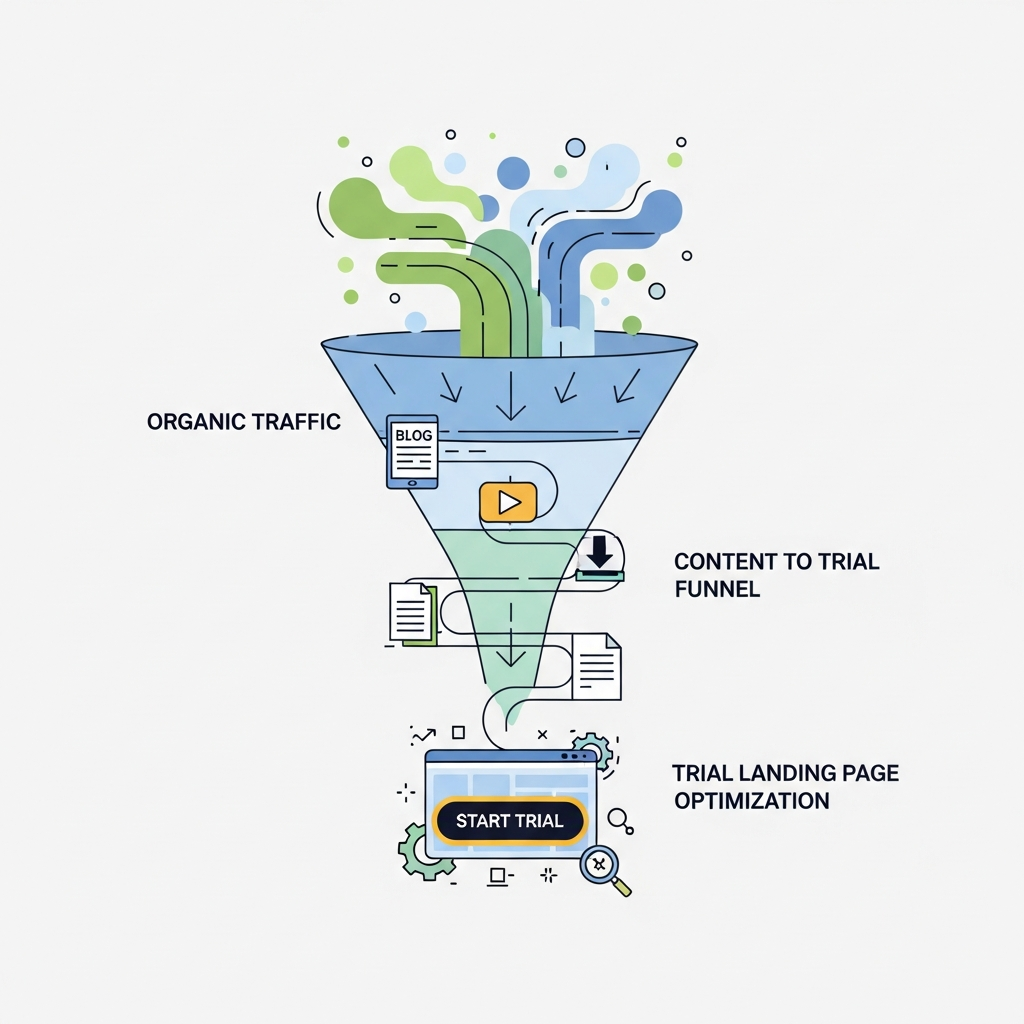
Think of the journey as a four-stage funnel: Awareness, Interest, Consideration, and Conversion. Each stage has distinct reader needs and corresponding content and CTAs. The objective is to guide readers seamlessly from discovery to action with minimal friction.
Awareness: attract readers who could benefit from a trial
In this stage, your goal is to illuminate a problem readers recognize they have and introduce your product as the practical solution. Content types include in-depth blog posts, how-to guides, research-backed articles, and short-case studies. Include a light, non-intrusive CTA that nudges readers toward learning more about a free trial or a guided tour.
Best practices:
- Lead with a strong value proposition in the intro.
- Use data points or a quick framework to demonstrate impact.
- Place a clearly visible CTA that invites readers to explore a trial or demo.
Interest: deepen value and offer a low-friction next step
Readers who show interest should see content that builds trust and proves relevance. This includes product-focused guides, feature overviews, and interactive assets. The CTA should offer a trial closer to experimentation, such as a self-serve trial or an interactive tour.
Best practices:
- Offer a lightweight trial path (e.g., 14-day free trial) to reduce risk.
- Include social proof and a brief case example to validate effectiveness.
- Keep forms short and purpose-driven; ask for essential details only.
Consideration: demonstrate value at scale and address objections
Readers are evaluating whether your product fits their workflow. Content should include feature comparisons, ROI calculators, and onboarding previews. The goal is to enable confident judgment and a clear path to starting a trial.
Best practices:
- Provide side-by-side feature glimpses and pricing transparency where appropriate.
- Offer an expedition-friendly tour or mini onboarding demo.
- Use a prominent, context-relevant CTA that leads to the trial page.
Conversion: remove friction and sign readers up for a trial
The final step should be friction-free. A well-optimized trial signup experiences minimal form fields, clear expectations, and immediate onboarding context. Emphasize risk reversal (no credit card required, cancel anytime) and provide an immediate next-step path after signup (guided onboarding, product tour, or a starter checklist).
Key takeaway: every stage should include a clear, testable CTA and trackable micro-conversions that feed the top of your funnel with insights.
Content-to-Trial Funnel: mapping content to each stage
A well-structured content-to-trial funnel aligns asset types with reader intent at each stage. Below is a practical blueprint you can adapt to your product and audience.
- Awareness assets: long-form guides, industry reports, and how-to posts that discuss a problem your product solves. CTA example: "See a 14‑day trial in action" or "Start your free trial".
- Interest assets: checklists, quick-start guides, and interactive demos that reveal value quickly. CTA example: "Launch your trial now".
- Consideration assets: ROI calculators, feature comparison pages, and onboarding previews. CTA example: "Start a guided tour".
- Conversion assets: streamlined trial signup forms, in-app onboarding prompts, and product tours. CTA example: "Start your free trial" with a no-card policy.
Content mapping example:
- Blog post: "How to reduce manual work with automated content" → CTA: "Try the trial"
- Checklist: "SEO automation checklist" → CTA: "Begin your trial"
- ROI calculator: "Estimate impact of automated content" → CTA: "Start your trial"
Pro-tip: create a lightweight lead-in that funnels readers from the blog to a trial page with a single click. For auto-published posts, ensure the meta description and on-page CTAs align with the trial objective so readers don’t encounter a disconnect between the post and your conversion goal.
Trial Landing Page Optimization: anatomy and examples
The trial landing page is the single most important touchpoint for conversion. It should communicate value quickly, present social proof, and offer a frictionless signup path. Below is a practical anatomy you can implement today.
Hero section
Clear headline that states the outcome readers can expect from the trial. Subheadline adds context. The primary CTA sits above the fold and uses action-oriented language.
Value proposition and proof
Two to four bullets that quantify benefits. Add testimonials or logos where appropriate. If feasible, include a short product tour video or GIF.
Trial features and signals
Highlight what users get during the trial, duration, and what success looks like. Include social proof and a simple progress indicator to reduce perceived risk.
Signup form and trust cues
Keep fields minimal. Include trust signals (privacy promises, data handling). Offer a secondary route to a guided tour if someone isn’t ready to sign up immediately.
Implementation tip: place an anchor-like CTA such as a button labeled "Start free trial" with a supporting secondary CTA like "View a guided tour". Link readers who are not ready to a lightweight onboarding checklist to hold engagement. Internal links should be used strategically to reinforce the trial value without distracting from the signup path. For example, you can refer readers to related editorial workflows or strategy posts: Editorial workflow for agencies, or your broader content archive: Blog index, and region-specific publishing practices: SAO PAULO publishing automation.
CTA Placement Best Practices
Where you place CTAs can dramatically impact trial conversion. The goal is to reduce the reader’s effort to act while keeping the reader focused on the value you promise.
Core rules
- Primary CTA above the fold on each primary landing page.
- Secondary CTAs near the bottom of sections to catch readers who drill into content.
- Visible, scannable CTAs with action verbs and no industry jargon.
Copy patterns
- "Start your free trial"
- "Launch your trial in 30 seconds"
- "See a live demo"
Design considerations
- Color contrast and button size that align with accessibility guidelines.
- Button shape and whitespace that draws attention without overwhelming the page.
- Consistent language across CTAs to avoid confusion.
Practical tip: run A/B tests on CTA color, wording, and placement. A small change can yield meaningful lift over a few weeks. For reference on editorial workflows and how teams manage CTA testing at scale, see Editorial workflow for agencies.
Lead Magnets that Convert: examples and copy patterns
Lead magnets are the gateway to trial signups when they align with a reader’s intent and demonstrate quick value. Use a mix of assets that can be consumed quickly and those that offer deeper value for higher intent readers.
- Checklists and templates that simplify a task related to your product.
- ROI calculators or impact estimators that quantify potential benefits.
- Mini-guides or playbooks that outline a step-by-step process.
Lead magnet copy patterns
Craft copy that emphasizes outcome, ease, and immediacy. Examples:
- "Get a 15-minute, no-cost ROI calculator for your team"
- "Download the 5-step onboarding checklist and start a trial today"
- "Access the quick-start template to accelerate your setup"
Placement matters: offer lead magnets on blog posts that discuss pain points your product solves. Then connect readers to the trial path via a natural CTA like "Try it free" or "Start your trial".
Measurement & Testing: a practical, repeatable approach
Data informs what to optimize next. Establish a lightweight measurement stack that captures both conversion events and user quality signals. Focus on actionable metrics you can influence in weeks rather than months.
Key metrics
- Trial signups per channel
- CTA click-through rate (CTR) by page
- Form abandonment rate
- Time-to-first-valuable-action in the product
Experiment plan
Adopt a cadence of small, rapid tests. For each test, define a hypothesis, a primary metric, a secondary metric, and a sample size target. Run tests for 1-2 weeks with clear success criteria.
Example test ideas:
- Test CTA wording: "Start free trial" vs. "Launch free trial"
- Test trial page hero: benefit-focused vs. feature-focused
- Test form length: 2 fields vs. 5 fields
For a broader view of automation and optimization strategies, review content strategy and SEO automation resources in your toolbox. You can also explore how internal linking can improve discovery and amplifies your funnel across pages: Editorial workflow for agencies.
Onboarding & Activation: turning signups into value quickly
Activation is the moment readers realize the trial delivers on its promise. A smooth onboarding experience reduces drop-off and increases the likelihood of converting to a paid plan later. Focus on guided tours, in-app tips, and a lightweight onboarding checklist that gets users to first value fast.
- Provide a brief product tour and a task list for the first day in the trial.
- Offer contextual help and proactively surface relevant features.
- Send a short email sequence that reinforces early wins and next steps.
Remember to maintain consistency with your content-to-trial narrative. Readers who engaged with a blog post about automation should see onboarding content that mirrors that topic, reinforcing the connection between what they read and what they can start in the trial.
Templates, checklists, and quick-starts you can reuse
Use these practical artifacts as starting points for your team. Adapt wording to fit your product and brand voice.
- Trial Landing Page Checklist: 12 items to ensure the page is conversion-ready.
- CTA Experiment Plan: a one-page worksheet to log hypotheses, variants, and outcomes.
- Content-to-Trial Mapping Template: aligns blog posts to trial stages with suggested CTAs.
Internal resources to help with scaling and consistency across teams include the following, all accessible through your internal content hub: Blog index and Editorial workflow. If you’re optimizing multilingual or regional sites, consider regional publishing patterns like the São Paulo example: SAO PAULO publishing automation.
Next steps: how to start implementing this playbook today
- Audit your current content-to-trial funnel. List the assets at each stage and identify obvious gaps between your content and your trial path.
- Audit your trial landing pages. Ensure a strong hero, a short form, and a single, prominent CTA above the fold.
- Design a 4-week test plan focused on CTAs, landing page copy, and lead magnet alignment. Prioritize tests with the highest potential impact and fastest feedback loops.
- Build a lightweight onboarding path within the trial to surface early value and reduce friction.
- Set up measurement and dashboards so you can observe progress, iterate, and communicate impact to stakeholders.
If you’d like help tailoring this playbook to your product and audience, consider a focused consultation. Blog readers can also explore more resources and templates here: Disclaimer or check industry benchmarks in your preferred language: Schema validation tools.