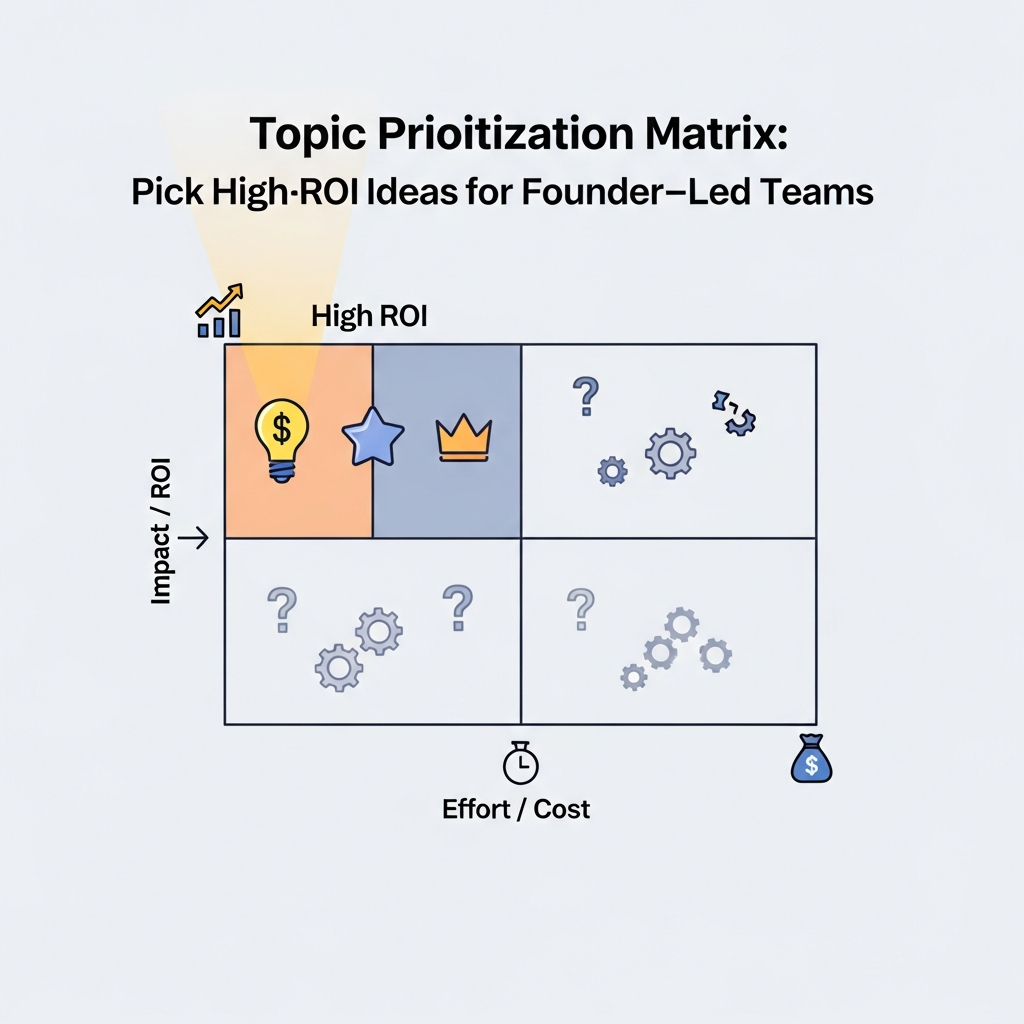
Topic Prioritization Matrix: Pick High-ROI Ideas for Founder-Led Teams
Introduction
Founders and early-stage marketers often face a critical constraint: time. Every content idea competes for limited bandwidth, so the real question becomes not just what to write about, but which topics will deliver the fastest business impact. A topic prioritization matrix gives you a repeatable method to evaluate ideas against business value, audience intent, and effort, so you can publish high-ROI content faster and with greater consistency.
This article introduces a practical framework you can implement in days, not weeks. It blends the core ideas behind content idea prioritization with a structured scoring system and a clear path from brainstorming to publication. If your goal is to increase signups, drive qualified traffic, and improve your content’s SEO returns, you’ll find this approach aligns with founder-led decision-making and team velocity.
For additional context on editorial workflows and scalable publishing, you can reference our notebooks on editorial processes in this guide and explore our broader blogs hub for related frameworks. If you’re exploring regional considerations, see our notes on São Paulo automation here.
Why Use a Topic Prioritization Matrix
A matrix helps avoid random content sprawl by forcing ideas through a disciplined lens. When founder-led teams use a scoring framework, they can:
- Align content with tangible business outcomes, such as signups or trial activations.
- Prioritize topics that satisfy clear keyword intent, not just high search volume.
- Balance speed to publish with long-term SEO value through structured data and internal linking planning.
- Standardize decision-making across the team, reducing debates and increasing predictability.
In practice, a matrix forces a conversation about impact, effort, competition, and intent—four dimensions that often determine whether a topic becomes a quick win or a slower drain on resources.
Core Components of a Topic Prioritization Matrix
A robust matrix evaluates ideas across five core dimensions. Each idea receives a score in each dimension, and the totals guide selection.
1) Business Impact
How directly does the idea drive outcomes like signups, activation, or revenue? Choose signals that reflect real-world value for your product or service.
2) Audience Intent (Keyword Intent Mapping)
What user intent does the topic serve? Informational, navigational, or transactional? Mapping intent helps ensure the content matches what people actually search for.
3) Content Difficulty & Publish Velocity
Estimate the time, resources, and complexity to produce the content. Founders often favor topics with faster paths to publish and iteration.
4) SEO & Competitive Landscape
Assess keyword difficulty, existing rankings, and how saturated the topic area is. Consider whether you can outperform incumbents with a unique angle.
5) Content Quality & Brand Fit
Does the topic align with your brand voice and channel strategy? Will it resonate with your audience and support long-term value?
These five dimensions form the backbone of the scoring framework, but you can adapt them to your business model. The goal is to create a repeatable, auditable process you can apply to every idea.
Build It Step by Step
Here’s a practical, repeatable process to construct your topic prioritization matrix in a few hours.
- Define your goals. Identify two or three primary business outcomes for the quarter (e.g., increase trial signups by 15%, grow blog-driven revenue, or boost demo requests).
- Brainstorm ideas. Gather a broad list of topics that could support those goals. Include formats like how-to guides, case studies, product updates, and comparison posts.
- Estimate impact and effort. For each idea, assign a rough score for Business Impact (1–5) and Effort/Publish Velocity (1–5, where a lower effort gets a higher velocity score).
- Assess intent and SEO depth. Map each idea to keyword intent and estimate SEO difficulty. Include a separate score for potential long-term ranking value.
- Evaluate competitive landscape. Note whether competitors already own this topic and how you might differentiate (e.g., through a unique framework or data).
- Check brand alignment. Ensure the idea fits your founder-led voice and can be expressed consistently across channels.
- Compute totals. Add the scores to get a total for each idea. Prioritize by highest total with consideration for risk and dependencies.
- Define a publishing plan. For the top ideas, outline a 90-day content calendar, the required resources, and a measurement plan.
As you grid ideas, consider a lightweight scoring template. A simple 5-point scale across each dimension provides enough discrimination without overcomplicating decisions.
To see concrete templates and templates for editorial planning, check our editorial workflow guide in this guide and browse our blogs hub for related examples.
Keyword Intent Mapping
Mapping intent is essential to aligning ideas with actual search behavior. Start by categorizing topics into common intent types:
- Informational: Answers questions, builds awareness, and educates readers.
- Navigational: Directs users to a specific resource or section of your site.
- Transactional: Encourages a just-in-time action like a signup, trial, or purchase.
Assign each idea an intent tag based on its likely queries. For example, a post about "how to build a content calendar for startups" is typically informational, while "signup for a content planning tool" leans transactional. When you combine intent with business impact, you get a clearer signal about where the ROI lies.
Pro tip: pair intent mapping with a simple keyword universe. Create clusters around core topics, then test one or two high-potential keywords per idea. This approach prevents misaligned content and speeds up early wins.
For hands-on examples of intent-driven content planning, explore our long-form content strategy posts in our editorial workflow article or dive into regional automation insights in our São Paulo post linked above.
Content Scoring Framework
A practical framework uses a simple scoring rubric across dimensions. Use a 1–5 scale, where 5 represents the strongest signal.
Dimension and Example Criteria
- Business Impact (1–5): potential to drive signups, revenue, or meaningful engagement.
- Intent Alignment (1–5): degree to which the topic matches identified keyword intent.
- Effort / Velocity (1–5): lower is better for velocity scores; higher indicates more effort required.
- SEO Opportunity (1–5): estimated keyword difficulty and potential for long-tail gains.
- Brand Fit (1–5): how well the topic aligns with founder voice and product positioning.
Calculate a total score by summing all dimensions. In many cases, high business impact combined with strong intent alignment and reasonable effort yields the best ROI. You can also apply weighted scoring if some dimensions matter more to your business goals.
To make scoring concrete, you can borrow the template in our notes and adapt it to your team’s cadence. See the practical examples in our content toolkit linked in the templates section below.
Remember: scoring is a living process. Revisit and adjust scores as you gather data from initial publishes and real-world performance.
High-ROI Topic Examples
Here are indicative topic patterns that tend to perform well for founder-led teams when mapped through the prioritization matrix:
- Product-led how-tos that demonstrate value quickly and invite trials or signups.
- Case studies showing measurable outcomes with your platform or service.
- Comparative guides that clearly position your solution against alternatives.
- Brief, actionable templates and frameworks readers can reuse today.
- Regional or language-specific content that unlocks new markets with low competition and high intent.
When you pair these topics with intent mapping and a lean publishing process, you increase the odds of early wins while building a durable content asset library.
For a deeper look at editorial strategies that scale, our editorial workflow guide offers practical steps you can adapt today.
Templates, Checklists & Tools
Adopt these lightweight artifacts to operationalize your matrix.
- Idea Brief Template: Problem, audience, intent, proposed format, and success metric.
- Scoring Checklist: A one-page rubric for each dimension with quick guidance on scoring.
- 90-Day Editorial Plan: A high-velocity calendar with buffer for iterations and updates.
Want a structured, repeatable content planning workflow? See our practical guide on editorial workflows and how teams publish at scale in the posts linked earlier.
Additional resources live in our blogs hub and dedicated regional post for São Paulo insights here.
Pitfalls to Avoid and Best Practices
Even a solid framework can misfire if you overlook common gaps. Watch for these traps:
- Over-optimizing for SEO at the expense of product relevance or user value.
- Neglecting to update or retire content that underperforms or loses relevance.
- Using vanity metrics (views alone) instead of business outcomes (signups, trials, revenue).
- Ignoring multi-language or localization needs that affect intent and conversion.
Best practices include starting with a small pilot, collecting feedback from the team, and integrating performance data into quarterly planning. Regularly revisiting scoring thresholds keeps the matrix aligned with evolving goals.
Implementation Roadmap for Founder-Led Teams
Adopt a staged rollout that minimizes risk while delivering tangible value.
Align goals, define the scoring rubric, and train the team on intent mapping. Generate a first backlog of ideas, score them, and select top 3–5 to publish in the next sprint. Publish and promote, measure outcomes, and refine the matrix based on results. Expand to additional topics, add multilingual considerations, and optimize internal linking around top posts.
For ongoing learning, explore the broader content strategy resources in our blog ecosystem and stay connected with the latest practices in editorial workflows.
FAQ
Q: How long does it take to implement a topic prioritization matrix?
A practical version can be up and running in a couple of days. A full, iterative program that runs weekly in a growing team can mature within a quarter.
Q: Should I weight some dimensions more than others?
Yes. Weighting should reflect your current priorities (e.g., if speed to publish is critical, Weight Effort/Velocity higher). Start with equal weighting, then adjust as you learn what drives results for your business.
Q: What are quick wins I can expect?
Topics that map clearly to transactional intent and offer a fast path to a signup or trial often yield the fastest ROI. Round out with a few informational pieces to support long-tail SEO and authority building.
Conclusion
A topic prioritization matrix offers founder-led teams a practical, repeatable approach to choosing content ideas that deliver measurable outcomes quickly. By aligning business impact, keyword intent, and publishing velocity, you create a disciplined workflow that reduces waste, accelerates learning, and scales your content program with confidence. Use the five core dimensions, map intent carefully, and apply a simple scoring rubric to decide what to publish next.
As you start applying this framework, remember that content is a long game. The right ideas, published consistently and supported by solid intent mapping and internal linking, will compound over time. If you’d like hands-on help tailoring a matrix to your specific business and channels, consider engaging with our team for a structured setup and ongoing optimization. You can explore our broader content capabilities and related resources in the posts and guides linked throughout this article.
For ongoing inspiration and practical templates, visit our blogs hub or read about editorial strategies in our dedicated guide. If you’re curious about regional automation scenarios, our São Paulo article provides useful regional context that complements global planning.