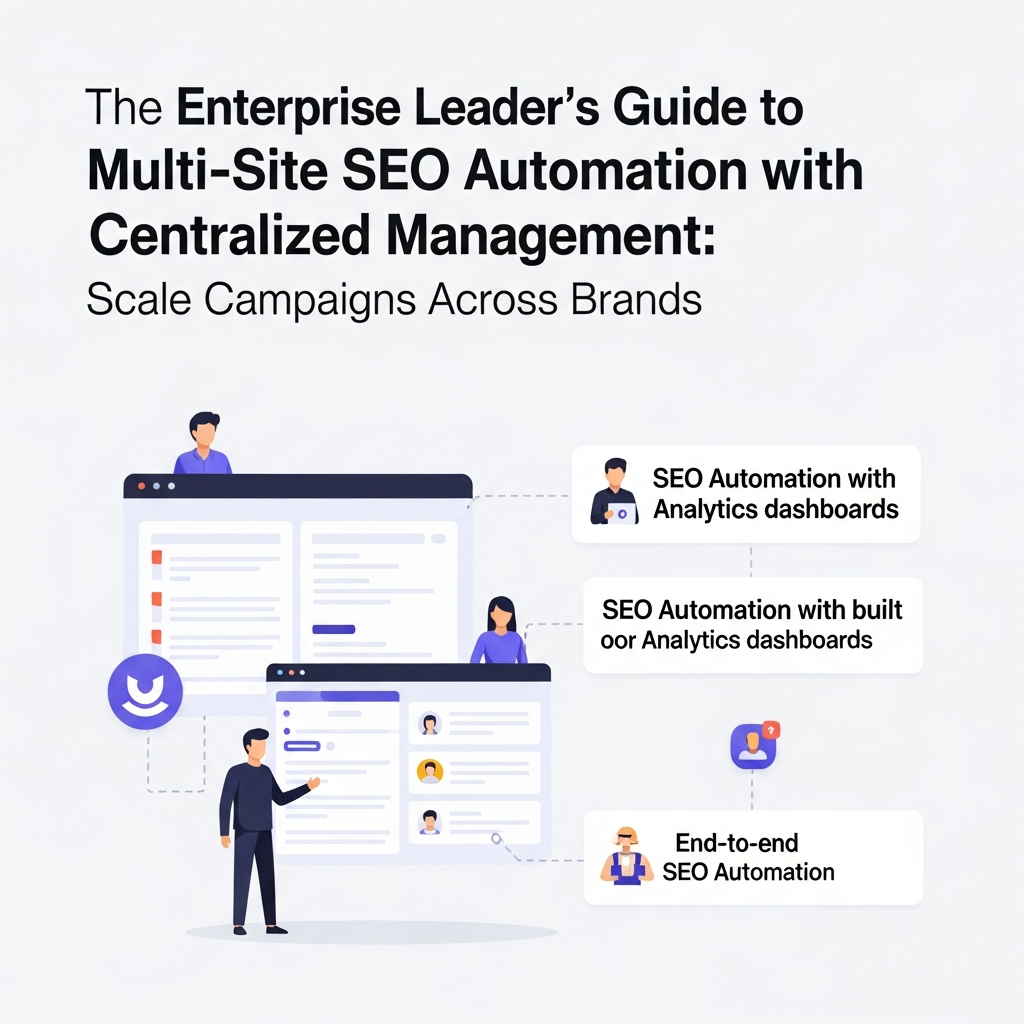
The Enterprise Leader's Guide to Multi-Site SEO Automation with Centralized Management: Scale Campaigns Across Brands
Why multi-site SEO automation matters for large organizations
Enterprise brands often manage hundreds of pages, languages, and product lines across multiple sites. The traditional, manual approach to SEO -- keyword research, content briefs, on-page optimization, linking, and reporting -- becomes infeasible at scale. As a result, teams struggle with inconsistent brand voice, governance gaps, and lag time between market opportunity and action.
Multi-site SEO automation with centralized management addresses these pains by providing a single source of truth for governance, data, and workflows. It enables teams to:
- Standardize keyword research and content frameworks across brands.
- Publish and optimize content at scale while preserving brand voice.
- Automate routine tasks like meta tag generation, internal linking, and cadence scheduling.
- Consolidate reporting for executive dashboards and procurement reviews.
For enterprise leaders, the outcome is tangible: faster time-to-market for campaigns, better content quality, and a more predictable, auditable ROI.
Centralized architecture and governance
A centralized management layer sits above brand sites, content systems, and analytics. It coordinates rules, permissions, and data models so that teams across regions and brands operate within a single framework. The core components typically include:
- Governance module: role-based access, approval workflows, and policy enforcement for content, links, and metadata.
- Data integration layer: connections to CMSs (WordPress, Shopify, Webflow), analytics (GA4, Search Console), and SEO tooling, all in a secured environment.
- Automation engine: rule-driven processes for keyword discovery, content briefs, on-page optimization, publishing schedules, and backlink opportunities.
- Analytics cockpit: centralized dashboards that translate activity into ROI metrics, risks, and opportunities across brands.
With this setup, brand teams maintain autonomy where needed while executives gain auditable governance, consistent KPIs, and a framework that scales with the business.
Key features to scale campaigns across brands
Implementing a scalable, centralized SEO automation platform hinges on selecting features that align with governance, performance, and speed-to-value. The following capabilities are foundational for enterprise-scale success.
Centralized dashboards and analytics
Enterprises require dashboards that aggregate performance across all sites. Look for:
- Cross-brand reporting with drill-downs by site, region, language, and product category.
- Real-time or near-real-time analytics for monitoring traffic, rankings, and content health.
- ROI-focused metrics: cost per acquisition, content ROI, and time-to-value for new campaigns.
When dashboards are built-in, teams spend less time reconciling data and more time acting on insights. See how our team integrates dashboards and governance in practice in our related guide on ROI and governance dashboards.
For a practical blueprint, explore our post on measuring ROI and governance in automated SEO dashboards.
End-to-end SEO automation
End-to-end automation covers the full lifecycle from discovery to optimization to publishing. Enterprises benefit from a unified flow that reduces manual handoffs and preserves consistency across brands. Core elements include:
- Automated keyword discovery and topic clustering across multiple markets.
- Content briefs generated from data-driven insights, tailored to each brand voice.
- On-page optimization and metadata generation at scale, with localization support.
- Automated publishing workflows to CMSs with checks for accessibility and mobile-friendliness.
Integrated keyword research and content automation
Automation should not replace human judgment; it augments it. The best systems integrate keyword research with content creation so that topics map to intent and funnel stages. Features to prioritize:
- Unified keyword databases with market-specific signals and search intent tagging.
- Content templates aligned to search intent and conversion goals.
- Quality controls to prevent drift in brand voice and factual accuracy.
As you scale, consider a capability like data-driven keyword discovery for automation platforms to surface high-potential opportunities across brands.
Customizable content calendar for SEO automation
A dynamic calendar coordinates topic scheduling, resource allocation, and publishing windows. Enterprises benefit from:
- Multi-brand calendars with visible dependencies across teams (writers, editors, designers, developers).
- Localization workflows for language variants and geo-focused pages.
- Automation hooks to assign briefs, kick off production, and trigger QA checks automatically.
To see a practical approach, review our guide on a 30-day content calendar and how to jumpstart SEO at scale.
For a localization-focused example, our São Paulo publication automation case study demonstrates how regional teams can contribute while staying aligned with global governance.
Data-driven keyword discovery for automation platforms
Automated discovery should surface opportunities that are aligned with business goals. Look for:
- AI-assisted keyword generation tempered by SERP reality checks and competition analysis.
- Geotargeting and language segmentation baked into the discovery engine.
- Exportable briefs and content plans that feed directly into content calendars and CMS workflows.
Combining discovery with automated briefs accelerates the path from insight to action, reducing cycle times and avoiding misalignment between teams and markets.
Integrated workflows: keyword research, content automation, and calendar management
Effective workflows stitch together data, people, and platforms. A practical enterprise workflow looks like this:
- Discovery phase: centralized keyword research identifies high-potential topics across markets.
- Briefing phase: automated briefs generate topic outlines, suggested headings, and meta templates.
- Content creation phase: writers and editors produce content that follows brand guidelines and localization rules.
- Optimization phase: on-page elements, schema, internal linking, and media assets are optimized automatically where appropriate.
- Publishing phase: CMS workflows publish content on schedule with QA gates and accessibility checks.
- Measurement phase: dashboards track performance against objectives and trigger automatic adjustments.
Automation reduces repetitive tasks and ensures consistency, but governance remains essential. Pair automation with standardized approval workflows to preserve brand integrity and regulatory compliance.
Internal links can provide deeper guidance on practical calendars and ROI governance. See our Automated 30-Day Content Calendar guide and the ROI governance article for implementation details.
Localization and global consistency
Global brands must balance consistency with local relevance. Use templates and localization workflows that support:
- Language variants and locale-specific keyword sets.
- Localized content calendars synchronized with global campaigns.
- Regional QA gates to ensure accuracy and cultural relevance.
Localization is not a bolt-on; it is a built-in capability of a scalable automation platform.
Governance, analytics, and ROI: turning automation into value
Governance in an automated environment means visibility, control, and accountability. Enterprises should demand:
- Role-based access and approval workflows that prevent unauthorized changes.
- Audit trails for every content decision, metadata change, and publishing action.
- ROI dashboards that translate activity into revenue impact, not just vanity metrics.
Analytics should answer questions like: Which topics move the needle by region? How long does it take to realize a positive ROI after publishing a new page? Which teams benefit most from automation, and where do bottlenecks persist?
To explore governance in depth, read our piece on ROI-focused dashboards and governance in automated SEO tools. See the linked article above for a structured breakdown, including templates you can adapt for your organization.
Implementation roadmap: from pilot to enterprise-wide rollout
Adopting multi-site SEO automation is a journey. A practical roadmap helps manage risk and demonstrate value early. Consider the following phases:
Phase 1: Readiness and pilot planning
- Define governance roles, success metrics, and a short pilot scope (e.g., 3 brands, 6 markets).
- Map CMS integrations and analytics data sources to ensure clean data flow.
- Set up baseline dashboards to compare pilot outcomes against existing performance.
Phase 2: Pilot execution
- Run automated keyword discovery and create initial briefs for pilot brands.
- Publish a controlled set of pages with automated tagging and internal links.
- Monitor quality gates and refine governance rules based on feedback.
Phase 3: Scale and governance expansion
- Onboard additional brands/sites and broaden localization coverage.
- Roll out centralized dashboards with executive reporting and SLA alignment.
- Iterate on templates, calendars, and workflows to optimize efficiency and quality.
For more detailed, practical guidance on governance and ROI, check out our ROI and governance dashboards article linked earlier.
Pitfalls to avoid and best practices
Even the best automation platforms can falter if governance and change management are neglected. Common pitfalls include:
- Over-automation without brand governance leading to inconsistent voice.
- Inadequate localization processes that produce awkward translations or cultural mismatches.
- Insufficient integration with CMSs or analytics resulting in data silos.
- Underestimating the importance of human review for accuracy and quality.
Best practices to mitigate these risks include establishing strict approval workflows, maintaining a human-in-the-loop for critical content, and continuously validating data flows across systems.
Vendor selection and governance for enterprise scale
When evaluating vendors for multi-site SEO automation, prioritize:
- Enterprise-grade security, data privacy, and SOC2-type controls.
- Scalability across hundreds of sites, languages, and CMS integrations.
- Robust SLAs, onboarding support, and a clear product roadmap aligned with governance needs.
- White-label or partner-friendly terms if you operate at agency scale or require OEM arrangements.
Request demonstrations that show how the platform handles multi-brand governance, localization workflows, and ROI reporting. Also review real-world case studies and proof points that reflect your industry and scale.
For practical context on ROI governance, consider reading our detailed piece on automated SEO dashboards and governance as you validate vendors.
Conclusion: the strategic value of centralized multi-site SEO automation
In today’s multi-brand, multi-market environment, enterprise leaders can unlock substantial value by standardizing the playbook for SEO across sites while empowering brand teams with localized control. Centralized management of automation, governance, and analytics reduces risk, accelerates time-to-market, and delivers a clearer path to measurable ROI.
By combining end-to-end automation with integrated keyword research, customizable content calendars, and data-driven discovery, organizations can scale campaigns across brand portfolios without sacrificing quality or governance. As you embark on this journey, leverage the practical resources linked throughout this article to design a rollout that fits your organization’s structure and goals.
For additional practical insights, explore the internal resources referenced earlier, including the Automated 30-Day Content Calendar guide and the ROI/governance dashboards article, and consider localized best practices such as Sao Paulo publication automation for Brazil-focused e-commerce campaigns.