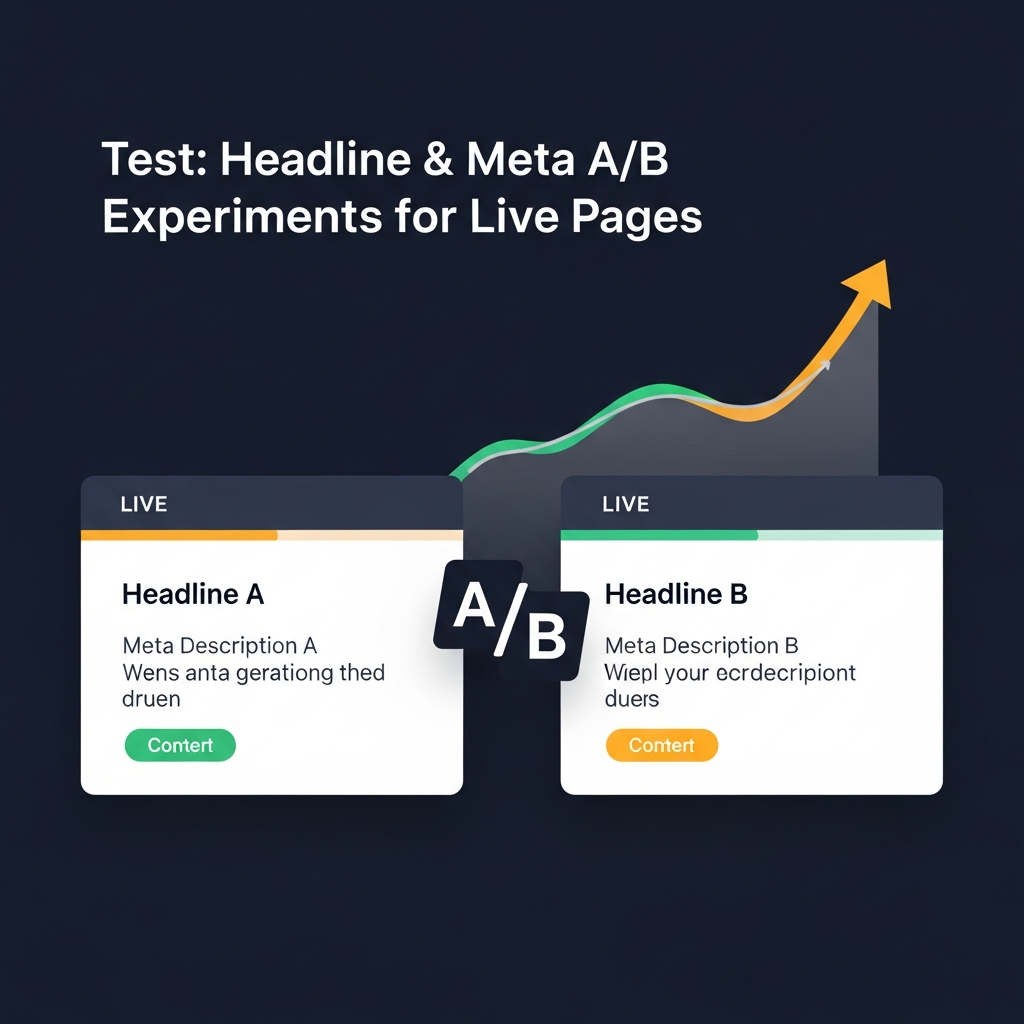
Test: Headline & Meta A/B Experiments for Live Pages
Why headline testing matters on live pages
Headlines are the first impression a user has of your page in the search results. They influence click-through rate (CTR), perceived relevance, and the initial user decision to continue reading. Even small changes in wording, order, or length can shift user intent signals enough to affect ranking indirectly through engagement metrics.
In practice, headline A/B testing on live pages helps growth teams quantify what resonates with real users in real-world conditions. Rather than relying on intuition, you gather evidence about what compels clicks while preserving brand voice. This is especially important for pages with high traffic potential or revenue impact, where a modest CTR lift translates into meaningful traffic gains over time.
For SEO teams, headline testing is not just about attracting clicks; it also shapes user expectations and on-page dwell time. If a headline promises one thing but delivers another, users may bounce quickly, hurting dwell time signals. Conversely, accurate and compelling headlines improve engagement, which can support rankings when interpreted alongside other on-page signals.
To begin, align headline hypotheses with user intent at a keyword level. This means pairing the core keyword with language that directly addresses the searcher’s goal. A well-structured testing approach provides defensible, replicable results that your team can scale across pages and domains.
Internal link: For broader editorial and testing workflows, see our guide on automated editorial processes: Editorial workflow for agencies planning, writing, and publishing at scale.
Designing effective headline A/B tests
Effective headline testing begins with a clear hypothesis. For example: “If we use a question-based headline, CTR will increase because it invites curiosity and signals relevance to the user’s intent.” Each test should isolate one element at a time: power words, length, punctuation, or the placement of keywords.
Key variables to consider include: length (short vs. long), structure (benefit-first vs. feature-first), tone (professional vs. provocative), and keyword placement (start vs. end). Avoid changing too many variables simultaneously to preserve interpretability of results.
Test design basics to follow:
- Define a single, testable hypothesis per variant.
- Use statistically valid sample sizes with a predetermined significance level (commonly 95%).
- Run tests long enough to cover typical traffic cycles and to avoid short-lived anomalies.
- Control for seasonality and external events that could skew results.
When crafting variants, start with evidence-based language. Use power words that align with intent and avoid misalignment with what users will see on the page h1, as this can hurt trust and bounce rates. A practical approach is to build 2–4 strong variants and progress to multi-variant tests only after initial results confirm a reliable direction.
Internal link: Explore more about scalable content systems that support testing: Editorial and testing workflows.
Meta description experiments: optimizing CTR and relevance
Meta descriptions are a critical nudge for users to click. They should complement the headline by clarifying value, setting expectations, and incorporating a clear call-to-action. When testing meta descriptions, avoid duplicating the headline and ensure the description remains accurate for the page content.
In A/B tests, try variations that emphasize different benefits, social proof, or unique selling propositions. Length is important: Google typically truncates descriptions around 150–160 characters on desktop and around 120–155 on mobile, but actual display varies by device and query. The goal is to create a compelling snippet that remains legible across devices.
Best practices include:
- Beginning with a hook that matches user intent.
- Including a keyword or topic phrase naturally.
- Providing a tangible outcome or what the user will gain.
- Maintaining accuracy to avoid click-through deception and potential ranking penalties.
To support experimentation at scale, consider a framework that pairs meta description variants with corresponding headlines to observe combined effects on CTR and bounce rate. This helps you understand whether certain headline–description pairings outperform others in directing high-quality traffic.
Internal link: For deeper analysis on testing frameworks, see our overview: Editorial workflows for agencies.
How title and meta work together: trade-offs and alignment
Titles and meta descriptions operate as a team on the SERP. The title is the primary signal for relevance and intent, while the meta description serves as a teaser that influences click probability. The most effective testing plan treats them as an integrated system rather than two isolated experiments.
Key trade-offs to manage include:
- Relevance vs. clickability: A highly clickable description without relevance can damage engagement; ensure alignment with the actual page content.
- Consistency with brand voice: Variants should reflect the established voice to maintain trust and recognition.
- Keyword visibility: Use primary keywords thoughtfully, avoiding keyword stuffing in both title and meta.
Practical tips include pairing a headline variant with a complementary meta description to test whether a cohesive story increases CTR more than independent optimizations. Always monitor dwell time and bounce rate to ensure users find what they expect, which reinforces positive signals to search engines over time.
Internal link: If you’re looking for a broader content strategy, read about scalable content workflows: Editorial workflows for agencies.
A practical experiment framework for SEO tests
Adopt a lightweight, repeatable framework that mirrors scientific testing principles. A practical framework includes: test definition, pre-registered hypothesis, baseline metrics, control and variant creation, a sampling plan, interim checks, and a final decision rule. The framework below gives you a blueprint you can apply to headline and meta experiments.
Framework blueprint
- Define the objective: e.g., lift CTR by X% while maintaining conversion rate.
- State a test hypothesis: “Variant A improves CTR by at least Y% over the baseline.”
- Establish metrics: CTR, average position, time on page, bounce rate, and conversion as feasible.
- Set sample size and duration: calculate with a power analysis to achieve statistical significance.
- Develop variants: keep one element constant per test to ensure attribution.
- Run and monitor: use live data and dashboards to watch for early signs of significance.
- Make a decision: select the winner based on pre-defined criteria, and implement across pages if scalable.
A practical tip: maintain a centralized test registry so teams can reuse successful variants across pages with minimal friction. This accelerates learning and ensures consistency across your site.
Internal link: for more on scalable workflows and testing, see our resource hub: Blogs and resources.
Tools, setup, and best practices
Successful tests require reliable data collection and a fast optimization loop. Start with a robust analytics setup that captures impressions, clicks, and on-page behavior for each variant. If you publish to a CMS, ensure your testing changes are versioned and reversible so you can rollback quickly if a variant performs poorly.
Recommended practices include:
- Use a consistent naming convention for variants to simplify reporting.
- Schedule tests to run across representative traffic segments, including desktop and mobile users.
- Monitor early signals but resist the urge to end tests prematurely due to noise.
- Document learnings and create a runbook so future tests start faster.
When selecting tools, look for features like AI-assisted variant creation, lightweight A/B testing capabilities for meta data, and straightforward CMS integrations. Some teams also pair testing with internal linking optimization and structured data checks to strengthen overall on-page signals.
Internal link: a hands-on guide to implementing editorial automation is at: Editorial workflows for agencies.
Case study blueprint: test plan and analytics
Use a simple, repeatable case study template to document each test. Include objective, hypothesis, test variants, sample size, duration, performance thresholds, and final outcome. Here is a ready-to-use template you can adapt for headline and meta experiments:
- Baseline page: current title and meta description.
- Variant A: revised headline copy that emphasizes a different angle.
- Variant B: alternative meta description focusing on benefits rather than features.
- Metrics: CTR, average position, dwell time, bounce rate, conversions.
- Result: winner selection with statistical significance and practical lift.
After you identify a winner, scale the approach to other high-potential pages. Always validate that the improved metrics hold across the site landscape and preserve brand integrity. For ongoing education, reference our fuller testing guide in the editorial resources section.
Internal link: learn more about scalable editorial and testing strategies: Editorial workflows for agencies.
Scaling tests across pages and CMS
Once you prove a winner on a single page, the natural next step is scale. Start with a cohort of pages that share intent, structure, and audience signals. Use a phased rollout to minimize risk and maintain control over brand voice. A scalable approach often involves creating a master variant library and applying it to groups of pages with minimal manual effort.
Scaling requires governance: maintain consistent guardrails around keyword usage, tone, and value propositions. Document the allowed deviations per page type and ensure your CMS can apply updates consistently across templates. When possible, automate the variant deployment via content templates so new pages inherit proven language patterns automatically.
Internal link: for a broader look at scalable content production, check our multi-page publishing guide: SAO Paulo automation for ecommerce Brazilian market.
Measuring success and avoiding common pitfalls
Two framing questions guide measurement: Did CTR improve in a statistically significant way, and did user satisfaction or engagement metrics worsen or remain stable? Track both to avoid optimizing for clicks at the expense of downstream outcomes like conversions or time on page.
Common pitfalls include over-optimizing for CTR at the expense of relevance, running tests with insufficient sample size, or letting external events bias results. Mitigate these risks by pre-registering hypotheses, using robust statistical methods, and validating results across devices and user segments.
Another pitfall is misalignment between headline and page content. If the page does not deliver the promised value, users exit quickly, which can harm dwell time and bounce rate. Maintain strong alignment by revisiting page copy as you refine your testing program.
Internal link to broader SEO experimentation resources: Blog and resources.
Next steps and practical takeaways
Begin with a small, replicable test that targets a high-traffic page with a clear intent. Define a tight hypothesis, a safe rollout plan, and a pre-defined decision rule. As you accumulate learnings, expand your test library and apply proven variants to related pages.
To support ongoing experimentation, consider documenting a maintenance calendar for headline and meta updates, so your team reviews performance quarterly and refreshes royalties of your best-performing variants. This helps sustain momentum without overhauling the entire site strategy at once.
Internal link: for practical editorial frameworks that support testing, visit: Editorial workflows for agencies and SAO Paulo automation for ecommerce.