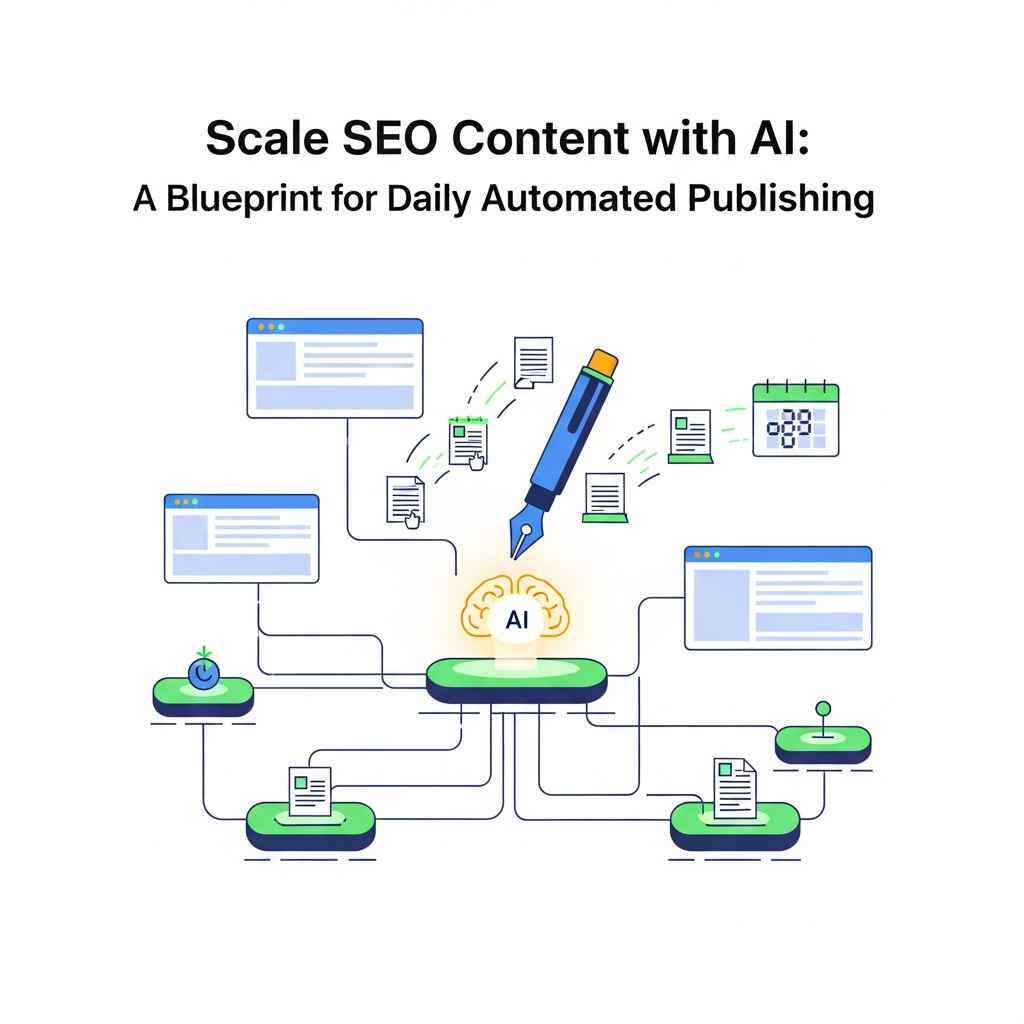
Scale SEO Content with AI: A Blueprint for Daily Automated Publishing
Introduction: Why daily automated publishing matters
In a crowded digital landscape, scale matters. For teams chasing organic growth across multiple sites, the difference between sporadic content and a daily publishing cadence can be the hinge for sustained SEO success. AI-powered SEO content automation unlocks consistent production, rigorous optimization, and centralized governance—without sacrificing quality or brand voice.
This blueprint outlines how to design an end-to-end, AI-driven workflow that regularly publishes optimized articles across several sites. It covers people, process, and technology considerations, with practical steps you can start today. It also shows how to balance automation with editorial oversight to protect content quality, relevance, and compliance.
Whether you run an agency serving multiple clients, an in-house team managing several brands, or a multinational organization with regional sites, the principles below adapt to your scale. For readers exploring practical workflow patterns, see our broader guidance on editorial workflows for agencies at scale.
AI-Powered SEO Content Automation Blueprint
The core idea is simple in concept but rich in detail in practice: design a repeatable, auditable process that converts strategic content plans into daily, optimized articles. This requires a structured content calendar, AI-assisted creation, automated on-page SEO, and a governance layer that ensures consistency across domains.
Key goals of the blueprint include:
- Produce high-quality, SEO-optimized content daily across multiple sites
- Maintain brand voice and editorial standards through templates and checks
- Automate metadata, internal linking, and schema where appropriate
- Coordinate global content calendars with localization and timezone awareness
- Provide transparent analytics dashboards to track ROI and impact
At the heart of this blueprint is a disciplined content calendar and a repeatable AI-assisted workflow that feeds a publishing engine. The result is predictable output, faster learning loops, and better visibility into what topics and formats move the needle for SEO.
To explore practical patterns and case studies, you can also review related posts about editorial workflows for agencies planning writing and publishing at scale.
Editorial workflow for agencies planning writing and publishing at scaleCore Workflow Components
Successful AI-powered SEO content automation rests on a set of integrated components. Each component solves a specific problem and, together, they create a seamless end-to-end flow from strategy to publishing.
Below are the essential building blocks, with practical considerations for implementation.
3.1 Content Calendar Automation
A robust content calendar aligns topics with keyword strategies, seasonal opportunities, and product/brand priorities. Automating calendar generation involves: strategic templates, keyword clustering, topic briefs, and scheduling gates that ensure readiness before publish.
Best practices include defining pillar topics, mapping a 90-day cycle, and linking each piece to relevant internal assets. Use AI to expand topic briefs into outlines, but keep final approvals in human hands to preserve quality and compliance.
3.2 AI-Generated Articles & Workflow
AI-generated drafts can speed up the initial write phase, but automation should include robust review steps. Create templates for introductions, conclusions, and call-to-action segments that preserve brand voice. Implement a multi-stage review: AI draft → human editor → SEO specialist review → compliance check.
When scaling, consider content modularity: reusable sections such as buying guides, how-tos, and product roundups that can be repurposed across sites with minimal edits.
3.3 SEO On-Page Optimization Automation
Automated on-page optimization includes meta titles/descriptions, header structure, canonical tags, image alt text, and internal linking heuristics. Use NLP-enhanced generation to create SEO-friendly headings and content blocks that follow your established schema and keyword strategy.
Be mindful of keyword density and avoid over-optimization. The automation should respect quality signals such as readability and user intent, not only keyword presence.
3.4 Internal Linking & Content Structure
Internal linking is a powerful signal for crawlability and topic authority. Automate sensible anchor text choices and hierarchical linking patterns that connect new posts to cornerstone content and category hubs. Establish guardrails to prevent broken links and ensure that linking aligns with user journeys.
In multilingual or multi-site contexts, maintain consistent linking taxonomy across languages and domains to preserve navigational integrity.
3.5 Media & asset automation
Images, diagrams, and videos contribute to engagement and SEO. Automate media generation or selection based on topic, with automated alt text and schema markup where appropriate. Use AI-assisted image generation where suitable, but always review for accuracy and licensing considerations.
Daily Publishing Across Multi-Site Networks
Publishing daily at scale across several sites requires disciplined governance and centralized orchestration. The objective is to eliminate bottlenecks while preserving brand consistency and editorial quality.
Key practices include a centralized publishing queue, CMS-ready templates, localization workflows, and role-based access controls. When done well, daily publishing becomes an engine for traffic growth and more robust content signals for search engines.
4.1 Centralized orchestration for multi-site SEO
Centralization reduces tool sprawl and simplifies governance. Build a single publishing queue with site-specific rules, language variants, and regional considerations. Use dashboards to monitor throughput, quality, and ROI by site.
4.2 Localization and localization workflows
Localization is not mere translation. It requires cultural adaptation, local keyword intent, and regional legal considerations. Establish localization tandems: a global content strategy paired with regional editors who review tone, units of measure, and regulatory compliance.
4.3 CMS integrations & automation adapters
Choose CMS adapters that support automation hooks, scheduling, and metadata templates. Common targets include WordPress and headless CMS stacks. Ensure APIs are secure, rate-limited, and well-documented to minimize disruption during scale.
Governance, Security & Compliance
As you scale, governance becomes as important as speed. Enterprise-grade content automation requires clear ownership, audit trails, and controls to prevent brand, legal, or data risks. Implement role-based access, review workflows, and documented escalation paths for any content that triggers risk flags.
Data privacy and security should be baked into every layer of the workflow. This includes data handling policies, access controls, and regular security reviews. Enterprises often require SOC2-type controls and vendor risk assessments; align your automation platform accordingly.
Quality Control, Testing & Metrics
Automation does not absolve humans of responsibility for quality. Build iterative QA into the workflow with: content readability checks, factual accuracy reviews, and SEO performance criteria. Use a blend of automated scoring and human audits to keep standards high.
Key metrics to monitor include organic traffic growth, SERP visibility for target keywords, time-on-page, bounce rate, and engagement signals. Leverage dashboards that connect to analytics platforms, enabling quick ROI assessments across sites.
Implementation Plan: Step-by-Step
Implementing AI-powered content automation at scale benefits from a phased plan. Here is a practical, repeatable approach you can adapt to your context.
- Define success metrics and KPIs for each site and content pillar.
- Map content pillars to keyword clusters and editorial calendars.
- Select technology stack: AI content generator, SEO automation layer, CMS integrations, and analytics dashboards.
- Develop modular content templates that guide AI output and editorial review.
- Set up an editorial workflow with stages, owners, and review gates.
- Pilot on a subset of sites to validate quality, speed, and governance.
- Scale gradually: expand to additional sites while monitoring KPIs and QA metrics.
- Establish ongoing optimization loops: update briefs, refresh old content, and refine topics based on performance data.
As you refine the pilot, document decisions and create a repeatable playbook that teams can reuse for new sites or languages. For organizational learning, consider reading more about editorial workflows for agencies and applying relevant patterns to your setup.
Pitfalls & Best Practices
Even with automation, several traps can derail scale efforts. Common pitfalls include over-reliance on AI without human review, neglecting localization nuances, and underestimating governance needs across multiple brands.
Best practices to avoid these pitfalls include: establish guardrails for tone and factual accuracy, implement localization reviews, and maintain a clear escalation path for content that triggers risk flags. Regularly audit the automation rules and update templates to reflect evolving SEO priorities and brand standards.
Further Reading & Internal Resources
To deepen your understanding and connect with practical examples, explore related resources. Our blog hub hosts ongoing discussions about AI-assisted SEO and editorial operations. For a hands-on tool to validate schema markup used in your articles, try our free schema validator tool.
Internal references:
- Visit our blog hub for more how-to guides
- Editorial workflow for agencies planning writing and publishing at scale
- Free schema validator
Conclusion: Start small, scale with discipline
The path to daily automated publishing with AI is not a magic switch; it is a carefully designed system of templates, checks, and governance. When built with a clear strategy, automation accelerates content velocity, improves consistency, and amplifies SEO outcomes across multiple sites. Use this blueprint as a practical road map, adapt it to your context, and iterate based on data and feedback.
Remember to balance automation with editorial oversight, maintain localization discipline, and keep a sharp focus on quality and user experience. With the right framework, AI-powered SEO content automation enables your team to publish reliably every day while delivering measurable improvements in organic visibility.