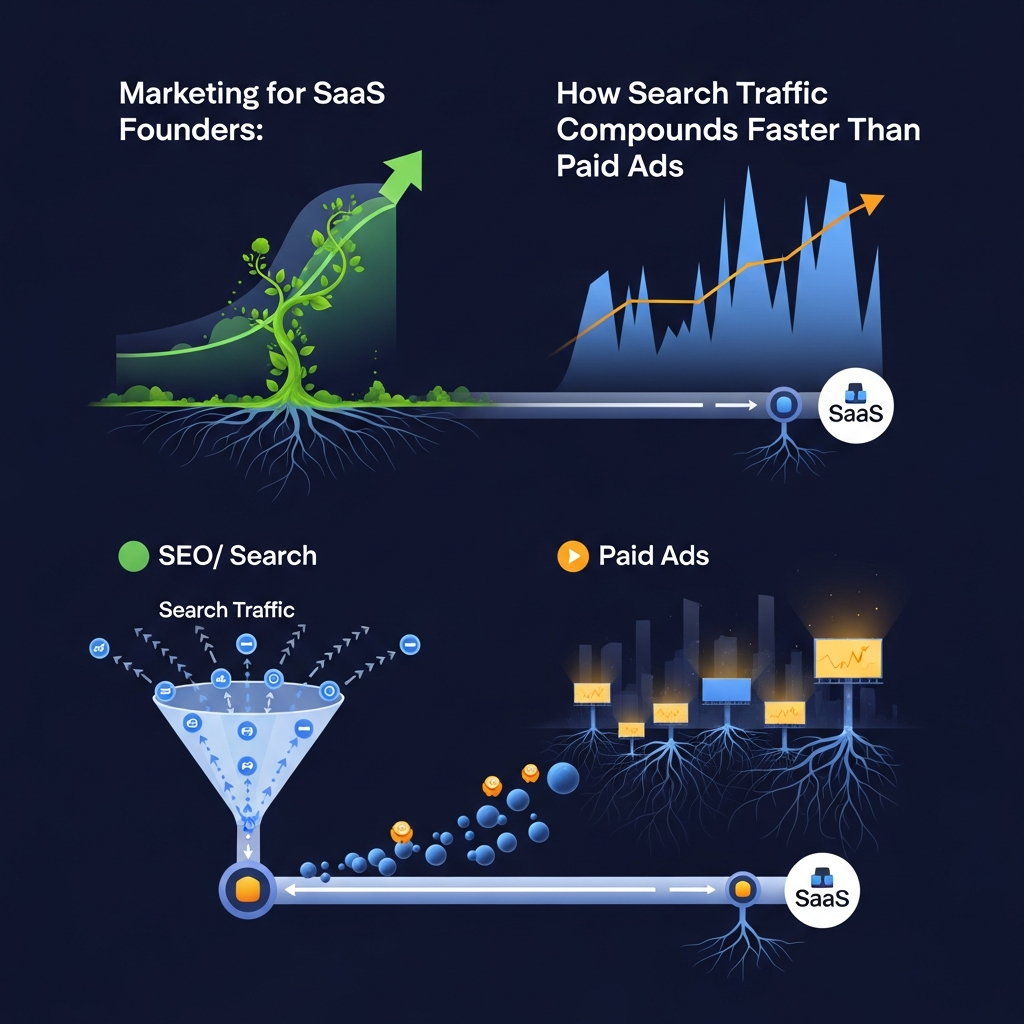
Marketing for SaaS Founders: Why Programmatic SEO Outperforms Paid Ads for Sustainable Growth
Why SaaS Search Traffic Matters
For SaaS founders, every new signup is a signal in a longer, compounding curve. Organic search traffic, when earned consistently, tends to compound as content gains authority and pages attract more relevant references over time. Unlike paid ads, which require ongoing budgets to sustain visibility, well-structured search traffic builds resilience and predictable growth. In the SaaS space, where the sales cycle can be long and the product complexity high, organic visibility often translates into higher customer lifetime value and lower churn when users discover your solution through education and problem-solving content.
Consider how a well-optimized SaaS blog, knowledge center, or product pages can capture intent at various stages of the funnel—from awareness to evaluation. A single, evergreen article about a core use case can continue ranking for months or years, driving signups with relatively little ongoing cost. This is the essence of programmatic SEO: identifying repeatable, scalable opportunities and systematizing their creation and optimization.
What Is Programmatic SEO and Programmatic Marketing?
Programmatic SEO is a structured approach to content and site optimization driven by data, automation, and repeatable processes. The core idea is to create an engine that scans the search landscape for keyword opportunities, prioritizes topics, generates or guides content creation, and optimizes on-page signals at scale. Programmatic marketing extends this thinking to cross-channel amplification, including internal linking, schema markup, and publishing workflows that output consistent, API-friendly assets across a site’s pages.
In practice, a robust programmatic SEO stack combines discovery (finding target keywords), clustering (grouping topics by intent and relevance), content production (long-form assets, briefs, and templates), optimization (on-page signals, internal linking, meta data), and publishing automation. The result is a repeatable machine that grows your organic footprint while maintaining a brand voice and product focus.
How Search Traffic Compounds Faster Than Paid Ads
Paid ads can deliver quick wins, but their effects are bounded by budget and click-through rates. Programmatic SEO compounds because each new ranking asset can accumulate impressions, earn backlinks, and improve related pages’ visibility. For a SaaS business, this means more product explorations, more feature comparisons, and more blog-driven conversion paths that don’t rely on an ongoing spend. The result is a lower customer acquisition cost over time and a higher organic share of voice against competitors.
The compounding effect hinges on a few levers: relevance, authority, and breadth. Relevance grows when content aligns with precise user intent—capturing a demand before competitors. Authority builds as pages attract credible mentions and become reference points within your niche. Breadth comes from content that covers a spectrum of related queries, often through topic clusters that interlink to distribute value across the site.
Building a Programmatic SEO Engine for SaaS
Start with a simple architecture and scale it. The engine has four core modules: discovery, content intent alignment, production automation, and performance feedback. Each module should be designed to operate with guardrails that protect brand voice and product accuracy.
Module 1 — Discovery and Opportunity Mapping
Identify topics your buyers search for, not just keywords. Use competitive keyword research to map gaps where your product solves a distinct problem. Create a priority list based on search volume, difficulty, and strategic alignment with your product roadmap. A practical output is an opportunity keyword map that groups related topics under overarching themes.
Module 2 — Content Intent and Clustering
Group topics by user intent: information, comparison, and transactional. Build topic clusters that interlink logically. Each cluster should have a pillar piece (long-form cornerstone content) and supporting posts or updates that answer related questions. This structure improves crawlability and helps search engines understand topical authority.
Module 3 — Production and Automation
Automate where possible, but preserve accuracy and brand voice. Use templates for briefs, outlines, and meta elements. Leverage AI-assisted editing for initial drafts, followed by human refinement to ensure clarity and correctness. A scalable system should also automate internal linking suggestions and canonical handling across the site.
Module 4 — Publishing and Feedback
Automate CMS publishing and scheduling, while enforcing QA gates. Implement dashboards that surface ranking signals, traffic, and engagement at the page and cluster level. Use a feedback loop to prune underperforming topics and double down on high-potential areas.
Tactical Keyword Tactics for SaaS
Three tactics form the backbone of a robust programmatic approach: competitive keyword research, finding low-competition keywords, and opportunity keyword mapping. Each tactic feeds the next, creating a pipeline from discovery to payoff.
Competitive Keyword Research
Study how competitors target your space. Identify gaps where your product edges out others—especially in areas where your features offer a unique advantage. This research guides your pillar topics and helps you prioritize quick wins that require minimal new assets.
Find Low-Competition Keywords
Low-competition opportunities often reside in niche problem spaces or product-focused use cases. These keywords enable quicker rankings and early traffic, which you can then build upon with broader content. A practical approach is to identify long-tail variants and questions that real buyers ask during the evaluation phase.
Opportunity Keyword Mapping
Map opportunities to owners across product and marketing. Align topics with product updates or features on your roadmap. By connecting keyword opportunities to release timelines, you create content that remains relevant and timely, increasing the odds of ranking high for core queries.
To deepen this approach, review related content in our editorial and publishing workflows that illustrate how to plan, write, and publish at scale: Editorial Workflow for Agencies.
Architecture, Workflow, and the Content Stack
A practical stack for SaaS SEO blends content planning, AI-assisted drafting, editorial review, and CMS publishing. The goal is to minimize manual toil while maximizing content quality, internal linking health, and structured data accuracy. A suggested workflow looks like this:
- Seed keyword map and topic clusters based on competitive research.
- Generate outlines and briefs that specify intent, audience, and required data points.
- Draft content with AI assistance, then human editors refine tone and accuracy.
- Apply internal linking recommendations and schema markup in a consistent, scalable pattern.
- Publish on a cadence that aligns with product releases and marketing campaigns.
The automation should also cover metadata generation, canonical URL management, and multilingual considerations if you serve global customers. A robust system provides real-time SERP visibility, enabling quick tweaks to stay ahead of shifting competition.
A Practical 90-Day Roadmap for SaaS SEO Acceleration
Use a staged approach to validate your programmatic engine while maintaining quality. The roadmap below outlines a pragmatic progression from setup to scale.
Days 1–30 — Foundation
- Assemble a cross-functional team: SEO, product, content, engineering, and design.
- Publish a prioritized opportunity keyword map and cluster plan.
- Create pillar content for 2–3 high-potential themes and outline supporting articles.
- Set up automated publishing and internal linking templates; implement basic schema.
Days 31–60 — Production and Early Gains
- Publish the pillar assets and supporting posts; establish a 2–3-week cadence for updates.
- Enhance internal linking and canonical strategies to improve crawl efficiency.
- Launch a multilingual or localization pilot if relevant to your market.
Days 61–90 — Scale and Optimization
- Expand topic clusters and deepen content around high-intent queries.
- Refine content briefs based on early performance data and SERP shifts.
- Introduce more automated analytics dashboards for stakeholders and clients, if applicable.
Throughout this ramp, maintain guardrails: monitor accuracy, brand voice, and customer outcomes. Consider internal links from related product pages to your content assets to boost relevance signals.
Risks and Governance: Keeping Programmatic SEO Healthy
Any automation strategy carries risk. Common issues in programmatic SEO include content cannibalization, keyword stuffing, misalignment with brand voice, and over-reliance on automated metadata. Mitigate these risks with human-in-the-loop checks, clear content guidelines, and regular audits of structure, schema, and link health. Regularly review performance not just on rankings, but on engagement and conversion outcomes.
Governance is essential when you operate at scale. Define ownership for each pillar, establish content quality thresholds, and document your editorial standards. When in doubt, pause automated publishing to verify alignment with product messaging and customer needs.
Real-World Lessons (Without Fabricated Figures)
While every SaaS business has unique dynamics, the underlying patterns are stable: identify high-potential topics tied to your product, build reliable content templates, and automate the repeatable components of publishing and linking. Use data as a compass, not a replacement for expert judgment. The strongest programs couple rapid experimentation with disciplined quality control, ensuring you don’t sacrifice clarity for speed.
To explore practical frameworks and templates in action, see related discussions in our posts on editorial workflows and scalable publishing.
Internal links: Blogs and Editorial Workflow for Agencies.
Key Takeaways
- Programmatic SEO is a scalable engine for long-term SaaS growth, pairing data-driven discovery with automated production and publishing.
- Compounding search traffic arises from topical authority, breadth of coverage, and consistent optimization signals across interlinked content.
- A practical roadmap emphasizes discovery, intent-aligned content, robust architecture, and clear governance to avoid common pitfalls.
For more on building scalable content systems, check out our broader guides and related posts on Blogs and the editorial workflow resources referenced above.
Internal Reading and Related Resources
To see how automation and publishing workflows can be integrated with your current tooling, explore these related pages and notes: