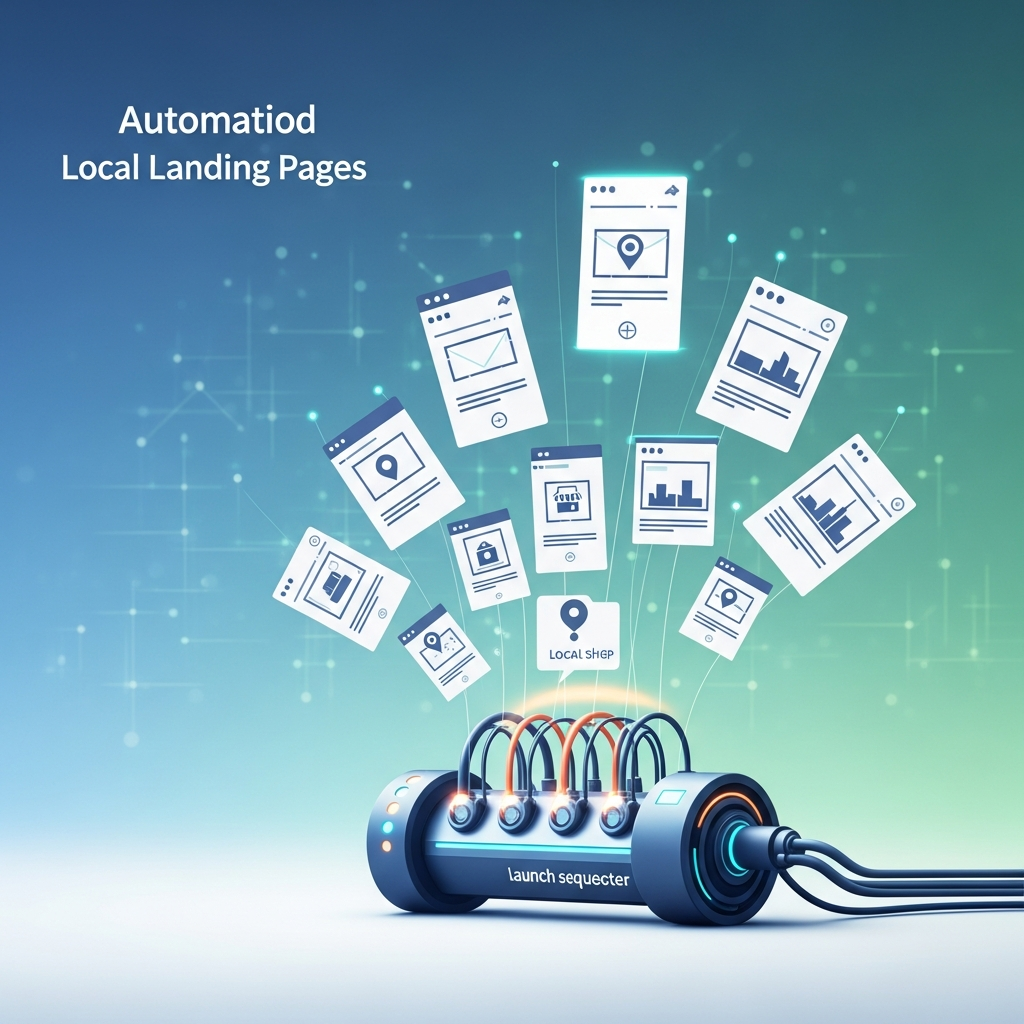
Local Launch Sequencer
The Local Launch Sequencer is a repeatable, scalable workflow designed to create, localize, and auto-publish high-conversion location pages across multiple markets. Built around the idea of automated local landing pages, it combines template-driven content, consistent NAP, and structured data to ensure each location page feels brand-consistent while ranking locally. This approach reduces manual work and enables teams to scale their local presence without sacrificing quality.
For teams already juggling many markets, the sequencing approach acts like a production line for local pages. Instead of recreating pages by hand, you assemble a framework that can generate dozens or hundreds of pages with consistent quality, then push them live with a click. The result is faster market coverage, fewer errors, and more reliable signals to search engines about your local authority.
Why automated local landing pages matter
Local SEO is about telling search engines where you operate, who you serve, and why your business is relevant in a given market. When location pages are crafted at scale with consistent structure and accurate data, you unlock several benefits:
- Improved local visibility across maps and organic results due to precise on-page signals and fresh content.
- Better user experiences thanks to consistent NAP information and location-specific details.
- Faster time-to-market for new markets or locations, enabling proactive expansion.
- Reduced risk of duplication penalties by using templates and standardized schema markup.
However, the key is not just volume—it’s quality at scale. The sequencer emphasizes unique, location-relevant data (services, hours, promotions) while preserving brand voice. For teams that publish location pages across many markets, automation becomes a force multiplier, turning local SEO from a sporadic effort into a repeatable system.
To see practical examples of how scalable content systems translate to real-world SEO results, explore our editorial workflow for agencies—a behind-the-scenes look at planning, writing, and publishing at scale. You can also visit our main blog hub for additional context and case studies.
For global or multi-location brands, localization isn’t just translation—it’s adaptation. The sequencer manages localization at scale while keeping local pages aligned with your brand and SEO strategy.
Core components of a Local Launch Sequencer
A robust Local Launch Sequencer rests on a few critical building blocks that work in harmony. Each component is designed to be reusable, auditable, and CMS-friendly so you can plug it into existing tech stacks.
1) Location page templates
Templates define the common structure for every location page: header sections, service proposition, testimonials, hours, and localized call-to-action. By using a single source of truth for layout, you preserve brand consistency while enabling each page to show market-specific data.
2) Dynamic localization data
The sequencer pulls in location-specific data such as city, neighborhood descriptors, local promotions, and contact details. When markets vary by language, currency, or regulatory requirements, templates adapt without creating duplicate, manual work.
3) Local schema markup and structured data
Structured data communicates location, opening hours, and contact channels to search engines. Automated schema generation reduces manual errors and ensures consistency across all pages, helping rich results and better snippet eligibility.
4) NAP consistency and data governance
Consistency of name, address, and phone number across pages and external listings is critical. The sequencer enforces a single source of truth for NAP, minimizing conflicts in search engines and maps results.
5) Publishing workflow and CMS integration
The automation layer connects to your content management system (WordPress, Webflow, Shopify, etc.) to publish pages on a schedule or on-demand. A publish belt ensures pages are created, reviewed, and deployed with proper version control and rollback capabilities.
As you implement these components, you should consider how to integrate internal linking and canonical signals to strengthen site-wide relevance for local pages. A well-designed internal linking strategy helps search engines discover all local assets and distributes authority effectively across markets.
Step-by-step blueprint to implement the Local Launch Sequencer
Use this practical blueprint as a starter kit for teams evaluating or building a scalable local page program. Each step is designed to be actionable and measurable.
- Define markets and data sources: List the locations you plan to target and identify the data sources for each page (local hours, promotions, service availability, testimonials, and local partners). Map each data point to a field in your CMS to support automatic population.
- Create location templates: Design a few core templates that cover the most common scenarios (service-area pages, city landing pages, and neighborhood pages). Include sections for unique selling propositions, local testimonials, and location-specific CTAs.
- Automate localization data import: Set up data feeds or manual entry processes that populate the template with market-specific values. Ensure the data model supports language variants if needed.
- Implement local schema and NAP governance: Generate structured data automatically and verify that NAP fields resolve consistently on every page. Use a validation checklist before publishing.
- Establish the publishing cadence: Decide how often new locations are added or updated. Use a recurring schedule (e.g., weekly or monthly) and a manual trigger for urgent expansions.
- Publish and monitor: Push pages to your CMS with versioned deployments. Monitor indexing, crawl consistency, and performance in your analytics platform. Adjust templates or data fields based on performance signals.
For more on scalable editorial workflows that pair with automation, explore this practical guide: Editorial workflow for agencies.
Architectural options and trade-offs
There isn’t a one-size-fits-all solution. Your choice of architecture should align with your CMS capabilities, developer resources, and how aggressively you want to scale.
Option A: Template-driven CMS integration
Leverage built-in CMS templating to populate fields from a centralized data store. Advantages include speed to first production, strong governance, and easy rollback. Trade-offs involve heavier reliance on data hygiene and template mastery by developers.
Option B: Headless approach with a content orchestration layer
A headless setup separates content creation from rendering. This is ideal for multi-brand or multi-platform publishing. It offers flexibility at the cost of added integration work and potential latency considerations.
Option C: Hybrid model for localization at scale
Combine templates with lightweight localization micro-services to adapt pages for specific markets without duplicating data. This balances speed and customization, but requires careful data governance.
Key considerations across options include data synchronization, error handling, and performance. Regardless of the architecture, prioritize automated validation, clear ownership for data sources, and a robust monitoring stack to catch anomalies early.
Best practices and common pitfalls
To maximize the value of automated location pages, follow these guidelines and watch for typical missteps that erode ROI.
- Keep content distinct at the page level. Avoid duplicative text blocks across locations; tailor unique value propositions, local acronyms, and market-specific examples.
- Maintain brand voice while localizing. Use neutral, consistent language for core benefits, but adapt anecdotes and examples to local contexts.
- Ensure data accuracy and timeliness. Regularly audit hours, address, phone numbers, and promotions to prevent outdated information from damaging local trust.
- Guard against over-automation. Include a lightweight human review step for spin-off pages or markets with unique regulatory considerations.
- Monitor performance holistically. Combine page-level metrics (CTR, dwell time) with site-level signals (crawl depth, internal linking health) to gauge impact.
Avoid common pitfalls such as over-structuring content, which can make pages feel mechanical, or under-investing in local signals beyond basic NAP data. Balance automation with thoughtful localization for true relevance in each market.
Measuring success and optimizing over time
Measurement should be anchored in clear KPIs that reflect both visibility and user action. Consider the following framework for ongoing optimization:
- Ranking improvements in core local queries for each market and page.
- Impressions growth on maps and organic results, with attention to click-through rate (CTR).
- On-page engagement metrics such as average time on page and scroll depth, indicating relevance.
- Conversion signals from location pages, including form submissions, calls, or store visits.
- Data hygiene metrics, such as NAP consistency across all pages and external listings.
Regularly review data in your analytics and SEO dashboards. Use A/B testing for page variants and iterate on templates based on performance. If you want practical guidance on achieving a higher level of automation with reliable reporting, see our white-paper on automated SEO workflows and dashboards.
A practical framework you can implement now
Think of the Local Launch Sequencer as four interconnected loops: Plan, Create, Publish, and Improve. Each loop feeds the next, creating a virtuous cycle of localization at scale.
Plan
Define target locations, data sources, and a schedule. Create a living playbook that documents the fields used by templates and the standard for local signals. Align the plan with your broader SEO strategy and brand guidelines.
Create
Populate the templates with location data and craft market-specific value propositions. Ensure local schema and NAP fields are generated automatically, while preserving content quality and readability.
Publish
Push pages to the CMS with version control, automated QA checks, and scheduled releases. Maintain a log of changes to support audits and rollback if needed.
Improve
Continuously monitor performance, gather feedback from users and search engines, and refine templates and data sources. Use insights to expand to new markets faster and with greater confidence.
For additional context on scalable workflows, check the post on practical editorial workflows: Editorial workflow for agencies and explore the main blog hub: our blog.
Next steps and how to get started
Running a pilot is a sensible way to validate the Local Launch Sequencer concept. Start with a handful of locations, implement templates, and automate data import. Measure local metrics and refine the process before scaling to additional markets.
If you’re evaluating tools or services to implement this approach, consider how your chosen solution handles:
- Template flexibility and localization support across languages
- Reliable CMS integrations with one-click publish capabilities
- Structured data generation and NAP governance at scale
- Transparent analytics and performance reporting
To learn more about scalable, automated SEO workflows and to see how others are performing, visit our blog hub or read about the Sao Paulo localization automation: Sao Paulo automation post. For practical editorial guidance, also explore the editorial workflow article mentioned earlier.
Ready to explore automated local landing pages in your stack? Contact our team for a tailored plan or request a demonstration to see how the Local Launch Sequencer can be integrated with your CMS, data sources, and localization processes.
Related resources: Editorial workflow for agencies, blog hub.