Keyword Intent Mapping Blueprint: Templates and a 30-Day Content Plan
Introduction
Keywords tell us what people want, but intents reveal why they want it. Keyword intent mapping is the practice of translating search intent signals into concrete content types, formats, and publication timing. The goal is to create a prioritized plan that aligns with brand voice, editorial capacity, and business goals. When you map intent to content, you reduce guesswork and increase the likelihood of earning clicks, dwell time, and conversions.
This blueprint provides practical templates, a repeatable workflow, and a 30-day plan you can adapt to any niche. It combines a simple four-step framework with actionable checklists, so you can move from keyword research to an executable schedule in days rather than weeks.
For readers exploring more on editorial efficiency, you might find value in our editorial workflow guide for agencies and the broader insights in our blog index.
A Four-Step Blueprint to Map Keywords to Content Types
The blueprint starts with intent discovery and ends with a publish-ready plan. Each step is designed to be lightweight, repeatable, and auditable so you can refine the approach over time.
Step 1: Define Intent Signals
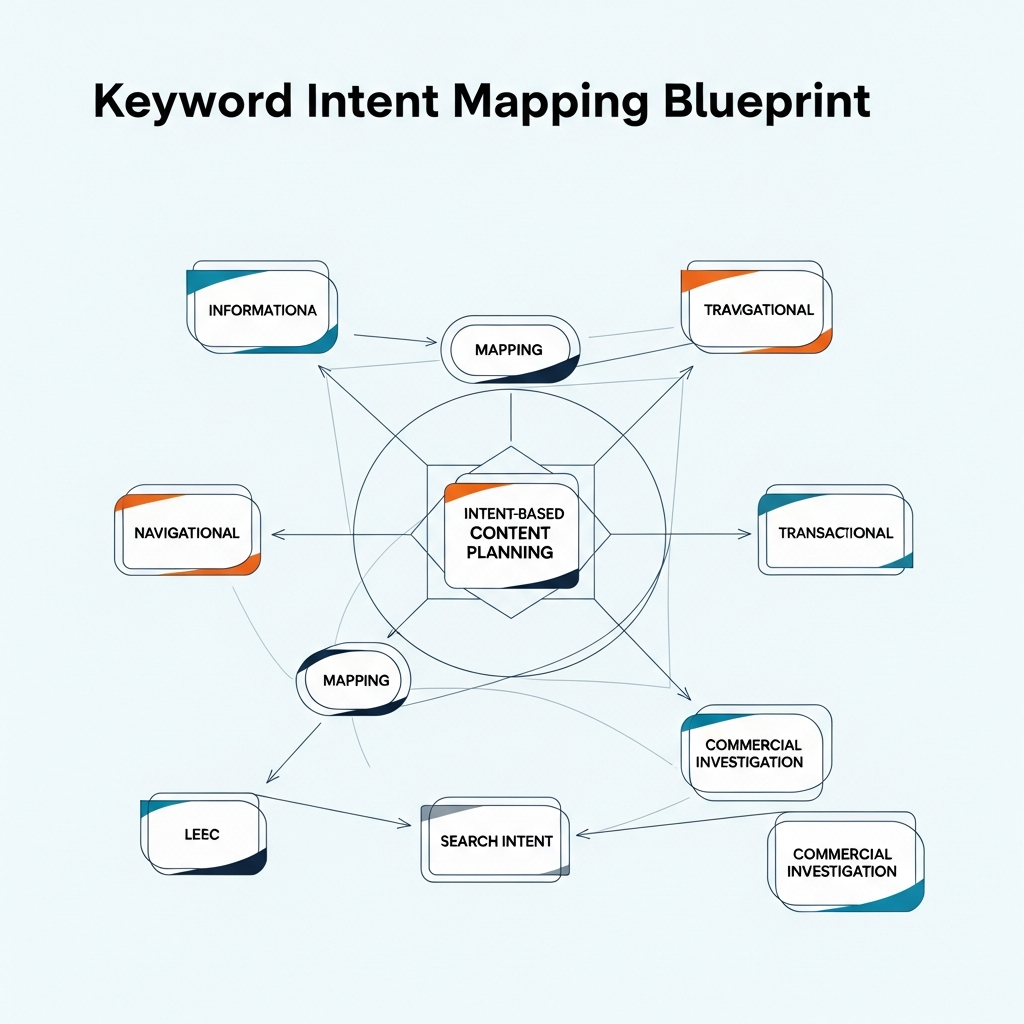
Intent signals include informational, navigational, transactional, and comparison queries. For each keyword, capture the dominant intent and any secondary intents that appear in related searches. Create a lightweight matrix that captures: keyword, primary intent, secondary intents, and suggested content type. This baseline makes it easier to prioritize content that best matches user needs.
Step 2: Map Content Types to Each Intent
Assign a content type to each intent. Informational queries often suit long-form guides, how-to articles, and explainers. Navigational and brand-related intents may map to product pages, category hubs, or case studies. Transactional intents crave clear conversion paths, comparison pages, and buying guides. The mapping should be explicit and visible in your templates so anyone can audit or update as search behavior shifts.
Step 3: Cluster Keywords into a Content Calendar
Group keywords by theme and intent to produce a coherent content calendar. Clustering helps you avoid content silos and promotes internal linking. Each cluster should have a primary topic page and supporting articles that answer related questions, address objections, or expand on subtopics. A well-clustered calendar accelerates indexation and improves topical authority.
Step 4: Prioritize and Schedule with a Scoring System
Use a simple scoring rubric to rank keywords for production. Consider factors like search volume, keyword difficulty, page authority, content gaps, and expected impact on funnel stages. A transparent scoring system makes it easier to justify content investments to stakeholders and to reallocate resources when needed.
Tip: Maintain a running backlog of candidate topics and a separate sprint backlog for 30-day execution. This keeps momentum even as campaigns evolve or as new data arrives.
Templates You Can Reuse
Templates provide consistency and speed. The following templates are designed to be lightweight, adaptable, and compatible with common editorial workflows.
Template A: Keyword-to-Content Mapping Table
Fields: Keyword, Primary Intent, Secondary Intents, Suggested Content Type, Content Goal, Priority Score, Suggested Publish Date. Use this table as the single source of truth for each keyword and its content counterpart. Update the priority score as new data comes in from analytics or user feedback.
Template B: Content Calendar Skeleton
Fields: Topic Page, Supporting Article 1, Supporting Article 2, Internal Link Targets, Publish Dates, Responsible Owner, Status. This skeleton keeps your team aligned and makes it easy to see coverage gaps at a glance.
Template C: Content Gap Analysis Worksheet
Fields: Topic Area, Current Coverage, Content Gaps, Questions Left Unanswered, Proposed Content, Priority, Impact. Use this to quantify missing angles and identify opportunities that might capture additional search demand.
For a practical walkthrough of templates, see our blog post on editorial workflows and scalable planning: editorial workflow templates.
Building a 30-Day Content Plan
Turning keyword intent mapping into a 30-day plan requires a tight cadence and clear ownership. The following steps help you translate insights into an executable calendar.
Step A: Establish Day 1–Day 7 Baselines
Begin with one cluster that represents a core topic. Produce a pillar page and two to three supporting posts. The pillar should cover the topic end-to-end, while the supporting posts answer related questions and seed internal links to the pillar.
Step B: Create a Daily Rhythm
Assign tasks for brainstorming, drafting, editing, optimization, and publishing. For example, Day 1 brainstorm and outline, Day 2 draft, Day 3 review, Day 4 optimize on-page signals, Day 5 publish, Day 6 promote, Day 7 review performance data. Repeat with new clusters each week.
Step C: Balance Formats and Channels
Mix long-form content with skimmable checklists, infographics, and short form posts. Plan repurposing opportunities—turn a pillar into a video script, a webinar outline, or social media carousels. This expands reach while preserving the core intent alignment.
When you publish, link to related content and ensure canonicalization where appropriate. If you have set up structured data, verify that schema is consistent across new pages.
To see how a calendar might look, consult our standard blog planning templates and adapt them to your editorial rhythm: our blog index.
Keyword Clustering for Calendar
Clustering is at the heart of a scalable content plan. Clusters group related keywords around a central topic, enabling efficient internal linking and topical authority. Here are practical methods to cluster at scale.
Method 1: Intent-Driven Clustering
Group by primary intent first, then assign secondary intents within each cluster. This helps ensure that every content asset answers a core need while also addressing adjacent questions. A clean intent hierarchy reduces cannibalization and clarifies the user journey.
Method 2: Topic Modeling with Seed Keywords
Start from 5–7 seed keywords and expand using related searches, questions, and suggested terms. This approach uncovers long-tail opportunities that competitors may overlook. Record the expansion in your Keyword-to-Content Mapping Table for easy reference.
Method 3: Value-Based Prioritization
Score clusters by potential value: search volume, intent quality, alignment with funnel goals, and potential to increase engagement metrics. Prioritize clusters that contribute to top-of-funnel awareness and mid-funnel consideration alike, ensuring a balanced content mix.
As you cluster, maintain a consistent taxonomy across the site. Unified labels make future analytics easier and help search engines understand your topics more clearly.
For a practical example of clustering in action, review our example mapping in the next section. You can also explore our editorial resources in the linked blog post above.
Content Gap Analysis
Content gap analysis identifies where your content could answer questions, remove objections, or provide deeper insights. It’s the fastest way to uncover opportunities that normalize into a 30-day plan, rather than chasing new topics blindly.
How to perform a quick gap analysis
1) Inventory existing content and map it to the intent framework. 2) Compare to top-ranking pages for the same topic to identify unanswered questions or missing angles. 3) Propose new assets that fill those gaps, prioritizing those with the highest impact and easiest production effort. 4) Reassess gaps on a weekly basis as rankings shift and new questions emerge.
Tools can help automate portions of this process, but human judgment remains essential for alignment with brand voice and audience expectations. For more on how to structure content gaps, see our templates section and the 30-day plan guidelines above.
To see practical examples of gap analysis in action, you can review related content planning resources in our blog directory: editorial workflows and our general blog hub: blog index.
A Practical Mapping Example
Imagine you run an e-commerce site selling ergonomic chairs. You start with a pillar page titled: How Ergonomic Chairs Improve Productivity. Your mappings might look like this:
- Keyword: ergonomic chair benefits — Intent: informational; Content type: long-form guide; Primary goal: educate and convert via email capture.
- Keyword: best ergonomic chair for back pain — Intent: informational/transactional; Content type: buyer’s guide with product comparisons; Primary goal: product discovery and conversions.
- Keyword: office chair price comparison — Intent: transactional; Content type: comparison page; Primary goal: drive direct sales or signups.
These mappings feed directly into your 30-day calendar, ensuring that each asset connects to others through internal links and features consistent schema markup where appropriate. You can replicate this approach for any category, including multilingual and multi-location variants if needed.
For further inspiration on how to structure content at scale, read about scalable editorial workflows at editorial workflows for agencies.
Editorial Workflow, Publishing, and Measurement
An efficient workflow turns intent-to-content mapping into repeatable outcomes. Define clear roles, assign responsibilities for research, drafting, editing, and publishing, and establish SLAs to keep the calendar on track.
Automation touchpoints
Where possible, automate keyword clustering, content briefs, metadata generation, and internal linking. Maintain a human-in-the-loop for quality checks, brand voice, and factual accuracy. Automated publishing to your CMS should be tested in a staging environment before applying to the live site.
Measurement and dashboards
Track learnings across the 30-day plan. Monitor metrics such as organic traffic, click-through rate, time on page, and conversion rate. Use a simple dashboard to compare planned vs. actual publish dates and to surface gaps for the next sprint.
For more on practical editorial systems, consider exploring additional guidance in our editorial resources hub: blog index.
Common Pitfalls and How to Avoid Them
Keyword intent mapping is powerful, but it’s easy to fall into traps that degrade quality or confuse users. Here are common pitfalls and practical fixes.
Pitfall 1: Misreading intent
Assuming intent without validation leads to mismatches between user expectations and content outcomes. Mitigate by annotating intent with supporting signals from search queries, on-page engagement data, and competitor analysis.
Pitfall 2: Over-optimizing for search signals
Overloading pages with keywords or structured data can harm readability and user experience. Favor clarity and usefulness; let optimization enhancements support the user journey rather than override it.
Pitfall 3: Creating content in silos
Without strong internal linking and a clear topic hierarchy, even well-made articles can struggle to earn authority. Always connect related assets and ensure navigation cues guide readers through relevant topics.
Pitfall 4: Ignoring performance signals
Poor page speed, mobile usability issues, or non-optimized metadata undermine content value. Include performance checks as part of the post-publish review process.
Getting Started: Action Steps
- Audit your current keyword list and identify primary intents. Create a simple intent matrix for 20–30 keywords to start.
- Draft a basic mapping table that links each keyword to a content type and a suggested publish date. Keep it light and flexible for the first sprint.
- Build a 30-day calendar with pillar pages and supporting assets. Schedule drafts and assign owners for each piece.
- Set up a measurement plan with clear success metrics. Start with top-line metrics like organic traffic and CTR, then add engagement metrics over time.
- Review and refine weekly. Use gaps uncovered by analytics to adjust priorities and improve upcoming content.
To further refine your approach, read our more in-depth resources and templates in the blog hub: blog index or explore the editorial workflow article for a template-driven path to scale: editorial workflow guide.
If you want a structured starting point, consider visiting the disclaimer page for policy and best practices: Disclaimer.