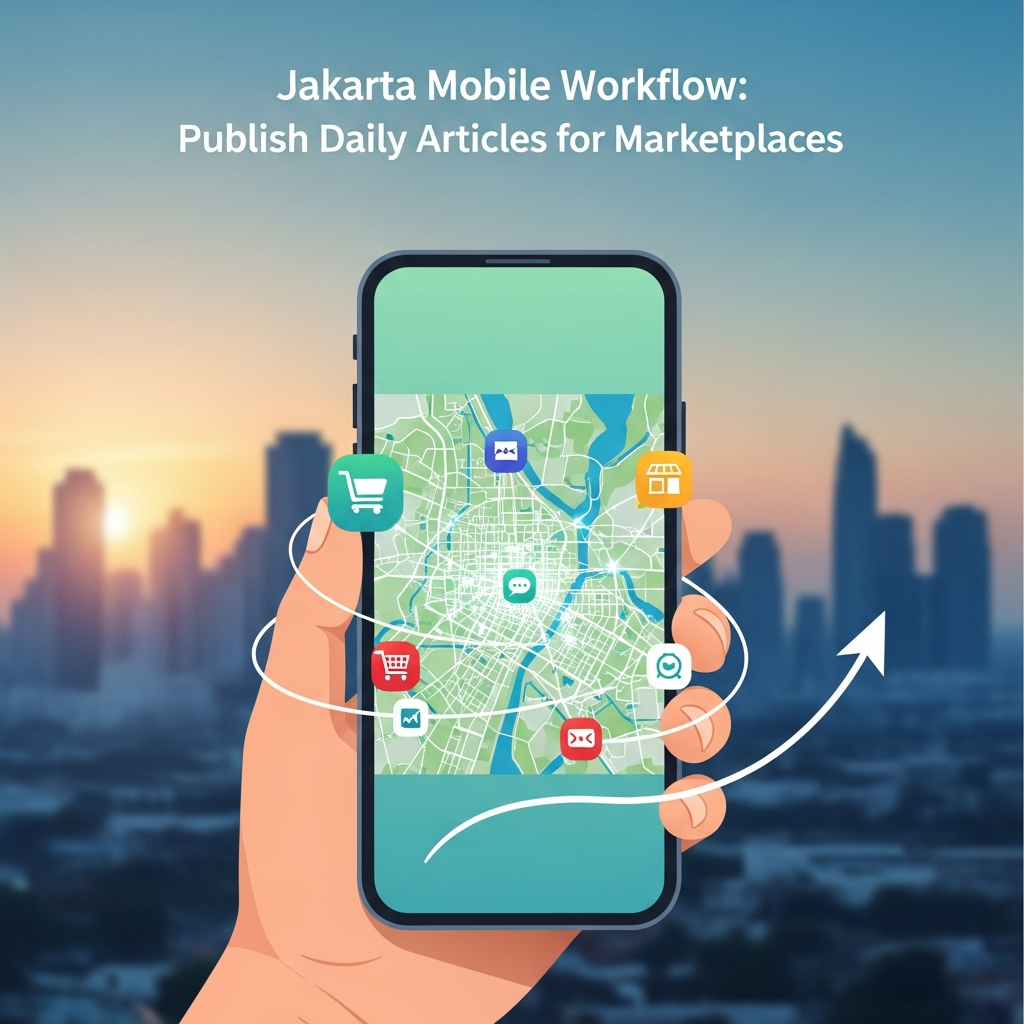
Jakarta Mobile Workflow: Publish Daily Articles for Marketplaces
Overview
Jakarta is a powerhouse for marketplaces and app ecosystems in Indonesia. The demand for fresh, mobile-optimized content—daily product descriptions, editorial updates, and category pages—has never been higher. This guide outlines a practical, mobile-first workflow to auto publish konten Jakarta across CMS platforms, enabling teams to publish to multiple marketplaces with speed and consistency.
Below, you will find a framework that combines content generation, SEO alignment, and CMS publishing in a repeatable pipeline. The objective is to reduce manual steps while preserving quality, brand voice, and local relevance. The approach is especially valuable for marketplace managers, growth teams, and agencies serving Jakarta-based clients or products targeting Indonesian shoppers.
Why Jakarta Matters for Marketplaces
Jakarta is Indonesia’s digital commerce hub, with a dense concentration of shoppers who rely on mobile devices for discovery and purchases. A mobile-first content strategy aligns with user behavior, ensuring product descriptions, editorial pages, and category briefs load quickly and render cleanly on smartphones. Automating daily publication helps maintain visibility in crowded marketplaces and supports rapid experimentation with new SKUs, campaigns, or regional promos.
Local SEO plays a critical role in search visibility for Jakarta-based marketplaces. When content is auto-published with consistent metadata and schema, search engines can index pages faster and understand their intent, improving discoverability for Jakarta users and nearby regions. The result is a healthier content cadence, more impressions, and a higher chance of conversions from organic search and marketplace feeds.
Mobile-first Architecture for Auto Publishing
A robust mobile-first architecture starts with content templates designed for speed and consistency. The core components include seed content blocks, metadata templates, and automated quality checks that run before any page goes live. The architecture should integrate tightly with your CMS (e.g., WordPress, Shopify, Webflow) and support one-click publishing of new product pages and editorial articles.
Key components
- Content templates tailored for product descriptions, editorial pieces, and category pages that render well on mobile devices.
- Automated metadata generation, including title tags, meta descriptions, and schema markup.
- Internal linking and canonical URL management to preserve page authority and crawl efficiency.
- One-click or scheduled publishing to CMS and cross-channel distribution to marketplaces and social channels.
Technical considerations
- Latency and rendering performance on mobile devices; prioritize above-the-fold content and lazy loading where appropriate.
- Canonicalization and duplicate content control to avoid SEO penalties.
- Localization and language handling for multilingual Jakarta audiences.
For readers who want deeper operational context, see our editorial workflow guidance for agencies planning writing and publishing at scale (Editorial Workflow for Agencies).
Content Types and Metadata
The auto-publishing workflow must handle multiple content types specific to marketplaces. Typical content types include product descriptions, editorial articles, and category overviews. Each piece benefits from structured metadata: structured data markup (JSON-LD), alt text for images, and canonical URLs to prevent content cannibalization. A well-managed metadata approach helps search engines understand page purpose and improves click-through rates from search results.
Product pages require accurate descriptions that reflect Indonesian consumer expectations, while editorial articles should maintain brand voice and be optimized for local intent. The combination of high-quality content and precise metadata drives a stronger presence in Jakarta’s competitive search landscape.
As you scale, maintain a clear taxonomy and consistent labeling. Use the same naming conventions for product variants, SKUs, and categories, so internal linking remains meaningful and crawlable. If you’re exploring cross-border reach, keep localization rules consistent to avoid conflicting signals across languages.
Internal linking is a critical lever for SEO at scale. Automated internal linking should surface relevant related products, articles, and category pages to boost crawlability and user experience. For a practical read on automation and linking, check our São Paulo automation guide (Sao Paulo Automation).
Step-by-Step Automation Workflow
Implementing a reliable automation workflow involves a sequence of well-defined steps. Below is a practical 7-step process that can be adapted to Jakarta-based marketplaces and apps:
- Define content scopes: decide which products, categories, and editorial topics will publish daily or on a schedule.
- Set up content templates: create reusable blocks for titles, descriptions, specs, and editorial intros that align with Jakarta consumer expectations.
- Automate keyword research and clustering: generate topic ideas and map them to search intents relevant to Jakarta shoppers.
- Generate content with AI or hybrid editors: produce long-form product descriptions and articles, then route to editors for polishing when needed.
- Optimize on-page signals: auto-create metadata, image alt texts, canonical URLs, and structured data per page.
- Publish and schedule: push content to CMS with one click or on a defined cadence; enable cross-channel distribution to marketplaces.
- Monitor and iterate: use dashboards to track indexing, rankings, and engagement; adjust templates and topics over time.
During implementation, maintain a governance plan that defines who approves templates, who reviews content, and how changes propagate across locales and brands. For a deeper dive into editorial workflows, refer to our article on editorial planning at scale (Editorial Workflow for Agencies).
Pro tip: start with a 30-day pilot focused on a single city block of products and a handful of editorial topics. Use the pilot to tune templates, metadata rules, and the publishing cadence before expanding across categories and markets.
SEO Lokal Jakarta: Localized Visibility at Scale
Local SEO is essential when Jakarta shoppers search for products and services near them. Automating content and local signals helps pages rank for location-based queries. Local considerations include optimizing for Indonesian language variants, incorporating local phrases, and ensuring NAP consistency across CMS pages that publish to multiple marketplaces.
Practical optimization tips include creating location-specific landing pages, adding schema for local business details where appropriate, and maintaining up-to-date local references in product descriptions and editorial pieces. Consistency matters; maintain uniform naming for locations, neighborhoods, and market-specific promotions to prevent fragmented signals.
Leverage automated localization pipelines to handle Bahasa Indonesia content and any regional dialects relevant to Jakarta audiences. Pair content with localized keywords like "SEO lokal Jakarta" and ensure they appear naturally in headings, meta descriptions, and product texts.
For additional operational insight, explore more on automation in our São Paulo article linked above and keep an eye on local-market variations as you scale.
CMS Integrations and Publishing Reach
A core capability of the Jakarta workflow is seamless CMS publishing. The system should publish to popular platforms with a single action and support scheduling for daily content drops. It should also enable cross-posting to marketplaces and social channels without duplicating effort.
Consider platforms commonly used in Indonesia, such as WordPress and Shopify, and verify that the automation supports templates, media management, and version control. A robust integration layer minimizes manual handoffs and reduces the risk of formatting errors that degrade mobile experiences.
Internal links within the content should be intelligently generated to improve crawlability and session depth. When content is published, ensure links are correct, canonical URLs are maintained, and images carry descriptive alt text for accessibility and SEO.
To explore related workflow topics, read our guide about editorial workflows for agencies (Editorial Workflow for Agencies).
Localization and Language Considerations
Localization goes beyond translation. It encompasses cultural nuances, local promotions, and region-specific product details. The Jakarta workflow should support multilingual content pipelines and ensure consistency across locales while preserving brand voice. Automating language-specific checks, keyword relevance, and tone adjustments helps maintain quality at scale.
When publishing Indonesian content, prioritize accuracy in product specifications and ensure that pricing, availability, and promotions reflect local conditions. A well-executed localization strategy can improve trust and drive higher conversion rates among Jakarta shoppers.
As you expand to other markets, reuse the same framework and adapt templates for new languages, keeping a centralized content governance model to avoid divergence across locales.
Security, Governance, and Data Integrity
Automation introduces scale, but governance remains essential. Ensure role-based access controls, audit trails, and change management for all automated publishing rules. Regular reviews of templates, metadata standards, and localization pipelines help prevent regressions and protect brand integrity.
Data integrity is critical when publishing to multiple CMSs and marketplaces. Implement validation layers that verify required fields exist, media assets are properly sized, and URLs are valid before content goes live. Establish a rollback procedure in case a published item needs to be paused or corrected quickly.
Measuring ROI and Key Metrics
Actionable measurement is the backbone of a successful automation program. Track metrics such as publishing cadence (days between posts), time-to-publish, indexation speed, and on-page engagement. For marketplace content, monitor impressions, click-through rates, and conversion signals from product listings and editorial posts.
Set clear KPIs for Jakarta-specific content: search visibility for local keywords, page speed scores on mobile, and the breadth of marketplace coverage. Use dashboards that combine content performance with CMS publishing health to identify bottlenecks and opportunities for optimization.
ROI emerges from faster content cycles, improved rankings, and higher organic traffic. Frame ROI in terms of time saved per publish cycle and incremental traffic attributed to automated content waves. If you want real-world benchmarking examples, review comparative analyses in our automated SEO tool community resources.
Implementation Roadmap: A 6-Week Plan
Week 1–2: Define content scope, select templates, and establish localization rules. Align with stakeholders on what qualifies as publish-worthy content and how it will be represented in Jakarta markets. Create starter templates for product descriptions and a sample editorial article set.
Week 3–4: Build the automation pipeline, connect to a CMS, and implement metadata generation. Validate schema markup, image alt texts, and canonical URLs. Run a small pilot to publish a batch of pages and monitor indexing signals.
Week 5: Scale, refine internal linking rules, and optimize for local search intents. Begin cross-channel publishing to marketplaces and social channels. Implement governance, access controls, and reporting dashboards.
Week 6: Review performance, iterate on templates, and prepare a rollout plan to expand across catalogs and locales. Use insights from the pilot to inform future content waves and localization expansions.
For additional context on editorial workflows during scaling, see our guide for agencies (Editorial Workflow for Agencies) and our São Paulo automation case study (São Paulo Automation). If you’d like to understand the legal and compliance side, consult our disclaimer and terms pages.
Ready to start? You can explore our platform features and see how they align with Jakarta’s market dynamics in Editorial Workflows or start a conversation with our team for a tailored plan.
Next Steps
If you are a marketplace manager in Jakarta or a growth team seeking a scalable, mobile-first publication engine, this framework offers a path to faster content cycles and stronger local visibility. Start with a pilot, measure the impact, and expand as you gain confidence in the automation.
For a deeper dive and a hands-on walkthrough, book a consultation with our experts or request a trial to see how auto publish konten Jakarta can transform your publishing efficiency and market reach.
Internal resources to aid your journey: São Paulo Automation, Editorial Workflows, and our disclaimer page for governance guidelines: Disclaimer.