Keyword Gap Analysis, Competitor Keyword Research, and Intent Mapping: An Actionable Opportunity Map for Content Strategy
Overview: Why a combined approach matters
Keyword gap analysis is the starting point for discovering what your site should be ranking for but currently isn’t. When paired with robust competitor keyword research and deliberate intent mapping, you gain a powerful, win-ready content plan. This approach moves beyond chasing high-volume keywords to building a coherent strategy that prioritizes topics your audience cares about, matches your product or service goals, and aligns with real search intent.
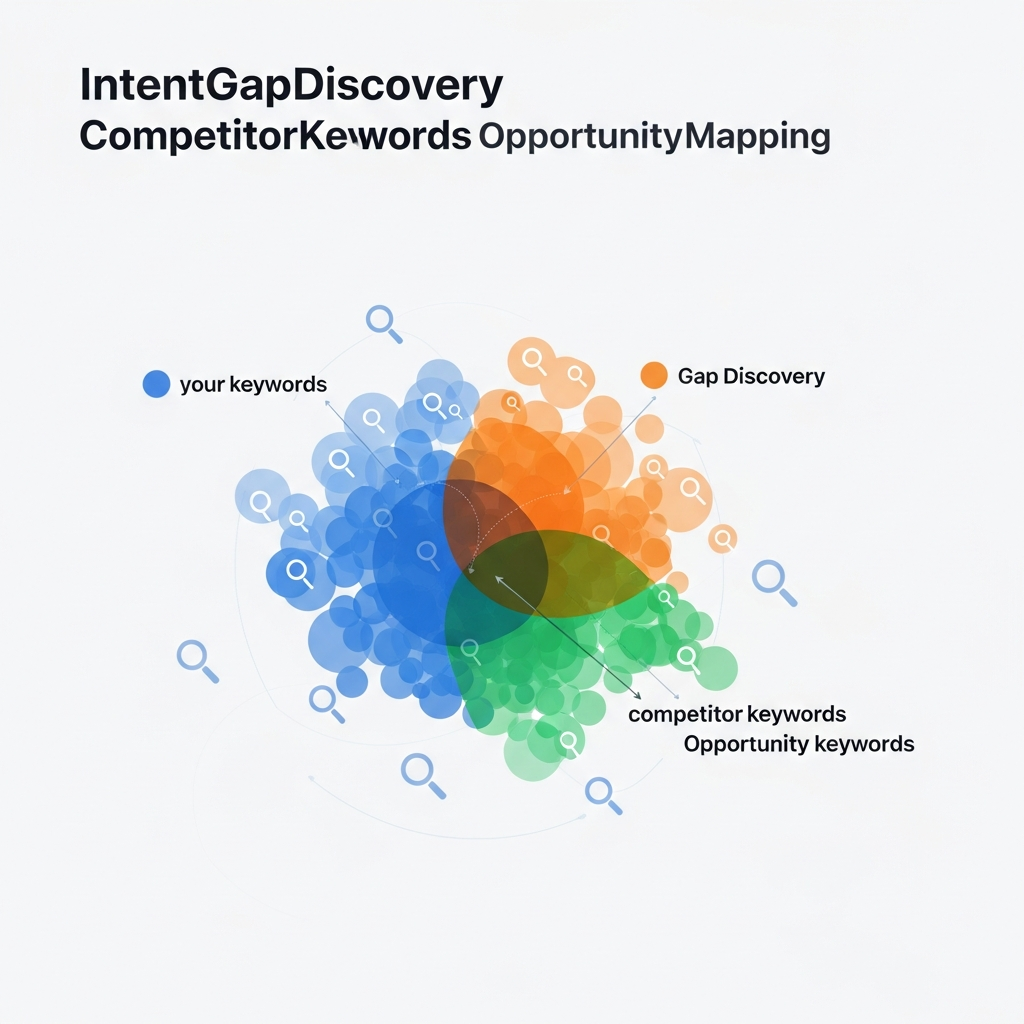
Think of it as three interlocking gears: gap discovery (where you’re missing opportunities), competitive insight (what your rivals are targeting and ranking for), and intent clarity (which topics move users through the funnel). When these gears mesh, you get a prioritized content roadmap that reduces waste, accelerates ROI, and guides cross-functional teams from ideation to publication with confidence.
Competitor keyword research: seeing what’s beneath the surface
Competitor keyword research helps you reveal gaps by mining the terms competitors rank for that you don’t. The goal isn’t to imitate, but to understand where your position is weak and where you can differentiate with your unique value proposition. Start by assembling a broad set of competitors—both direct rivals and aspirational peers—and collect their keyword footprints across product pages, blog content, and category hubs.
Data sources for a solid baseline include on-page keywords, search volume, ranking position, and intent signals. A practical method is to build a keyword gap matrix: list your competitors on one axis and their high-ranking keywords on the other, then mark which queries you currently rank for and which you don’t. This visual helps teams spot high-impact gaps quickly.
To keep this process repeatable, establish a routine cadence (e.g., quarterly) and a clear handoff to content and SEO operations. A simple starter workflow is to export competitor keyword lists, unify them into a master corpus, and run a delta analysis to identify top gaps that align with your product roadmap. For organizations using content automation or CMS-first strategies, consider integrating this workflow into your editorial calendar so that gaps translate directly into briefs and sprints. For deeper immersion in practical publishing workflows, see our guide on editorial workflows for agencies here and note how these processes map to scalable content production. Also, explore the main platform at asimpletool.com for integrated automation options.
From a tooling perspective, create a short list of reliable sources and keep a consistent naming convention to avoid duplication. If you want to read about how to structure data for quick analysis, check our multi-topic example in the internal knowledge base the blogs hub.
Intent mapping: translating gaps into buyer actions
Intent mapping assigns every keyword to a recognizable user goal. Common intent buckets include informational, navigational, and transactional. When you map keywords by intent, you can design content that not only attracts clicks but also moves users toward the next step—whether that’s signing up for a trial, downloading a resource, or requesting a demo.
A practical approach is to create a 3-column matrix: keyword, intent, and recommended content action. For example, a gap around “keyword gap analysis” could map to an informational article explaining the concept, a how-to guide on performing a gap analysis, and a decision-oriented piece about selecting tools for a gap-analysis program. Include indicators for internal linking opportunities and cross-linking with product or service pages to reinforce the user journey.
To deepen your mapping, categorize topics by funnel stage (awareness, consideration, decision) and by purchase motivation (pain relief, efficiency, cost savings). For teams exploring multilingual or localized strategies, map intent to locale-specific content to avoid one-size-fits-all messaging. If you’d like to see a tangible example of combining intent and topic depth, our internal knowledge base provides step-by-step templates in the blog archive Editorial Workflow for Agencies.
Topic opportunity map: structuring ideas into a live plan
An effective topic opportunity map is a two-dimensional grid that plots topics against intent and business impact. The x-axis represents intent precision (informational to transactional), while the y-axis captures potential impact (reach, relevance, revenue potential). Use color-coding to indicate quick wins, medium-term opportunities, and long-term bets.
How to build it in 60 minutes or less:
- Step 1: Gather a master list of potential topics from gap-analysis outputs and competitor keywords.
- Step 2: Tag each topic with assumed intent and a rough impact score (1-5).
- Step 3: Validate intent with search intent signals (SERP features, question-based queries, etc.).
- Step 4: Prioritize topics that combine strong intent signals with achievable complexity (lower internal effort, higher transfer to business goals).
As you populate the map, consider cross-linking opportunities between high-potential topic clusters to create a cohesive content ecosystem. For a practical demonstration of how topic maps feed editorial calendars, read our overview on editorial strategies in the linked resources Local Language Publishing and Agency Editorial Workflow.
Finally, test your map with a small set of pilot pieces before expanding to a full year. A pilot helps you verify keyword relevance, content quality, and translation fidelity if you’re operating in multiple languages.
Finding low-competition keywords: the sweet spot of ROI
Low-competition keywords (often long-tail, highly specific, or niche phrased) are your fastest path to early wins. They typically have lower search difficulty, allowing you to achieve meaningful rankings with less content and link-building effort. Identify these terms by combining three signals: search volume, keyword difficulty, and topic relevance to your product or service.
Strategies to uncover these keywords include:
- Analyzing long-tail derivatives of core topics your site already covers.
- Mining questions people ask in forums, reviews, and comment sections that closely tie to your offerings.
- Targeting locale-specific phrases for regional pages or localized product variants.
When selecting low-competition keywords, pair each with a content plan that clearly demonstrates how you’ll service the intent, not just rank for curiosity queries. You can reinforce this with strong on-page signals: helpful headers, structured data, and deep internal linking to related topics and product pages. For a broader view on automation, see how automated keyword research supports content strategy in our Ranklytics-driven toolkit Ranklytics AI.
Content prioritization framework: turning gaps into a publishable plan
A practical prioritization framework balances impact, effort, and risk. A simple scoring model is Impact x Feasibility, optionally adjusted for strategic fit. Here’s a ready-to-apply version you can use in your next planning session:
- Score each gap candidate on impact (1-5) based on potential traffic, revenue, and alignment with product goals.
- Score feasibility (1-5) by considering content complexity, the need for translation, and internal resources available.
- Compute a priority score = Impact × Feasibility. Higher scores rise to the top of the content calendar.
- Flag risks such as cannibalization, over-optimization, or ethical concerns in data usage or claims.
To operationalize, translate top-priority topics into briefs with clear success metrics, publishing timelines, and assigned owners. Then map each brief to a corresponding content type (pillar article, cluster post, product page update, or local landing page) to ensure a cohesive content ecosystem. For workflow inspiration, explore our internal guides on scalable editorial processes Editorial Workflow for Agencies.
Implementation blueprint: from discovery to publication
Use this 6-step blueprint to implement keyword gap analysis, competitor keyword research, and intent mapping into a living content plan:
- Assemble your data: pull competitor keywords, your own keyword set, and potential topics into a central workspace.
- Perform gap analysis: identify high-potential keywords your site does not cover adequately.
- Map intent: categorize gaps by intent and align with appropriate content actions.
4) Build the topic opportunity map, prioritizing items with the best combination of impact and feasibility. 5) Create briefs: for each top-priority topic, define audience, messaging, content format, required data, and internal linking strategy. 6) Publish and measure: publish to the CMS with clear attribution and track performance against predefined KPIs.
When you’re ready to turn data into action, integrate these steps into your editorial tooling. For hands-on practice, consider starting with a small pilot program and using a direct link to your content calendar so teams can see the plan in one place. If you’re curious how this ties into a broader SEO automation stack, you can explore automation options for CMS publishing and internal linking in our tooling overview Ranklytics.
Tools and workflows: making the map work at scale
At scale, the collaboration between keyword research, intent mapping, and content production relies on an automation-friendly stack. Key components include:
- Keyword discovery and clustering to reveal gaps fast.
- Content generation and optimization that aligns with search intent.
- CMS publishing with scheduling and version control.
- Internal linking automation to strengthen crawlability and topical authority.
- Structured data and canonical management to protect page quality.
If you want a practical example of a scalable workflow, our internal articles discuss editorial workflows and publishing at scale Editorial workflows for agencies, and our broader platform ecosystem supports multi-channel publication with robust analytics the blogs hub.
For a broader perspective on AI-assisted optimization and content automation, you can also review competitive case studies and tool comparisons in our partner ecosystem Outrank and Ranklytics AI.
Pitfalls and best practices: what to avoid and what to adopt
Common pitfalls include over-optimizing for low-competition keywords at the expense of relevance, neglecting user intent in favor of volume, and publishing without a clean internal linking strategy. To minimize risk, pair keyword gaps with realistic content briefs, ensure the data reflects current search behavior, and keep a strict review cadence to prevent cannibalization or outdated claims.
Best practices include maintaining brand-consistent voice across languages, validating topics with real user queries, and building an evergreen content spine that supports new gaps as your product evolves. Always measure content performance with clear KPIs—organic traffic, rankings for target terms, and engagement metrics—to close the loop between discovery and business impact.
Quick-start checklist: ready-to-run in a single planning session
- List 20–30 competitor keywords and identify gaps where you rank poorly or not at all.
- Tag each gap with intent type and an estimated impact score (1–5).
- Build a topic opportunity map and highlight top-priority themes.
- Produce briefs for the top 6–8 topics with clear success metrics.
- Assign owners, set publishing dates, and determine internal linking targets.
- Draft content and optimize with structured data and canonical URLs.
- Publish to CMS and monitor SERP movement in real-time dashboards.
- Review results after 6–8 weeks and adjust the roadmap accordingly.
For a deeper dive into automating content workflows and linking strategies, see our CMS integration overview and editorial workflow resources. Start exploring on the home page and read more on the blogs hub. If you’re curious about local variants of this approach, check our local language publishing guide Sao Paulo case study.