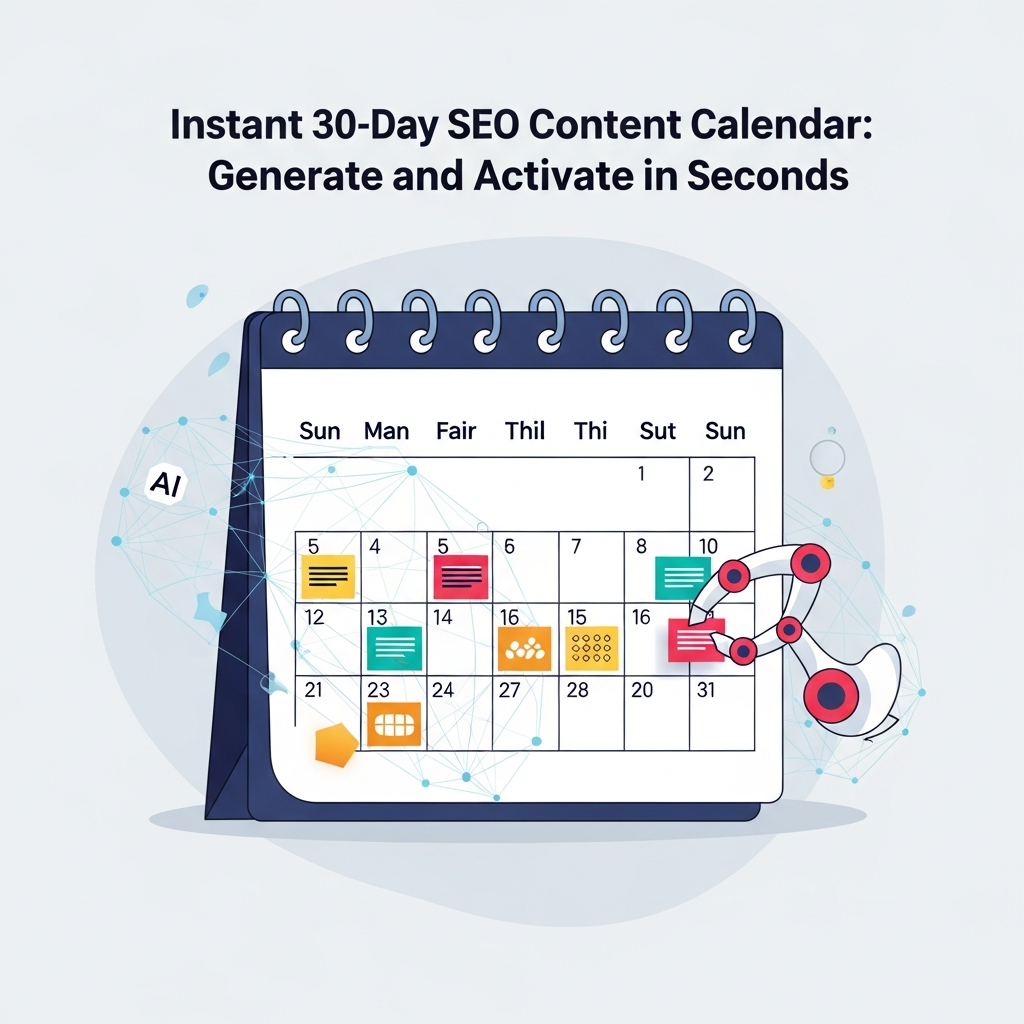
Instant 30-Day SEO Content Calendar: Generate and Activate in Seconds
Why a 30-Day SEO Content Calendar?
A 30-day content calendar is a strategic framework that aligns topic ideation, production, and publishing with your SEO goals. It turns vague intentions into a concrete stream of publishable content that search engines can index consistently. When you operationalize topics, keywords, and publishing dates, you create a predictable cadence that improves crawlability, topical authority, and user engagement.
With an instant 30-day content calendar, you gain velocity without sacrificing quality. You can cover core topics, test new formats, and respond to real-time signals from competitors and search trends. The result is a measurable lift in organic traffic, more opportunities for internal linking, and better alignment with product launches or promotions.
Key benefits include: predictable publishing, better keyword coverage, cross-channel coordination, and a framework for scalable content production. It also reduces the stress of “what do we publish next?” by providing a ready-to-execute plan that teams can hit from day one.
The Four Building Blocks of a Fast 30-Day Plan
To generate an instant 30-day calendar that actually moves the needle, focus on four core pillars:
- Topic pillars: Identify 3–5 evergreen topics that map to your audience’s questions and purchase journey.
- Keyword mapping: Align primary and secondary keywords with each pillar to ensure intent-aligned content.
- Competitor context: Benchmark what competitors publish and identify gaps to exploit.
- Content formats and cadence: Decide on formats (how-to, list, case study, video, etc.) and a publishing rhythm that fits your team."
Each pillar becomes a mini-calendar of daily ideas. The goal is to create a mix of evergreen pieces and timely posts that capture current search interest. You can also plan for 1–2 pre-written articles per pillar to accelerate production and maintain quality standards.
As you design topics, consider how the content will interlink. A well-structured internal linking strategy helps search engines crawl more efficiently and boosts page authority. It also improves the user journey by guiding readers toward conversion-focused assets.
60-Minute Setup: A Fast-Start Framework
If you’re pressed for time, use this 60-minute framework to kickoff your instant 30-day calendar. Each step should take about 10 minutes, with optional quick reviews at the end.
: List 3–5 core topics tied to your audience and offerings. Write one-sentence goals for each pillar (e.g., awareness, comparison, conversion). : For each pillar, identify 2–3 primary keywords and 3–5 supporting terms. Keep search intent in mind (informational, navigational, transactional). : Quick scan of top 5 competitors. Note common topics, gaps you can fill, and formats they’re underutilizing. : Generate 6–8 topics per pillar to fill the month. Ensure a mix of long-form cornerstone pieces and shorter, timely posts. : For each topic, draft a one-paragraph brief, a short outline, and a recommended word count. Include target keywords and potential internal links. : Assign dates and formats. Include buffer days for revision, holidays, and promotions.
Optional: Pre-write initial briefs and outlines using an AI-assisted workflow. The goal is to have a publish-ready skeleton for the first week, with drafts queued for the next two weeks.
A Practical 30-Day Template: Week-by-Week Schedule
Here’s a concrete template you can copy. Adapt the topics to your industry and audience. Each day aligns with a pillar and a keyword target. You’ll also see example formats to help you visualize content variety.
- Day 1: Pillar A – Foundational guide to the core topic (long-form, 1800–2200 words).
- Day 2: Pillar A – Quick-start checklist (1200–1500 words) with a practical CTA.
- Day 3: Pillar B – Comparative post (900–1200 words) comparing common approaches.
- Day 4: Pillar B – Quick win: 10 actionable steps (800–1000 words).
- Day 5: Pillar C – Case study teaser and summary (900–1200 words).
- Day 6: Pillar C – How-to video or infographic (supplemental content).
- Day 7: Pillar A – FAQ roundup and troubleshooting tips (800–1200 words).
Tip: Reserve 1 day each week for editing and QA. This ensures your calendar remains high quality and publication-ready. If you publish daily, maintain a consistent style guide and keep internal links tight to your conversion pages and product pages.
Competitor-Based Planning: Outperform with Insight
Competitor-based planning uses what others publish as a data source, not a template. You’re looking for opportunities they miss and formats they neglect. Start with a quick heatmap of topics and formats across your top 5 competitors. Identify gaps such as:
- Undercovered long-tail keywords that match your buyer intent
- Undervalued content formats (e.g., comparison guides or FAQs)
- Underrepresented geos or languages for localization
- Opportunities for updated content (recent data, updated best practices)
Turn gaps into 5–10 high-potential topics for your 30-day calendar. Create briefs that capitalize on those gaps with clearer performance expectations, such as expected organic traffic lift or target rankings. Pair these topics with internal links to your strongest pages to accelerate authority transfer.
Practice tip: Maintain a running log of competitor position changes and correlate with content updates. This helps you measure impact and refine your calendar over time.
AI-Driven Calendar Generation and Pre-Written Articles
AI can accelerate topic ideation, outline creation, and even initial drafts. Use AI-assisted briefs to ensure consistency with your brand voice and compliance standards. A typical flow includes:
- Generate topic briefs that include purpose, target keywords, search intent, suggested format, and CTA ideas.
- Produce outlines and meta blocks (title tags, meta descriptions, and schema suggestions) to speed up QA.
- Create 1–2 pre-written articles or article briefs per pillar that editors can polish, ensuring consistency in tone and references.
- Review AI outputs with a human editor to enforce accuracy, avoid factual errors, and maintain brand voice.
Prompts to kick off AI content generation include: “Create a 1,800-word cornerstone article around [Topic] with sections on [subtopics], integrating [Primary Keyword] and [Secondary Keywords], and include 6 internal links to high-priority pages.” For meta elements, prompt with: “Generate SEO-friendly title, description, and schema markup suggestions for [Topic], targeting [Primary Keyword].”
Want a practical starting point? Our editorial workflow guide provides step-by-step prompts and templates to standardize AI-assisted content across teams. Read more in our blog for a hands-on walkthrough.
Publishing, QA, and Governance for Scale
Scale requires clear governance. Establish a publishing protocol that includes content QA, legal/compliance checks (as applicable), brand voice alignment, and a review cycle. A simple governance model might include: a 2-step editorial review, a final publish approval, and a quarterly content audit. Use standard templates for briefs, outlines, and QA checklists to keep consistency across 30 days of publishing.
Automation can handle scheduling and reminders, but humans should validate: factual accuracy, citations, and alignment with your overall marketing goals. Centralized dashboards can track progress, publication dates, and on-page optimization changes for every piece.
Measuring Success and Optimization
Set clear success metrics before you begin. Common KPI targets for a 30-day SEO content calendar include:
- Impressions and click-through rate (CTR) for target pages
- Organic traffic lift to pillar pages and the wider cluster
- Keyword ranking movement for primary and secondary terms
- Internal link equity distribution and time-on-page improvements
- Conversion-related metrics tied to content-driven paths (newsletter signups, product pages, demos)
Use analytics and search console data to monitor performance. Schedule weekly reviews to adjust the calendar, pause underperforming topics, and reallocate resources to high-potential ideas. Over time, your 30-day calendar should evolve into a living strategy that adapts to seasonality and market shifts.
Templates, Tools, and Next Steps
Beyond the calendar itself, leverage templates and tools that streamline the process. For example, use a standard editorial brief template, topic clusters, and a publishing calendar that integrates with your CMS. You can also validate structured data and schema marks with online tools to improve visibility in search results.
To explore more editorial templates and AI-assisted planning resources, see our blog hub with practical guides like Editorial Workflow for Agencies: Planning, Writing, and Publishing at Scale. For schema-related checks, you can try our free schema validator to ensure your content is primed for rich results. And if you want a broader view of our capabilities, visit the asimpletool homepage.
Concrete Examples and Ready-to-Use Templates
Below are practical examples you can adapt today. Each includes a topic, target keyword, suggested format, and a rough outline. Start by copying the template into your content planning tool and customizing for your audience.
- Primary Keyword: instant 30-day content calendar
- Format: Long-form pillar with a How-To and a checklist
- Outline: Introduction, SEO audit steps, common issues, quick fixes, checklist, FAQ, conclusion
- Internal links: to cornerstone pages and product pages
Another ready-to-use template is a 1,000–1,500 word weekly recap post that highlights results from the previous week, lessons learned, and a preview of topics for the next week. This maintains momentum and provides value to teams and stakeholders.
For more templates and inspiration, check our blog catalog and experiment with the suggested formats. Our content calendar automation guide can help you scale this approach across multiple sites while maintaining governance and quality.
Closing Thoughts
An instant 30-day content calendar is not just a planning tool; it’s a strategic engine for SEO velocity. By combining pillar-based topic planning, competitor insights, AI-assisted briefs, and solid governance, you can publish consistently, optimize intelligently, and measure impact with clarity. The result is a repeatable, scalable process that accelerates growth without sacrificing quality.
Ready to start? Explore our editorial workflow resources, validate your schema, and leverage our blog for ongoing guidance. With the right framework, you can generate and activate a powerful 30-day content calendar in seconds, not days.