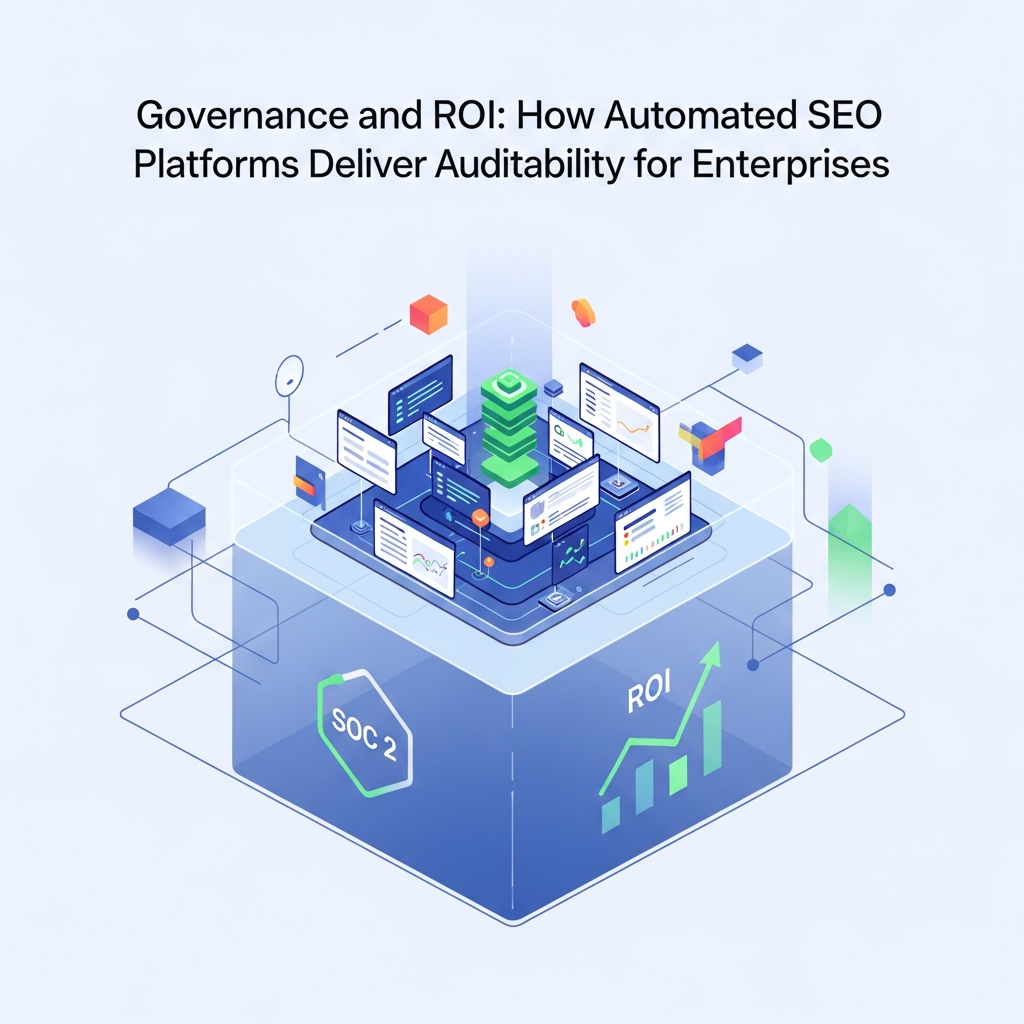
Governance and ROI: How Automated SEO Platforms Deliver Auditability for Enterprises
Governance overview
In large organizations, governance is the backbone of scalable SEO programs. Governance defines who owns what, establishes repeatable processes, and creates the controls that ensure every action—from keyword discovery to content publication—aligns with business goals. With automated SEO platforms, governance is not a bolt-on feature; it is the operating system that makes scale possible without compromising quality or compliance.
At its core, enterprise SEO automation governance covers three layers: policy, process, and performance. Policy sets the guardrails—who can access data, what changes require approvals, and how data is shared across teams. Process turns those guardrails into repeatable workflows for keyword research, content ideation, and technical optimization. Performance translates governance into measurable outcomes—ROI, risk management, and executive-ready reporting.
From an architectural perspective, governance should be embedded in the platform itself. That means centralized access control, role-based permissions, audit trails, and a clear data lineage that makes it possible to answer questions like: Who changed an on-page tag? When was a change published across multiple sites? How did a particular optimization affect a KPI across geographies?
Key governance components
- Access control and data segmentation across teams and brands
- Change management with auditable approvals
- Centralized policy libraries for SEO standards and brand guidelines
- Standardized reporting templates for executive dashboards
- Audit-ready data retention and export capabilities
Why governance matters for enterprise SEO automation
Enterprises operate across many brands, markets, and CMS ecosystems. Without strong governance, automation can amplify missteps—unvetted content, inconsistent branding, or privacy oversights—that erode trust and trigger compliance concerns. A robust governance model ensures that automation accelerates growth without sacrificing quality, security, or transparency.
Governance also supports procurement and vendor management. Enterprises typically engage multiple stakeholders—from CIOs to marketing VPs—who require consistent metrics, reliable SLAs, and predictable ROI. An automation platform designed with governance in mind helps you align stakeholders, justify investments, and maintain auditable records for audits and board reviews.
Advantages of governance-led automation
- Faster time-to-value through repeatable, auditable workflows
- Improved risk management with traceable decision histories
- Stronger alignment between content quality, brand standards, and business goals
- Enhanced stakeholder confidence for funding, renewals, and expansions
Auditability: logging, traceability, and controls
Auditability is the ability to demonstrate what happened, when, and by whom. For enterprises, this is not optional—it is a legal and governance requirement that spans data privacy, security, content approvals, and performance reporting. Automated SEO platforms should deliver built-in audit trails that capture every action—from schema changes and internal linking updates to content calendar approvals and publish events.
Concrete auditability features include:
- Immutable change logs for all optimization activities
- Time-stamped approvals tied to specific campaigns and brands
- Versioned content and schema changes with rollback capabilities
- Centralized activity dashboards for compliance reviews
To illustrate governance in action, consider a multinational retailer that updates metadata across 25 sites. An audit-driven flow ensures a single approval path, timestamps each change, and makes the entire activity traceable for internal governance reviews and external audits.
Security and data privacy: SOC 2 and beyond
Security and data privacy are foundational to any enterprise-grade SEO automation strategy. In addition to standard encryption and access controls, you should expect platform-level governance that supports data isolation, role-based access, and incident response. One widely adopted standard is SOC 2, which assesses controls around security, availability, processing integrity, confidentiality, and privacy. A SOC 2–compliant SEO platform helps reassure executives, IT, and compliance teams that data is handled with rigor.
Beyond SOC 2, robust data privacy practices address how data is stored, processed, and shared across internal teams and external vendors. Enterprises typically require data residency options, clear data retention policies, and strict vendor risk management protocols. An effective platform will provide:
- Granular user permissions and segmentation by brand or geography
- End-to-end encryption and secure APIs with auditability
- Data retention controls and easy export for legal holds
- Third-party risk assessments and continuous monitoring
For teams exploring governance and compliance, the exact phrasing SOC 2 compliant SEO platform in vendor literature can be a useful signal, but you should verify the scope of controls and the auditor's scope letter. Platform security is not a checkbox; it is an ongoing program that evolves with regulatory changes and threat landscapes. If you are pursuing localization at scale, consider how data privacy and residency requirements vary across geographies and ensure the platform supports those needs.
As a practical touchpoint, you can explore tools and resources such as schema validators to ensure data structures align with privacy and governance standards. See our schema validator tool for a quick reference, and remember to verify privacy-by-design considerations in any automation rollout.
ROI measurement and dashboards
At scale, governance must translate into clear, defendable ROI. ROI dashboards for SEO should connect activities to measurable business outcomes such as organic traffic, conversions, revenue, and customer lifetime value. The best practice is to define a small set of leading and lagging indicators that executives can trust and that teams can influence directly.
Key ROI elements to include in your governance plan:
- Baseline benchmarking across sites and markets
- Attribution models linking SEO changes to revenue and ROAS
- Daily/weekly dashboards for operational teams and monthly executive reports
- Cost-to-value calculations showing time saved through automation
Practical examples show how automation accelerates keyword discovery and content production while preserving quality controls. A typical implementation ramps up content volume and optimization tasks across 4-6 quarters, with ROI dashboards updating in real time as campaigns mature. For a concrete look at how governance supports ROI storytelling, consider pairing your data with case studies from adjacent platforms, and use your internal dashboards to highlight improvements in efficiency and revenue impact.
To deepen your ROI capabilities, you might also explore how editorial workflows contribute to measurable gains. Our editorial workflow guide, for instance, outlines end-to-end processes for planning, writing, and publishing at scale. Editorial workflow for agencies: planning, writing, publishing at scale provides a blueprint you can adapt to your governance model. This resource is a practical touchpoint for teams aiming to tighten content velocity without compromising governance or quality.
Multi-site management: dashboards and governance at scale
Enterprises typically manage dozens or hundreds of sites across regions. Centralizing governance for multi-site SEO is not only efficient; it reduces risk by standardizing metrics, workflows, and reporting. A robust multi-site architecture supports consolidated dashboards, global templates, and site-specific overrides that preserve local relevance while maintaining global governance standards.
Key considerations for multi-site governance include:
- Centralized visibility into performance across all sites
- Brand consistency with reusable templates for titles, meta descriptions, and structured data
- Localization and geo-specific optimization workflows
- Permissions and roles that scale with organizational structure
Localization is a critical dimension of multi-site governance. If your organization operates in multiple languages or markets, you should enable localization workflows that integrate with translation services, regional keyword research, and local content calendars. A practical way to operationalize this is to dedicate governance layers to regional teams while preserving a single source of truth for global metrics. For teams exploring localization patterns and regional strategies, our Sao Paulo automation article demonstrates how teams implement localized content publishing at scale in a specific market; it can offer practical insights for broader deployment. Sao Paulo automation for Brazilian ecommerce provides a relevant case study and approach.
Vendor SLAs and governance considerations
SLAs (service-level agreements) are a cornerstone of enterprise governance. They set expectations for uptime, performance, security incident response, data processing commitments, and support ownership. When evaluating an automated SEO platform, insist on a governance-first SLA that covers:
- Uptime guarantees and maintenance windows aligned with business cycles
- Response times for issues affecting multiple sites or critical pages
- Change-control procedures for platform updates and feature deployments
- Data privacy and residency commitments with explicit data handling responsibilities
- Audit rights and access to governance documentation for internal reviews
Vendor SLAs should be tied to measurable outcomes and include escalation paths that align with your internal governance structure. In practice, you should map SLAs to your ROI dashboards so leadership can see the direct impact of service levels on performance and risk exposure. If you want to explore a self-serve check on governance readiness, try our schema validator tool linked earlier to validate data structures that feed your dashboards and reports.
Practical implementation steps for governance in automation
Implementing governance in an automated SEO program is a staged process. A typical rollout includes discovery, policy design, pilot testing, scaling, and ongoing optimization. Each stage should emphasize auditable processes, security, and ROI visibility.
- Define governance policy: roles, approvals, data access, and reporting standards.
- Map workflows to policy: keyword research, content briefs, on-page optimization, and publishing across sites.
- Establish an audit framework: what gets logged, who reviews, and how findings are reported.
- Launch a pilot: select 2-3 brands or sites to test governance at scale.
- Scale with governance templates: reusable playbooks for every site type and market.
- Measure ROI: connect activities to revenue, traffic, and efficiency gains.
During the pilot, insist on clear documentation and dashboards that demonstrate progress against baseline metrics. The goal is to prove that governance does not slow work, but rather accelerates it with predictable quality and improved risk controls. For broader context on governance and enterprise readiness, you can also view other enterprise-focused materials within our resource library.
Risks and pitfalls to avoid
Even with strong governance, automation introduces potential risks. Common pitfalls include over-automation that erodes editorial quality, inconsistent data across sites, and under-investment in security or privacy controls. Avoid these by maintaining strict editorial standards, enforcing data quality checks, and conducting regular governance audits. A robust audit trail reduces repair work after incidents and sustains trust with both internal stakeholders and external partners.
Best-practice checklists help teams stay on track. Use a quarterly governance review to validate access controls, ensure alignment with policy libraries, and refresh ROI reporting templates. Periodically reevaluate vendor SLAs to reflect evolving business needs and regulatory requirements. Finally, continue to enrich your governance with real-world case studies and practical benchmarks to illustrate progress and opportunities for optimization.
For readers seeking quick access to practical governance resources, consider these actions: locate and bookmark relevant internal content, monitor dashboards for early warning signs, and maintain open channels with security and compliance teams. The right governance framework makes automated SEO scalable, auditable, and inherently trustworthy for enterprises pursuing aggressive growth with disciplined risk management.
Internal resources and related content you may find useful include our platform overview and editor-focused guides. To explore a scalable content workflow in our blog library, check out the following pages: ASimpleTool platform overview, Editorial workflow for agencies: planning, writing, publishing at scale, and our free schema validation tool schema validator tool.