Automating SEO Content at Scale: From URL to Daily Articles
Introduction
In today’s fast-paced digital landscape, the ability to produce high-quality content at scale directly affects visibility, traffic, and revenue. Automating SEO content at scale is not about replacing humans; it’s about orchestrating a robust, repeatable workflow that turns an input URL into a publish-ready article ecosystem. The result is a dependable cadence of SEO-optimized content, from headlines and meta to on-page structure and internal links, all aligned with your content strategy.
This guide walks through a practical framework for end-to-end automation—from URL ingestion to daily articles—while highlighting guardrails for quality, compliance, and brand consistency. You’ll see how AI-generated articles, image optimization, publishing cadences, and CMS integrations come together to support teams operating across multiple sites and languages.
Why automate at scale
Automation unlocks several strategic benefits. First, it reduces the manual bottlenecks that slow down content calendars and limit coverage across topics, regions, or product categories. Second, it creates a repeatable process that can be audited, improved, and scaled without sacrificing quality. Third, when paired with strong governance, automation helps maintain brand voice, safety, and compliance across dozens or hundreds of pages.
For agencies, in-house teams, and enterprises, the objective is a predictable flow: identify a URL, generate a brief, craft an SEO-optimized draft, publish, and then measure impact. Operationalize this with clear SLAs, dashboards, and a content calendar that supports daily publication without overwhelming writers or editors.
End-to-end workflow: from URL to published article
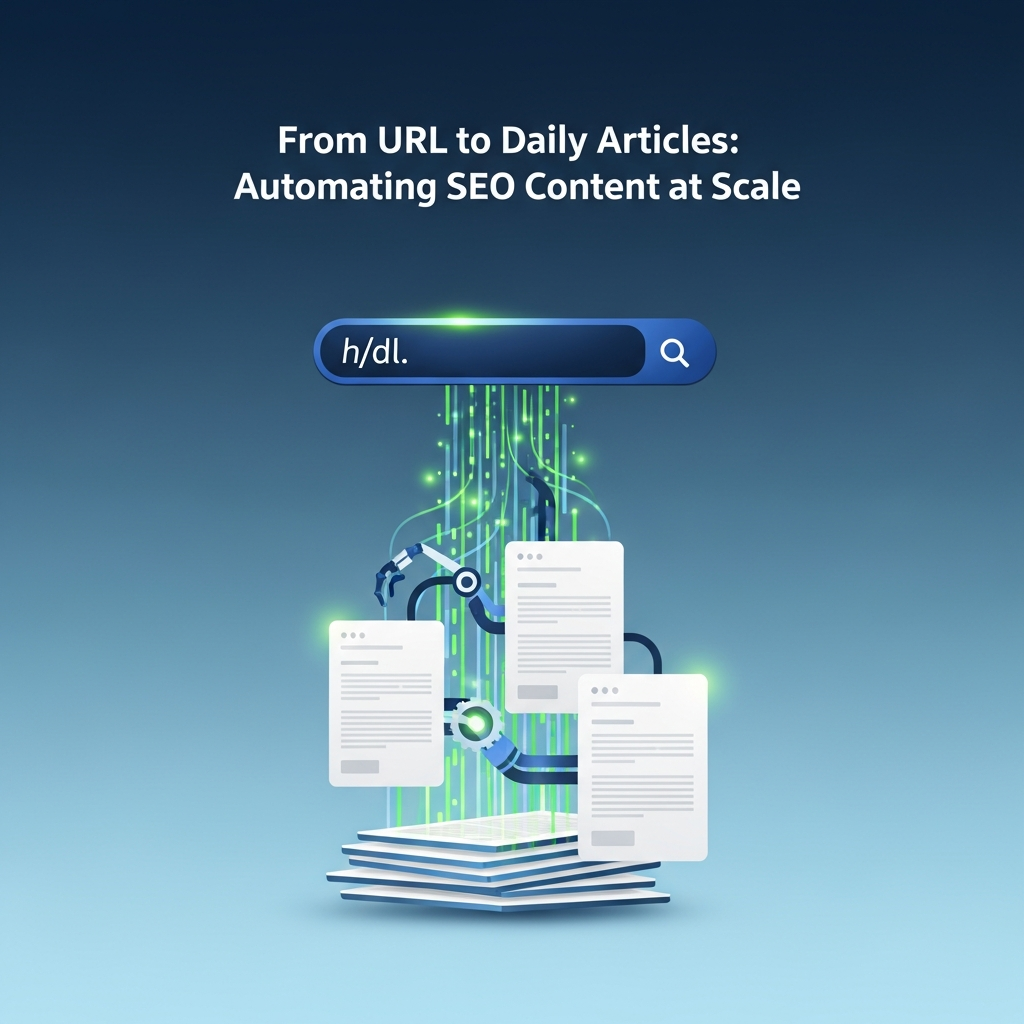
The core workflow can be distilled into a repeatable loop with these stages: URL ingestion, AI-powered drafting, SEO optimization, image enrichment, QA and editorial review, CMS publishing, and ongoing performance feedback. Each stage is designed to be automated or semi-automated, with manual checkpoints where quality control is critical.
1) URL ingestion: A list of target URLs or topics serves as the seed. The system pulls contextual signals (topic intent, audience, competitors, and existing page signals) to frame the content brief.
2) AI-powered drafting: An AI model generates outlines and draft copy, tuned to your brand voice and SEO goals. The draft includes H2/H3 structure, keyword placement, and semantic relevance without keyword stuffing.
3) SEO optimization: Automated on-page SEO includes meta tags, title optimization, schema, internal linking opportunities, and image alt text. Quality controls ensure no over-optimization and alignment with your guidelines.
4) Image enrichment: AI-assisted image generation or selection supports the article with alt text and size optimization for fastest load times and accessibility compliance.
5) Editorial QA: Editors review for factual accuracy, brand voice, and legal considerations. This checkpoint can be lightweight or thorough depending on risk and topic sensitivity.
6) CMS publishing: The content is published or scheduled via your CMS via API or connectors, with fallbacks for manual publishing when needed.
7) Performance feedback: Post-publish analytics feed back into the loop, informing future URL selections and optimization priorities.
Internal links, related topics, and content clusters emerge organically through this workflow, strengthening your site’s topical authority over time.
Core components of the system
Successful scale relies on a handful of components working in concert. Each piece is a lever you can pull to adjust quality, speed, coverage, or governance.
- Content generation: AI-driven briefs and drafts that respect your style, audience, and SEO targets. It should support multilingual outputs when needed.
- SEO optimization: Automated meta data, headings, schema, and internal linking suggestions aligned with keyword strategy.
- Image optimization: AI-assisted image creation or curation with accessibility and performance considerations (ALT text, file size, lazy loading).
- Editorial governance: Brand voice guidelines, fact-check processes, and compliance checks built into a lightweight review flow.
- Publishing automation: CMS connectors and API integrations that publish on schedule or on demand without manual intervention.
- Analytics loop: Dashboards that link content performance to SEO metrics, informing future iterations.
When these components are integrated, teams gain a scalable engine for daily article production while preserving quality and governance.
Governance, quality, and compliance
Automation without governance can lead to quality drift or brand inconsistency. Establish guardrails around tone, factual accuracy, local legales, and data privacy. Implement a triage path for flagged content, and define escalation steps for higher-risk topics. Documentation and version control are essential—keep a record of prompts, revisions, and approval statuses for auditable content history.
For multi-region sites, localization workflows should include translation memory, locale-specific keywords, and cultural nuance checks. Security and vendor governance—such as access controls, data handling, and incident response—should be baked into every enterprise deployment.
Technology stack and integrations
The technology backbone combines AI content generation, SEO automation, CMS connectors, and analytics integrations. A well-constructed stack supports multi-site management, role-based access, and real-time performance monitoring. Where possible, favor platforms with native CMS integrations (WordPress, Webflow, Shopify) and robust APIs to minimize custom development.
Beyond core content, consider tools for structured data, image optimization, and automated internal linking. A strong stack also provides governance features, including access auditing and compliance reporting, which are essential for enterprise deployments.
Content calendar and publishing cadence
A clearly defined content calendar is the heartbeat of scalable publishing. For daily article production, map topics to audience intent, seasonality, and product launches. Use a cadence that balances coverage breadth with depth, ensuring you don’t overwhelm readers with duplicate topics or repetitive formats.
Automate calendar generation where possible, with manual review for high-value or high-risk topics. Use forecasting to anticipate bandwidth needs and plan for peak periods. A well-tuned calendar aligns SEO goals with editorial creativity, not the other way around.
Scaling across sites and localization
Scaling to many sites requires centralized governance, consistent templates, and a scalable translation/localization workflow. Central dashboards provide visibility across brands, geographies, and languages. Localization should preserve tone and intent while optimizing for locale-specific search behavior and cultural nuances.
Multilingual automation demands robust keyword and topic clustering, language-specific SEO rules, and quality checks that reflect regional expectations. When done right, you unlock market-ready content that can be published quickly and consistently across all sites.
Implementation plan: from pilot to scale
Start with a focused pilot on a representative URL set and a fixed publishing cadence. Define success metrics (traffic uplift, engagement, and publication velocity) and a short feedback loop. Use a staged rollout: pilot, refinement, then scale across sites or languages.
Key steps include: 1) assemble a cross-functional team, 2) choose target URLs and keywords, 3) configure AI prompts and SEO rules, 4) run editorial QA checks, 5) publish and monitor, 6) iterate based on data. Document learnings to improve future cycles and to support governance reviews.
Pitfalls and best practices
Common risks include narrowing content too aggressively, over-optimizing meta-data, and inconsistent brand voice. Avoid creating topics with insufficient intent or poor search demand. Maintain a human-in-the-loop for accuracy and compliance, especially in regulated industries.
Best practices include setting guardrails for tone and factual accuracy, using templates to standardize structure, and building a robust review process. Regularly audit your keyword strategy and ensure internal linking remains natural and valuable to readers.
ROI and measurement
Measuring the impact of automated content requires a clear starting point and a dashboard that ties content outputs to SEO outcomes. Track metrics such as organic traffic, click-through rate, time on page, bounce rate, and conversions attributed to published articles. Use A/B experiments for headlines and meta descriptions to optimize performance over time.
Consider long-term effects on domain authority and topical authority. ROI should account for time saved in publishing cycles, improved content coverage, and the incremental traffic gained through consistent daily publishing.
Getting started: quick-start guide
To begin, outline your primary objective (e.g., scale daily publishing for a multi-site portfolio) and identify a small set of URLs to pilot. Establish governance rules, define editorial QA thresholds, and configure core SEO settings. Then run a two-week pilot to validate the workflow before expanding to additional sites or languages.
For teams exploring deeper learning, the following resources provide practical guidance and real-world workflows. Editorial workflow for agencies planning, writing, and publishing at scale offers a blueprint for editorial governance, while our blog hub aggregates articles on automation strategies. If you’re considering localization, see the São Paulo publishing automation guide: São Paulo automation guide for region-specific insights.
Internal navigation and related resources
For broader context on how automation integrates with your content strategy, explore our internal resources and case studies in the linked pages above. These entries illustrate how teams negotiate CMS integrations, automation workflows, and analytics to achieve sustainable SEO gains.
Conclusion
Automating SEO content at scale is not a single tool or a magic wand. It’s a carefully designed workflow that combines AI-assisted drafting, SEO optimization, and reliable publishing with governance and analytics. When implemented with clear roles, robust QA, and a scalable content calendar, this approach enables daily publication at scale while maintaining quality and alignment with strategic objectives. The goal is a repeatable engine that accelerates growth, supports multi-site management, and delivers measurable value over time.