Ethics Guard Framework
Introduction
Artificial intelligence is changing how content is created, reviewed, and distributed. With power comes responsibility. AI-generated content can scale rapidly, but it also risks inaccuracies, brand misalignment, and non-compliance with laws and platform policies. The Ethics Guard Framework offers a practical, runnable approach to embedding ethics into every stage of content production—from ideation to publication.
This guide outlines concrete guards, role delineations, and workflows you can adapt to your team. It is designed for teams that must publish accurate, compliant, and brand-safe content while keeping production fast and cost-effective. For more on editorial processes that support scale, see editorial workflows for agencies and our broader resources in our blog.
Why Ethics Matter
Ethics matter because content shapes beliefs, decisions, and behaviors. When AI contributes to writing, translation, or data summarization, errors can scale quickly across audiences and channels. In regulated industries, misstatements can trigger legal risk. In brand marketing, inconsistent tone or misrepresented facts can erode trust and loyalty. The guardrails described here help teams reduce risk, protect brand integrity, and improve audience trust without sacrificing speed.
Ethical content practices also support governance and reporting. When you can demonstrate an auditable flow—from source verification to final publication—you improve internal accountability and external credibility. That clarity matters for stakeholders, customers, and regulators alike.
Ethics Guard Framework Overview
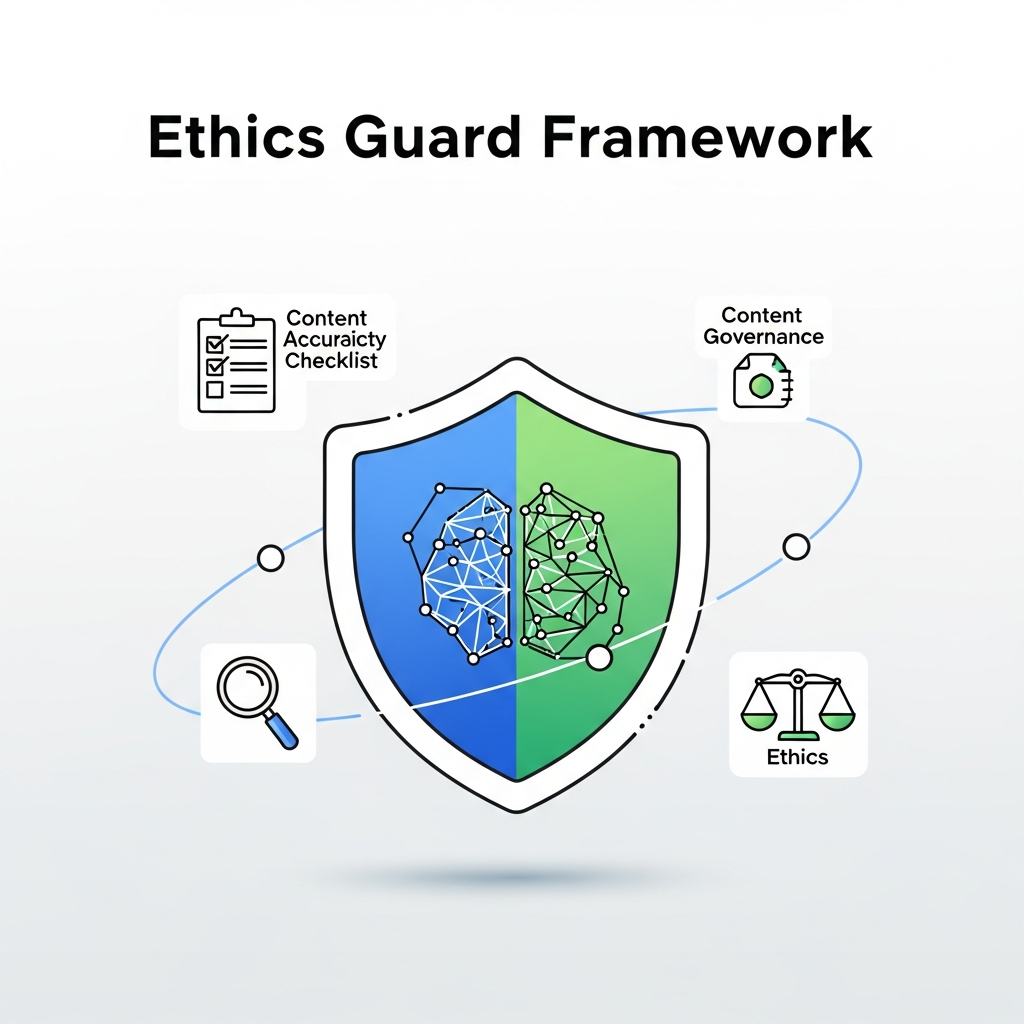
The Ethics Guard Framework comprises four interconnected guards that act as checkpoints before content goes live: Accuracy Guard, Brand Voice Guard, Compliance Guard, and Transparency Guard. Together with a Human Review workflow and a governance structure, they form a holistic system that scales with your team’s needs.
Think of these guards as a quality assurance circuit. Each guard catches different kinds of risk, and they are designed to be practical, repeatable, and auditable across multiple teams and languages. The goal is not perfection in isolation but a reliable, repeatable process that reduces risk while maintaining speed to publish.
Within your tech stack, these guards can be realized through a combination of automation, templates, checklists, and human oversight. You can implement them in stages, starting with a minimal viable guard and expanding as your content library grows. For teams seeking a practical therapy-net for content quality, this framework provides a clear path to improvement.
Accuracy Guard
The Accuracy Guard focuses on factual correctness, data integrity, and source reliability. It is the first line of defense against misstatements that could mislead readers or harm your brand reputation.
Core components
- Source verification: Every factual claim should be traced to a credible source with a citation and a retrieval date.
- Cross-checking: Key facts should be cross-verified across multiple independent sources when possible.
- Data provenance: When AI tools transform data, preserve the origin and explain any transformations.
- Date stamping: Include publication or most recent update dates to signal currency.
Practical steps
- Define a minimal set of non-negotiable facts for each article and attach sources in the draft.
- Run a fact-check pass using both automated checks and a human reviewer for high-stakes claims.
- Maintain an evidence log that records where each claim originated and when it was verified.
Tip: Build a content accuracy checklist as part of your editorial workflow and integrate it into your CMS templates. This makes accuracy checks a standard, repeatable step rather than an afterthought.
Brand Voice Guard
Brand voice guard ensures that AI-generated content remains aligned with your brand personality, tone, and messaging guidelines across channels and locales.
Key elements
- Tone consistency: Define tone variants by audience segment and channel.
- Terminology: Maintain brand-approved terminology, acronyms, and product names.
- Voice architecture: Use sentence length, cadence, and diction guidelines to preserve cadence across outputs.
Operational tips
- Develop a living style guide and store it in a centralized location accessible to AI editors.
- Feed AI prompts with brand voice constraints and example passages to maintain consistency.
- Include a voice-check rubric in the human review stage to catch tonal drift before publish.
For more context on continuous editorial workflows, explore editorial workflows for agencies and consider bookmarking our blog index for ongoing guidance.
Compliance Guard
The Compliance Guard covers legal, regulatory, and platform-specific requirements. It helps guard against copyright violations, privacy concerns, disclosures, and other obligations that vary by jurisdiction and context.
What to cover
- Copyright and licensing: Respect rights, use licensed assets, and attribute properly.
- Privacy and data handling: Avoid disclosing personal data without consent and follow applicable data protection rules.
- Disclosures and sponsorships: Clearly indicate sponsorships, paid content, and affiliations when applicable.
- Platform policies: Ensure compliance with CMS, social, and distribution channels’ terms of service.
Implementation steps
- Create a compliance brief template tied to each content piece, including licenses, sources, and privacy notes.
- Require a compliance sign-off in the final review before publishing.
- Set up automated checks to flag non-compliant elements (unlicensed images, unverified claims, etc.).
Compliance is a shared responsibility. If you need additional context on ethical AI usage and governance, you can also review disclaimer and policy pages for broader guidance.
Transparency & Auditability
Transparency makes AI-driven content more trustworthy. Auditability means you can trace decisions, prompts, data sources, and editorial approvals through an auditable trail.
What transparency looks like
- Versioned content with change logs and author notes.
- Source links and transformation notes for AI-generated passages.
- Clear attribution of AI assistance when applicable.
How to implement
- Attach a metadata block to each piece describing AI involvement, sources, and checks performed.
- Store a copy of the original prompts (where permissible) and the final editor’s notes.
- Generate a quarterly transparency report that summarizes the types of content produced, common risk areas, and corrective actions taken.
Human Review Workflow
Automation accelerates production, but human review remains critical for nuanced judgments, ethics, and brand alignment. The Human Review Workflow defines who reviews what, when, and how feedback is captured.
Workflow outline
- Draft generation by AI editor or content writer.
- Automated checks (accuracy, privacy, compliance, voice consistency).
- Human review assignment to a designated reviewer with a defined SLA.
- Reviewer signs off with specific notes and required changes, if any.
Tip: Build lightweight review templates with checklists for consistency. This reduces cognitive load and speeds up approvals while preserving quality.
Governance & Roadmap
Governance provides the framework, roles, and cadence for ongoing ethics management. A simple governance model includes policy ownership, risk assessment, and a roadmap that evolves with your content program.
Roles and responsibilities
- Policy owner: Sets guard requirements and approves governance updates.
- Editorial lead: Oversees content quality controls and the human review workflow.
- Compliance officer: Monitors regulatory changes and ensures alignment with legal obligations.
- AI/Tech lead: Maintains tooling, prompts, and integration with CMS and analytics.
Roadmap ideas
- Phase 1: ImplementAccuracy and Brand Voice guards with a lightweight human-in-the-loop.
- Phase 2: Add Compliance and Transparency checks; implement auditing dashboards.
- Phase 3: Scale to multilingual content; automate more routine checks and reporting.
Implementation Roadmap
Use a phased approach to deploy the Ethics Guard Framework without overwhelming your teams. Start with a minimal viable guard set and expand as you gain confidence and experience.
- Define guard acceptance criteria and success metrics.
- Embed the Accuracy Guard in your drafting templates and CMS workflows.
- Incorporate Brand Voice Guard into prompts and style guidelines.
- Introduce Compliance Guard through a check-list and sign-off process.
- Launch Transparency Guard with metadata and versioning blocks.
- Establish a Human Review workflow with SLAs and escalation paths.
- Set up governance rituals: quarterly reviews, risk assessments, and published case studies.
Remember to tie each guard to measurable outcomes, such as accuracy rate, publication speed, and defect rates in published content.
Risks & Pitfalls
No framework is perfect. Common challenges include alert fatigue from too many checks, over-correction hurting speed, and misalignment between teams. To mitigate risk, balance guard rigor with practical thresholds and maintain clear ownership.
Practical mitigations
- Prioritize high-impact topics for rigorous checks and lightweight process for routine content.
- Automate where possible, but reserve human review for claims, legal risk, and brand-critical topics.
- Regularly revisit guard criteria as products, audiences, and regulations evolve.
Tools & Checklists
Adopt practical tools to support the four guards and the downstream workflows. The list below is a starter kit you can adapt to your stack.
Checklist highlights
- Content accuracy checklist: claims, sources, dates, and cross-checks.
- Brand voice checklist: tone, terminology, and cadence guidelines.
- Compliance checklist: licenses, privacy disclosures, and platform policies.
- Transparency artifacts: change logs, AI involvement notes, and source citations.
Integrated tooling can include CMS plugins, AI editing interfaces, and lightweight dashboards. If you want deeper guidance on building a scalable editorial engine, see our resources and case studies on editorial workflows for agencies.
Need more context on our approach? Visit the blog for practical examples and templates. For policy considerations, review our disclaimer page.
Metrics & KPIs
To prove the value of the Ethics Guard Framework, track a compact set of indicators that reflect quality, risk, and efficiency.
Suggested metrics
- Accuracy rate: percentage of factual assertions passing fact-checks.
- Publication cycle time: from draft to publish, by topic and channel.
- Rejection/rewrites: rate at which pieces require substantial edits in human review.
- Compliance incidents: violations detected in post-publication audits.
- Voice alignment score: evaluator-based rubric of tone and terminology adherence.
- Auditability score: completeness of metadata, version history, and source logs.
Establish a dashboard that surfaces these metrics to stakeholders on a regular cadence. This transparency helps teams improve and it demonstrates accountability to leadership and clients.
FAQ
Q: Do I need every guard to start with?
A: No. Start with Accuracy Guard and Brand Voice Guard as the foundation, then add Compliance and Transparency as you scale.
Q: How do I balance speed with quality?
A: Use a staged rollout, automations for routine checks, and reserved human review for high-risk content. Regularly review guard thresholds to avoid bottlenecks.
Q: What about multilingual content?
A: Extend all four guards to languages with localized prompts, sources, and review teams. Start with core markets and expand progressively.
Case Studies & Real-World Outcomes
Organizations implementing the Ethics Guard Framework report improvements in trust, accuracy, and efficiency. While details vary by industry, the pattern is consistent: structured checks reduce post-publish corrections and increase confidence in AI-assisted content. To explore practical examples relevant to your sector, consult our published resources and templates on the blog.
Closing Thoughts
Ethical AI content is not a one-time project but a continuous capability. The Ethics Guard Framework gives teams a pragmatic, scalable model for maintaining accuracy, brand safety, and compliance as AI enables faster production. Start small, build a governance rhythm, and iterate based on what you learn from audits and reviews.
Whether you are an agency, a mid-market brand, or a publisher, aligning your teams around these guards helps you publish with confidence. For a guided conversation about tailoring this framework to your stack, consider booking a consult or exploring our broader editorial resources.