Enterprise SEO Automation: Centralized Management for Multi-Site Campaigns
Why enterprises need automation for SEO across many sites
Large brands operate at scale across multiple websites, languages, and regions. Manual processes quickly become a bottleneck, leading to inconsistent messaging, delayed launches, and fragmented data. Enterprise-grade SEO automation addresses these challenges by introducing governance, repeatable workflows, and centralized control over every campaign asset. Automating routine tasks—from keyword research and on-page optimization to publishing and reporting—frees up teams to focus on strategy, experimentation, and cross-brand alignment. It also reduces human error that can creep in when dozens or hundreds of pages are updated in silos. For executives, the payoff is clearer visibility into how SEO investments translate into traffic, engagement, and revenue across the portfolio.
In practice, enterprises gain a unified operating model: standardized templates, automated checks, and centralized dashboards that reveal performance across brands and markets. This framework makes it easier to benchmark campaigns, spot gaps, and accelerate best practices across the entire digital estate. A practical starting point is to map core workflows—research, content creation, optimization, publishing, and analytics—and then automate the handoffs between teams and systems. For teams exploring a scalable approach, see our editorial workflow for agencies planning, writing and publishing at scale guide and borrow its structure to design enterprise-grade processes. You can also validate data quality with our free schema validator to ensure that structured data remains consistent as you scale.
Architectural pillars of enterprise SEO automation
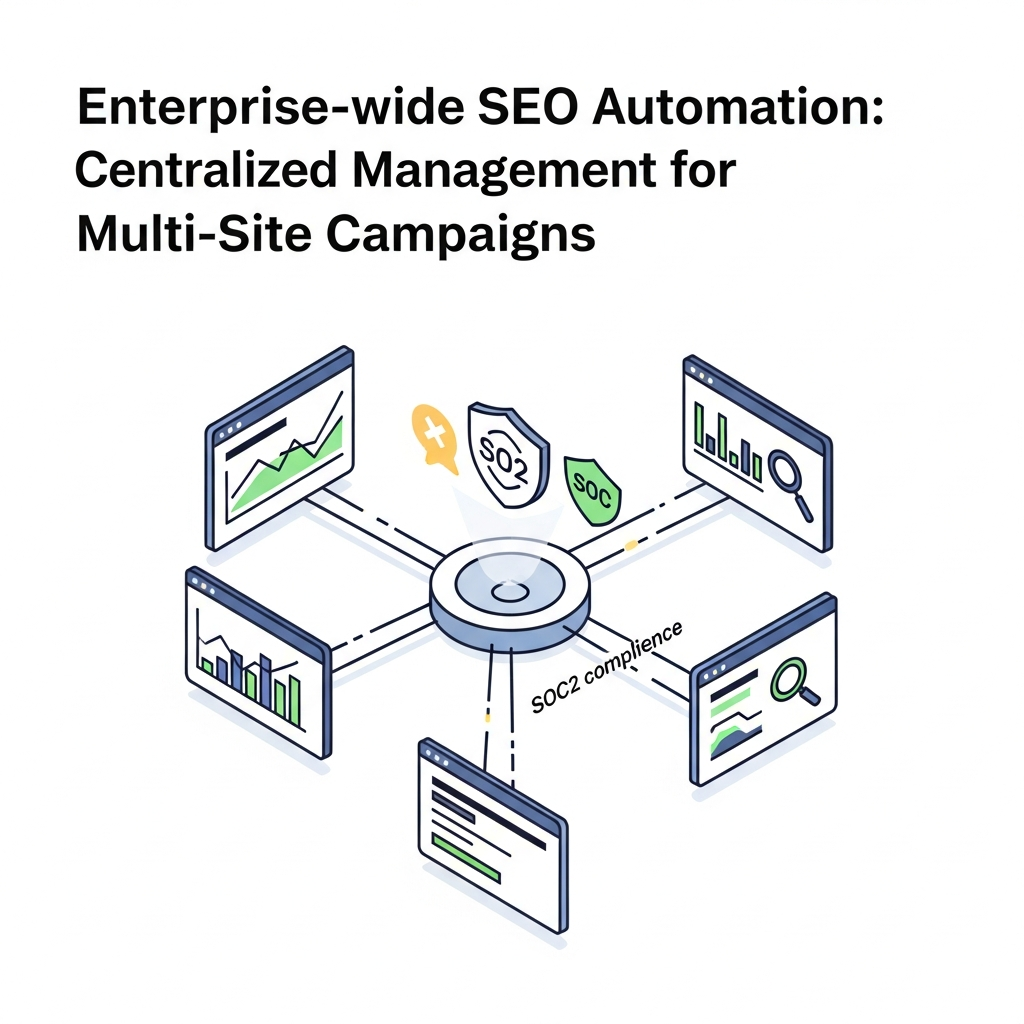
Three architectural pillars underpin effective enterprise SEO automation: centralized management, secure data practices, and scalable integrations. A fourth pillar—visibility through analytics—tying these together ensures leadership can make informed decisions quickly.
Centralized management and governance
Centralized management means one source of truth for keyword strategies, content calendars, on-page templates, and publishing rules across all sites. This enables brand-consistent optimization while preserving local relevance. A governance layer defines who can approve changes, how content is localized, and which pages are prioritized during campaigns. It also helps standardize risk controls, such as who can deploy schema changes or adjust internal linking structures across the portfolio.
Security, access controls, and data sovereignty
For enterprise programs, security isn’t optional. SOC2-type controls, role-based access, audit logs, and data residency options are essential. A robust automation platform should support least-privilege access, automated anomaly detection, and clear audit trails that satisfy governance and external compliance demands. When evaluating tools, request a formal data-security appendix detailing encryption, key management, and access governance across environments.
APIs, CMS integrations, and data interoperability
Legacy CMSs and newer headless systems require flexible integrations. Enterprise-grade automation should offer APIs, webhooks, and native integrations with popular platforms (WordPress, Shopify, Webflow, Notion, and other CMS ecosystems) to streamline data flows between content management, analytics, and optimization engines. A well-architected solution supports data portability and governance across systems, reducing vendor lock-in and enabling smoother migration if needed.
Governance and SLAs: making vendor relationships work
Governance and Service Level Agreements (SLAs) are the backbone of enterprise partnerships. They specify how services are delivered, how performance is measured, and what happens when expectations aren’t met. For large portfolios, governance should cover access controls, data privacy, incident response, and change management. When SLAs include measurable metrics such as uptime, data freshness, reporting cadence, and support response times, it becomes easier to benchmark vendors and justify renewals or migrations to leadership.
Key governance components to insist on
- Clear ownership and escalation paths for incidents and feature requests.
- Documented data-handling practices, including privacy controls and breach communication plans.
- Auditability: immutable logs that prove what changes occurred, when, and by whom.
- Defined deployment windows and a rollback plan for major updates.
To understand how governance translates into practice, read our blog hub for broader governance discussions, and explore our editorial workflow guide for concrete process templates. If you need to validate data quality before rollout, our schema validator can help ensure data structures stay consistent as you scale.
Centralized analytics dashboards: measuring ROI at scale
Analytics are the compass for large SEO programs. Centralized dashboards aggregate performance across sites, brands, and markets, turning raw data into actionable insights. A mature solution provides cross-site KPIs, trend analyses, anomaly alerts, and drill-down capabilities to understand performance drivers—from page-level changes to campaigns and site migrations.
Consider dashboards that show:
- Organic traffic and share of voice across domains
- Keyword rankings and page-level visibility by market
- Content calendar adherence and production velocity
- Conversion metrics linked to organic visits (ROAS and ROI proxies)
- Technical health signals (crawlability, page speed, structured data status)
To keep reporting practical, establish quarterly executive summaries that highlight wins, gaps, and recommended investments. For hands-on inspiration, our editorial workflow article demonstrates how to align content planning with analytics-driven decisions. And for ensuring data quality even at scale, consider validating schema and structured data continuously via the schema validator.
White-label partnerships and enterprise collaboration
Enterprises often value white-label capabilities that allow internal teams or partners to present SEO insights under their own brand. A robust solution includes customizable dashboards, branded reports, and governance controls that can be adapted to partner SLAs. A collaborative platform also supports co-development roadmaps so agencies and brands can align on feature priorities and timelines.
When evaluating options, request documentation on branding options, report customization, and partner onboarding processes. Real-world readiness includes the ability to provision partner accounts rapidly, share white-labeled dashboards securely, and maintain consistent data governance across all collaborators.
CMS integrations for enterprises
Enterprises rely on a mix of CMS technologies—WordPress, Webflow, Shopify, and bespoke systems. Your automation stack should integrate with these environments without forcing a teardown of existing workflows. Key integration patterns include:
- Content calendars and publishing workflows push to each CMS with versioned assets
- On-page optimization rules apply consistently across pages while honoring locale and brand variance
- Schema and structured data updates propagate to CMS metadata fields automatically
- Analytics tags and tracking configurations stay synchronized across sites
Think in terms of API-first design, event-driven updates, and robust error-handling. If you want to explore practical examples of how a CMS integration pattern can look, our editorial workflow article offers a close look at scalable publishing at scale, which you can adapt for enterprise needs. For quality checks on interlinked data, use the schema validator to validate structured data before publishing.
Implementation roadmap: pilot to scale
A pragmatic rollout moves from discovery to a measured pilot, then to full-scale deployment. A typical roadmap includes these stages:
- Discovery and baseline: map current workflows, data flows, and CMS touchpoints.
- Pilot scope: choose a high-impact brand or region, define success metrics, and configure core automation templates.
- Pilot execution: run the pilot for a fixed period, monitor performance, and adjust governance and SLAs as needed.
- Scale plan: expand to additional sites, regions, and languages with standardized templates and governance.
- Optimization: continuously improve templates, dashboards, and integration points based on feedback.
Throughout the rollout, maintain tight alignment with stakeholders and document lessons learned. A well-documented implementation plan helps avoid scope creep and ensures a steady path to value. For practical process templates, reference our governance-focused materials and editorial workflow guidance in the connected resources.
Security and SOC2 compliance considerations
Security and compliance are non-negotiable at enterprise scale. Ensure the platform supports SOC2-comparable controls, robust access management, encryption in transit and at rest, and clear incident response procedures. Additionally, demand clear data ownership terms, data residency options, and third-party audit reports. A mature vendor will provide an attestation package or an independent audit report that your risk team can review during procurement cycles.
Consider implementing a regular vendor review cadence that reassesses security posture, data handling practices, and incident histories. This keeps governance tight and helps executives feel confident about ongoing risk management. For those seeking ongoing education on governance topics, the governance and SLAs section above provides actionable lenses to evaluate potential vendors more effectively.
Choosing the right enterprise SEO automation platform: a decision framework
Selecting an enterprise-grade platform requires a structured approach that weighs capability, risk, and value. Start with a decision framework that covers these pillars:
1) Alignment with strategic goals
Ensure the platform can support multi-brand strategies, scalable content operations, and centralized reporting that resonates with executives. Clarify how automation will accelerate product launches, seasonality plans, and market expansions.
2) Governance, security, and SLAs
Demand explicit governance models, access controls, data privacy commitments, and measurable SLAs. Ask for a template SLA and a security appendix that outlines incident response, data handling, and auditability.
3) Integrations and data topology
Map data flows across CMSs, analytics tools, and content calendars. Confirm API coverage, webhook reliability, and data export formats to prevent vendor lock-in and enable smooth migrations if needed.
4) Analytics maturity and ROI
Look for cross-site dashboards, lead and revenue attribution, and the ability to segment results by brand, region, and language. Tie KPIs to business outcomes such as traffic growth, conversions, and cost efficiency.
For practical references on process governance and editorial workflows, see our linked resources in this article and consult the blog hub. If you want to validate data quality before deployment, use the free schema validator to ensure structured data remains consistent across changes.
ROI patterns and practical takeaways
Quantifying ROI in large-scale SEO programs requires careful consideration of both direct and indirect effects. Direct signals include traffic growth, keyword visibility, and conversion lift. Indirect benefits involve faster go-to-market for campaigns, reduced manual workload, and improved brand cohesion across sites. A mature enterprise program measures efficiency gains (time saved), accuracy improvements (fewer errors in on-page optimization), and governance benefits (reduced risk exposure) alongside traffic and revenue metrics.
While precise numbers will differ by domain and market, the value of automation often appears as a multiplicative effect: you unlock more campaigns per year with consistent quality, and you gain the capacity to run longer-term, data-informed experiments. For further reading on enterprise SEO procurement and governance, refer to our blog hub and governance-focused resources, and consider validating structured data quality with the schema validator as part of the QA process.
Bringing it all together
Enterprise SEO automation is not a single-tool decision; it is a holistic program that harmonizes governance, security, data, and people. The most successful deployments start with clear owner-ship, a precise impact map, and a staged rollout that aligns with executive priorities. By investing in centralized management, robust analytics, and CMS-ready integrations, you can scale your multi-site campaigns with confidence while maintaining brand integrity and delivering measurable business impact. For ongoing reading and practical templates, explore our blog hub and the editorial workflow guide, or validate data quality with our schema validator as you plan your next rollout.
Note: This article references best practices and general strategies for enterprise SEO automation. Specific configurations should be adapted to your organization’s governance, data policies, and technology stack.