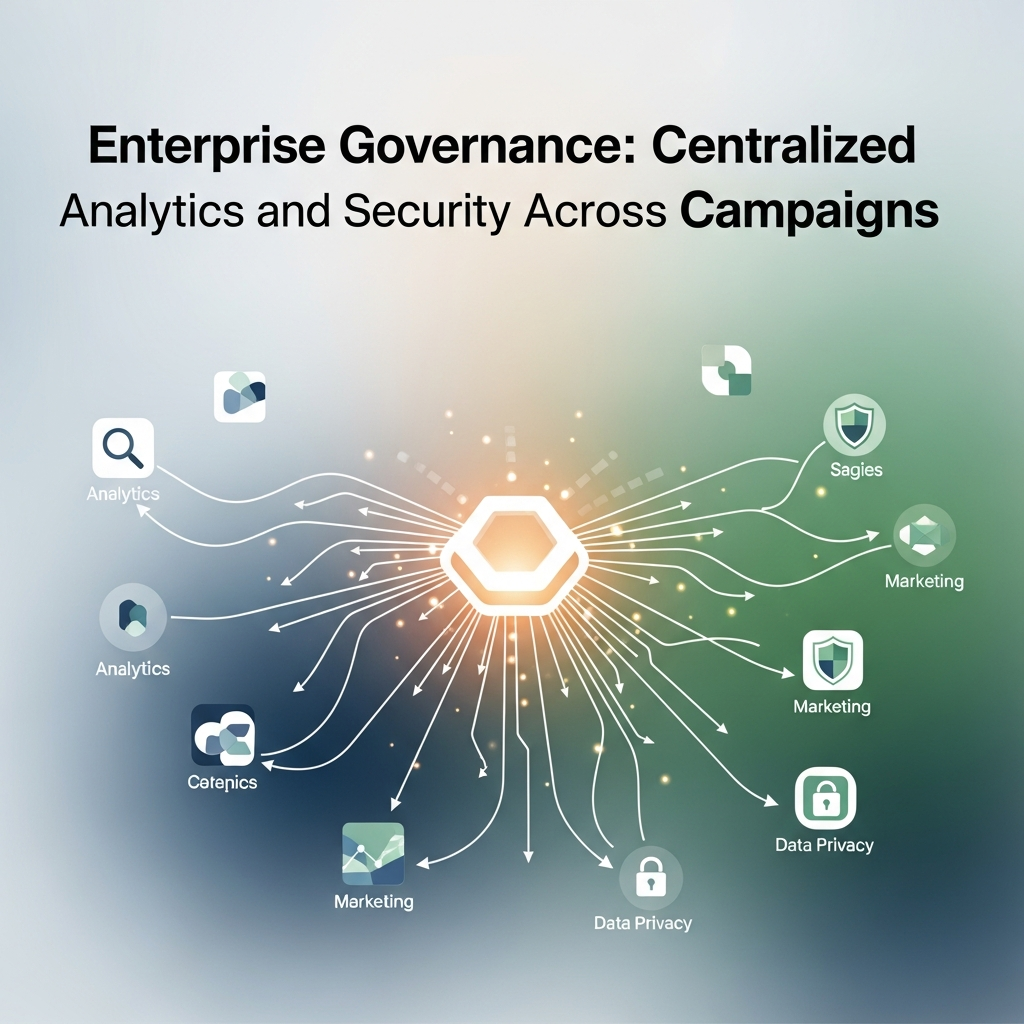
Enterprise Governance: Centralized Analytics and Security Across Campaigns
1. Why enterprise-grade governance matters across campaigns
In today’s era of multi-site campaigns and distributed teams, governance is not a luxury—it is a prerequisite. Enterprise-grade multi-site governance provides a unified framework to align strategy, measurement, and security across hundreds of pages, channels, and markets. Without it, organizations face inconsistent data, fragmented decision making, and regulatory risks that erode ROI.
Centralized governance establishes common policies for data collection, role-based access, and standard operating procedures that scale with your business. It enables executives to trust the numbers and managers to act quickly without compromising brand integrity. For teams that run campaigns across geographies, a governance-first approach helps maintain consistency while allowing local flexibility where it matters most.
As you design governance for scale, remember that it is a living system. It must adapt to new products, CMS stacks, and evolving privacy laws. The right framework balances control with speed, so teams can iterate rapidly while staying compliant. This article outlines how to build that balance by combining centralized analytics, rigorous security, and clear vendor management—so your campaigns can grow without friction.
2. Architecting centralized analytics for multi-site campaigns
A centralized analytics architecture is the backbone of enterprise governance. The goal is to consolidate disparate data sources into a single source of truth that supports cross-site comparisons, executive dashboards, and operational reporting. Start by mapping data sources across sites, campaigns, and channels—ERP, CRM, CMS, analytics tools, and ad platforms all contribute valuable signals.
Key steps include defining a unified data model, standardizing dimensions (such as region, brand, product category), and establishing data quality checks. Implement an automated ETL/ELT pipeline to cleanse, normalize, and sync data with a centralized warehouse or data lake. This enables unified attribution, cross-site funnel analysis, and consistent KPI definitions across marketing teams.
Practical practices include:
- Adopt a single taxonomy for campaigns, creatives, and audiences to enable reliable cohort analyses.
- Use role-based dashboards so executives see strategic metrics, while analysts access technical detail.
- Leverage automated anomaly detection to surface data quality issues before they become blind spots.
To learn from real-world patterns, explore content on editorial workflows and scalable publishing strategies in the following resources: Editorial workflow for agencies planning, writing, and publishing at scale and Asimpletool blog.
3. Security and data privacy at scale
Security and data privacy are foundational to enterprise-grade governance. When you operate across multiple sites, you must enforce consistent protections for customer data, internal IP, and analytics signals. Start with a mature access control model, including single sign-on (SSO), multi-factor authentication (MFA), and least-privilege permissions. Audit trails are essential for accountability and incident response.
Data protection strategies should cover encryption at rest and in transit, tokenization for sensitive attributes, and robust data retention policies. Regular security reviews, vulnerability assessments, and red-team exercises help identify gaps before they impact campaigns. Consider data residency requirements and cross-border data transfer rules that may apply to regional teams and partners.
Beyond technology, governance must address process. Define incident response playbooks, change management protocols, and supplier risk reviews that are revisited on a quarterly basis. This ensures security and privacy are not siloed into a single team but are embedded in the day-to-day workflow of every campaign manager and developer.
4. SOC 2 compliance and governance requirements
SOC 2 compliance is often a non-negotiable criterion for enterprise partnerships. It demonstrates that a vendor has controls in place to protect sensitive data and manage risk across service delivery. While SOC 2 alone does not guarantee security, it provides a structured framework for governance that auditors and procurement teams recognize.
To prepare for SOC 2 discussions, document your data flow diagrams, control mappings, and evidence of monitoring activities. Vendors should offer clear evidence of access controls, change management, incident response, and vendor management programs. For enterprise buyers, it is worth requesting a SOC 2 Type II report and an explanation of any exceptions and remediation plans.
As you evaluate solutions, align SOC 2 requirements with your internal governance SLAs and procurement policies. Clear articulation of how data moves between multi-site instances, how access is granted and revoked, and how audit logs are retained will shorten contract negotiations and improve confidence in long-term partnerships.
5. Governance SLAs and vendor management
Governance SLAs formalize expectations for performance, risk, and accountability. They cover uptime, data availability, response times, change management, and security incident handling. A well-crafted SLA for enterprise-grade multi-site governance should be pragmatic, scalable, and aligned with the business cycle of procurement and renewal.
Vendor management requires ongoing oversight of third-party risk, subcontractor controls, and exit strategies. Maintain a single source of truth for vendor documents, risk assessments, and performance metrics. Regularly review vendor roadmaps to ensure they align with your governance priorities and interoperability needs across CMSs, analytics tools, and data platforms.
Practical tips include: establishing quarterly governance reviews, creating a shared risk register, and requiring suppliers to provide SOC 2 or equivalent certifications. Also, insist on clear data migration and data deletion terms to protect against vendor lock-in and ensure a clean exit if needed.
6. Designing enterprise dashboards for executives and operators
dashboards should be tailored to distinct audiences. Executives often need high-level, outcome-focused views (ROI, pipeline impact, cross-site revenue). Operators and analysts require drill-down capabilities (page-level metrics, event-level data, error rates). A well-designed suite of dashboards enables both perspectives without sacrificing governance or security.
Key design principles include role-based access, consistent color semantics, and clear attribution models. Use normalized KPIs across sites and brands to support apples-to-apples comparisons. Provide built-in storytelling features so leaders can surface insights in executive briefings without exporting raw data.
When choosing a tooling stack, prioritize dashboards that support native data governance, audit trails, and exportability in secure formats. Integrate dashboards with the broader analytics ecosystem to ensure alignment with measurement frameworks and quarterly business reviews.
7. Implementation roadmap: from pilot to scale
Turning governance into practice requires a staged approach. Start with a discovery phase: inventory sites, data sources, CMS integrations, and key stakeholders. Define a minimal viable governance model that delivers quick wins while laying the groundwork for full-scale adoption.
The pilot phase should include a restricted scope, such as a single brand or region, with clearly defined success metrics. Establish data quality rules, access controls, and a governance playbook that can be extended as you scale. Use learnings to inform the rollout plan, timelines, and resource requirements for broader deployment.
Scale requires governance champions across teams, a centralized governance council, and reusable templates for dashboards, SLAs, and data models. Create an onboarding program for new sites, including a standard data mapping exercise and a checklist for privacy and security reviews. Consider linking to related governance content such as editorial workflow for agencies planning, writing, and publishing at scale to align content governance with analytics governance, and Asimpletool blog for ongoing insights.
8. Common pitfalls and how to avoid them
Even with a solid plan, organizations stumble. Common pitfalls include over-centralization that slows local teams, insufficient data quality controls, and vague ownership during handoffs. Another risk is underestimating change management; people resist governance changes if the benefits are not clearly communicated.
To mitigate these risks, maintain a lightweight governance charter that evolves with the business. Involve regional and brand leads early, document data definitions, and publish a living data dictionary. Invest in training and enable self-service analytics with guardrails that prevent accidental data leakage or misinterpretation.
Finally, avoid vendor lock-in by designing for interoperability. Favor standards-based APIs, open formats, and well-documented data contracts. This approach ensures you can migrate modules or consolidate tools without compromising governance integrity.
9. Getting started: practical starter checklist
Use this starter checklist to kick off enterprise-grade multi-site governance:
- Assemble a governance steering group with representatives from marketing, IT, security, legal, and finance.
- Map data sources, identify gaps, and define a unified data model and KPI framework.
- Establish role-based access controls and an auditable single source of truth.
- Define SOC 2 alignment goals and request necessary controls from vendors.
- Draft governance SLAs with measurable uptime, response times, and data handling terms.
- Plan a phased rollout starting with one brand or region before expanding.
- Design executive and operator dashboards with appropriate drill-down capabilities.
- Schedule quarterly governance reviews and continuous improvement rituals.
For ongoing guidance, see related resources such as editorial workflow for agencies planning, writing, and publishing at scale, and SAO Paulo automation for Brazilian e-commerce.
Need more insights as you plan your governance strategy? The Asimpletool blog hosts a range of practical articles on centralized analytics, security, and enterprise dashboards that complement this guide.