Content Governance: Versioned Editorial Controls for High-Volume Teams
What is Content Governance?
Content governance is the system of people, processes, and technologies that ensure every published piece aligns with business goals, brand voice, accuracy, and compliance. For teams producing content at scale, governance becomes the backbone that preserves quality while accelerating throughput. It is not merely a set of rules; it is a repeatable, auditable framework that guides planning, creation, review, and distribution across channels.
Effective governance addresses five core questions: who approves what, what standards define quality, how changes are tracked, how to maintain brand voice at scale, and how to demonstrate compliance across all published assets. When these elements are codified, content teams can publish confidently, even as volume increases. This article explores a practical, versioned approach to editorial controls designed for agencies, mid-market brands, and publishers—those who must scale without sacrificing consistency or governance.
Versioned Editorial Controls: A Practical Framework
Versioned editorial controls combine version history, staged approvals, and a clear decision log. The idea is simple: every content artifact carries a history, a responsible owner, and a gate that must be passed before it goes live. The benefits are tangible: faster rollback of issues, clearer accountability, and a living blueprint of how content should be created and published across contexts.
Think of versioned controls as layers of guardrails that protect the content from drift. The guardrails include templates and brand voice references, editorial checklists, and predefined approval paths. The gates are decision points: draft submission, reviewer feedback, compliance validation, and final publication. The result is a scalable system where quality is embedded, not added on top.
Key elements to implement:
- Documented ownership for each content asset (author, editor, reviewer, publisher).
- Versioned artifacts with clear change logs and rollbacks.
- Defined approval paths with time-bound SLAs and escalation rules.
- Editorial templates that encode tone, structure, and metadata.
For teams that work across multiple brands or client ecosystems, versioned controls provide a single source of truth. This reduces misalignment and speeds up review cycles because reviewers always know what changed and why.
Version Control for Content
Version control for content is more than a software concept; it is a discipline for tracking every change across drafts, metadata, and asset links. In practice, you want a system where each content item has:
- A historical timeline showing edits, reverts, and author attributions.
- Branching capabilities for experimentation (e.g., regional variants, A/B content tests).
- Rollback procedures that restore a previous state without data loss.
- Audit logs that satisfy compliance needs and enable reporting to stakeholders.
Branching is particularly useful for brands operating in multiple markets. You can create a branch for each language or region, then merge back when appropriate, preserving the original structure while accommodating localization. A robust version-control approach also helps with crisis management—if a piece contains a factual error, you can locate the exact change and restore the correct version quickly.
When selecting a tooling approach, consider:
- Granularity of changes tracked (paragraphs, metadata, images).
- Ease of rolling back individual sections without affecting the rest of the article.
- Compatibility with CMS environments (WordPress, Webflow, Shopify, etc.).
Editorial Workflow at Scale
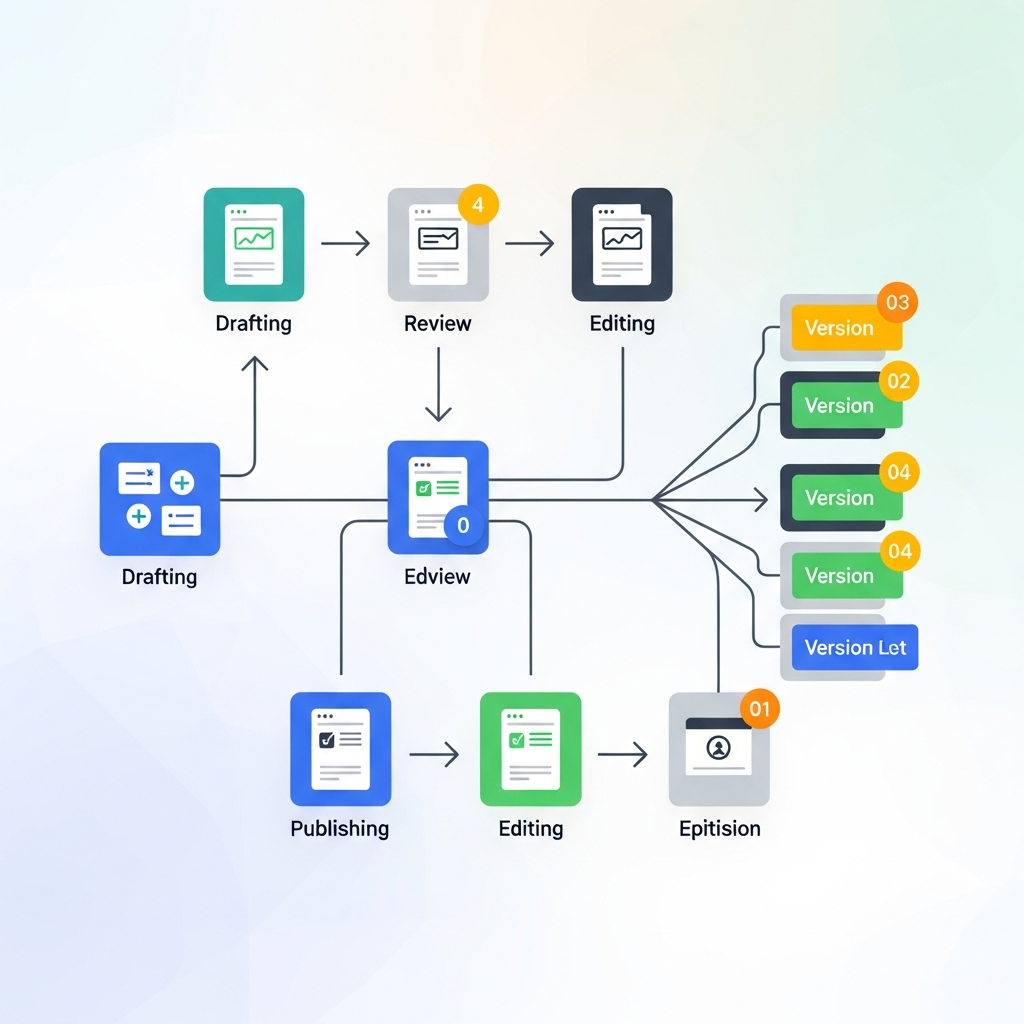
An editorial workflow maps the journey from idea to published asset. At scale, you need a repeatable rhythm that minimizes handoffs, aligns with brand strategy, and accelerates time-to-publish. A typical workflow includes:
- Planning: topic briefs aligned to strategic goals and audience intent.
- Drafting: writers produce content adhering to templates and metadata standards.
- Editing: a dedicated editor polishes copy, checks for tone, accuracy, and structure.
- QA & Compliance: fact-checking, licensing approvals, and accessibility checks.
- Publishing & Scheduling: content goes live on target channels with correct timing.
- Post-Publish Review: performance tracking and iterative improvements.
To operationalize this, create defined roles (Content Owner, Editor, Compliance Lead, Publisher) and document SLAs for each stage. Automations can enforce deadlines, route tasks to the right owners, and surface blockers early in the cycle. A strong workflow also keeps a living archive of past campaigns, enabling data-driven refinement over time.
Practical tips:
- Use templates for briefs and editorial checklists to standardize quality across teams.
- Implement a two-pass editing approach: content quality and brand alignment first, then SEO optimization second.
- Link planning should occur early, guiding internal linking and canonical strategies.
For deeper exploration, see our in-depth guide on editorial workflow for agencies planning writing and publishing at scale: editorial workflow for agencies planning writing and publishing at scale.
Brand Voice Guidelines and Quality Checklist
Brand voice guidelines provide the compass for tone, terminology, and grammatical style. When teams publish at scale, a living quality checklist ensures every asset meets the same standards, regardless of the author. A quality checklist typically covers:
- Tone consistency with brand persona and audience segment.
- Clarity, conciseness, and readability (Flesch-Kincaid targets, sentence length).
- Terminology consistency, glossary alignment, and industry-specific language.
- Grammatical accuracy, inclusive language, and accessibility considerations.
- SEO basics: title tags, meta descriptions, and structured data alignment.
- Compliance checks (disclosures, licensing, privacy considerations).
Quality is not a one-off gate; it is a recurring practice embedded into the content lifecycle. Publish a living style guide and maintain a centralized glossary that any author can reference. Over time, automated checks can flag deviations and prompt reviewers to intervene before publication.
Take a pragmatic approach: codify the top 20 most common brand expressions and the 10 most frequent compliance notes, then expand as needed. This makes governance tangible and scalable for high-volume teams.
Publishing Approvals and Compliance at Scale
Publishing approvals are the formal gates that ensure quality and compliance before content reaches the audience. A scalable approval process typically includes:
- Role-based access control with explicit ownership for each asset.
- Multistage approvals (Draft > Reviewer > Compliance > Publisher).
- Audit logs documenting who approved what, when, and why.
- Time-bound SLAs and escalation paths for stalled assets.
- Automated nudges and reminders to keep teams on schedule.
In practice, approvals should feel light-touch when possible but stringent enough to prevent risky publishing. Consider templated approval checklists that combine brand, accuracy, and compliance signals. For multilingual or multi-brand contexts, ensure approvals can be scoped by language or brand to avoid cross-pollination errors.
As a reference point, you can explore related topics in our ecosystem, including the Sao Paulo publishing automation guide for ecommerce in Portuguese: Sao Paulo automation for ecommerce publishing.
Architecture, Playbooks, and Tooling
A robust content governance system combines human processes with technical guardrails. The architecture typically comprises the following layers:
- Content Layer: templates, assets, metadata, and versioned documents.
- Editorial Layer: workflows, roles, and review gates integrated into the CMS.
- Governance Layer: brand guidelines, quality checklists, and compliance rules.
- Delivery Layer: distribution to CMS, CMS-driven scheduling, and cross-channel publishing.
Practical playbooks to adopt now:
- Daily content triage: quick wins to stabilize quality and throughput.
- Weekly review rituals: synchronized checks for brand and accuracy.
- Monthly governance audits: ensure the system remains aligned with strategy and regulatory changes.
Tools to consider include versioned document storage, editorial workflow modules, and clear metadata schemas. If you want an accessible, hands-on case study of how governance scales for an agency-like operation, see our editorial workflow guide and related articles linked below.
Internal note: for a concrete, region-specific example of publishing automation, see Sao Paulo automation article and our disclaimer page for governance disclaimers: Disclaimer.
Metrics, ROI, and Continuous Improvement
Governance is not only about quality; it is about measurable outcomes. The value of a versioned, rule-based editorial system shows up in several metrics:
- Time-to-publish per asset and cycle time improvements across teams.
- Rate of rework or failed previews before publication.
- Consistency scores against the brand voice and style guidelines.
- Compliance incidents and the speed of remediation after detection.
- SEO and engagement signals (organic traffic, dwell time, and conversion metrics) as a downstream effect of higher quality publishing.
Establish a dashboard that ties governance signals to business outcomes. A transparent reporting loop encourages continued investment and helps stakeholders understand how governance translates to revenue, risk reduction, and brand integrity.
Tip: start with a 90-day governance experiment, track a small cohort of content assets, and gradually scale the program. The goal is to prove ROI while increasing confidence in the publishing engine.
90-Day Roadmap to Implementation
Implementing versioned editorial controls is a journey, not a one-off project. A pragmatic 90-day plan might look like this:
- Days 1–14: Discovery and Design — map current processes, identify bottlenecks, define governance principles, and select tooling partners if needed.
- Days 15–30: Documentation and Templates — create brand voice guidelines, editorial templates, and a starter quality checklist. Establish roles and initial SLAs.
- Days 31–60: Pilot Workflow — implement a pilot in a single CMS and domain (e.g., a subset of content or a regional site). Introduce versioning hooks and a two-pass editing process.
- Days 61–90: Scale and Refine — expand to additional brands or locales, incorporate feedback, and begin formal KPI tracking. Optimize for speed without sacrificing quality.
As you embark, maintain a feedback loop with content creators, editors, and compliance stakeholders. The most successful governance efforts are those that evolve with real-world use and outcomes.
For more practical context on editorial workflows at scale, revisit our guide here: editorial workflow for agencies planning writing and publishing at scale.
If you’re exploring regional publishing momentum, you can also consult Sao Paulo’s automated publishing guide: São Paulo ecommerce publishing automation.
Conclusion: Governance as a Growth Enabler
Content governance with versioned editorial controls is a practical necessity for teams delivering high volumes of content. It protects brand integrity, accelerates time-to-publish, and provides an auditable path from draft to distribution. By combining version control, a robust editorial workflow, brand voice guidelines, and structured approvals, organizations can scale with confidence.
Remember: governance is most effective when it balances rigor with usability. Start small, codify the essentials, and then expand in iterations. The payoff is not just fewer missteps; it’s the freedom to publish more often, with greater consistency, across more channels and audiences.
For readers who want to explore more about editorial workflows and governance in our broader ecosystem, check out the disclaimer page for governance context: Disclaimer.