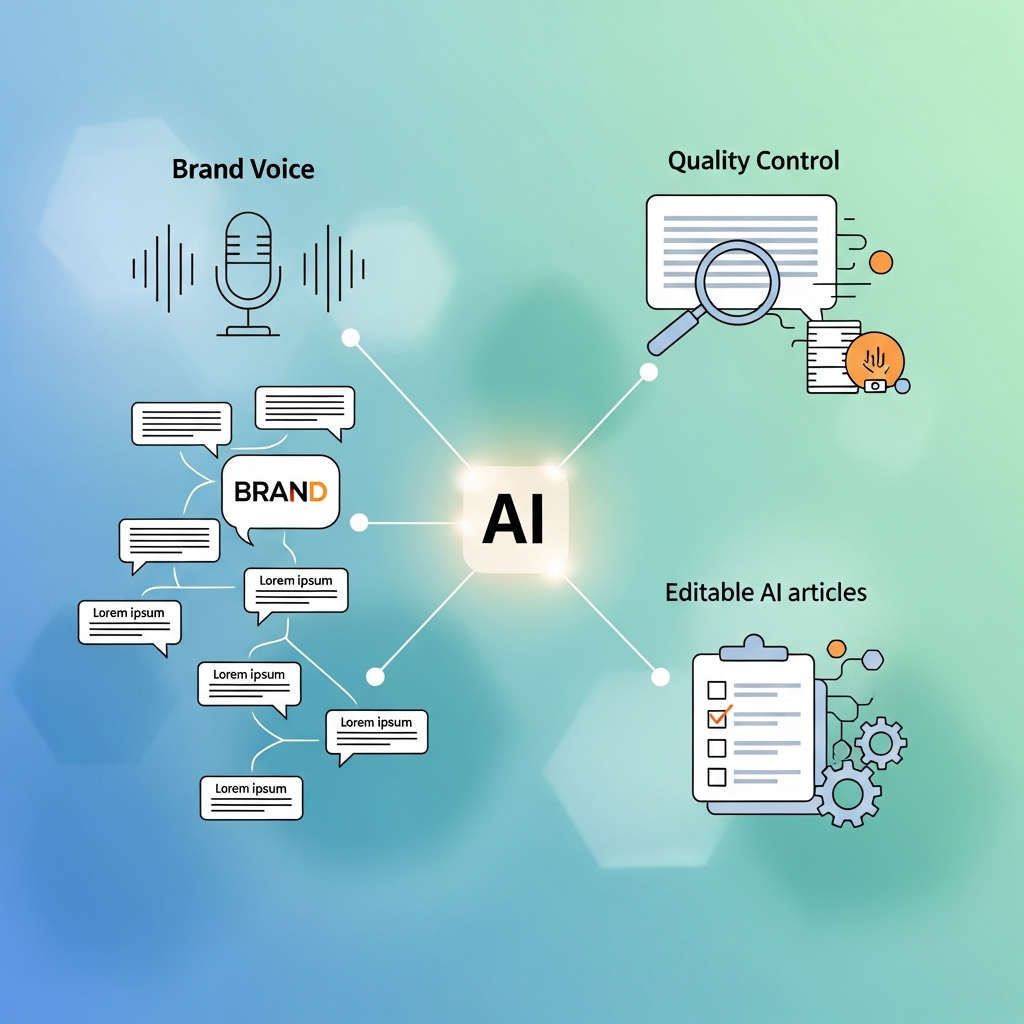
Brand Voice AI Content: Quality Control for AI Generated SEO Content
Overview
As brands increasingly rely on AI to generate SEO content at scale, the risk of drifting away from established voice and quality expectations grows. Brand voice AI content requires a deliberate governance layer that aligns machine-generated output with human-defined standards. This includes clear voice guidelines, calibrated tone, consistent terminology, and rigorous quality checks. Without these controls, AI can produce content that feels generic, inconsistent, or misaligned with audience expectations, even if it ranks well in search results.
This guide provides practical, repeatable approaches to preserve brand personality, ensure factual accuracy, and maintain editorial integrity when content is written by AI. You’ll learn how to define your voice for machines, set up an editorial workflow, implement calibrations at the drafting stage, and apply governance that scales across teams and multiple sites. For teams already practicing structured content operations, these practices plug into existing workflows and augment them with AI-driven efficiency.
Important note: the strategies below are designed to work with a mixed- author environment—human editors, subject-matter experts, and AI writing assistants. The goal is to create a single brand voice that transcends individual writers and tools while enabling faster, consistent content production. See our broader blog resources for templates and exemplars that illustrate the concepts in action.
To get hands-on with the editorial side of AI content, consider exploring our editorial workflow resources and governance checklists available in the site’s blog hub and related tooling, including schema validation utilities that help ensure data quality across pages.
Quick reference: the keywords that anchor this guidance include brand voice AI content, AI content quality control, editable AI articles, tone consistency AI, editorial workflow for AI content, and brand voice calibration AI. These terms appear throughout the article as practical, reusable concepts you can adopt today.
Defining Your Brand Voice for AI Content
A brand voice is not a single sentence in a style guide; it is a living set of characteristics that pervades every article, meta tag, and snippet your audience encounters. When content is produced by AI, you must translate that voice into machine-friendly prompts, templates, and guardrails. Start with a concise voice brief that covers tone (formal, friendly, authoritative), vocabulary (technical vs. approachable), cadence (short sentences vs. longer paragraphs), and core values (trust, empathy, boldness, clarity).
A practical approach to define brand voice for AI content includes:
- Creating a style guide tailored for AI authors, including preferred adjectives, sentence length norms, and preferred phrasing for key concepts.
- Cataloging a glossary of brand-specific terms, product names, and industry jargon to reduce ambiguity in prompts.
- Defining guardrails for sensitive topics, disclaimers, and factual language to avoid misrepresentations or biased conclusions.
- Maintaining a tone matrix that maps audience segments to voice variations, so AI adapts appropriately by context.
In practice, translate the brand voice brief into machine-readable prompts. For example, provide pre-approved sentence templates, controlled vocabularies, and a set of calibration tests your AI can run before publishing. This makes the output more predictable and easier to review by human editors.
For deeper exploration of voice calibration concepts, our blog hub offers examples of how teams implement tone and style in real campaigns. Read more from our blog hub.
Tone Consistency and Brand Calibration for AI
Tone consistency means that the same message feels recognizably your brand across all channels and authors—human or AI. AI can drift if prompts aren’t anchored to a stable tone framework. Calibration is the ongoing process of aligning AI output with this framework through prompts, temperature settings, and post-processing edits.
Best practices to maintain tone consistency include:
- Lock down a set of tone presets with examples for each content type (blog posts, product pages, FAQs, case studies).
- Embed a tone-check step in the editorial workflow that compares AI output against a tone-score rubric before human review.
- Utilize controlled language prompts that reinforce brand adjectives and avoid stylistic drift over time.
- Document common phrases and preferred formulations to reduce variability across writers and AI assistants.
When tone drifts, quick interventions include re-prompting with a refined brief, running a tone calibration pass, and scheduling a short retraining session with editors. The goal is not to micromanage language but to ensure consistent voice signatures across all AI-generated content.
As you scale, you may benefit from a centralized tone dashboard that highlights outliers and drift patterns across pages and topics. This helps governance teams spot issues early and guide editors toward faster remediation.
Editorial Workflow for AI Content
A robust editorial workflow for AI content blends machine efficiency with human oversight. The workflow should be repeatable, auditable, and adaptable to different content types. A typical AI-enabled workflow includes briefing, drafting, review, optimization, and publishing, with version control at each step.
Key steps to implement a scalable editorial workflow include:
- Briefing: Start with a content brief that includes target keyword targets from your SEO plan, voice guidelines, and any mandatory inclusions (facts, data points, citations).
- Drafting: Use AI to draft sections aligned to prompts; provide constraints that enforce brand voice and factual checks.
- Review and Calibration: Have editors review for accuracy, tone, and readability. Apply a calibration pass if tone variance is detected.
- Editing and Optimization: Editors refine structure, optimize for SEO (headings, meta elements, structured data), and ensure accessibility compliance.
- Publishing: Publish with standardized meta tags and schema where applicable; ensure internal cross-linking aligns with SEO goals.
For practical templates and structured prompts, see Editorial workflow resources that illustrate planning, writing, and publishing at scale at our blog: Editorial workflow for agencies planning writing and publishing at scale.
Integrating AI into this workflow means you should treat AI output as a draft that requires human verification. This approach preserves the speed of AI while safeguarding brand value and accuracy.
Quality Control Framework for AI Content
Quality control for AI content is not an afterthought; it is a governance layer that ensures factual accuracy, consistency, and alignment with audience expectations. A practical QC framework combines automated checks with human review and includes three core pillars: accuracy, consistency, and compliance.
Accuracy focuses on verifiable facts, data points, and claims. Implement processes such as: fact-check prompts, citation requirements, and cross-referencing with trusted sources. Consistency emphasizes voice, terminology, and style across articles. Use prompts and templates to lock vocabulary and tone, and run a post-generation tone check. Compliance covers accessibility, legal constraints, and privacy considerations, ensuring your content adheres to applicable policies.
To operationalize QC, establish a multi-step review pipeline that includes:
- AI-generated draft with embedded citations and source notes
- Editor verification for accuracy and source credibility
- Quality metrics reporting (tone score, factual consistency, readability)
- Final optimization for SEO, structured data, and accessibility
Incorporating a schema validator as part of your QC ensures data accuracy and improves SEO visibility. Use tools like our schema validator tool to audit structured data and metadata automatically.
Practically, you’ll want to define a set of QC metrics and pass/fail criteria. For example, a simple rubric might score factual accuracy, tone adherence, grammar quality, and SEO alignment on a 0-10 scale. Content failing to meet minimum thresholds should be returned to the drafting stage for revision before publishing.
Governance, Security, and Compliance
Governance is the backbone of AI-generated content at scale. It governs who can generate content, how prompts are managed, where data is stored, and how content is reviewed and published. Enterprises especially benefit from governance that includes access controls, auditing capabilities, and vendor accountability. A robust governance model helps you manage multi-site deployments, maintain brand consistency, and satisfy executive reporting requirements.
Key governance practices include:
- Role-based access to AI content platforms and a clear approval chain
- Documentation of prompts, prompts libraries, and calibration tests
- Audit trails for content creation, edits, and publishing actions
- Regular reviews of brand voice guidelines and update protocols
- Security and data privacy measures aligned with organizational policies
Governance extends to vendor relationships as well. When evaluating AI content tools, look for reliability, SLAs, data handling policies, and the ability to scale across teams and sites. For broader governance insights, visit our blog hub and related governance templates that discuss multi-site management and vendor governance in depth.
To explore governance-focused content now, visit our blog hub for hands-on guidance and case studies from brands implementing scalable governance models.
Localization and Accessibility Considerations
Brand voice must translate across languages and cultures without losing its core identity. AI can accelerate localization, but it also introduces risks of tone misalignment or cultural blind spots. A disciplined approach combines machine-assisted translation with human review, ensuring that voice, humor, and value propositions resonate appropriately in each locale.
Practical localization practices include:
- Glossaries and locale-specific style guides that reflect regional preferences
- Localized prompts and region-aware SEO considerations
- Accessibility checks (WCAG compatibility, alt text for images, ARIA roles) during the editing stage
- Quality controls that compare localized outputs against original voice guidelines
Accessibility and localization are not afterthoughts; they are essential components of quality content. If you rely on AI for multilingual output, build a localization review step into your QC workflow and schedule periodic audits to catch drift across languages.
Implementation Roadmap: From Pilot to Scale
Moving from pilot to full-scale governance of AI content requires a concrete plan with milestones, Owners, and measurable results. A practical roadmap might include these phases:
- Foundation: define voice guidelines, create templates, and set up the editorial workflow.
- Calibration: implement tone checks and a calibration rubric; train editors on evaluating AI output.
- Quality Control: deploy the QC framework, including fact-checking and schema validation tooling.
- Governance: establish access controls, auditing, and governance documentation for multi-site campaigns.
- Optimization: refine prompts, update glossaries, and expand localization workflows.
- Scale: roll out to additional teams and content types, monitor KPIs, and adjust governance as needed.
During implementation, leverage internal and external resources to keep momentum. For example, integrate the editorial workflow guidance from our blog to standardize how teams plan, write, edit, and publish at scale. You can explore more about scalable editorial workflows here: Editorial workflow for agencies planning writing and publishing at scale.
Common Pitfalls and Best Practices
Even with a strong framework, teams encounter common challenges. Awareness of pitfalls helps you preempt issues and maintain momentum.
- Overreliance on AI without human oversight can erode voice and accuracy.
- Inconsistent prompts lead to variable tone across articles.
- Inadequate governance causes brand drift during rapid publishing cycles.
- Falling behind on accessibility or schema requirements reduces content quality and search performance.
Mitigate these risks with a disciplined approach: maintain a living style guide, enforce a mandatory calibration pass, and schedule quarterly governance reviews. To explore practical templates and tools that support AI-driven content while preserving quality, try our schema validation resource to ensure your metadata and markup stay consistent across pages: schema validator tool.
Putting It All Together
Preserving brand voice in AI-generated SEO content is not a single tweak; it is an end-to-end discipline that starts with a clear theory of voice, continues with a repeatable editorial workflow, and ends with rigorous quality control and governance. When these elements work in concert, you gain faster content velocity without sacrificing brand integrity, accuracy, or accessibility.
As you implement these practices, remember that you do not need to reinvent your entire content operation at once. Start with a focused pilot, lock in a small set of templates and tone presets, and gradually extend governance to additional teams and locales. Our resources and blog posts are designed to help you learn and apply these concepts incrementally, while keeping a sharp eye on SEO outcomes and audience trust.
For ongoing insights and practical examples, visit our blog hub to explore related topics and case studies. Browse our blog hub for more on editorial workflow, AI content governance, and voice calibration in real-world campaigns.