Backlink Qualification Framework: Score Prospects Before Outreach
Why Qualify Backlinks Before Outreach
Backlink prospects come in many shapes and sizes, from niche blog posts to high-authority news sites. Not every link opportunity is worth pursuing, and some can even hurt your performance if handled incorrectly. A repeatable qualification framework helps you quickly separate high-impact, low-risk targets from vanity links or risky domains.
A structured approach reduces wasted outreach time, improves your hit rate, and strengthens your overall SEO ROI. By focusing on prospects that meet a clear set of criteria, you can tailor outreach messaging, anchor text, and content alignment for maximum results. This framework draws on common best practices across agency and in-house teams and translates them into a scalable scoring system.
To ground this guide in practical steps, we’ll blend concepts like domain trust signals, relevance assessment, and outreach prioritization into a single, auditable process. If you want a broader view of editorial workflows that tie into link-building efficiency, you can explore related processes in our editorial workflow resources Editorial workflows for agencies planning, writing and publishing at scale and other practical guides on our blogs.
Framework Overview: The Scorecard that Wins
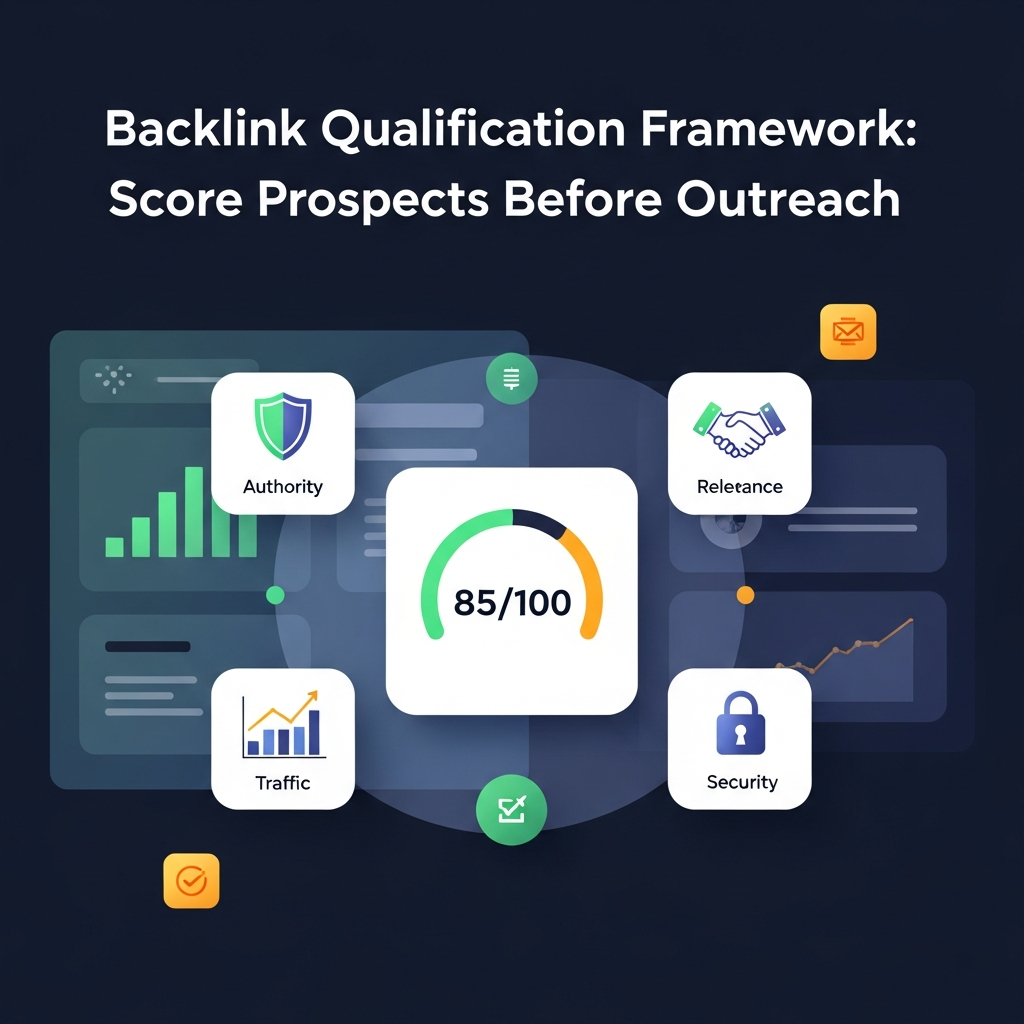
The backbone of the backlink qualification framework is a three-layer scorecard that you can apply to every prospect. Layer one evaluates the domain and page-level signals (trust, authority, crawlability). Layer two evaluates relevance to your content and topic space. Layer three prioritizes outreach based on opportunity magnitude and risk. Combined, these layers guide both decision-making and outreach sequencing.
The framework is designed for speed and consistency. You can score a large list of prospects in a single session, then sort by composite score to determine which targets warrant outreach effort first. The goal is to maximize link value while minimizing the chance of penalties or wasted outreach time.
Pre-Qualification Criteria: What Creates a High-Quality Prospect
Before you assign any numerical scores, establish a baseline of pre-qualification that all prospects must meet. This ensures bad seeds never enter your scoring process and helps your team focus on targets with genuine potential.
- Relevance: The site’s primary topic should align with your content. A strong topical fit increases the likelihood that your link will drive qualified traffic and improve keyword rankings.
- : The page hosting the link should feature well-formed content, proper editorial standards, and useful context for readers.
- Editorial integrity: The site should demonstrate consistent editorial quality, not a spammy or link-factory history.
After you confirm these pre-qualifications, you can move into the scoring stage with confidence that you’re evaluating legitimate opportunities.
For a broader take on editorial workflows that support scalable content and linking, see our detailed guides Editorial workflows for agencies planning, writing and publishing at scale and related topics in our blogs.
Backlink Scorecard: A 0–5 Scoring Model
Use a 0–5 scale for each dimension to simplify decision-making. A score of 0 means the prospect fails the criterion; 5 indicates a perfect fit within that dimension. A composite score is the sum of the individual criterion scores. We’ll cover typical criteria and suggested thresholds.
Core Criteria and Scoring
- (0–5): Consider metrics like domain trust signals, historic stability, and absence of penalties. Higher scores mean a strong, reputable site with editorial legitimacy.
- (0–5): How closely does the host page or domain match your niche and content goals?
- (0–5): Is the link placed in a meaningful, content-rich context rather than a footer or sidebar?
- (0–5): Is the anchor text natural, varied, and consistent with the page’s content, reducing the risk of over-optimization?
- (0–5): Links embedded in long-form content or within high-authority pages carry more weight than link aggregations.
- (0–5): The hosting page should have credible content, clean HTML, and no spammy sections that would undermine trust.
A practical example: a prospect with domain authority 4, relevance 4, link context 3, anchor risk 1 (low risk), link location 4, and page signals 4 would score 20 out of a possible 30 for this framework. You can set a minimum composite threshold (e.g., 15–18) to decide whether to pursue.
For a deeper dive into how to architect a scalable scoring framework for agencies, check our reference materials in editorial workflows Editorial workflows for agencies planning, writing and publishing at scale.
Domain Trust Signals: What Really Matters
Domain trust signals are a composite view of a site’s authority, reputation, and editorial quality. Important signals include historical domain behavior, quality of linking domains, content quality, and the presence (or absence) of spam-like patterns. When evaluating a domain, look for consistency across signals rather than chasing a single metric.
Practical signals to consider include: a clean backlink profile with a mix of editorial links, absence of spammy link networks, strong and natural internal linking, published content that demonstrates expertise, and a long-standing presence in the topic community. While no single metric is perfect, a combination of factors yields a more reliable judgment of trustworthiness.
If you want to learn more about how to implement domain trust signals at scale, explore our broader content strategy guides and workflow templates in our resource library Editorial workflows for agencies and other practical guides on our blogs.
Relevance Assessment: Aligning with Your Content
Relevance is arguably the most critical determinant of long-term link value. A link from a page that closely matches your topic signals to search engines that your content is a credible fit for readers with the same interests. Relevance is not just about keywords; it’s about topic alignment, content depth, and reader intent.
Assess relevance across three dimensions: topical fit, page purpose, and audience alignment. Topical fit means the host page covers related themes in a meaningful way. Page purpose refers to whether the page is informative, authoritative, or community-driven. Audience alignment asks whether the readers share intent with your own audience. Nominally, the higher the alignment across these three dimensions, the stronger the potential value of the link.
For practical guidance on content relevance and how it ties into editorial planning, see our editor-focused resources and planning templates Sao Paulo publishing automation for ecommerce (Portuguese) and our general blog index blogs.
Outreach Prioritization: Where Effort Delivers ROI
After scoring, you must decide how to allocate time and resources. Outreach prioritization uses the composite score to sequence targets and determine messaging intensity, follow-up frequency, and content customization. A practical approach blends quantitative scores with qualitative judgments from your outreach team.
One effective method is to categorize prospects into three tiers: A (high ROI and low risk), B (moderate ROI or some risk), and C (low ROI or high risk). Allocate your outreach resources accordingly: A-tier targets get personalized outreach with longer-tail content and co-creation opportunities; B-tier receive standardized but contextualized outreach; C-tier are deprioritized or saved for future refreshes.
To see how teams practically implement this, consider exploring editorial workflows and gating strategies in our content guides Editorial workflows for agencies and the broader content ecosystem on our blogs.
Nofollow vs. Dofollow: When and How to Use Each
The decision to use nofollow or dofollow anchors affects how search engines treat the link and, in some cases, your risk profile. Dofollow links carryPageRank and can influence rankings when placed on high-quality pages. Nofollow links do not pass PageRank but can still drive traffic, diversify a link profile, and contribute to a natural anchor-text distribution.
A practical rule is to favor dofollow links from reputable sites when the page context is strong and relevance is high. Use nofollow for pages where editorial standards are uncertain, user-generated content, or when linking to sponsor content or paid placements. Built well, a mix of dofollow and nofollow links contributes to a healthier, more natural link profile.
For teams managing a diverse portfolio of links, it helps to document anchor-text strategies and usage rules as part of your outreach playbook. If you’re interested in more practical guidance for link composition, our related posts offer detailed workflows Editorial workflows for agencies and broader SEO practices blogs.
Workflow, Templates, and a Practical Plan
Turn the scoring framework into a repeatable workflow. Start with a prospect intake sheet (CSV or Google Sheet) that captures: domain, page URL, topical fit, first contact date, and each scoring dimension. Use a simple formula to compute a composite score and assign a tier automatically.
Templates speed up outreach: a personalized outreach email that references the content value, a follow-up cadence, and a tracking sheet for responses. A lightweight example of a plan you can adapt is below:
- Collect 50–100 prospects and pre-qualify them using the framework.
- Score each prospect and categorize into A/B/C tiers.
- Draft 1–3 outreach variants per tier with context-aligned value propositions.
- Launch outreach in batches over two weeks, then review performance and adjust.
For hands-on templates and a practical starter kit, visit our blogs or editorial resources. A helpful example of how other teams structure their workflows can be found in our editorial workflow guides Editorial workflows for agencies.
If you’re exploring how to implement similar processes in your content operations, you can also review our local publishing automation case studies as a reference to scale across multiple markets Sao Paulo publishing automation.
Practical Example: Scoring a Realistic Prospect
Let’s walk through a hypothetical prospect. The site operates in a closely related niche with a well-structured article hub, regular publications, and a history of credible mentions. Scoring dimensions yields: Domain trust 4, Relevance 5, Link context 3, Anchor risk 1, Location 4, Page signals 4. The composite score is 21/30, placing it in the A tier. The outreach plan would include a tailored outreach email referencing the host article and proposing a content collaboration or resource to share.
Now contrast that with a site that shows weak topical fit and inconsistent publishing. It may score 9/30, placing it in the C tier and deprioritized for now. You can set refresh intervals (e.g., quarterly) to recheck lower-ranked targets as your content and domain authority evolve.
The best way to reuse this example is to incorporate it into your team’s playbook and adapt the scoring thresholds to your niche. If you want a more concrete blueprint aligned to your stack, our white-label editorial workflows and CMS integrations can help you scale with confidence Editorial workflows for agencies.
Pitfalls to Avoid
Even a robust framework can fail if you fall into common traps. Overemphasis on a single metric, neglecting relevance, or pursuing low-quality domains for vanity links can backfire. Another frequent mistake is failing to document decisions and relying on gut feel alone. A repeatable, auditable process dramatically reduces these risks.
To maintain discipline, require at least two independent reviewers for high-stakes targets and maintain a public decision log. For a broader look at common SEO automation challenges and how to mitigate them, explore comparative guides in our tech-stack resources and case studies blogs.
Next Steps: Implementing at Scale
Ready to start qualifying backlinks at scale? Step one is to establish a baseline data set you can score consistently. Step two is to train your outreach team on the scorecard, the tier system, and the templates. Step three is to review results after a pilot period (e.g., 30–60 days) and refine thresholds and workflows as needed.
If you’d like hands-on guidance tailored to your domain and content goals, consider engaging with an expert who can tailor the framework to your team, tooling, and CMS. For more practical insight into related content optimization and link-building workflows, check our resources Editorial workflows for agencies and our main blog hub blogs, as well as our Sao Paulo automation post Sao Paulo publishing automation.
Real-World Value: Quick References
While every domain has its own dynamics, a disciplined backlink qualification process consistently improves outreach ROI when implemented with care. In industry examples, teams that adopt a structured scorecard tend to see more high-quality placements and clearer reporting to stakeholders.
If you want to see how these ideas translate into concrete results, look for case studies and client success stories once you’re evaluating vendors or tools. For a deeper read on content strategy and editorial efficiency, explore our editorial workflow content and standard templates Editorial workflows for agencies.
Conclusion
A well-designed backlink qualification framework helps you vet and prioritize prospects before outreach, improving efficiency, reducing risk, and boosting ROI. By combining domain trust signals, relevance assessment, and a disciplined outreach prioritization plan, you can scale link-building without sacrificing quality.
This approach is practical, auditable, and adaptable to different niches and team sizes. If you’re ready to implement a tailored version for your agency or brand, consider mapping your own scorecard to your content goals and CMS workflow. Our resources and templates are designed to support you in building a repeatable, scalable process.