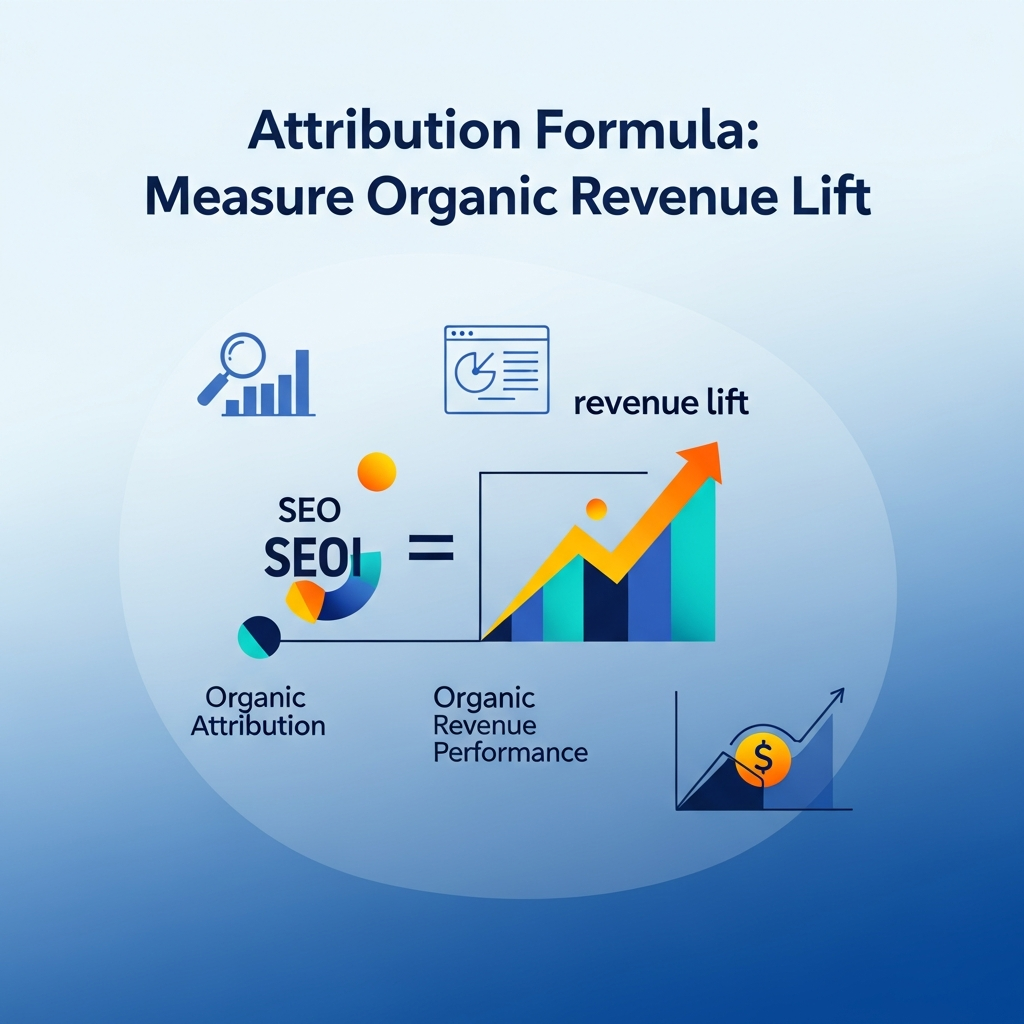
SEO ROI Formula: How to Measure Organic Revenue Lift with GA4 Attribution and Content Metrics
What is the SEO ROI formula?
At its core, the SEO ROI formula answers a straightforward question: how much additional revenue does your organic search program generate, relative to the cost of running that program? The formula is simple in theory but requires careful attribution and clean data to be useful in decision-making.
In practice, you measure incremental revenue attributable to SEO initiatives, assign a share of that revenue to SEO activity, and then compare that figure to the total investment in your SEO program. When you frame it this way, you can quantify value in monetary terms, not just rankings or traffic volume.
The key components are clear: incremental revenue, attribution for SEO, program cost, and a transparent period for measurement. When combined with automated content programs and GA4-based attribution, the numbers become actionable for stakeholders who need to see ROI beyond vanity metrics.
Why organic revenue attribution matters
Organic revenue attribution is the bridge between traffic and business impact. Without attribution, it’s easy to mistake more visits for more revenue. With attribution, you can distinguish which visits, interactions, and content actually contribute to the bottom line.
GA4 provides modern attribution models that help you map user journeys across channels. When you align GA4 data with ecommerce revenue, on-page events, and content performance metrics, you gain a holistic view of how organic search contributes at multiple touchpoints—from first interaction to final conversion and assisted conversions along the way.
In addition to revenue, attribution helps you understand non-revenue outcomes that drive value—like long-term customer lifetime value, repeat purchases, and high-intent actions such as newsletter signups or product page views. These signals improve the precision of your SEO ROI calculations and make the case for continued investment more compelling.
Attribution framework: GA4, revenue, and content metrics
The attribution framework combines data from GA4, your ecommerce platform, and content performance signals. A robust framework lets you quantify SEO impact while accounting for cross-channel influence and content quality.
GA4 SEO attribution
GA4 enables model-based and data-driven attribution to assign credit for conversions across multiple interactions. For SEO, you’ll typically track organic sessions, on-site events (add-to-cart, checkout, form submissions), and revenue tied to organic sessions. Use GA4’s exploration reports to compare last-click, first-click, and data-driven models to understand how SEO interactions contribute along the path to conversion.
Organic revenue attribution
Assign a portion of incremental revenue to organic search. This requires isolating the effect of SEO changes from other channels and external factors. A practical approach is to measure revenue lift during SEO program windows and compare it to control periods or against a baseline with similar seasonality and traffic patterns.
Content performance metrics
Content quality and optimization drive engagement and rankings, which in turn influence revenue. Track page-level metrics such as organic sessions, bounce rate, time on page, scroll depth, and conversion events. Link these metrics to conversions to understand which content factors most strongly correlate with revenue growth.
Build your measurement plan
A solid measurement plan outlines data sources, attribution rules, windowing, and governance. Start with the basics: define the measurement period, the revenue metric (gross revenue, net revenue after refunds, or gross profit), and the SEO program costs (audits, content production, optimization, and tooling).
Data sources should include GA4 for traffic and engagement, your ecommerce platform for revenue, and any internal systems you use for cost tracking. Ensure consistent tagging (UTMs or GA4 parameters) so you can attribute revenue cleanly to the organic channel and, more specifically, to SEO efforts.
Quality data is essential. Deduplicate events, reconcile revenue cycles with attribution windows, and account for seasonality. A small error in data hygiene multiplies into large misstatements in ROI, especially when evaluating multi-month programs or enterprise-scale campaigns.
For ongoing governance, establish clear owners, SLAs for data updates, and a cadence for ROI reviews with stakeholders. The goal is not a one-off calculation but a repeatable process that informs budgeting and strategy across campaigns and teams.
To deepen your understanding of editorial workflows and scalable content ecosystems, see our broader resources in the blog when you’re ready to link the content planning with ROI tracking. Editorial workflow for agencies planning, writing, and publishing at scale.
Step-by-step: calculating the SEO impact
Follow these steps to compute a credible SEO ROI estimate. Each step builds on reliable data and aligns with the SEO ROI formula.
- Establish a baseline period that matches seasonality and external factors so you can compare apples to apples.
- Measure incremental organic revenue during the SEO program period. This is revenue that would not have occurred without SEO efforts, after controlling for other channels.
- Determine the share of that incremental revenue attributable to SEO, using GA4 attribution models and content signals. This is the portion of lift you credit to organic search optimization.
- Account for SEO program costs, including content production, optimization, tooling, and personnel. Sum these up to obtain total SEO investment for the period.
- Calculate ROI with the standard formula: ROI = (Incremental SEO-attributable revenue - SEO costs) / SEO costs. A positive result indicates a favorable ROI.
Example to illustrate the concept: suppose the baseline period shows $120,000 in organic revenue, and the SEO program period shows $170,000 in organic revenue. The incremental organic revenue is $50,000. After applying attribution, you credit $40,000 to SEO. If the SEO program cost is $8,000, then ROI = (40,000 - 8,000) / 8,000 = 4.0x. This is a simplified example, but it demonstrates how the math translates to business value.
For a practical workflow that blends content planning and ROI tracking, you can reference the editorial workflow guide linked above. Editorial workflow for agencies planning, writing, and publishing at scale.
Remember to document assumptions and sensitivity analyses. Small changes in attribution shares or windowing can shift the ROI materially, so present a few scenarios (optimistic, base, and conservative) to provide context for leadership decisions.
Automating content and measuring ROI
Automation changes both the scale of content production and the speed at which you can iterate on SEO ideas. When you pair automation with rigorous ROI measurement, you unlock a stronger case for continued investment. Key benefits include faster time-to-publish, more consistent content quality, and traceable linkages between content efforts and revenue outcomes.
As you automate, ensure your data pipelines stay clean. Automated content calendars, keyword plans, and on-page optimization signals should feed directly into GA4 events and ecommerce revenue tracking. This tight integration helps you attribute lift more accurately and reduces the risk of misattribution.
For readers exploring automation use cases across regions, you can explore localized automation strategies in our Sao Paulo article focused on ecommerce publishing. Sao Paulo automating publication for Brazilian ecommerce.
In practice, start with a minimal viable automation loop: publish a batch of optimized content, monitor its impact in GA4, and adjust your content calendar and keywords based on observed ROI signals. This iterative approach helps ensure ROI remains responsive to real-world performance.
For more general reading on content strategies and ROI, check our blog resources. Blog resources.
Common pitfalls and best practices
Be mindful of data quality and scope. Mixing data from different systems without reconciliation can inflate or deflate ROI figures. Align attribution windows with purchase cycles and verify revenue attribution across both the last interaction and assisted conversions.
Avoid double-counting revenue that appears across multiple channels. Use model-based attribution to balance credit among organic search and other channels that influence a customer path. Document assumptions and clearly state which channels are included in the ROI calculation.
Best practices include establishing a governance model with defined roles, SLAs for data refresh, and regular ROI reviews with stakeholders. Keep the ROI calculation transparent and auditable so leadership can trust the numbers.
As you adopt automation, ensure that content quality controls remain rigorous. Automation should support human editors, not replace them. Maintain brand voice, factual accuracy, and editorial standards to sustain long-term revenue growth from SEO.
Practical checklist and templates
- Define the measurement window based on typical purchase cycles and seasonality.
- Identify data sources: GA4, ecommerce platform, CRM, and any marketing automation tools.
- Set attribution models in GA4 and document how credit will be allocated to SEO.
- Quantify SEO program costs: content creation, optimization, tooling, and labor.
- Compute incremental SEO-attributable revenue and calculate ROI with multiple scenarios.
- Review data quality and reconcile any discrepancies across systems.
- Prepare a stakeholder-ready ROI narrative with visuals showing lift and ROI over time.
Want more practical guidance? Explore our broader editorial and measurement resources as you implement your plan. For editorial workflows at scale, see the link above, and for regional automation insights, refer to the Sao Paulo article. Editorial workflow for agencies planning, writing, and publishing at scale | Sao Paulo automation post for ecommerce publishing.