Scaling Branded Content Across CMS and Commerce Platforms Without Sacrificing Brand Voice
Table of Contents
The challenge: publish at scale while preserving voice
Brands increasingly need to publish high volumes of branded content across multiple CMS and commerce platforms. The goal isn’t just quantity; it’s consistency of voice, accuracy of data, and alignment with SEO and AI-driven search signals. When content travels from WordPress to Webflow and Shopify, the governance standards must travel with it. This means templates, tone guidelines, data sources, and QA protocols must be portable and enforceable at every step of the workflow.Without a formal framework, teams struggle with drift in brand language, inconsistent formatting, and manual publishing bottlenecks. The result can be a fractured content ecosystem where readers experience different tones, different data accuracy levels, and inconsistent calls to action. The stakes increase as content becomes a measurable driver of traffic, conversions, and brand perception across channels.In practice, scaling branded content requires a repeatable process that combines governance with automation. The aim is to produce reliable outputs that feel native to each platform while preserving the same core brand voice across all touchpoints.
A practical governance framework for branded content
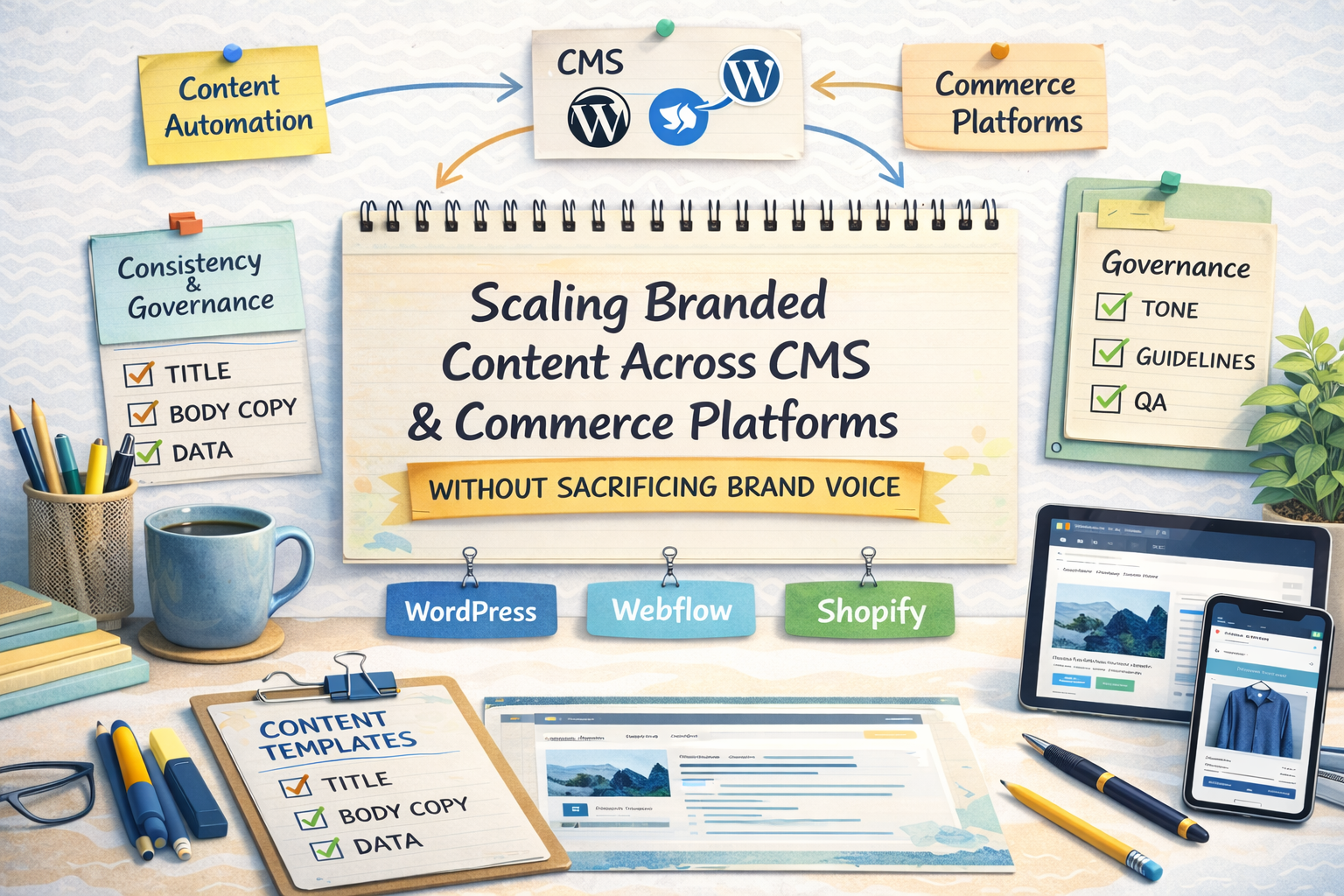
Governance is the backbone of scalable content. A structured framework ensures every piece aligns with brand voice, factual accuracy, and platform-specific constraints. The following framework offers a practical, deployable approach that scales from a single team to enterprise-wide operations.1) Voice and tone governance: Create a living brand voice guide that covers vocabulary, tone, formality, and preferred sentence structures. Build a tone dictionary or lexicon that editors and AI models can reference. Regularly review outputs for consistency and update guidelines as brand goals evolve.2) Content templates and modular blocks: Use modular content blocks (lede, body, data snippet, quote, takeaway) that can be recombined for different platforms without losing voice. Templates act as guardrails for length, structure, and data sourcing.3) Data sources and attribution: Standardize data sources, quotes, and statistics. Maintain a library of approved sources and an attribution process so that every article carries credible, up-to-date information.4) Editorial QA and sign-off: Implement a multi-step QA flow that includes tone review, factual checks, and platform-specific checks before publication. Automate reminders and approvals where possible to reduce friction.5) Versioning and change control: Track revisions across all platforms. Maintain an auditable history so changes to the brand voice or data can be rolled back if needed.These governance components translate into concrete guidelines that teams can operationalize. The key is to ensure every content asset carries the same DNA, regardless of where it’s published.
Architecture and tech stack for cross-platform publishing
To scale across CMS and commerce platforms, you need an architecture that separates content creation from platform delivery while maintaining a single source of truth. A practical stack typically includes a centralized content hub, API-driven publishing connectors, and platform-specific rendering logic.Central content hub: A structured content repository (content model) that stores articles, metadata, media, data sources, and governance attributes. This hub acts as the single source of truth for all channels.API publishing connectors: Platform adapters that map the content model to each destination’s data schema. WordPress, Webflow, and Shopify each have unique requirements; adapters handle normalization, formatting, and media delivery while preserving brand voice.Platform-specific rendering: Lightweight templates on the destination side ensure the same voice and data presentation matches platform conventions. This includes typography, components, and layout nuances that differ across WordPress, Webflow, and Shopify.With this architecture, teams can push updates quickly while ensuring governance controls travel with content. The result is faster time-to-publish and more reliable cross-platform performance.
Content automation: briefs, prompts, and data sources
Automation accelerates scale but must be anchored to human-guided governance. The core automation loop includes content briefs, AI-assisted drafting, data integration, and human QA. The goal is to generate consistent outputs that feel authored rather than generated.Content briefs: Standardize brief templates that capture target audience, category intent, required data points, and governance constraints. Include guidance on tone, length, and platform-specific adaptations.Prompts and models: Design prompts that enforce brand voice, request citations for data points, and segment output by platform. Use prompt templates that can be reused for multiple articles, reducing cognitive load and drift.Data sources and quotes: Connect to approved data feeds, industry benchmarks, and expert quotes with clear attribution. Store quotes and statistics in the content hub so they can be reused and updated without rewriting copy.Quality assurance: Build automated checks for tone consistency, factual accuracy, and formatting. Combine AI-assisted checks with human review to maintain high standards and reduce risk.
Cross-platform publishing: WordPress, Webflow, and Shopify
Publishing across WordPress, Webflow, and Shopify requires harmonized content models and careful mapping of fields such as title, body, media, tags, and taxonomy. The objective is to deliver publish-ready content to each platform without manual rework.Content modeling alignment: Define a universal content schema that captures core elements (title, summary, body, data snippets, quotes, CTAs, media) and platform-specific fields (SEO metadata for WordPress, design tokens for Webflow, product context for Shopify).Adapter patterns: Implement adapters that translate the central schema to each destination’s API requirements. This reduces duplication and enables standardized governance across channels.Release orchestration: Coordinate publishing windows, related assets, and cross-linking across platforms. A centralized scheduler ensures simultaneous or staged releases as campaigns demand.
SEO and AI search readiness: schema, prompts, and signals
Modern branded content should be optimized for both traditional search and AI-first discovery. This requires a disciplined approach to schema, structured data, and content prompts that surface relevant signals to search engines and AI copilots alike.Schema and metadata: Apply schema markup that supports article structured data, author attribution, and data-driven snippets. Keep schema up to date with evolving AI search expectations to maintain visibility.AI-ready prompts: Craft prompts that encourage data-rich paragraphs, timely statistics, and quotes with clear sources. This improves perceived expertise and helps AI systems present reliable information.Internal linking and signals: Build a robust internal linking strategy from the central hub, ensuring topical authority and cohesive user journeys, while avoiding content overload and dilution of key messages.
Measuring impact: metrics and ROI
Scale without measurement is futile. Establish a concise set of metrics that align with business goals and governance standards. Track editorial velocity, content quality scores, platform-specific engagement, and, of course, traffic and conversions tied to branded content.Editorial velocity: Measure time-to-publish, number of articles per week, and adherence to templates. Use these insights to optimize the content pipeline and reduce bottlenecks.Quality and governance scores: Create a scoring rubric for tone consistency, factual accuracy, and formatting fidelity. Regularly review scores to calibrate the governance framework.Platform performance: Monitor how each platform performs with the same assets. Look for opportunities to adapt formatting and CTAs to improve engagement without sacrificing brand integrity.ROI signals: Tie content outputs to downstream metrics such as organic traffic, session duration, and conversions. Use attribution models that reflect multi-channel impact.
Governance and operating model
A scalable operation needs clear roles, responsibilities, and processes. A practical governance model assigns accountability for content quality, platform delivery, and data integrity across teams and vendors.Roles and responsibilities: Define who creates briefs, who approves copy, who maintains the content hub, and who monitors analytics. Ensure responsibilities travel with content as it moves between platforms.Review cadences: Establish regular reviews of voice guidelines, data sources, and platform adapters. Schedule quarterly refreshes to keep the system aligned with brand evolution and market changes.Vendor and tool governance: If outsourcing parts of the workflow, implement SLAs and clear governance policies for white-label solutions, API access, and data privacy. Maintain a single source of truth to minimize fragmentation.
Roadmap and practical checklists
Transitioning to a scalable, voice-consistent publishing model requires a phased plan. A practical 90-day roadmap helps teams build momentum and demonstrate value quickly.90-day checklist: Establish the content model, finalize governance guidelines, build platform adapters, install QA gates, and run a pilot across one content pillar. Iterate based on feedback and measurable signals.110–180 day expansion: Scale to additional brands or product lines, broaden data source libraries, and optimize publishing schedules. Introduce automation refinements and dashboard reporting for executives.Ongoing governance: Maintain a living style guide, keep data sources fresh, and continuously align with evolving SEO and AI search best practices. Remember that scale is a journey, not a single milestone.
Common pitfalls and best practices
Even with a solid framework, teams encounter common challenges. Anticipating these helps maintain quality while expanding reach.
- Drift in tone: Regularly refresh the tone guide and run periodic tone checks on published articles.
- Inconsistent data: Enforce data source governance and automate data validation against authoritative feeds.
- Publish bottlenecks: Invest in adapters and automation that reduce manual re-entry and handoffs.
- Platform fragmentation: Keep a single source of truth and synchronize changes across adapters to avoid misalignment.
- Over-automation: Maintain human-in-the-loop QA to catch nuances that AI may miss, especially around brand-sensitive claims.
Best practices center on maintaining a strong governance spine while enabling the flexibility needed to tailor content to each platform. The balance between automation and human oversight is the key to durable scale.