Scale Internal Linking Automation and Structured Data Across a Large Site
Table of Contents
Introduction
For large sites—whether a growing SaaS platform, a global ecommerce catalog, or a multi-brand publisher—scalability is the name of the game. Manual internal linking and scattered schema tagging become bottlenecks that limit crawl efficiency, page authority distribution, and overall SEO performance. This guide explains how to scale internal linking automation and structured data across a large site, so your pages are discovered faster, indexed more completely, and ranked with greater consistency.
Automation is not a silver bullet; it requires careful governance, clear taxonomy, and ongoing quality checks. When applied thoughtfully, automation helps you maintain a cohesive site architecture, ensure consistent schema tagging, and optimize how your pages link to one another. It also supports metadata optimization and canonical URL management—two often overlooked levers that influence how search engines crawl and index content.
As you read, you’ll find practical frameworks, step-by-step playbooks, and examples you can adapt. If you need policy considerations or legal notes, see our Disclaimer and Terms and Conditions for alignment details.
Why Scale Internal Linking at Large Scale
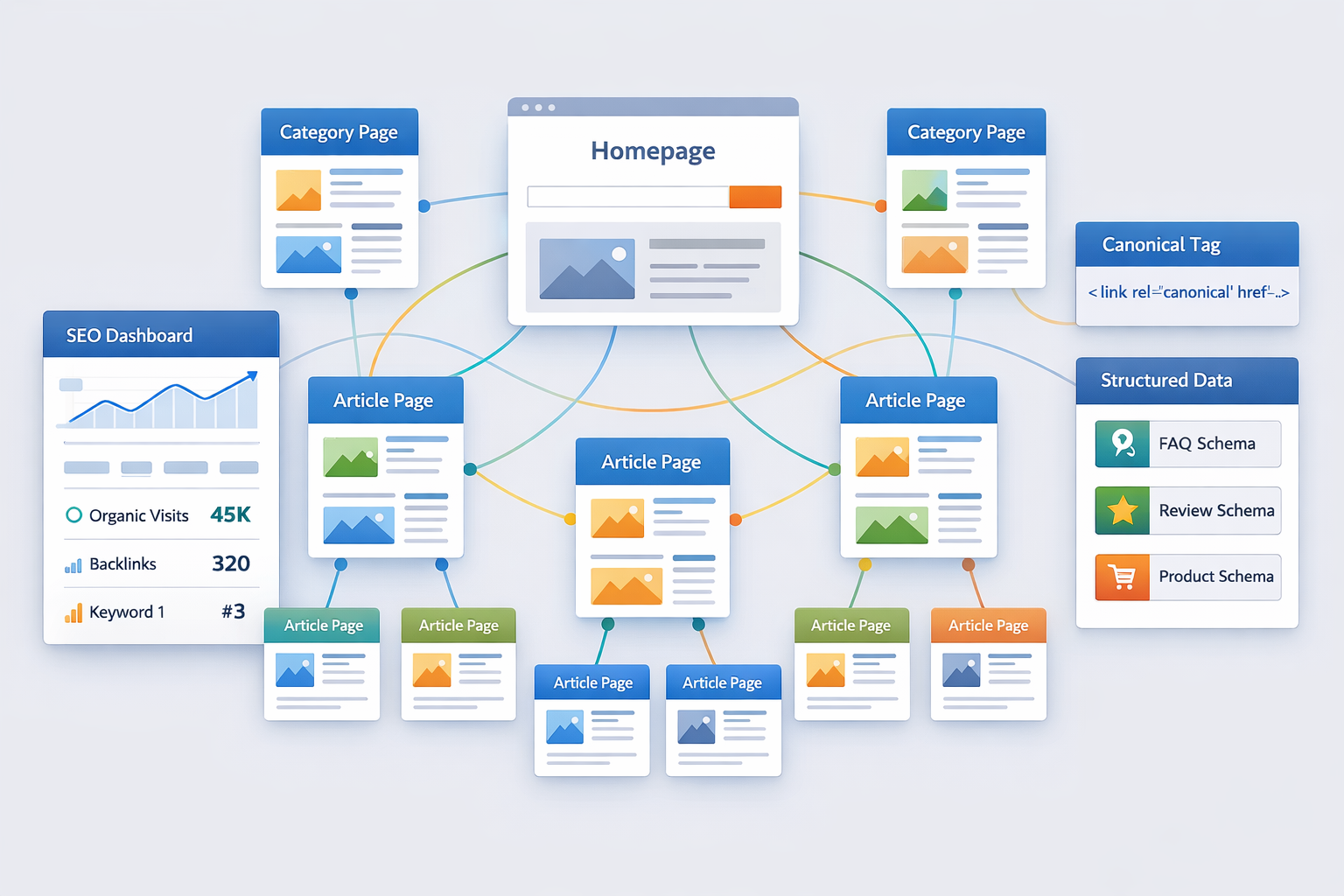
Internal linking is more than navigation; it’s a signal about topic authority, content relationships, and crawl priority. At scale, automation helps you implement a consistent linking framework across tens or hundreds of thousands of pages without bottlenecks. The benefits extend beyond rankings: improved user experience, better crawl efficiency, and more predictable distribution of link equity across hub pages and satellites.
Key benefits of a scalable approach include:
- Accelerated indexing and crawl budget utilization through intentional hub-and-spoke structures.
- Consistent anchor-text usage aligned with topic clusters, reducing ambiguity for search engines.
- Fewer orphan pages and improved discovery of new or updated content.
- Reduced manual effort and faster onboarding for new teams or brands within the same tooling.
Beyond linking, automation supports site-wide SEO goals by coordinating with structured data and metadata. This ensures that internal links work in concert with schema tagging and canonical URL strategies to improve overall page quality signals for search engines.
The Role of Structured Data and Metadata at Scale
Structured data and metadata are the semantic backbone that helps search engines understand page purpose, content type, and relationships. When scaled, schema tagging and metadata optimization must be consistent across thousands of templates and content types. Automation helps enforce schema templates, reduce drift, and ensure that every page carries the right JSON-LD blocks, breadcrumb trails, and article or product schemas as appropriate.
Scale requires templates rather than ad-hoc tagging. A well-designed schema strategy includes:
- Hub-and-spoke schemas for content clusters (e.g., pillar pages with child articles).
- Consistent breadcrumb schemas that reflect your taxonomy and navigation paths.
- Product, article, FAQ, and how-to schema variants tailored to content type.
- Metadata optimization, including title tags, meta descriptions, and canonical management, synchronized with internal linking rules.
Automation should also guard against schema duplication and conflicting metadata. Regular validation using a JSON-LD validator and schema auditing routines is essential, especially when teams scale across regions or languages.
Governance and Ownership for Scale
Automation without governance leads to drift. A scalable program requires clear ownership, documented standards, and periodic audits. Consider the following roles and responsibilities:
- Content Architect: Defines taxonomy, clusters, and hub pages.
- SEO Operations Lead: Oversees linking rules, canonical URL strategy, and schema templates.
- Content Editors: Applies automated recommendations while preserving brand voice.
- Engineering/Platform Owner: Maintains integration points, validation pipelines, and performance considerations.
Governance also extends to policy and compliance. Always provide a human-in-the-loop review for critical changes, and maintain a changelog that documents why every link or schema adjustment was made. For policy details, see the Disclaimer and Terms pages linked in this article.
Automation Blueprint: 8 Key Steps
1) Audit and Baseline
Start with a comprehensive crawl to map existing internal links, anchor text distribution, page authority, and schema coverage. Identify orphan pages, under-linked content, and pages with conflicting metadata. This baseline informs your future targeting and KPI tracking.
2) Define Clusters and Pillars
Create topic clusters anchored by pillar pages. Each pillar should have a defined set of related articles, product pages, and resources. The linking strategy should reinforce the pillar’s authority while enabling efficient discovery of related content.
3) Establish Linking Rules
Document rules for anchor text, link depth, and link refresh cadence. Decide on anchor text variations for different contexts (navigational vs. editorial links) to avoid keyword stuffing and maintain a natural user experience.
4) Design Schema Templates
Define JSON-LD templates for each content type, including breadcrumbs, article, FAQ, and product schemas. Ensure templates reflect your taxonomy and hub structure, and plan for multilingual variants where applicable.
5) Metadata and Canonical Planning
Align title tags, meta descriptions, and canonical URLs with your linking strategy. Canonical tags should reflect the primary content on a page, while internal links guide users and crawlers to the most authoritative versions.
6) Automate with Guardrails
Implement automation that generates internal links based on defined clusters and tag completion status. Include safeguards to prevent over-linking, ensure no broken links, and validate schema blocks on publish. Use human-in-the-loop checks for edge cases.
7) Publish and Validate
Publish targeted updates in controlled batches. Use validation dashboards to verify link integrity, schema validity, and metadata correctness. Periodically run automated checks to catch drift or errors before they impact users or crawl budgets.
8) Monitor, Learn, Iterate
Track metrics like crawl rate, index coverage, page authority distribution, and SERP performance. Use insights to refine clusters, adjust anchor strategies, and improve template robustness over time.
For detailed policy and compliance references, visit our Disclaimer and Terms and Conditions pages.
Technical Patterns: Linking, Canonical URLs, and Schema
Adopt proven patterns that scale across thousands of pages without sacrificing quality. Consider hub-and-spoke linking, where pillar pages link to cluster articles and vice versa in a controlled manner. Use contextual internal links within body content to reinforce relevance while avoiding over-optimization.
Canonical URL management should align with your content architecture. When multiple pages share similar topics, ensure the canonical points to the most authoritative version. This reduces duplicate content signals and concentrates authority where it matters most.
Schema tagging should be modular. Build reusable JSON-LD blocks that can be dropped into new templates, ensuring consistency across pages. Use hub-based schemas for content clusters, and adapt product or FAQ schemas to specific page types as needed.
Execution tips:
- Leverage templates to enforce consistent breadcrumb and article schema across sections.
- Prefer semantic anchor texts that reflect topic intent rather than generic navigation phrases.
- Validate each publish with automated checks for broken links and schema validity.
During scale, it helps to maintain a living style guide that documents preferred anchor terms, taxonomy naming, and schema usage to avoid drift across teams.
Measuring Success: Metrics and Dashboards
Track both process KPIs and business outcomes to ensure the automation delivers tangible value. Possible metrics include:
- Indexing rate and crawl budget utilization per site region or language.
- Link equity distribution across pillar pages and clusters.
- Schema coverage percentage by page type and language.
- Canonical consistency and 404/redirect error counts.
- Time-to-publish for updates and rate of change in crawl activity.
Build dashboards that combine site health signals with content performance. Regularly review results with stakeholders, and adjust targets as your catalog grows or language coverage expands.
Common Pitfalls and How to Avoid Them
Automation can backfire if governance is weak. Some common issues include over-linking, anchor-text dilution, schema drift, and canonical mismatches. Combat these with guardrails, human reviews for critical changes, and ongoing validation tests. Also ensure accessibility considerations are baked into linking strategies so that navigation remains usable for all visitors.
Another risk is performance overhead from complex automation pipelines. Design lightweight validation steps and monitor impact on CMS publish times. If you see latency, decouple heavy checks from live publishing and run them in a staging environment before deployment.
Implementation Plan: A Practical Roadmap
Here’s a six- to eight-week plan that organizations can adapt. Each week builds on the previous one, with measurable milestones to keep the project on track.
- Weeks 1-2: Audit and Strategy—Complete baseline crawl, map taxonomy, identify pillar pages, and define clusters. Establish governance roles and success metrics.
- Weeks 3-4: Template Creation—Develop linking rules, schema templates, and metadata standards. Create a pilot set of pillar pages with initial cluster links and JSON-LD blocks.
- Weeks 5-6: Automation Build—Implement automated linking rules, template injections, and validation checks. Run a staged publish to validate output without affecting live pages.
- Weeks 7-8: Scale and Monitor—Expand to additional sections, implement dashboards, and establish a regular audit cadence. Iterate based on performance data.
For reference policies and compliance, see the Disclaimer and Terms.
Conclusion and Next Steps
Scale is attainable when you combine a solid architecture with disciplined governance and automation that respects user experience. By automating internal linking alongside structured data and metadata, you can improve crawlability, ensure consistent on-page signals, and accelerate site-wide SEO improvements.
If you’re ready to explore how a scalable automation approach could work for your site, start with a staged assessment of your pillar architecture and content clusters. By aligning linking, schema, and canonical strategies, you can unlock more predictable growth across search engines and users alike. For policy and terms details, visit our Disclaimer and Terms pages.