Real-Time Research Workflows for Content
Introduction
In today’s fast-moving content ecosystem, data credibility and freshness are not optional extras—they are core signals that influence search rankings, reader trust, and engagement. Real-Time Research Workflows for Content provides a practical blueprint for sourcing live data, securing expert quotes, and updating content dynamically at scale. The goal is to help content teams maintain accuracy, demonstrate authority, and sustain SEO performance without sacrificing efficiency.
This guide blends process design, governance frameworks, and concrete tooling patterns so you can build repeatable pipelines that deliver fresh, credible content. You’ll learn how to structure data signals, automate sourcing, embed citations, and maintain brand voice across multiple channels and platforms.
Why Real-Time Research Matters
Credibility is a competitive differentiator in content. Readers expect fresh statistics, current expert opinions, and up-to-date references. When a piece demonstrates live data and transparent sourcing, it earns higher engagement, longer time on page, and better chances of earning authoritative backlinks.
For SEO, search engines increasingly reward content that aligns with real-world signals. Real-time data can also unlock opportunities for featured snippets, rich results, and improved coverage of niche trends. By instituting real-time research workflows, teams reduce the risk of outdated claims and improve overall content quality.
The approach described here is designed for teams that publish at scale across WordPress, Webflow, and Shopify, while maintaining governance and brand standards. It emphasizes repeatable processes, not one-off genius moments.
Workflow Architecture: The Blueprint for Real-Time Research
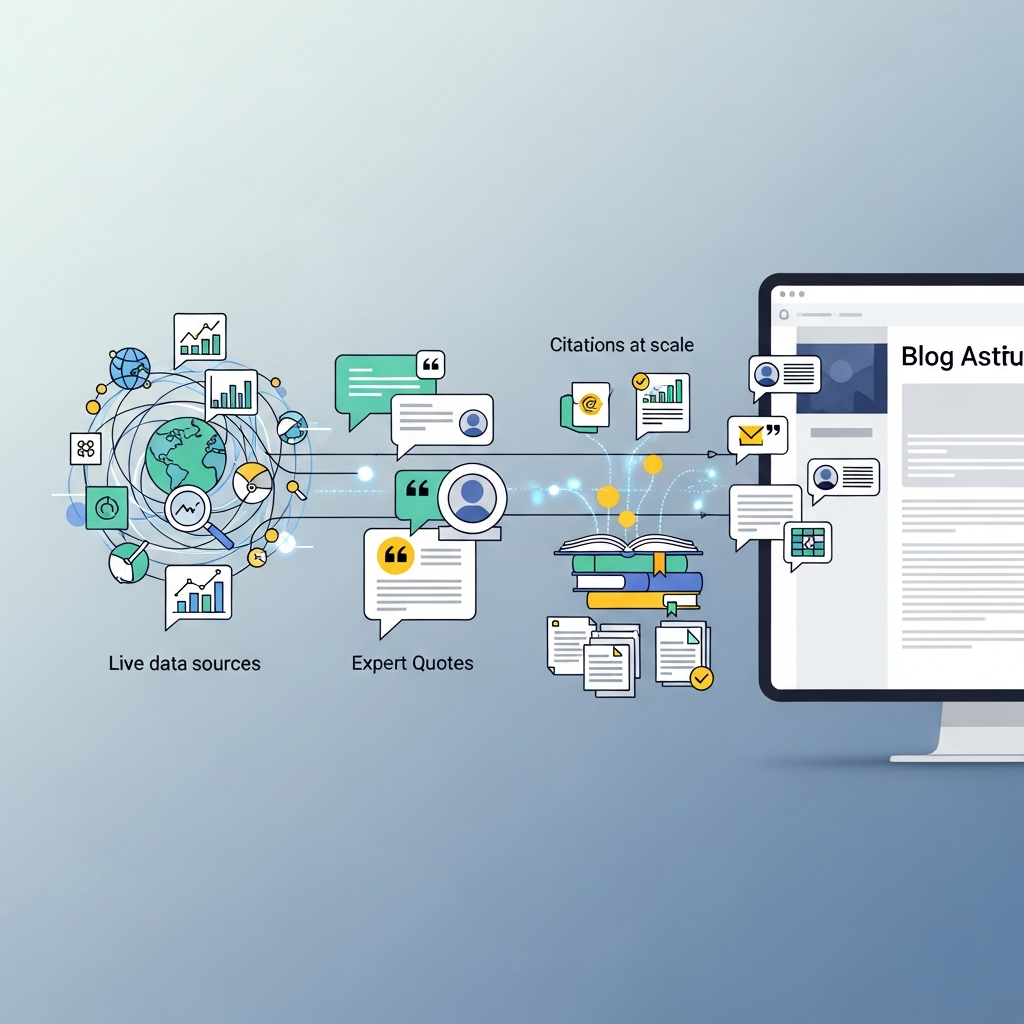
A robust real-time research workflow rests on three pillars: signals (data sources), signals processing (fetching, validating, and normalizing data), and signals presentation (how data and quotes are surfaced in content). When combined, these pillars enable continuous improvement without sacrificing quality control.
The architecture outlined here supports multiple content formats and channels, allows governance over data provenance, and scales with your publishing velocity. It’s intentionally modular so teams can plug in or swap data sources as the landscape evolves.
Core components
- Data signals catalog: a catalog of data types (statistical figures, market indicators, benchmarks, etc.) with source metadata and update cadence.
- Data ingestion layer: automated adapters that fetch data from APIs, spreadsheets, government portals, industry reports, and credible think tanks.
- Validation and normalization layer: rules to verify accuracy, handle units, date formats, and outliers; standardize naming conventions.
- Attribution and quotes store: a central repository for expert quotes, with licensing, permissions, and citation rules.
- Content integration layer: templates and CMS hooks to render updated data and quotes in content assets with proper bylines and timestamps.
Sourcing Live Data at Scale
Real-time data is only as valuable as its trustworthiness. Start by defining the data signals most relevant to your audience and content goals. Build a lean data-signal catalog that prioritizes accuracy, freshness, and licensing clarity.
Step-by-step data sourcing plan
- Identify signal candidates: public statistics, industry benchmarks, transactional data, and user-generated insights relevant to your niche.
- Choose primary sources: official statistics portals, peer-reviewed journals, and credible industry bodies. Document source authority and update frequency.
- Set update cadences: real-time for some metrics, daily or weekly for others; align with your editorial calendar.
- Automate data retrieval: leverage APIs or scheduled exports; implement robust error handling and retries.
- Validate and normalize: unit consistency, date formats, and currency normalization; maintain version history.
- Annotate provenance: store source URL, access date, and license status with every data point.
Practical data sources include public APIs (e.g., government statistics portals, financial market data, health indicators), credible third-party datasets, and partner feeds. Establish SLAs with data providers and document any licensing restrictions to avoid reuse issues.
A well-structured ingestion pipeline minimizes manual work. Consider using a lightweight ETL (extract-transform-load) approach that feeds directly into your content briefs or CMS-ready data objects.
Integrating Expert Quotes and Citations
Expert quotes can elevate credibility when used responsibly. The key is to obtain permission where needed, attribute properly, and embed quotes in a way that complements the narrative rather than interrupting it.
Best practices for quotes and attribution
- Source quality: prioritize recognized subject-matter experts and primary researchers. Keep a roster of preferred sources with contact information and licensing notes.
- Permission and licensing: track licenses, usage rights, and expiry dates. Use paraphrasing where permissible and quote only as allowed by the license.
- Attribution: include the author name, affiliation, and date of the quote when possible. Link to the source where appropriate and allowable.
- Context and stitching: integrate quotes into the story arc of the article. Avoid over-quoting; let data points and quotes reinforce key takeaways.
- Editorial consistency: maintain a consistent tone with your brand voice while presenting quotes in a readable, scannable format.
A practical approach is to maintain a quotes library linked to your data signals. When a data point updates, you can pair it with a relevant expert quote to provide interpretation and authority. Always verify the recency of quotes alongside the data they accompany.
Data-Driven Content Updates
Updates should be seen as a feature, not a one-off chore. Designing an ongoing update cadence helps ensure content remains fresh and credible. The objective is to minimize manual rework while preserving editorial control and brand consistency.
How to implement a content update cadence
- Define update triggers: data thresholds, time-based cadences, or event-driven changes (e.g., a new fiscal quarter alters benchmarks).
- Automate update workflows: set up tasks that fetch data, re-run validations, and surface updated figures in the article outline.
- Preview and governance: require reviewer sign-off for visual changes, data shifts, and new quotes.
- Versioning and history: maintain a changelog for content updates to support transparency and auditing.
Present updates transparently by annotating the latest revision date, citing sources, and offering readers a quick “what changed” summary. This approach helps maintain trust and supports long-tail SEO by signaling ongoing relevance.
Governance, Quality, and Risk Management
Real-time research introduces data variation and sourcing complexity. A strong governance model ensures accuracy, protects against misinterpretation, and sustains brand integrity across channels.
Governance framework essentials
- Data provenance policy: document sources, licensing, and update cadence for every data class.
- Content briefs with data standards: templates that require citations, data units, and timestamped figures.
- Quality assurance gates: automated checks plus editorial review before publication.
- Auditability: maintain records that support future verification and potential audits.
To minimize risk, decouple data presentation from editorial narrative where possible. Use clear callouts for data points, include dates, and maintain a steady cadence for refreshing content.
Tools, Playbooks, and Checklists for Real-Time Research
A practical stack for real-time workflows combines data ingestion, validation, content authorship, and governance tools. The objective is to keep the process repeatable, auditable, and scalable.
Suggested tooling categories
- Data ingestion and ETL: lightweight connectors, API clients, scheduled jobs.
- Validation and normalization: schema validation, unit conversions, and anomaly detection.
- Quotes management: licensing trackers, quote library, attribution tooling.
- Content integration: CMS templates, dynamic blocks, and inline data widgets.
- Governance and workflow: version control, review queues, and dashboards for KPIs.
Build a playbook that includes data signal definitions, sourcing rules, validation checks, and editorial review steps. Provide a lightweight “how to” for new team members to minimize ramp time.
Real-World Scenarios and How Real-Time Research Helps
While each organization has unique data needs, several common patterns emerge when teams adopt real-time research workflows. Consider these scenarios as templates for your own content pipelines.
Scenario A: A SaaS growth post refreshed with monthly benchmarks
A growth team publishes monthly articles comparing product adoption benchmarks across regions. Live data pulls from official statistics portals and product usage metrics are incorporated with a clear timestamp. Expert quotes provide interpretation, and the piece is updated when new data arrives, maintaining a consistent voice through a governance layer.
Scenario B: A shopping brand refreshes product guides with current pricing and availability
E-commerce teams integrate live price bands and stock levels to ensure accuracy. Quotes from industry analysts are included to frame pricing trends. Updates trigger automatic reviews to ensure consistency with brand messaging and regulatory requirements.
Implementation Roadmap: How to Start in 90 Days
A structured rollout reduces risk and accelerates time-to-value. The roadmap below outlines phases, milestones, and outcomes that teams can adapt to their org size and publishing velocity.
Phase 1 — Foundation (Weeks 1-4)
- Define data signals and sources; create a living data catalog.
- Set up ingestion adapters and validation rules; establish data governance basics.
- Create templates for data-driven content briefs and citations.
Phase 2 — Automation (Weeks 5-8)
- Implement automated data pulls and content renderers in CMS templates.
- Build a quotes library with licensing and attribution workflows.
- Integrate automated QA checks and sign-off steps.
Phase 3 — Scale and governance (Weeks 9-12)
- Expand signals to additional domains; refine update cadences.
- Establish consistent brand voice across modules and formats.
- Deploy dashboards to monitor data freshness, accuracy, and ROI signals.
Pitfalls to Avoid and Best Practices
Real-time research is powerful but can become risky if not managed carefully. Common pitfalls include over-automation without governance, citing questionable data sources, and presenting data without proper context. The best practices below help mitigate these risks.
- Always verify data claims against primary sources; avoid cherry-picking inferences.
- Document licensing and permissions for every quote and figure used.
- Maintain transparency about update dates and data versions.
- Use a staged publishing process so updates are reviewed before going live.
Next Steps: Turn Real-Time Research into Real Results
Ready to implement real-time research workflows at scale? Start by mapping your data signals and selecting a few high-impact sources. Build a lightweight data catalog, automate a basic ingestion-validation loop, and pair data changes with a small set of editor-approved templates. As you gain confidence, expand to more sources, add quotes, and increase your cadence.
If you’re evaluating platforms or consulting partners, look for capabilities like API-based publishing, cross-platform CMS support, and a governance framework that keeps brand voice intact while enabling rapid updates. A well-designed workflow reduces risk and accelerates growth by delivering credible, data-backed content to your audience.