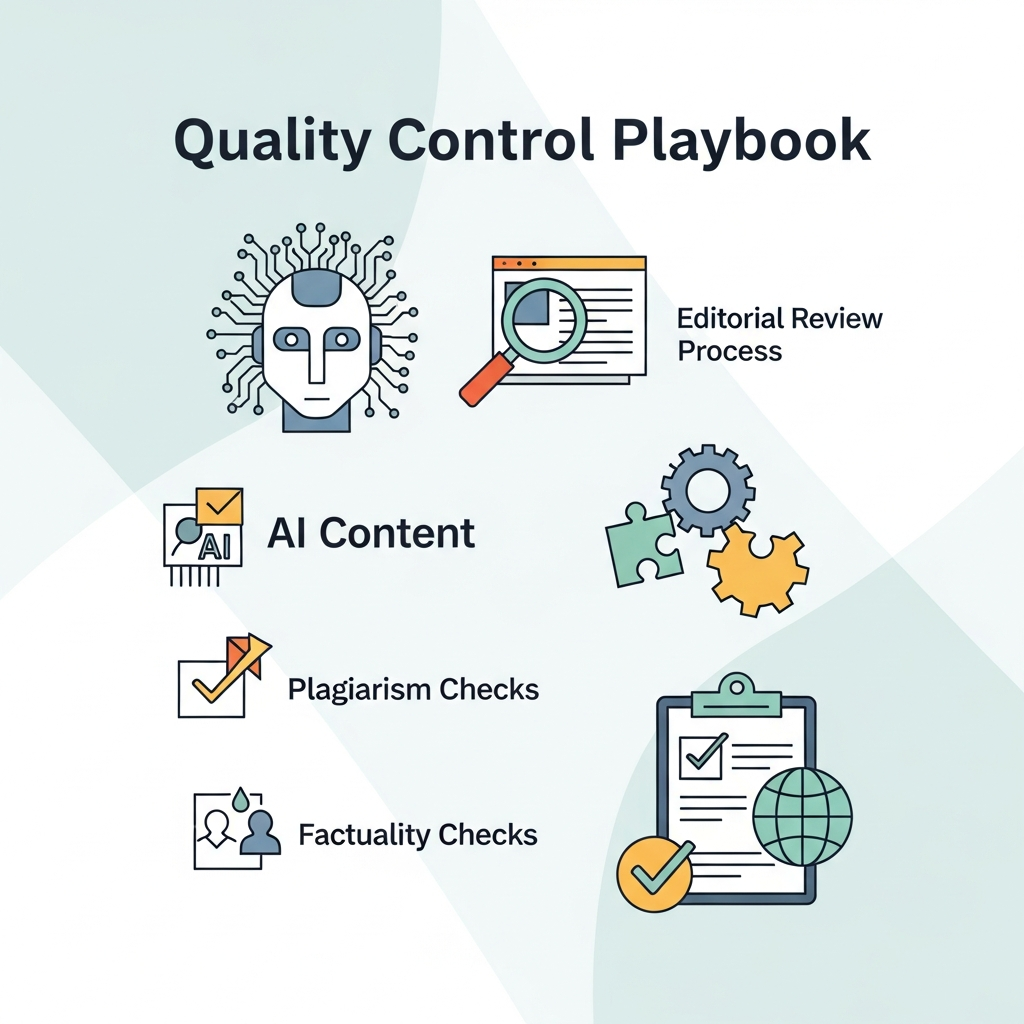
Quality Control Playbook: AI Content Quality Checklist for Pre-Publish QA
Framework: Plan, Validate, Iterate
The AI content quality checklist is built around a simple but effective framework: Plan, Validate, Iterate. This ensures that AI-assisted writing aligns with brand voice, factual accuracy, and technical SEO standards before going live.
Plan: Define the article’s intent, audience, and key takeaways. Map out the required checks: editorial review, factual verification, plagiarism, schema and meta, accessibility, localization, and internal linking. This stage also establishes the human in the loop touchpoints and sign-off criteria.
Validate: Execute checks with lightweight reviews and automated tooling. Capture issues with clear severity levels and owners. Validate not only that the content is correct, but that it adheres to brand guidelines and publishing templates.
Iterate: Close the loop with fixes, re-checks, and final approval. Maintain a living playbook that evolves with new content formats, languages, and publishing channels.
Key terms to remember in this workflow include the AI content quality checklist, the editorial review process, the plagiarism and factuality checks, and the schema and meta optimization requirements. Integrating these concepts early reduces risk and accelerates go-live timelines.
Pre-Publish Checks: A Step-by-Step Route
Use this structured route to ensure every AI-generated article meets publishing standards. Each step has practical actions, ownership notes, and expected outcomes.
-
Clarify intent and audience — Confirm the article’s purpose, target readers, and intended platform. Record a short brief and verify alignment with the editorial calendar.
- Outcome: A documented brief that guides the remaining QA steps.
-
Editorial alignment — Review tone, voice, and brand alignment. Ensure terminology matches internal style guides and that the piece fits the host site’s audience expectations.
- Tools: In-house style guide, glossary, and templated voice samples.
-
Factuality checks — Validate facts, figures, dates, and names. Cross-check with reliable sources and, where possible, cite sources directly in the content.
- Mechanism: Quick fact-check rubric with at least two independent references.
-
Plagiarism and originality — Run a plagiarism scan and review any overlaps. Confirm that ideas and language are sufficiently original or properly attributed.
- Threshold: Set an acceptable similarity percentage (e.g., under 15% with attribution where needed).
-
Schema and meta optimization — Ensure proper structured data usage (Article, Breadcrumb, Organization). Verify canonical URL and ensure meta title and description reflect page content and primary keyword intent.
- Checklist: meta title length, keyword density within natural language, and open graph data.
-
Internal and external linking — Audit links for relevance and value. Ensure internal links enhance crawlability and that external links point to reputable sources.
- Best practice: Use contextual links and avoid overlinking in a single paragraph.
- Accessibility and readability — Check headings structure, paragraph length, alt text for images, and mobile readability. Ensure the article is accessible to a broad audience.
- Localization readiness — If multilingual, verify translations or localization notes and ensure consistent terminology across markets.
- Publish readiness sign-off — The content owner signs off, and the content is queued for publication on the CMS with the appropriate publishing schedule.
Internal links to our policy pages and terms can serve as a reference for standards. For example, visit the homepage for a quick overview of our publishing framework, or consult our disclaimer and terms when evaluating policy alignment.
Editorial Alignment: The Editorial Review Process
A robust editorial review process ensures the content remains on-brand, accurate, and useful. Establish a multi-step review path that includes a content author, a primary editor, and a quality gate before publication.
Checklist for editorial review
- Brand voice and terminology aligned with the style guide.
- Clarity of the argument and logical flow from introduction to conclusion.
- Consistency in headings, bullets, and callouts to aid skim-reading.
- Appropriate use of multimedia (images, charts, captions).
Document the final approval and include a note about any remaining caveats or pending edits. This creates a clear trail for accountability and future audits.
Factuality Checks: Verifying Truth in AI-Generated Content
Factual accuracy is a non-negotiable aspect of quality control. Use a layered approach to factual checks that scales with content volume.
Recommended steps
- Cross-reference key claims with primary sources and data sets.
- Annotate where numbers come from and include citations when possible.
- Flag any statements that require time-sensitive verification and schedule a follow-up check.
When in doubt, pause publishing and escalate to a subject-matter expert for final review. This reduces the risk of misrepresentation and misinformation.
Schema and Meta Optimization: Structuring for Search and Snippet Richness
Structured data helps search engines understand content context and improves how pages appear in results. Ensure the following are in place for every article:
- Article schema with author, datePublished, wordCount, and publisher information.
- Breadcrumbs reflecting site hierarchy for better navigation signals.
- Canonical URL to prevent duplicate content issues.
- Meta title and description tailored to the content and primary keyword.
- Image alt text that describes visuals and reinforces topic relevance.
Schema completeness is a high-leverage area; even small gains here can improve click-through and indexing speed.
Human in the Loop Editing: Why People Still Matter
Automated content can accelerate production, but human oversight ensures nuance, brand fidelity, and accountability. Implement a human in the loop strategy that blends AI efficiency with human judgment at key decision points.
- Initial draft generation by AI with a human editor supervising tone and structure.
- Second-pass review for factual accuracy and stylistic polish.
- Final approval by a content owner or subject-matter expert before publication.
This approach helps maintain trust with readers and protects against editorial drift over time.
Practical Checklists and Mini Frameworks
Inline QA checklist (ready-to-use)
- Purpose and audience clearly stated
- Brand voice consistency verified
- Fact checks completed with sources cited
- Plagiarism scan passed with acceptable similarity
- Schema, meta title, and meta description present and aligned
- Canonical URL set and no broken links
- Alt text present for all images
- Accessible formatting and readable length
Adapt this checklist per team needs and publish only after a green-light review.
Implementation Guide: Embedding the Playbook into Your Workflow
Turn this playbook into a living, documented process within your content operations. Start with the most impactful checks and scale gradually.
- Assign owners for each QA stage and set SLA targets for reviews.
- Integrate automated checks (plagiarism, schema validation, meta tag checks) into the CMS publishing workflow.
- Schedule periodic audits of published content to identify and correct drift.
- Train editors and writers on the QA framework and provide quick reference sheets.
For practical insights on how a scalable QA system can operate, explore additional resources at our homepage and review our policy pages disclaimer and terms.
Notes, Resources, and Next Steps
This playbook is designed to be pragmatic and adaptable. Use it as a baseline, then tailor it to your domain, editorial cadence, and publishing stack. Consider integrating it with a dedicated QA tool or your existing editorial workflow to maximize consistency and speed.
If you’re looking for a turnkey solution that aligns content quality with SEO readiness, explore how AI-assisted content workflows can fit your team. See the examples and case studies on our site for reference to practical outcomes and ROI implications.
Internal links to important policy pages help reinforce governance and standards across your site: