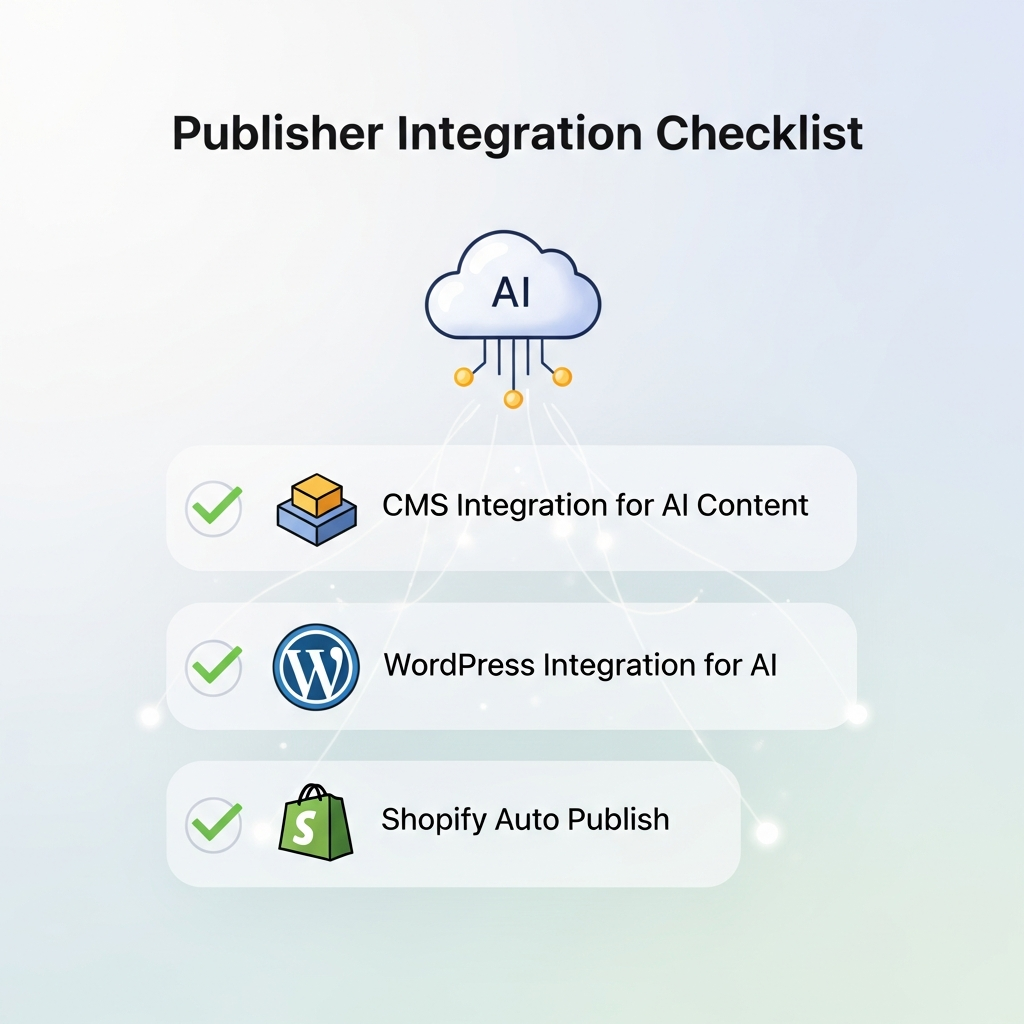
CMS Integration for AI Content: Publisher's Technical Checklist
Why CMS integration matters for AI content
AI-generated content can accelerate production, extend reach, and maintain a consistent brand voice. But without a well-planned CMS integration, you risk misalignment between content creation, approval workflows, publishing timing, and on-page SEO signals. A robust integration ensures that AI content moves smoothly from generation to publication, while preserving governance, security, and performance goals.For publishers, agencies, and brands, the payoff comes from a unified system that combines content generation, editing, formatting, and one-click publishing to multiple CMS platforms. This enables faster go-to-market, scalable multilingual support, and better alignment with editorial calendars. The goal is to reduce manual toil, not introduce new points of failure.
Architecture options for AI content publishing
There is no one-size-fits-all approach. The right pattern depends on your existing stack, compliance requirements, and the frequency of publishes. Here are three common architectures you might consider.
- Push-based API publishing: AI content is generated in a content engine and pushed to the CMS via an API. This is fast and deterministic, ideal for real-time updates and high-frequency publishing.
- Middleware or middleware-as-a-service: An orchestration layer translates AI output into CMS-ready blocks, handles asset management, and routes content to multiple CMSs (WordPress, Shopify, custom CMS). Great for multi-site publishers.
- Headless CMS with editorial overlay: Content is authored in a headless system, then rendered via APIs into CMS front-ends. This approach emphasizes structured data, schema markup, and cross-channel distribution.
Trade-offs you should consider
Each architecture has strengths and trade-offs around latency, governance, and complexity. Push-based systems offer speed but require tight API governance and security controls. Middleware provides orchestration and easier scale but adds another layer to manage. Headless approaches maximize structure and flexibility but may demand more upfront integration work. Align your choice with editorial cadence, security posture, and available engineering resources.
Data flow and content lifecycle
A well-defined data flow ensures that every AI-generated artifact moves through a repeatable lifecycle: creation, review, enrichment, validation, publishing, and archival. A clean lifecycle supports rollback, audit trails, and compliance with content standards.
- : AI writes draft content, metadata, and media assets, tagged with intent, audience, language, and brand voice.
- Editorial review: human editors or automated validators check for accuracy, bias, and tone against a brand guide.
- Enrichment: auto-add structured data, alt text for images, canonical URLs, and internal links guided by an AI-assisted linking engine.
- Validation: QA checks on formatting, SEO fields, and CMS field mapping; content passes through governance gates before publishing.
- Publishing: content is published to one or more CMS targets, with versioning and scheduling aligned to editorial calendars.
- Archival: outdated or superseded content is deprecated and redirected as needed.
Content mapping and field alignment
Key tasks include mapping AI output to CMS fields (title, meta description, slug, tags, hero image, body blocks) and ensuring media assets are uploaded and linked correctly. A reliable mapping layer abstracts CMS-specific quirks and ensures consistency across WordPress, Shopify, and custom CMSs.
Security, governance and access control
CMS integrations for AI content demand rigorous security. Treat API keys like secrets in a vault, enforce IP allowlists, rotate credentials regularly, and enforce least-privilege access for service accounts. Audit trails should capture who published what, when, and through which channel. Consider role-based approvals for drafts that reach production, and implement content-review gates to prevent accidental leakage of confidential material.
Authentication and authorization
Use OAuth or token-based systems with short lifetimes. Rotate keys, restrict scopes, and monitor usage anomalies. For multi-site setups, centralize credential management to simplify revocation during staff changes or vendor transitions.
Data privacy and compliance
Respect data locality, encryption at rest and in transit, and data retention policies. If your AI workflows ingest customer data, ensure anonymization and minimization practices are in place before content generation occurs.
Publishing to WordPress, Shopify, or a custom CMS
WordPress and Shopify have different content models. A robust integration abstracts these differences so editors can publish consistently across platforms. Pay attention to content blocks, schema, image handling, and URL structures to preserve SEO value and user experience.
WordPress-specific considerations
Map AI blocks to Gutenberg blocks or classic editor fields, ensure featured image handling and alt text, and manage slugs and canonical URLs. Use post types that align with your editorial workflows, and consider scheduled publishing for seasonal campaigns.
Shopify-specific considerations
Product and collection pages require careful alignment of product descriptions, rich content, and metadata. Ensure that AI-generated content respects product taxonomy, image assets, and metafields. If publishing blog content, respect Shopify's content blocks and page templates to maintain consistency.
Custom CMS considerations
Custom CMSs often need a tailored mapping layer. Define a schema for content entities, support for multilingual content, and a reliable media pipeline. A well-defined API contract reduces back-and-forth between content creators and developers.
Internal linking, schema markup and SEO at scale
Automated internal linking and structured data are essential for crawlability and search performance. Implement rules to suggest internal links based on topical relevance and hierarchy. Inject schema.org markup for articles, FAQs, and product pages where applicable. Maintain canonical URLs and avoid duplicate content by harmonizing page versions across CMSs.
- Automated internal linking should respect site structure and noindex pages.
- Schema types to consider: Article, WebPage, Organization, Organization and OrganizationContact if relevant.
- Ensure canonical URLs reflect preferred versions and language variants.
Localization and brand voice at scale
Global brands require multilingual content without sacrificing tone. Use AI to draft translations with human-in-the-loop quality checks, and enforce brand voice through glossaries and style guides. Establish language-specific templates and SEO metadata that align with local search intent.
Localization workflow patterns
Two common patterns include automated translation with editorial review and bilingual content pipelines where human editors validate machine-generated variants. Both rely on a central glossary to keep terminology consistent across locales.
Quality assurance, safety, and compliance
Quality controls are critical when publishing AI-generated material. Establish editorial gates, plagiarism checks, factual verification, and tone audits. Maintain guardrails around sensitive topics, regulatory content, and customer data usage. Regularly review generated content against a living content guideline to adapt to changes in policy or brand strategy.
Practical QA steps
- Run AI content through a fact-check pass for claims that could be time-sensitive or high-stakes.
- Check for bias, inclusivity, and respectful language aligned with brand values.
- Verify SEO metadata, canonical URLs, and image alt texts before publishing.
Step-by-step implementation checklist
Use this practical checklist to move from concept to production with confidence. Each step should map to a milestone in your growth plan.
- : establish roles, approvals, and published content standards. Create a publisher playbook that describes who signs off at each stage.
- : select a push, middleware, or headless pattern based on your stack and team capabilities.
- : inventory all CMS fields used across WordPress, Shopify, and any custom CMS to align with AI outputs.
- : implement key rotation, access controls, and audit logging before any data leaves your environment.
- : create reusable templates for articles, product pages, and landing pages to accelerate publishing.
- : schedule publishes in alignment with editorial calendars and marketing campaigns.
- : introduce automated checks and manual review steps as appropriate.
- : start with one CMS (e.g., WordPress) and a limited content type, then scale.
- : track publishing latency, errors, and SEO performance to guide enhancements.
Vendor selection, tooling, and roadmap
When evaluating tools, prioritize CMS compatibility, API reliability, white-label options for agencies, and transparent analytics. Compare integration depth for WordPress, Shopify, and any custom CMS. Ensure your vendor provides robust onboarding, detailed SLAs, and clear data-handling policies. Build a phased roadmap that starts with core content types and expands to multilingual, multi-site publishing, and advanced schema automation.For governance and legal considerations, review licensing terms and data usage policies in the Terms and Conditions page. You can read the official terms here: Terms and Conditions.Additional guidance and disclosure can be found in our Disclaimer page: Disclaimer.
Conclusion
Integrating AI content workflows with a CMS ecosystem is a strategic capability for modern publishers. A well-designed integration reduces friction, improves publish velocity, and preserves quality and governance across WordPress, Shopify, and custom CMSs. By choosing the right architecture, enforcing strong security controls, and building a scalable content lifecycle, you unlock reliable, repeatable results at scale. Use this checklist as a practical blueprint to plan, pilot, and expand your AI publishing program with confidence.Ready to explore how to tailor this approach to your specific stack? Consider starting with a focused pilot project that targets one CMS and one content type, then expand across channels as you gain confidence and observe measurable improvements in time-to-publish, quality, and SEO performance.