End-to-End API Publishing Pipelines for Multichannel Commerce: Automate Content from Brief to Live
Why End-to-End API Publishing Pipelines Matter
In multichannel commerce, brands publish content across CMSs and ecommerce platforms with speed and consistency. An end-to-end API publishing pipeline coordinates planning, creation, validation, and deployment through programmable interfaces. It reduces manual friction, enforces brand governance, and enables per-channel optimization without redoing work for every platform.
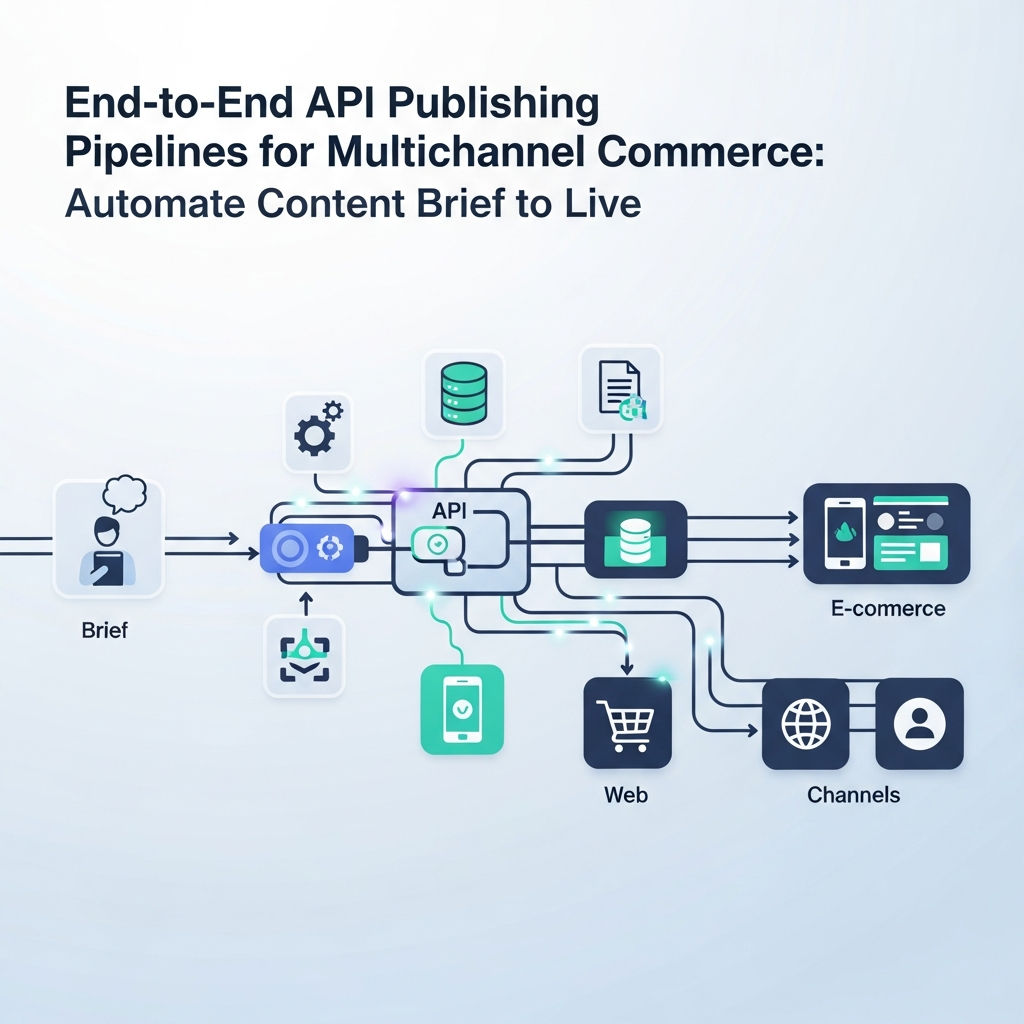
Consider a typical workflow: a new product briefing generates a set of articles, product descriptions, FAQs, and social assets. An API-driven pipeline ingests the brief, enriches content with data and quotes, validates against brand rules, and publishes automatically to WordPress, Webflow, and Shopify. The result is a synchronized, cross-platform publish that preserves voice and data integrity. This is the essence of End-to-End API Publishing Pipelines.
For growth-minded marketing teams and agencies, the payoff is tangible: faster time-to-live for campaigns, better SEO signals from consistent content across domains, and measurable ROI through reliable traffic and conversion lift. The goal is not merely automation for its own sake, but a repeatable, auditable process that scales alongside product velocity and channel expansion.
Core Components of the Pipeline
A robust pipeline rests on a few essential building blocks. Each block is designed to be independent yet well-integrated, so teams can swap in better tools without reworking the entire system.
Content planning and briefs
The planning layer translates a high-level marketing brief into structured content briefs. It defines audience personas, tone, data requirements, citation rules, and success metrics. A formal content brief becomes the input to the automation layer, ensuring consistency even as outputs scale.
API contracts and content schema
APIs require strict contracts. A content schema specifies fields like title, body, author, publish date, meta data, canonical URLs, and localization data. A shared contract reduces ambiguity between creators, editors, and automated transformers.
Generation and enrichment
Automation combines AI-assisted drafting with data enrichment. It injects statistics, expert quotes, and product specs, while preserving brand voice. Enrichment also involves asset creation, such as thumbnails, infographics, and video captions, all accessible through consistent API responses.
Validation and approval
Quality gates verify structure, tone, data accuracy, and compliance. An approval step can route content to editors or automated checks, ensuring issues are caught before publishing. Validation is not a single checkbox; it is a layered sequence of syntactic checks, semantic checks, and brand governance rules.
Planning to Publishing Automation
Effective automation starts with a plan that links inputs (briefs) to outputs (live content). This plan should define data models, transformation rules, and publish targets. A well-designed plan acts as the single source of truth for the entire pipeline.
Mini framework: the Content Cadence Canvas. This lightweight template helps teams map inputs, transformations, and outputs across channels. It includes five layers: Brief, Transformation, Validation, Publish, and Monitor. Each layer has explicit owners, SLAs, and decision criteria.
Key practices include establishing clear data contracts, versioning content schemas, and documenting failure modes. When teams disagree about a field’s format or required data, versioned contracts prevent regressions and misalignments across platforms.
Data governance and localization
Localization, localization, localization. If you publish across regions or languages, you need a localization workflow embedded in the pipeline. The plan should specify locale mappings, date formats, currency, and region-specific SEO rules so content remains relevant and compliant everywhere it appears.
Architecture Options for Cross-Platform Publishing
There are two dominant architectural patterns for cross-platform publishing: a centralized content hub and distributed publishing via direct CMS APIs. Each has trade-offs in control, speed, and complexity.
Centralized hub with per-platform adapters
A central content hub stores all content and exposes platform-specific adapters or connectors. This approach provides uniform governance and a single data model while reducing platform-specific drift. Editors work in one place, and adapters transform content to each CMS or commerce API format.
Distributed publishing across platforms
In a distributed setup, content originates in the target CMSs via API or third-party connectors. This approach can reduce latency for local edits and empower channel owners to tailor outputs, though it often requires stricter governance to prevent inconsistencies across channels.
For many brands, a hybrid model works best: a centralized canonical content model with per-platform adapters or microservices that adjust output when needed. This preserves governance while enabling platform-specific optimizations.
Automation Workflow Patterns
Patterns describe how data travels from brief to live. They influence reliability, observability, and time-to-publish.
Triggers, queues, and idempotence
Triggers react to briefs or content updates. Jobs are enqueued, ensuring backlogs don’t overwhelm systems. Idempotence guarantees repeated executions don’t duplicate content or publish conflicting versions.
Event-driven publishing and retries
Publishing events propagate to each platform. If a platform temporarily fails, the system retries with backoff, logs the fault, and escalates when necessary. This reduces data loss and keeps outputs consistent.
Observability-first monitoring
End-to-end visibility across planning, generation, validation, and publishing is essential. Dashboards should answer: What failed? Where did latency spike? Which channel is lagging? What content is overdue for publication?
Governance, Quality, and Brand Safety
Governance is the backbone of scalable content operations. It aligns brand voice, legal compliance, and data accuracy with automated workflows.
Brand voice governance
Define tone, vocabulary, and style rules in machine-readable form. Enforce these rules at every step of the pipeline—from drafting to publication—to sustain a consistent brand presence across all channels.
Quality checks and compliance
Embed checks for factual accuracy, statistics currency, and licensing requirements for quotes. Include privacy and data handling guidelines where user data appears in content or metadata.
Performance, Scale, and Reliability
Automation scales with traffic and product velocity. Plan for peak loads, API rate limits, and hardware failures without compromising content quality.
Metrics that matter
Track publish latency per channel, error rates by service, content performance metrics (traffic, dwell time, conversions), and governance compliance incidents. These metrics guide optimization and demonstrate ROI to stakeholders.
Security and access control
Protect API endpoints with authentication, least-privilege access, and audit trails. Ensure content delivery networks and caching layers don’t bypass validation steps or expose sensitive data.
Implementation Roadmap
Putting theory into practice requires a staged plan with clear milestones. Here is a pragmatic 90-day path tailored for teams aiming to publish across WordPress, Webflow, and Shopify via API.
Phase 1 — Foundations (Weeks 1-3)
- Define the canonical content model and API contracts.
- Map briefs to content briefs and design the planning workflow.
- Prototype adapters for WordPress, Webflow, and Shopify with basic publish capabilities.
Phase 2 — Enrichment and governance (Weeks 4-6)
- Implement enrichment pipelines with data sources and quotes.
- Establish brand voice rules and QA gates.
- Introduce basic observability dashboards for end-to-end visibility.
Phase 3 — Scale and reliability (Weeks 7-12)
- Introduce retries, idempotence, and error-handling policies.
- Enhance localization workflows and multi-format outputs.
- Roll out to pilot teams and collect feedback for optimization.
Pitfalls and Best Practices
Avoid common missteps that derail API publishing pipelines. Learning from these can save months of rework.
- Over-optimizing for speed at the expense of accuracy. Always validate critical facts and quotes.
- Ignoring platform-specific constraints such as Shopify rate limits or Webflow CMS fields.
- Failing to version contracts or content schemas, which creates drift across channels.
- Underestimating governance; without it, scale leads to inconsistent tone and data hygiene issues.
- Assuming a single tool fits all; adopt modular components and replace as needed without rewiring everything.
Best practices include starting with a minimal viable pipeline, investing in robust contracts, and building an operator-friendly runbook. The aim is to achieve predictability at scale with continuous improvement.
Conclusion: From Brief to Live, at Scale
End-to-End API Publishing Pipelines unify planning, generation, validation, and deployment into a cohesive, auditable flow. By treating content as a programmable asset and imposing disciplined governance, brands can publish consistently across WordPress, Webflow, and Shopify—all while maintaining voice, data quality, and SEO strength. The roadmap above is designed to help teams start small, learn quickly, and expand with confidence as channel requirements evolve.
If you’re ready to explore how to design and implement a scalable API publishing strategy for your organization or clients, consider evaluating a dedicated automation partner or platform that supports API-first publishing, content governance, and cross-platform delivery. The next step is to map your current briefs to a canonical content model and begin building adapters for your primary CMS and commerce targets.