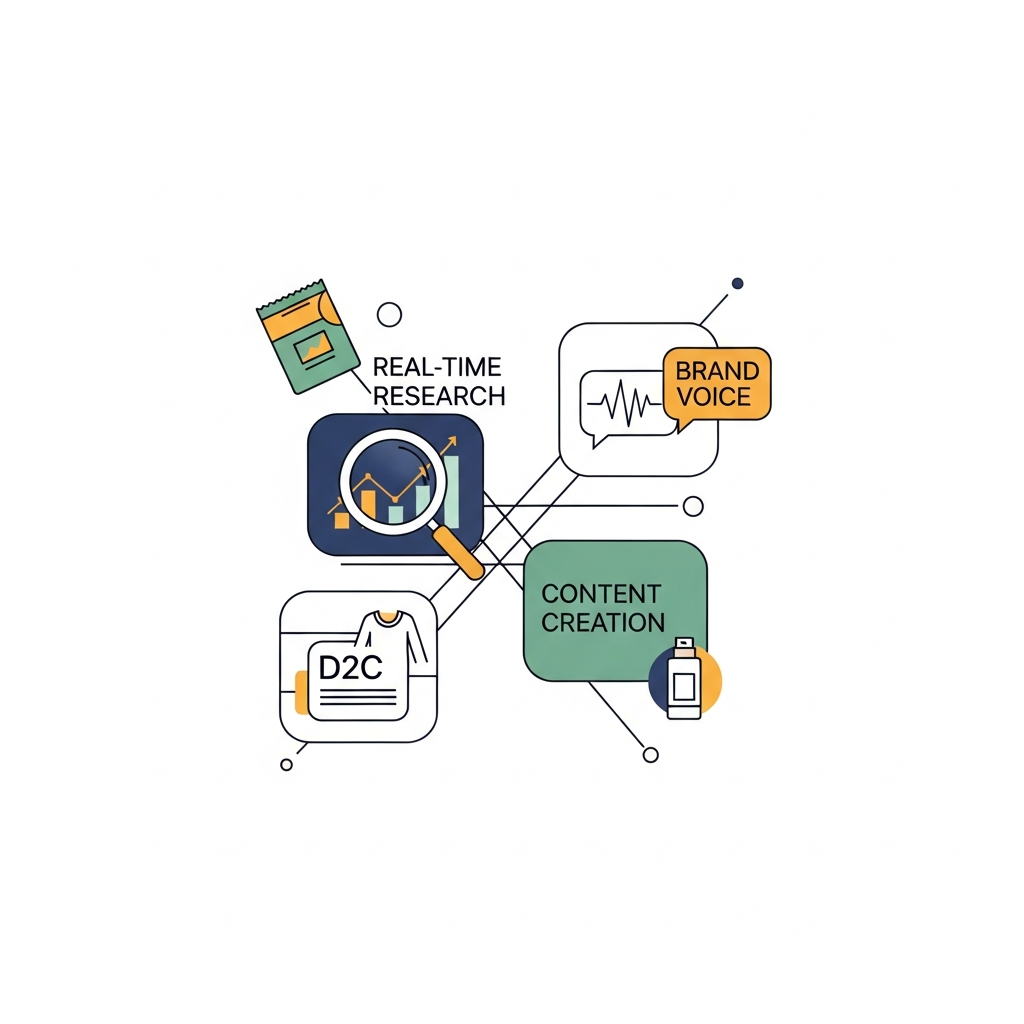
Daily Branded Content at Scale for D2C Brands: Real-Time Research, Brand Voice, and SEO
Table of Contents
Overview: What daily branded content at scale means for D2C brands
For D2C brands, daily branded content is less about volume and more about velocity with quality. The goal is to publish articles that reinforce the brand voice, provide real value to shoppers, and perform well in search. Achieving this requires a disciplined content cadence, real-time research, and automated publishing across the platforms that matter most in ecommerce—primarily Shopify and Webflow, with room for other CMS integrations as needed.
When done right, daily content becomes a living asset: it informs product pages, supports category strategies, earns backlinks, and signals authority to AI and traditional search. The framework below outlines a practical approach to build a scalable pipeline that preserves brand integrity while unlocking fast time-to-market for new products and campaigns.
Real-Time Research for Ecommerce Content
Why real-time data matters
Real-time research ensures your articles reflect the latest market dynamics, consumer questions, and product developments. Ecommerce topics move quickly—seasonal trends, new features, and competitive moves can render yesterday’s data obsolete. A real-time approach helps your content stay relevant, trustworthy, and more likely to earn favorable rankings and user engagement.
Sources and workflow
Establish a lightweight, repeatable workflow that blends three data streams: authoritative statistics and quotes, recent product updates, and user questions captured from search intent signals. Build a living content brief that updates automatically as new data arrives. Automation should pull from reliable data sources, verify the credibility of quotes, and tag information with timestamps for transparency.
A practical workflow looks like this: trigger a brief refresh when product pages update, push a prompt to the content team with the new data, auto-embed quotes or statistics where appropriate, and re-publish on the appropriate cadence. This keeps your content fresh without sacrificing quality.
Structured templates help maintain consistency. Start with a core brief: intent, audience, key questions, statistics, and a set of expert quotes. Then layer the data with a narrative that ties to product categories, current campaigns, and evergreen themes. Finally, validate with a quick QA pass focusing on accuracy, attribution, and timeliness.
Brand Voice at Scale
Governance and consistency
Brand voice governance is the backbone of scalable content. Create a living voice brief that defines tone, vocabulary, and style across categories. Use a tone matrix to map voice variations by audience segment, product category, and channel, ensuring each article remains on-brand while staying adaptable for sub-brands or regional differences.
Templates, briefs, and guardrails
Develop content briefs that translate brand guidelines into actionable requirements for writers and LLMs. Guardrails include predefined sentence structures, preferred verbs, and approved data sources. An automated feedback loop surfaces alignment issues early, reducing misfits and rework. Consider a quarterly review to incorporate evolving brand guidelines and audience feedback.
Examples of practical implementations include: a standard intro that frames a problem in one to two sentences, a mid-section that presents evidence from real-time data, and a conclusion that ties back to product value. This consistency makes scaling content easier without sacrificing nuance or personality.
SEO for Ecommerce Content
Foundations that scale
SEO for ecommerce content at scale requires a disciplined combination of topical authority, on-page optimization, and freshness signals. Start with a robust keyword framework that includes product-category topics, buyer-intent queries, and long-tail variations drawn from real-time search intent. Use this framework to guide daily briefs so every article aligns with measurable goals.
LLM optimization and schema
Leverage LLM optimization markup to improve AI search visibility. This includes structured data that helps search systems understand content type, relevance, and timeliness. Embedding concise, data-backed insights and expert quotes can boost perceived authority. Maintain a balance between natural language and schema-driven signals to avoid over-optimization or content that reads as robotic.
Internal and external signals
At scale, keep a tight internal linking strategy that guides users through category hierarchies while signaling topic relevance to search engines. Additionally, cultivate high-quality backlinks through networked references and credible third-party sources. Real-time research enhances this by enabling fresh, citable data in each article, improving both user value and backlink appeal.
Publishing Automation Architecture
Shopify publishing automation
Automating publishing to Shopify involves API-driven content ingestion, templated layouts, and dynamic product linking. The architecture should support posting to product-category pages, blog sections, and landing pages, with consistent metadata and structured data for SEO. A secure publishing queue ensures content goes live at the right time, with rollback options in case of errors.
Webflow publishing automation
Webflow automation focuses on visual consistency, responsive design, and asset management. Integrate your content workflow with asset pipelines for images, infographics, and videos. Automations should handle versioning, responsive breakpoints, and alt-text optimization to improve accessibility and SEO signals.
Cross-platform considerations
When publishing across multiple platforms, you must manage content governance, consistent metadata, and shared data sources. Use a centralized content brief that feeds all channels, with platform-specific rules baked in. A single source of truth minimizes divergence and ensures a coherent brand experience everywhere shoppers interact with your content.
Cross-Platform Publishing for Ecommerce
Cross-platform publishing enables you to reach shoppers wherever they are, without duplicating effort. It also unlocks a holistic content footprint, where a single article informs product pages, category hubs, and social previews. The key is to maintain consistency while honoring platform peculiarities—SEO signals on Shopify pages, and design-first considerations on Webflow assets.
Practical steps include mapping article topics to product taxonomy, designing modular content blocks that can be recombined for category pages, and maintaining a shared media library. Regular audits ensure that cross-linking, canonical tags, and hreflang (where applicable) stay correct as your catalog expands.
Cadence, Workflow, and Governance
Daily cadence and content briefs
Implement a daily content brief that outlines the goal, sources, and data to cite. A typical cadence might involve a morning data pull, a brief attachment for the content team, and a publish window in the afternoon or next morning. This cadence supports rapid iteration without sacrificing rigor.
Roles and accountability
Assign clear responsibilities: research owners for data credibility, writers/editors for tone and structure, and platform engineers for automation reliability. Establish SLAs for each stage of the pipeline and a governance review each sprint to ensure consistency with brand guidelines and SEO objectives.
Quality control and QA
Automated checks should verify data freshness, citation quality, and alignment with briefs. Human QA focuses on tone, readability, and factual accuracy. Build a lightweight escalation process for data discrepancies, and maintain an auditable trail of changes and approvals.
Implementation Roadmap
- Define governance and cadence: establish the brand voice matrix, data sources, and publishing schedule.
- Set up automation stack: connect CMSs (Shopify, Webflow) to your content planning and publishing tools, with a common data layer for research.
- Create templates and briefs: standardize briefs, data schemas, and QA checklists for every article.
- Launch a pilot program: target a single category and 5-10 articles per week to validate workflows and SEO impact.
- Scale and optimize: expand to additional categories, refine voice guardrails, and iterate on data sources and backlink strategies.
A successful rollout requires measurable targets: time-to-publish, traffic lift, engagement metrics, and keyword rankings. Use these KPIs to guide ongoing optimization and justify resource allocation for the product and content teams.
Pitfalls and Best Practices
- Overloading articles with data can hurt readability. Balance insights with narrative clarity.
- Outdated data reduces credibility. Automate real-time refreshes and timestamp updates.
- Brand voice drift across categories. Use a living voice brief and automated checks to maintain consistency.
- Publishing friction slows momentum. Aim for a lightweight, auditable publishing process with fail-safes.
Best practices include aligning data sources with your product taxonomy, building a robust content matrix that maps topics to buyer intents, and continuously testing different content formats (text, infographics, short-form videos) to enhance engagement and SEO signals.
Next Steps
If your goal is to unlock daily branded content at scale with real-time data and automated cross-platform publishing, start with a clear governance framework and a lean automation stack. Begin with a small pilot, measure impact, and iterate. If you’d like expert help to design a scalable solution tailored to your D2C brand, consider a consult to map your data sources, content briefs, and publishing workflow end-to-end.
Learn more about our approach and how it can integrate with your ecommerce strategy by exploring our services overview or booking a strategy session with our team.